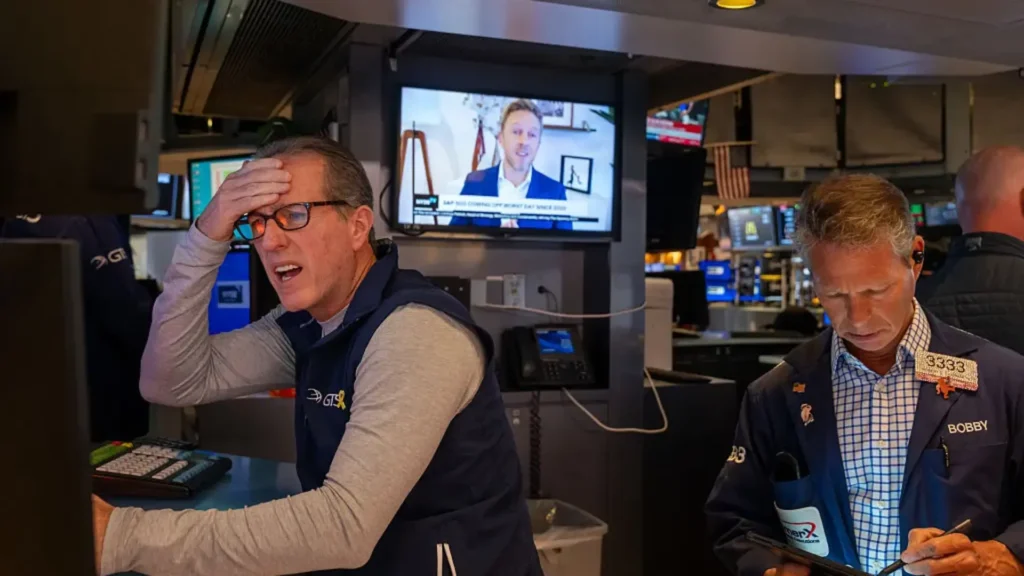
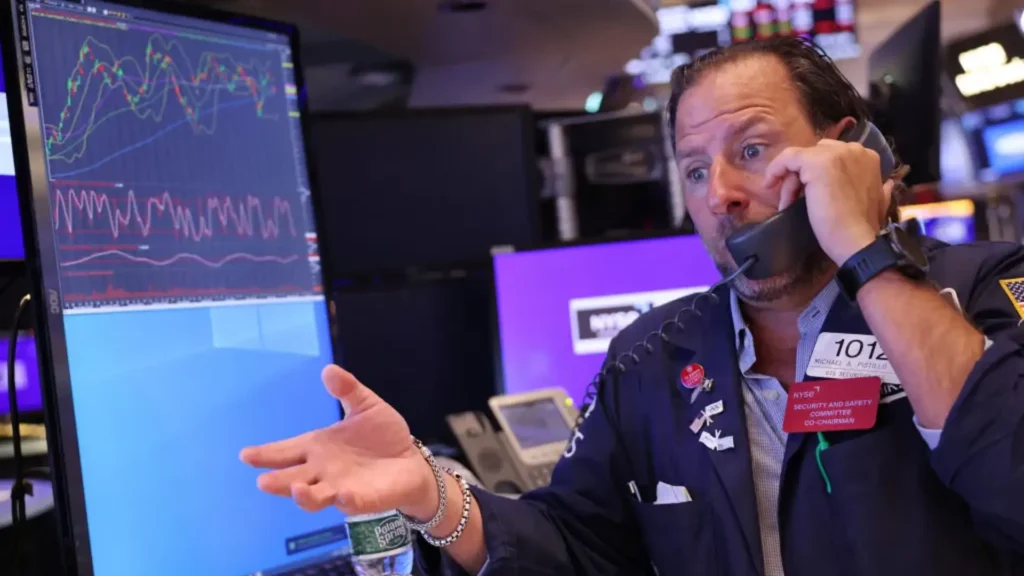
Global markets plunged again. When will the downtrend end? | Credit: Spencer Platt/Getty Images
Share
Key Takeaways
Asian markets experienced their steepest drop since the 2008 financial crisis.
European and U.S. equities follow the collapse, with futures extending the recent downturn.
Despite the downturn, some analysts see potential opportunities, particularly in China and India.
Experts advise investors to stay calm, focus on long-term horizons, and ensure diversified portfolios to weather volatility.
The international consequences of Donald Trump’s sweeping tariffs have begun to unfold, with global markets plunging into what can only be described as Black Monday.
The selloff has escalated into one of the most significant and worst market crashes since the 2008 financial crisis, as trade war fears and retaliatory measures from key global players stoke widespread panic.
Asian markets kicked off Monday with a dramatic plunge, marking one of the worst sell-offs in years driven by escalating trade war concerns.
The MSCI Asia Pacific Index fell 7.9%, with major losses reported in leading companies such as TSMC, Tencent, and Sony. Hong Kong’s Hang Seng Index saw a steep decline of over 10%, its worst performance since 1997.
The broader regional markets all closed in the red, signaling widespread investor pessimism.
Murthy Grandhi, Company Profiles Analyst at GlobalData, told CCN, “The downturn rippled across Asia—South Korea’s Kospi, Singapore’s benchmark, and Taiwan’s equity markets all faced steep declines.”
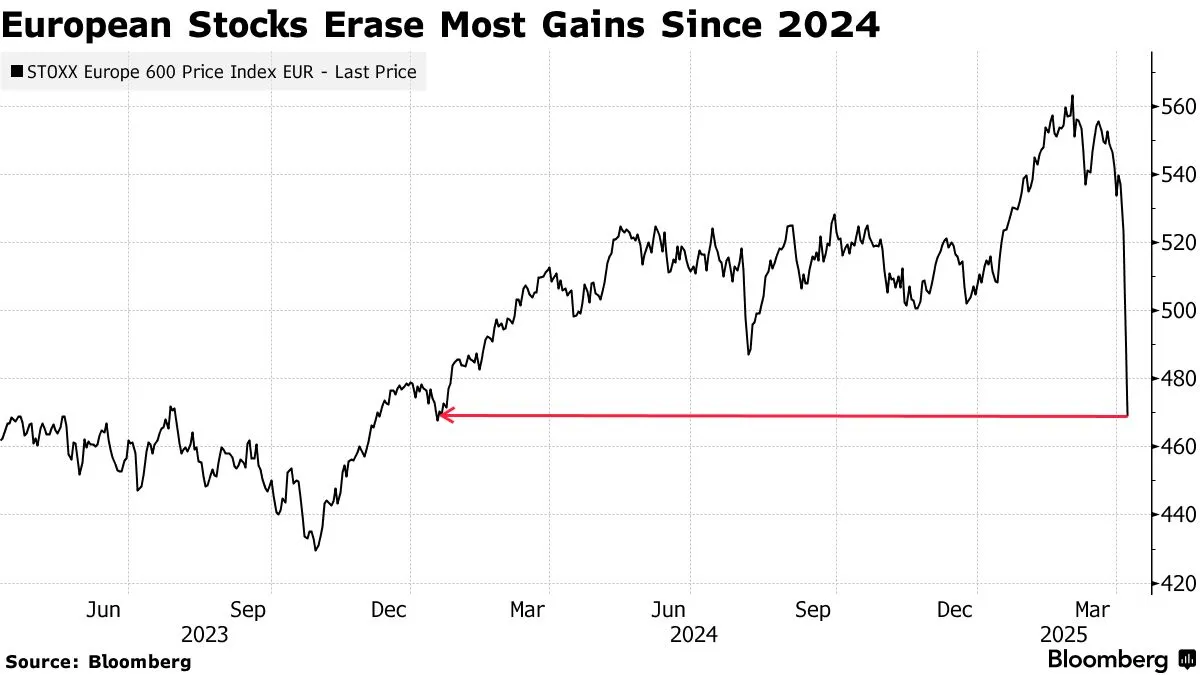
European stocks drop to their lowest level in over a year. | Credit: Bloomberg
As the shockwaves rippled across the globe, European stocks also took a major hit.
Key indexes fell sharply, with Frankfurt down by over 4%, Paris dropping nearly 3%, and Milan plunging 5%. Financial stocks, particularly banks, were among the hardest hit, with many banks temporarily suspended from trading. Export-driven sectors also saw heavy losses.
Luxury brands in France, including LVMH and Hermès, dropped 4.9% and 6.8%, respectively, while technology firm ASML saw a 2.8% decrease.
Other notable declines included Ferrari, which opened 3.8% lower, and Rheinmetall, which fell 8.7%. Thales, one of Europe’s largest companies, was the worst performer, sinking 13%.
Continuing Collapse in the U.S.
Following sharp drops in both Chinese and European markets, U.S. investors are increasingly concerned about a potential trading halt, echoing the market-wide pauses that occurred during the COVID-19 crisis in March 2020.
If the market falls by 13% or 20%, Monday’s market open will likely trigger circuit breakers, similar to those in the Asian and European sessions.
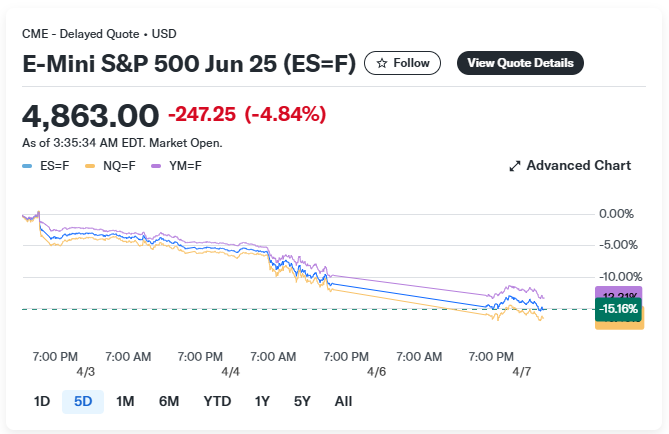
Futures for major New York indexes have plummeted as the equities sell-off deepens. | Credit: Yahoo! Finance
At press time, the S&P 500 futures had fallen by over 4%, while the Nasdaq, known for its heavy tech stock concentration, dropped by 4%.
Dow Jones Industrial Average futures were down 2.5%, a loss of approximately 1,000 points. Additionally, oil prices dipped over 3%, falling below $60 per barrel for the first time since 2021.
Susannah Streeter, head of money and markets at Hargreaves Lansdown, told CCN, “The tech-stock turmoil looks set to rampage for another day on Wall Street. The bears are already out in force across the Nasdaq, and futures indicate another steep fall for the index.”
“With, as yet, no indications of a rolling back of tariffs, investors are reassessing earnings estimates denting valuations. This will knock on U.S. consumer confidence, which has already fallen sharply,” Streeter added.
Streeter doesn’t think a shift is coming anytime soon.
“Given so many Americans invest in the stock market, which acts as a safety blanket for life’s expenses, the stock market rout will dent wealth perceptions, which may make a downturn even deeper,” she said.
Streeter emphasized that while a market downturn can be unsettling for investors, it’s important to stay calm and focus on the long-term. She pointed out that markets typically recover after periods of crisis and uncertainty.
The analyst suggested that investors regularly review their portfolios and ensure they are diversified across different regions and asset types to help manage risk. She also recommended dollar-cost averaging to help ride out market swings.
Mohit Kumar, a Global Economics analyst at Jefferies, told CCN he thinks President Donald Trump will likely have to back down in the coming days, but in a way that lets him claim a win.
“Equity ownership is high in the U.S., and several Senators and House representatives have large equity portfolios. There would be a lot of pressure on Trump to negotiate and ease some tariff fears,” Kumar said.
In light of the uncertainty, Kumar suggested focusing on assets and sectors that may be less affected by tariffs but have fallen due to broader market trends or investor adjustments.
He also believes that Europe and Asia are likely to outperform the U.S. during this pullback, noting that the trade war has led many investors to look outside the U.S.
“The trade war has created a lot of uncertainty for investors, who are looking at avenues outside the U.S.. In Europe, defense and financials should perform on a relative basis. In Asia, China and India would be dip-buying candidates,” Kumar noted.
Giuseppe Ciccomascolo began his career as an investigative journalist in Italy, where he contributed to both local and national newspapers, focusing on various financial sectors.
Upon relocating to London, he worked as an analyst for Fitch's CapitalStructure and later as a Senior Reporter for Alliance News. In 2017, Giuseppe transitioned to covering cryptocurrency-related news, producing documentaries and articles on Bitcoin and other emerging digital currencies. He also played a pivotal role in establishing the academy for a cryptocurrency exchange website. Crypto remained his primary area of interest throughout his tenure as a writer for ThirdFloor.