Is Ye's new memecoin a rull pug? | Credit: Matthias Nareyek/Getty Images
Share
Key Takeaways
Kanye West, now known as Ye, has launched YZY Money, a Solana-based memecoin tied to his Yeezy brand.
Behind the hype of a “new economy,” YZY’s tokenomics gave 70% of the supply to Ye’s team and allowed unusual control over liquidity.
YZY’s value rocketed to $3B before collapsing below $1 in the same day, a boom-and-bust cycle familiar in memecoins.
Some days after the launch, Ye said his account was hacked and shared the precise link to YZY.
Kanye West – now officially known as Ye – has ignited a firestorm in crypto and pop culture with the launch of YZY Money, a Solana-based memecoin tied to his Yeezy brand.
Within minutes of launch, the token’s market cap briefly topped $3 billion before plunging by two-thirds amid accusations of insider trading and growing skepticism from fans and analysts.
The volatile debut has sparked a central question: Is Ye’s “new economy” a true innovation in fan engagement, or just another celebrity crypto hustle?
This article examines YZY’s launch, tokenomics, on-chain clues, market performance, past celebrity parallels, and Ye’s authenticity to assess whether YZY is a cultural experiment or a high-risk rug pull in the making.
YZY’s Flashy Launch on Solana – Hype, Hacking Fears and “A New Economy”
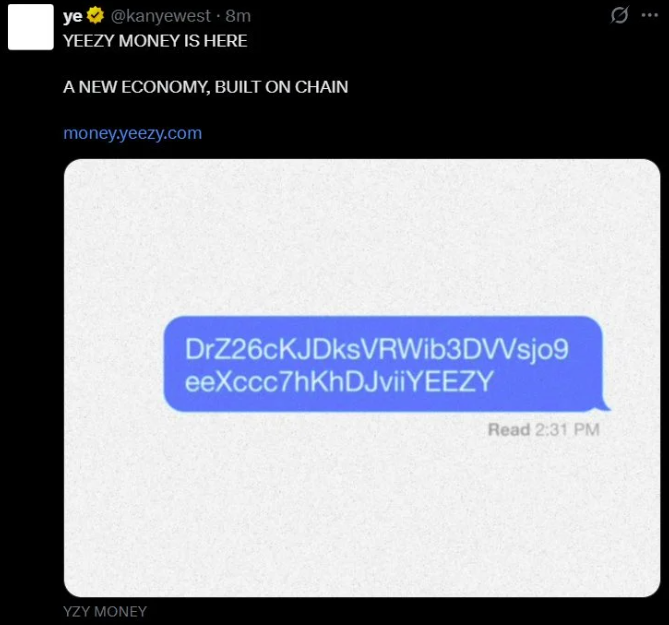
Ye’s announcement of his memecoin. | Credit: X
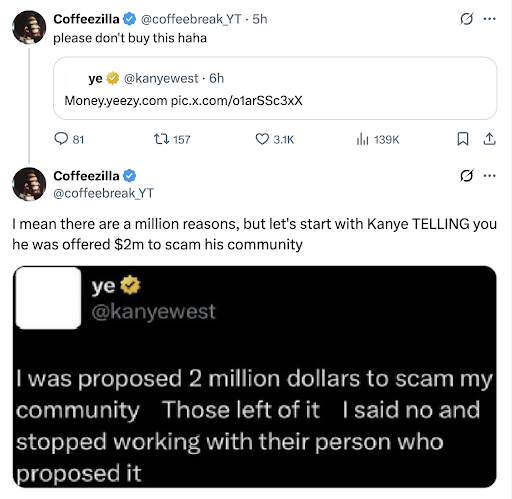
Posted late on Au. 20, 2025, the announcement shocked the crypto community, especially given Ye’s past dismissal of coins as hype-driven scams. Many initially suspected a hack, recalling his February claim that he’d once refused $2 million to launch a fake coin.
To silence rumors, Ye later shared a self-filmed video confirming the launch was real—though some skeptics even questioned if the clip was AI-generated.
Fan reactions split sharply: on Reddit, some branded it a “betrayal” and “the least obvious rug pull,” while speculators rushed in. The official website promoted a full “YZY ecosystem” built around the token, including Ye Pay (a crypto-friendly payment processor) and a YZY Card for spending YZY or USDC worldwide.
YZY was even added as a payment method on Kanye’s Yeezy merch store. Still, the fine print stressed the token was “not an investment opportunity” but an “expression of support” for the Yeezy community—language seemingly designed to lower expectations and regulatory risk, even as trading speculation soared.
New Trending Crypto Wallet Offers
Sponsored
Disclosure
We sometimes use affiliate links in our content, when clicking on those we might receive a commission at no extra cost to you. By using this website you agree to our terms and conditions and privacy policy.
He clarified that his official crypto venture is YZY_MNY, not the impostor accounts promising a “YZY” token.
The message included the address pattern “DrZ26cKJDksVRWib3DWsjo9eeXccc7hKhDJviiYEEZY” to help fans identify the authentic token contract.
Inside YZY’s Tokenomics: Anti-Sniping Tricks and Insider-Leaning Structure
Beyond the celebrity buzz, YZY’s tokenomics reveal a launch designed with anti-bot protections yet overwhelmingly favoring insiders.
The total supply is split into 70% for Yeezy Investments LLC (Ye and his team),
20% for public buyers, and
10% for liquidity.
The insider share is locked under Jupiter Lock contracts with multi-phase cliffs and a 24-month vesting period—meant to prevent immediate dumping. In theory, this vesting is meant to prevent Ye’s team from immediately dumping their massive holdings on the market.
However, as you’ll learn, the actual liquidity setup undermined some of these safeguards in practice.
To deter sniper bots, the team deployed 25 identical token contracts at once, randomly selecting one as the official YZY. This 1-in-25 shell game gave real traders an edge and slowed automated frontrunners (as any sniper would have at best a 4% chance of targeting the correct YZY contract at launch).
Still, on-chain data shows insiders dominated from the start. Notably, Coinbase director Conor Grogan flagged that 94% of the YZY supply was initially controlled by insiders, with a single multi-sig wallet holding 87% of the total supply before distribution began
By my estimation, at least 94% of the new Kanye token is insider owned -87% of the new Kanye token was owned by a single multisig (now dispersed to multiple wallets) -3%+ was bought in a single transaction, with size, by assorted (prepared) wallets at market open -7%+ in LP pic.twitter.com/gokotoI39s
Liquidity setup raised bigger red flags, including:
Instead of pairing YZY with USDC in the initial pool, the team seeded it with YZY alone, retaining full control to later inject or withdraw USDC and manipulate prices. As Lookonchain warned, this mirrored the LIBRA scandal where developers pulled liquidity and left traders stranded.
In a typical decentralized exchange (DEX) liquidity pool, a token is paired with a base asset (like USDC or SOL) to enable trading; by adding only YZY, the YZY team essentially had unilateral control to inject or withdraw USDC later and set prices at will.
The result is a paradox: YZY touts vesting and anti-sniping as fairness measures, yet its supply and liquidity remain tightly centralized.
This guy clearly had insider info about @kanyewest launching a token—but only part of it.
The net effect of YZY’s tokenomics is a dichotomy: on one hand, Ye’s team built in anti-bot and vesting features that signal a “fairer” launch; on the other hand, the concentration of supply and liquidity control in insider hands is extreme, even by crypto standards.
In essence, YZY’s structure was built to enrich the founder (who could potentially see billions on paper at peak prices) while dangling a relatively small portion to public buyers as the float.
On-Chain Whales and Wallets: Evidence of Insider Trading Frenzy
If the tokenomics set the stage, YZY’s opening trading provided the drama. Solana blockchain data, analyzed by Lookonchain and OnChain Lens, shows several wallets with apparent advance knowledge of the correct contract address swooping in immediately. One, wallet 6MNWV8…, even tried to buy before the launch was public—evidence of a tip-off.
Once live, it spent 450,611 USDC on 1.29 million YZY, flipped most of it within hours, and walked away with over $1.5 million in profit, exactly the kind of insider trading the anti-sniping mechanism was supposed to prevent.
Another whale poured 12,170 SOL ($2.28M) into YZY, briefly holding $8.29M worth of tokens, an unrealized gain of $6M.
Meanwhile, latecomers suffered: one buyer sank 1.55M USDC into nearly 1M YZY at $1.56, only to panic-sell at $1.06, losing $500K in under two hours.
Blockchain sleuths quickly flagged these patterns as insider-driven, comparing YZY’s liquidity games to the LIBRA rug pull tied to Argentine politician Javier Milei.
Critics also resurfaced Ye’s own warnings from February about “coins preying on fans,” with Coffeezilla noting the irony: “He was offered £2m to scam his community… and now he’s doing the very thing he warned about.”
The early on-chain evidence around YZY paints a picture of a launch rife with insider advantage. Despite clever anti-sniper tactics, those with the right connections or information still positioned themselves to reap enormous rewards, dumping on later investors once the price spiked.
This kind of activity is a hallmark of what the crypto community would call a “rug pull” or at least a heavily insider-biased launch, and it has led to public calls for investigations. Whether any of this crosses legal lines is unclear, crypto markets are loosely regulated, but it undoubtedly erodes trust among the fanbase and retail traders who weren’t in on the deal.
From Moon to Crash: YZY’s Wild Market Ride in 24 Hours
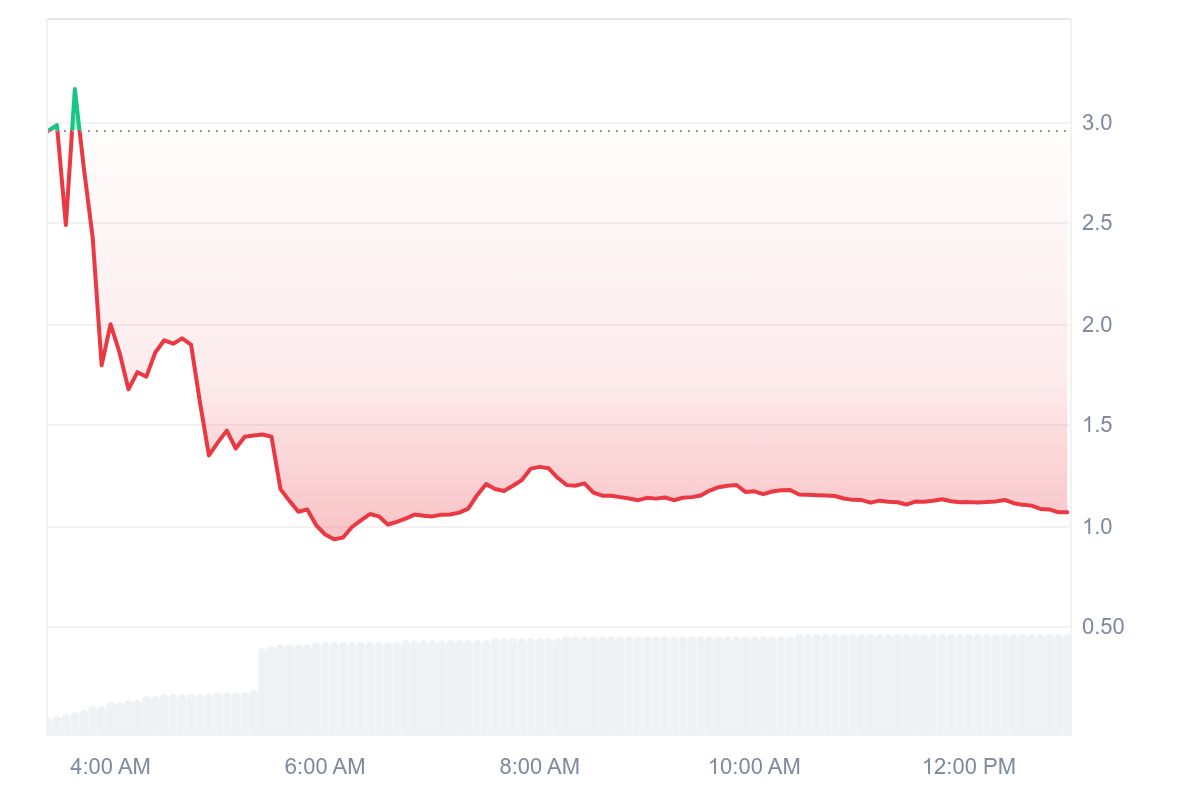
YZY’s first day of trading was whiplash-inducing. Launching near zero, the token skyrocketed nearly 6,800% to $3.16 within 40 minutes (as reported by GeckoTerminal and Nansen), briefly topping a $3B market cap.
YZY price since its launch. | Credit: CoinMarketCap
But by evening it had plunged below $1.00, erasing two-thirds of its value, with an intra-day low around $0.91, marking a >70% drawdown from the top (according to CoinMarketCap data).
In 24 hours, swings reached 30% within a single hour, and by day two the market cap had collapsed to $300–400M—still large, but far from the initial frenzy. The boom-and-bust mirrored countless meme coins before it, driven more by FOMO than fundamentals.
Yet, in those white-knuckle trading hours, some traders managed to turn volatility into profits. On derivative exchanges, opportunists were already shorting and longing YZY with leverage. One trader on the Hyperliquid platform reportedly cleared about $202,000 in profit by shorting YZY’s plunge, essentially betting that the initial pump would not hold.
Conversely, another trader tried to catch the falling knife with repeated long positions and ended up racking up over $159,000 in losses as the token kept sliding. These anecdotes highlight the high-risk, high-reward nature of such speculative manias.
Meanwhile, several notable crypto personalities disclosed they had jumped into YZY during the volatility – not as endorsements of its fundamentals, but as pure momentum plays.
Notable figures like BitMEX’s Arthur Hayes was spotted buying YZY (his exact profits/losses remain undisclosed)
Leverage trader James Wynn also piled in—Wynn likening YZY to Trump’s memecoin ($TRUMP), which ran from $4B to $15B before crashing 88%.
On social media, sentiment was divided. Crypto Twitter (X) was alight with both FOMO-driven hype and cynical takes. Crypto Twitter hyped “It’s definitely a moon shot opportunity,” while many Reddit fans decried it as a cash grab or a symptom of Ye’s desperation after his recent financial and reputational troubles.
“A fool and his money…,” one Redditor wrote tersely, and another said, “Man this decline and spiral needs to be studied and courses on it offered in colleges”, referencing the artist’s tumultuous recent years culminating in this crypto gambit.
Meanwhile, Ye has offered no follow-up statements. Beyond the launch video, he’s remained silent on the crash and insider concerns, leaving holders unsure whether YZY will evolve into a real ecosystem (with Ye Pay and YZY Card) or whether the launch hype was the entire show.
Celebrity Crypto Déjà Vu: From EthereumMax to Akon City
For those who follow celebrity crypto ventures, YZY Money feels like déjà vu (a French phrase that literally means “already seen”).
The 2021–2023 wave of star-backed tokens offers plenty of cautionary tales, including:
The most infamous was EthereumMax (EMAX), hyped by Kim Kardashian, Floyd Mayweather Jr., and Paul Pierce. Kardashian’s Instagram post reached 250M followers, coinciding with a brief spike before the token crashed 98%. Investors sued, alleging a pump-and-dump, and while parts of the case were dismissed, core fraud claims are still active. Kardashian paid $1.26M in SEC fines for failing to disclose her $250K promo fee, while Mayweather faced both lawsuits and earlier SEC action. The precedent was clear: celebrity promotions can spark legal consequences when fans lose money.
Other ventures promised more than tokens but collapsed just the same. Akon’s grand plan for a $6B “Akon City” in Senegal, powered by Akoin, produced little beyond a stone marker before the government officially abandoned it in 2025. Akoin itself plunged from $0.15 to fractions of a cent. The parallels to YZY are stark: global star power, sweeping promises, but little delivery.
Even celebs who merely lent their names—Lindsay Lohan, Jake Paul, Lil Yachty, and others—were fined by the SEC in 2023 for touting tokens without disclosure.
Politics hasn’t fared better. Donald Trump’s TRUMP memecoin, with 80% insider allocation, spiked at launch then collapsed, serving as the very model Ye’s insiders reportedly wanted to emulate. Argentina’s Javier Milei faced similar backlash when a meme coin tied to him imploded.
The pattern is consistent: hype draws in retail, insiders profit, latecomers lose, and reputations suffer. YZY may be new in branding, but its trajectory looks all too familiar.
Is Ye Really Behind It? Untangling Authenticity and Motives
Ye’s sudden reversal on crypto has fueled speculation: did he change his mind purely for money, or was he pushed by advisors—or even hacked? Just six months ago he called launching a coin a scam that preyed on fans.
Insiders say the shift stemmed from both opportunity and frustration: after losing partners like Adidas and Balenciaga and being cut off by Shopify, Ye saw crypto as a censorship-resistant way to monetize his brand.
Framed as the “official currency of Yeezy,” YZY was pitched as a way to buy sneakers or tickets directly, building a micro-economy around his products.
Yet the execution—sudden launch, meme coin marketing, heavy insider allocation, frenzied trading—undermines that vision. A true community currency might have rolled out slowly with fan airdrops or loyalty perks, not speculative chaos. The site even warns YZY isn’t an investment while touting its $3B market cap, a contradiction that damages credibility.
Questions also remain about who’s really running YZY.
Ye isn’t a crypto developer, so the technical and distribution setup likely came from advisors or hired experts with their own incentives.
Still, his massive personal allocation (worth billions at peak) suggests he understood the upside. His silence post-launch is also striking: no roadmap, no answers on insider holdings, no comment on volatility—possibly legal strategy, or simply that he considers his job done.
Regardless, responsibility rests with Ye: this isn’t a paid endorsement but his own project. If YZY unravels, it could tarnish his legacy, erode fan trust, and even invite SEC or FTC scrutiny. At minimum, the reputational risk is enormous.
How to Protect Yourself From Celebrity Memecoin Rug Pulls
The YZY Money frenzy is only the latest reminder that celebrity-backed crypto projects can be as dangerous as they are flashy. While not every coin is a scam, history shows that fans often end up footing the bill when hype fades.
Here are key steps to protect yourself:
Look past the celebrity brand: A famous name does not equal legitimacy. Kim Kardashian’s EthereumMax, Floyd Mayweather’s promotions, and Akon’s Akoin all collapsed despite huge star power. Ask: if this token had no celebrity attached, would it still have value?
Check tokenomics and distribution: Who controls most of the supply? In YZY’s case, 70% was allocated to Kanye’s company. Any coin where insiders own the majority can easily become a dump on retail buyers.
Follow the liquidity: Transparent projects lock liquidity on decentralized exchanges with verifiable contracts. If liquidity is controlled by the devs (as YZY’s unusual one-sided pool was), it’s a red flag for a rug pull.
Demand utility beyond hype: Does the token actually do anything — power a payment network, give access to services, or support a platform? Or is it only trading on name recognition? Real projects outline a roadmap and deliverables.
Be wary of sudden spikes: A token that rockets to a multibillion valuation in hours, like YZY did, is almost certainly driven by speculation, not fundamentals. Volatility that steep is usually followed by sharp crashes.
Don’t rely on influencer announcements alone: Even verified posts can be misleading, compromised, or later disavowed. Double-check with blockchain data, trusted news outlets, and community forums before investing.
Invest only what you can afford to lose: Memecoins are speculative by nature. Treat them like a gamble, not a savings plan. If you wouldn’t put that money on a roulette table, don’t put it into a celebrity coin.
Conclusion
So, is YZY Money a bold cultural experiment, a savvy financial play, or just another celebrity rug pull? The evidence leans cynical. YZY’s debut bore all the hallmarks of a meme coin pump: massive insider allocations, speculative frenzy, no real utility at launch, and insiders allegedly cashing out millions within hours.
It’s difficult to see it as a sincere bid for a community currency when 70% of supply sits with Ye’s company and the market was primed for a pump. As one analyst put it, “heads, the celeb wins; tails, the fans lose.”
Still, YZY is brand new. If Ye wants to salvage credibility, the next few weeks are crucial: delivering on Ye Pay, launching the YZY Card, or even redistributing some of that 70% could help. Yet history shows most celebrity tokens fade quickly once the hype cycle ends. For fans and investors, the lesson is clear: brand power is no substitute for fundamentals, and due diligence is essential.
In the end, YZY has been more cultural spectacle than financial innovation, highlighting the mix of celebrity influence, hype, and greed that drives these manias.
Whether Ye is remembered as a visionary experimenting with new tech or just another star cashing in at fans’ expense will depend on what comes next. For now, the cautionary voices seem vindicated and Ye’s own warning that “coins prey on the fans with hype” feels like the most accurate verdict.
FAQs
What is YZY Money?
YZY Money is a Solana-based memecoin launched by Kanye West (Ye) under his Yeezy brand. Marketed as the foundation of a “new economy,” it was tied to Ye’s ecosystem through promises like Ye Pay, a crypto-friendly payment processor, and a YZY Card for spending YZY or USDC. Despite this framing, its fine print describes the token not as an investment, but as a symbolic show of support for the Yeezy community.
Why is YZY Money so controversial?
The controversy stems from insider-heavy tokenomics and its volatile debut. Seventy percent of supply was allocated to Ye’s company, and blockchain data suggested insiders profited millions within hours of launch. The liquidity pool setup also gave Ye’s team unusual control over pricing. Combined with Ye’s prior dismissal of crypto as a scam, the launch raised skepticism about whether YZY was a genuine project or simply a cash grab.
How did the market react to YZY’s launch?
The token experienced wild swings. Within 40 minutes of launch, it surged nearly 6,800% to a peak price of $3.16, briefly topping a $3B market cap. But by the same evening, it had plunged below $1.00, wiping out two-thirds of its value. Early whales and insiders booked huge profits, while late buyers suffered heavy losses. Analysts compared the launch to previous celebrity pump-and-dump schemes.
How does YZY compare to past celebrity crypto projects?
YZY follows a familiar pattern. Projects like EthereumMax (promoted by Kim Kardashian and Floyd Mayweather), Akon’s Akoin, and Donald Trump’s TRUMP token all saw explosive hype followed by collapse, lawsuits, or regulatory crackdowns. The common thread: celebrity-driven hype attracted retail investors, insiders cashed out, and fans were left holding losses. YZY appears to be repeating that cycle.
Disclaimer:
The information provided in this article is for informational purposes only. It is not intended to be, nor should it be construed as, financial advice. We do not make any warranties regarding the completeness, reliability, or accuracy of this information. All investments involve risk, and past performance does not guarantee future results. We recommend consulting a financial advisor before making any investment decisions.
Giuseppe Ciccomascolo began his career as an investigative journalist in Italy, where he contributed to both local and national newspapers, focusing on various financial sectors.
Upon relocating to London, he worked as an analyst for Fitch's CapitalStructure and later as a Senior Reporter for Alliance News. In 2017, Giuseppe transitioned to covering cryptocurrency-related news, producing documentaries and articles on Bitcoin and other emerging digital currencies. He also played a pivotal role in establishing the academy for a cryptocurrency exchange website. Crypto remained his primary area of interest throughout his tenure as a writer for ThirdFloor.


 Easy
Easy