All You Need to Know About the YZY Token Launch | Credit: Veronica Cestari
Share
Key Takeaways
Kanye West launched the YZY token on Aug. 21.
There are numerous concerns about rug pulls and insider trading.
Is the YZY token another in a long line of failed celebrity launches?
Kanye West’s new YZY token launched today and is already stirring up controversy in the crypto world.
Traders are pointing to red flags — from insider trading whispers to a liquidity pool reportedly controlled by the dev — calling it a setup that looks all too familiar.
Kanye West’s YZY token exploded onto the scene this week, instantly dominating X discussions, but not for the reasons fans might have hoped.
Within hours of launch, crypto sleuths flagged a series of glaring red flags that suggest manipulation and insider trading may already be at play.
The biggest issue centers on YZY’s liquidity setup. Instead of being paired with a stablecoin like USDC, the liquidity pool contains only YZY.
On decentralized exchanges (DEXs) such as Uniswap, prices are normally determined by a balance between assets in the pool.
But in this case, the design gives the developer near-total control over the funds.
Get These Top Crypto Casino Offers Now!
Sponsored
Disclosure
We sometimes use affiliate links in our content, when clicking on those we might receive a commission at no extra cost to you. By using this website you agree to our terms and conditions and privacy policy.
LIBRA had ended in a notorious rug pull, and the fact that the court found no irreparable harm may have emboldened new projects to try similar tactics.
The parallels are so striking that some community members openly speculate Davis could be behind the YZY rollout.
Meanwhile, alleged insider trading has already surfaced. One wallet spent roughly $450,000 on YZY, flipped it for $1.5 million in profit, and even burned 129 SOL in priority fees to front-run other traders.
Some of those wallets are now openly bragging about their gains on social media — further fueling the perception that YZY may be less about community and more about opportunism.
YZY Social Sentiment
Social sentiment for YZY is overwhelmingly negative, but that has not stopped specific influencers from pushing the token.
James Wynn, who has over 400,000 followers, has repeatedly promoted YZY and suggested it could “kickstart the retail bull market”.
On Hyperliquid, the token was listed with 3x leverage, leading traders to pile in.
One trader lost $160,000 by longing YZY and has now doubled down, even though the price has crashed from over $3 to less than $1.
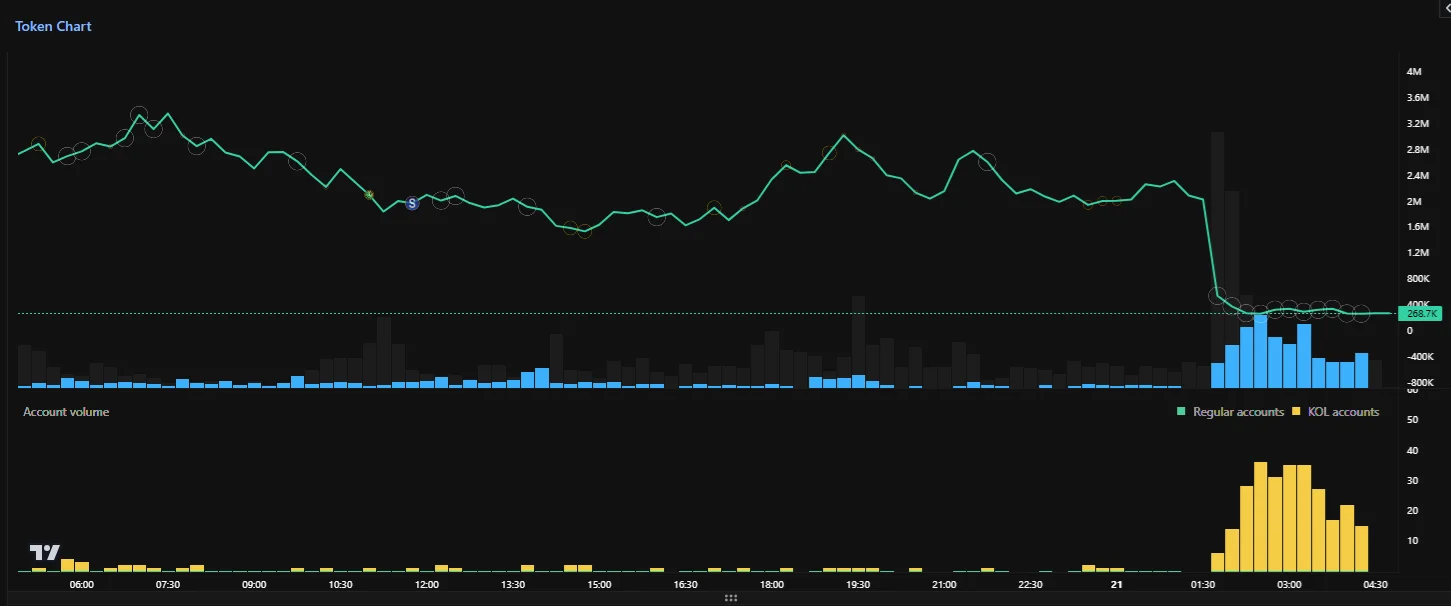
Data from X-Alpha shows that social mentions for YZY grew once the price crashed.
There is disproportionate buzz created by Key Opinion Leaders (yellow), rather than it being organic interest.
Several large accounts, such as @Edwardbayc, @Rami_Hashimi, @belfort_max, and @Godsburnt, all made similar tweets about it, claiming massive profits and promising giveaways to users who like and retweet posts that resemble engagement farming.
Even CoinMarketCap joined in, listing the token and polling its users on whether YZY is “the next big thing”.
CCN has collaborated with X-Alpha to offer you the best X+On-chain data analysis tool in the market for free! Get the X-Alpha Chrome extension that our CCN Analysts use HERE.
YZY Controversy
The YZY launch highlights the risks of celebrity-backed tokens, where hype often overshadows fundamentals.
With insider wallets profiting millions and social media influencers pushing questionable narratives, retail traders appear to be left holding the bag.
YZY may become another cautionary tale in crypto’s long list of failed celebrity coins.
Disclaimer:
The information provided in this article is for informational purposes only. It is not intended to be, nor should it be construed as, financial advice. We do not make any warranties regarding the completeness, reliability, or accuracy of this information. All investments involve risk, and past performance does not guarantee future results. We recommend consulting a financial advisor before making any investment decisions.
Valdrin Tahiri is a cryptocurrency analyst and reporter at CCN, specializing in technical analysis with a focus on Elliott Wave theory, on-chain metrics, and fundamental research. He brings over seven years of experience in the crypto space as both a trader and writer.
He discovered cryptocurrencies in 2017 while earning his MSc in Financial Markets at the Barcelona School of Economics, which sparked a deep interest in blockchain and market dynamics. Since then, he’s contributed to top crypto outlets like BeInCrypto and CoinGape.
Valdrin also served as Community Manager of BeInCrypto’s Telegram group for three years, helping grow it into one of the largest crypto communities worldwide. His expertise in market structure and price patterns allows him to break down complex trends into clear, actionable insights.
He’s published thousands of articles covering altcoins, Bitcoin cycles, and macro trends.