“It’s Like Gravity”: Optimum’s Dr. Muriel Medard on Why Web3 Needs a True Memory Layer
Share
Public blockchains keep getting faster at computation, but their weakest link is still how data is stored, propagated, and recalled at scale i.e., the “memory” of the system. From validator gossip to data availability and mempools, today’s networks juggle ad-hoc fixes that don’t age well as usage spikes.
Into that gap steps Optimum, a company built around Random Linear Network Coding (RLNC), a decentralized, mathematically proven way to move and remember data efficiently across large, unreliable networks.
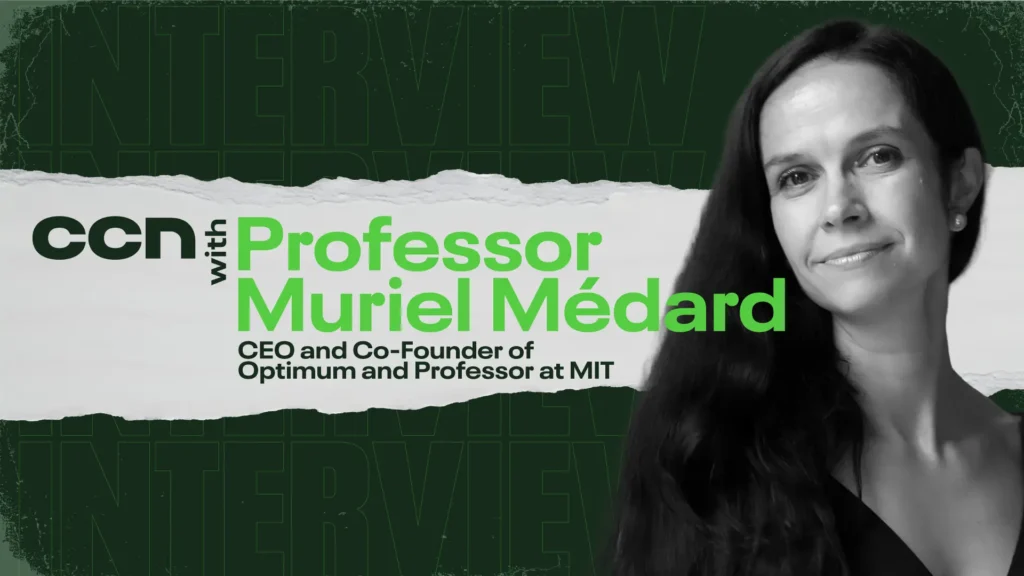
CCN spoke to Dr. Muriel Médard, co-founder at Optimum and the NEC Professor of Software Science and Engineering, Electrical Engineering and Computer Science (EECS) at MIT, about turning two decades of research into a production memory-and-networking layer for Web3.
Try Our Recommended Crypto Exchanges
Sponsored
Disclosure
We sometimes use affiliate links in our content, when clicking on those we might receive a commission at no extra cost to you. By using this website you agree to our terms and conditions and privacy policy.
From Information Theory to Web3: The Long Arc to Optimum
Before Web3 existed, Dr. Médard was already building its mathematical foundations. Her work in decentralized coding began in the early 2000s, long before decentralization became a tech mantra.
“The reason I really wanted to build Optimum is because it’s the result of a long, long arc of research and development in my lab at MIT… I started working in decentralized coding in the 2000s, really a long time ago. This combination of propagation and memory has been my life’s work.”
Back then, she recalls, decentralized approaches were considered fringe.
“I like to joke that my colleagues would do wellness checks on me because the number of times I’ve heard, ‘Why on earth would you want something that’s decentralized, Muriel?’ Everything was point-to-point.”
When Web3 arrived and with it, massive network stress, the time was finally right, she said.
“I knew that this would come… You could have told me it would come in five years or 50, and I would have believed either.”
Why Memory Is the Missing Layer in Blockchain
Every computer relies on both compute and memory. For Dr. Médard, blockchains are trying to decentralize compute, including consensus, execution, and validation, but still lack a true decentralized memory layer.
“Web3 has done an amazing job decentralizing the CPU part… But the underlying part, the memory and you cannot have compute without memory. You can have memory without compute, but not the other way around.”
She compares the need to build a “socket” for data, much like the electric grid or the internet’s sockets, which abstract away complexity.
She explained that in a network, you need to have that look as though it was a single dedicated service. “What we’re trying to do is basically to create a socket for the memory.”
Without that layer, every node must manually coordinate, exchanging endless control messages, an approach she says cannot scale.
“How can you build anything that scales if you’re going to need that much information to coordinate? It doesn’t scale. It’s like gravity. Who cares if I like it or not? It’s there.”
Optimum’s Approach: Making Decentralization Fast
Optimum’s first product, OptimumMP2P, enhances Ethereum’s gossip protocol (libp2p) and integrates with Solana’s Turbine system, without asking blockchains to change their core architecture.
“Our approach has been not to integrate directly with chains, but to create a sidecar so that we go in a permissionless way. We’re not trying to change protocols or ask people to stop using Linux, so to speak. It should just be an API.”
At its core, Optimum uses Random Linear Network Coding (RLNC), an innovation Dr. Médard co-invented. RLNC allows nodes to blend packets of data into new, useful equations, ensuring every participant can reconstruct the full dataset efficiently, even under failure or censorship attempts.
“You’re shredding and then you’re making new equations. And the trick here is to make equations that are random and therefore can be made by anybody at any time without knowing the history or the topology or anything like that.”
The results, she says, are dramatic:
“In data availability tests, the efficiency relative to traditional Reed-Solomon codes is staggering, orders of magnitude better.”
And for her, the philosophy is simple:
“As much as possible, you should use math. It’s free, it’s scalable, environmentally friendly, and just morally more satisfying.”
Beyond Blockchain: AI, Quantum Safety, and Education
The implications of a shared decentralized memory layer extend beyond crypto — into AI and post-quantum security.
“If you want to have on-chain data that is going to be used for learning and is going to be used not by a single project, but multiple projects, you absolutely need a memory layer. What are you going to do? Transfer massive amounts of data on-chain every time someone wants to learn something? The thing would just crumble.”
She also sees coding theory as the backbone of future-proof encryption.
She said all quantum-safe systems rely on coding. “It’s all coding,” she emphasized.
Médard said you can keep the quantum-safe property of McEliece while massively lowering the cost of decryption and transmission with RLNC.
Still, one of her main goals is bridging the gap between traditional engineering and the Web3 world.
She shared that at the National Academies of Engineering meeting, she realized nobody in her section was working on Web3 at all. For her, there is a disconnect and education is key.
To that end, Optimum is launching ‘Hacknets,’ similar to decentralized hackathons, using lightweight “Flex nodes.” She explained that these flex nodes are memory nodes that are much lighter than validators.
“We’re bringing together people from all over the world.” “We’re running one at Cosmoverse in Croatia this month. We ran one at MIT last month. We’ll be running ones online. ”
For Dr. Muriel Médard, decentralization isn’t ideology, it’s inevitability.
Ultimately, the conversation turned philosophical. For Muriel, people talk about decentralized versus centralized for moral or personal reasons based on their own philosophy.
But for her, “It’s like gravity. Who cares if I like it or not? It’s there. If you really do want a very extensive worldwide network, that’s what happens.”
Optimum’s work reminds us that the next leap in blockchain efficiency won’t come from faster consensus or larger blocks but from the simplest computing truth: no system can compute without memory.
Disclaimer:
The information provided in this article is for informational purposes only. It is not intended to be, nor should it be construed as, financial advice. We do not make any warranties regarding the completeness, reliability, or accuracy of this information. All investments involve risk, and past performance does not guarantee future results. We recommend consulting a financial advisor before making any investment decisions.
Dr. Lorena Nessi is an award-winning journalist and media technology expert with 15 years of experience in digital culture and communication. Based in Oxfordshire, UK, she combines academic insight with hands-on media practice.
She holds a PhD in Communication, Sociology, and Digital Cultures, and an MA in Globalization, Identity, and Technology.
Lorena has taught at Fairleigh Dickinson University, Nottingham Trent University, and the University of Oxford. She is a former producer for the BBC in London, with additional experience creating television content in Mexico and Japan.
Her research focuses on digital cultures, social media, technology, capitalism, and the societal impact of blockchain innovation.
She has written extensively on digital media and emerging technologies, with her work featured in both academic and media platforms. Her Web3 expertise explores how blockchain technologies shape culture, economics, and decentralized systems.
Outside of work, Lorena enjoys reading science fiction, playing strategic board games, traveling, and chasing adventures that get her heart racing. A perfect day ends with a relaxing spa and a good family meal.


 Easy
Easy