Beyond Binance: Komodo's Decentralization Push for Cross-Chain Freedom
Share
With Binance removing Komodo’s token KMD in 2025, the project faces one of its defining moments. Komodo is an open-source, multi-chain blockchain platform known for its atomic swap technology and focus on interoperability, security, and decentralized exchanges (DEX).
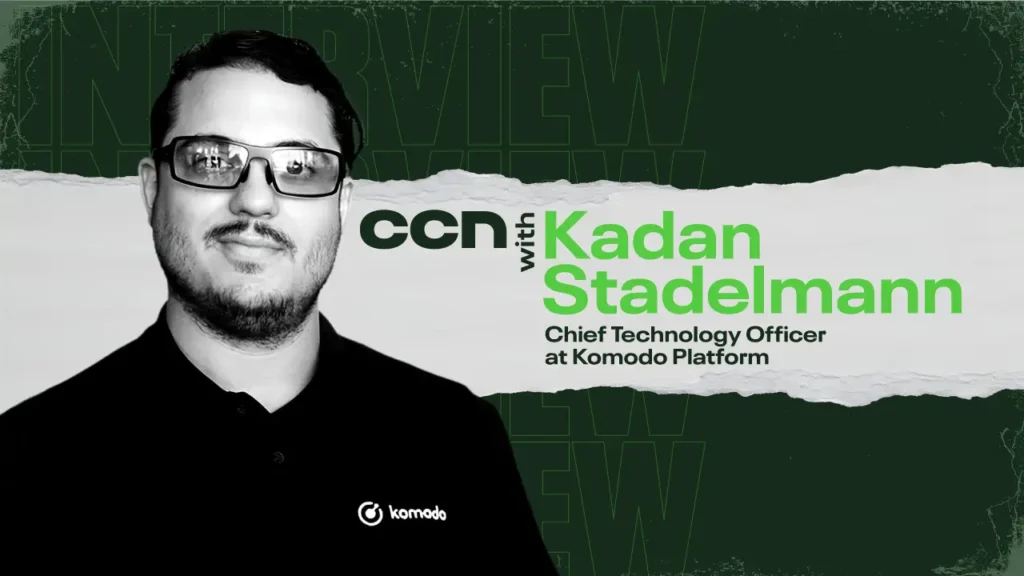
For Kadan Stadelmann, Komodo’s Chief Technology Officer (CTO), this challenge is an opportunity to return to the roots of blockchain:decentralization, user sovereignty, and open technology.
In this interview with CCN, Stadelmann explains how Komodo plans to grow beyond centralized exchanges (CEX), improve its DEX technology, and preserve privacy while staying compliant with future regulations.
“We need to put the power and control over crypto into the end user’s hand,” Stadelmann said.
“That’s where we come from, and that’s what we’ve been doing for the last ten years.” As the crypto industry moves toward tighter regulation, Komodo’s vision to empower users directly may prove more relevant than ever.
Try Our Recommended Crypto Exchanges
Sponsored
Disclosure
We sometimes use affiliate links in our content, when clicking on those we might receive a commission at no extra cost to you. By using this website you agree to our terms and conditions and privacy policy.
Origins and Vision: From Zcash to Interoperability
Komodo began as a fork of Zcash, combining privacy technology with cross-chain innovation. In 2015 and 2016, many projects tried to reinvent blockchain infrastructure independently, leading to fragmentation.
Stadelmann recalled that Komodo’s community wanted to “efficiently and effectively bridge these different communities and crypto sets.”
He explained that interoperability soon became Komodo’s core goal. Even though privacy was a key component at the start, exchanges pressured the project to tone down those features.
“Exchanges such as Binance forced us to remove privacy tech to take a distance from the core OG crypto ethos,” he said.
Instead, Komodo refocused on connecting blockchains through atomic swaps, a technology it helped pioneer as early as 2013.
“Komodo is referenced as one of the inventors of cross-chain atomic trading and cross-chain atomic swaps,” Stadelmann said. “That’s like really our key focus, this DEX technology stack from a very low-level perspective.”
Komodo After Binance’s Delisting: Building Independence
The Binance delisting was a turning point. Before the removal, KMD traded up to $3 million daily on Binance, while DEX activity remained minimal as it was still in beta.
According to Stadelmann, today, Komodo’s non-custodial wallet, which integrates the DEX, records around 10,000 monthly active users and five-figure daily swap volumes.
He also revealed that professional market makers formerly operating on Binance are now working directly with Komodo’s DEX.
“We’re basically routing that liquidity into Komodo DEX,” he said. “People see now that there’s like active liquidity being put in. And that’s something that we’re going to like scale up further”.
When asked if the team plans to pursue relisting, Stadelmann’s answer was clear: no. Komodo intends to go fully independent from centralized exchanges.
“For the long term, it’s a benefit for KMD,” he said. “If you manage to get sufficient liquidity with solid spread and coverage of key pairs specifically for your assets (…) you are independent. You don’t rely on any centralized exchange.”
He emphasized that fiat on-ramps and stablecoins such as USDT and USDC already provide enough liquidity routes for users.
“We really moved to a point where I believe centralized exchanges, specifically as we know them now, are obsolete,” Stadelmann said.
Balancing Privacy and Regulation in Komodo’s DEX
Komodo’s DEX operates without mandatory KYC (Know Your Customer) requirements, protecting users’ privacy, a choice that also raises regulatory questions. Stadelmann said the team recognizes the need for balance between privacy and compliance.
“We absolutely need to build technology stacks that can comply with regulations,” he said. “You can build a great balance between privacy and compliance.”
Komodo integrates sanction lists and publicly known blockchain addresses to prevent exposure to illicit funds. Its system identifies each actor within the DEX by a public address, allowing the team to block risky participants while keeping user data private.
He also predicted that future regulations will involve zero-knowledge KYC systems, systems in which data stays encrypted but can be accessed legally if required.
“Some type of standardization is needed,” he said. “ We’ll see some type of KYC, maybe even like zero knowledge KYC, where your data is kind of somewhere and someone could access this in case there’s, you know, courts or, you know, multiple parties debounding it,” Stadelmann argued.
Atomic Swaps, Interoperability and Gas-Free Trading
Komodo recently implemented IBC (Inter-Blockchain Communication) to connect its DEX with the Cosmos ecosystem. Stadelmann said this integration arose from community involvement in Cosmos events and a shared goal of improving interoperability between UTXO chains like Bitcoin and Ethereum Virtual Machine (EVM) or Cosmos-based networks.
The project’s HTLC-based atomic swaps, using hash time locks, form the foundation of its DEX. Unlike automated market makers (AMMs), Komodo’s order-book model prevents counterparty and rug-pull risks.
“The worst that can happen is someone steps back from an ongoing trade or swap,” he said.
“The system is being enhanced to even remove the risk of having wasted time on potential swaps, arbitrage deals.”
Komodo has also implemented gas fee swaps using Ethereum’s account abstraction (ERC-4337) and Paymasters. This allows users to transact without holding specific native tokens for gas.
Stadelmann said the team designed the system to fix a long-standing decentralized finance (DeFi) problem: users often need an asset they do not yet own to complete a swap.
Komodo’s new model allows fees to be handled more flexibly, either through a small adjustment in trading costs or from a pooled gas reserve supported by partners.
The goal, he explained, is to make transactions seamless so users no longer have to buy a separate token just to trade.
Can Transparency and Security Exist Without Surveillance?
Komodo’s philosophy is simple: privacy by design and no user tracking. The platform collects no identity data, and all activity remains visible on-chain instead of through analytics software.
“We do not collect data,” Stadelmann explained.
“You don’t have to track users. You can get all the data you want on chain. You just look at the blockchain and that’s the beauty of the public ledger
He criticized wallets and services that monitor user behavior or portfolio values, arguing that once compromised, this data poses major security risks.
Stadelmann’s point was clear: when digital wealth reaches a huge scale, protecting it becomes a matter of survival. For him, true security lies in decentralization, removing single points of failure and giving users full control over their encrypted assets.
The Road Ahead: Games, Modularity, and Open Infrastructure
Komodo’s next phase focuses on making KMD deflationary. A quarter of all DEX transaction fees are used to buy and burn KMD from the market, creating sustained buy pressure.
“The key goal for us and for KMD is to render it more and more a deflationary tokenomic model,” Stadelmann said.
The team is also exploring GameFi integration to extend utility. He added that KMD’s current market position presents a strategic opportunity for long-term holders.
He said it is a big opportunity for the market to reset and detach itself from the centralized threat that undermined the crypto ethos.
Komodo’s architecture is built on the Komodo DeFi Framework (KDF), a modular system that can evolve with new technologies such as artificial intelligence and zero-knowledge proofs (ZKP).
Stadelmann said that the peer-to-peer node serves as the core engine of Komodo’s DEX, acting as the system’s brain. He explained that the same framework can expand beyond blockchains, connecting any protocol that requires secure, trustless, peer-to-peer (P2P) communication.
He sees Komodo continuing to serve as a core bridge for UTXO chains like Bitcoin and Dogecoin to interact with newer ecosystems.
He concluded there aren’t many DEXs that bridge native, non-wrapped assets across chains. He believes that is Komodo’s strength and our focus going forward.
Disclaimer:
The information provided in this article is for informational purposes only. It is not intended to be, nor should it be construed as, financial advice. We do not make any warranties regarding the completeness, reliability, or accuracy of this information. All investments involve risk, and past performance does not guarantee future results. We recommend consulting a financial advisor before making any investment decisions.
Dr. Lorena Nessi is an award-winning journalist and media technology expert with 15 years of experience in digital culture and communication. Based in Oxfordshire, UK, she combines academic insight with hands-on media practice.
She holds a PhD in Communication, Sociology, and Digital Cultures, and an MA in Globalization, Identity, and Technology.
Lorena has taught at Fairleigh Dickinson University, Nottingham Trent University, and the University of Oxford. She is a former producer for the BBC in London, with additional experience creating television content in Mexico and Japan.
Her research focuses on digital cultures, social media, technology, capitalism, and the societal impact of blockchain innovation.
She has written extensively on digital media and emerging technologies, with her work featured in both academic and media platforms. Her Web3 expertise explores how blockchain technologies shape culture, economics, and decentralized systems.
Outside of work, Lorena enjoys reading science fiction, playing strategic board games, traveling, and chasing adventures that get her heart racing. A perfect day ends with a relaxing spa and a good family meal.


 Easy
Easy