Tangem Pay CEO reveals major breakthrough | Credit: CCN
Share
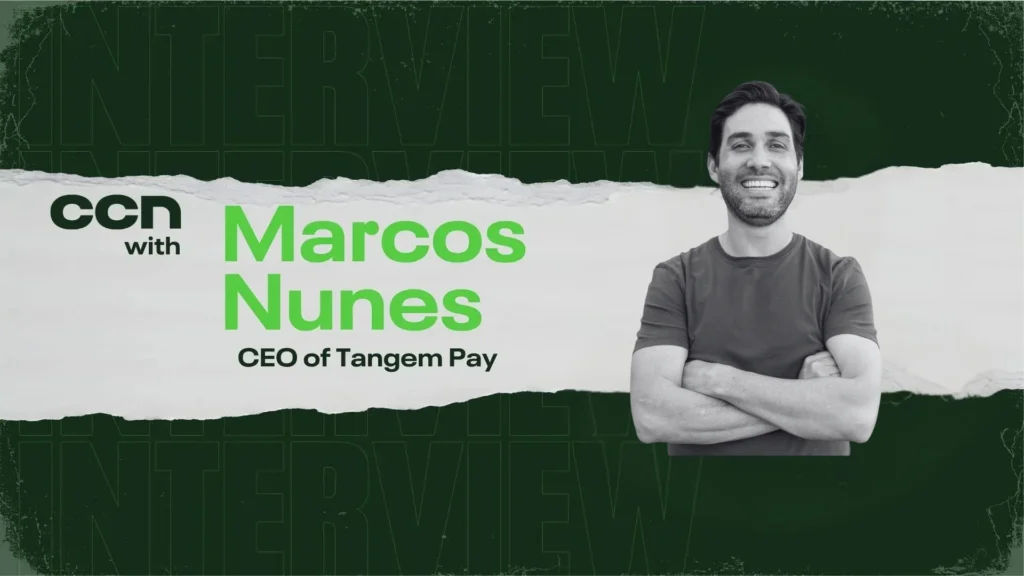
At the Blockchain Futurist Conference 2025 in Miami, Dr. Guneet Kaur, CCN Senior Editor, spoke with Marcos Nunes, CEO of Tangem Pay, about the future of blockchain payments and how the company is bridging traditional finance with crypto through its strategic Visa integration.
As digital assets move closer to mainstream use, Tangem Pay stands at the intersection of hardware wallet innovation and financial infrastructure.
The company, known for its Swiss-engineered hardware wallets, is now expanding into payment solutions designed to make crypto spending as intuitive as swiping a card.
During the conversation, Nunes shared how Tangem evolved from a secure storage provider into a comprehensive financial ecosystem.
He discussed the company’s mission to merge security, scalability, and convenience while building a bridge between on-chain assets and traditional financial systems.
He also outlined Tangem’s strategy for global adoption, emphasizing trust, accessibility, and regulatory readiness.
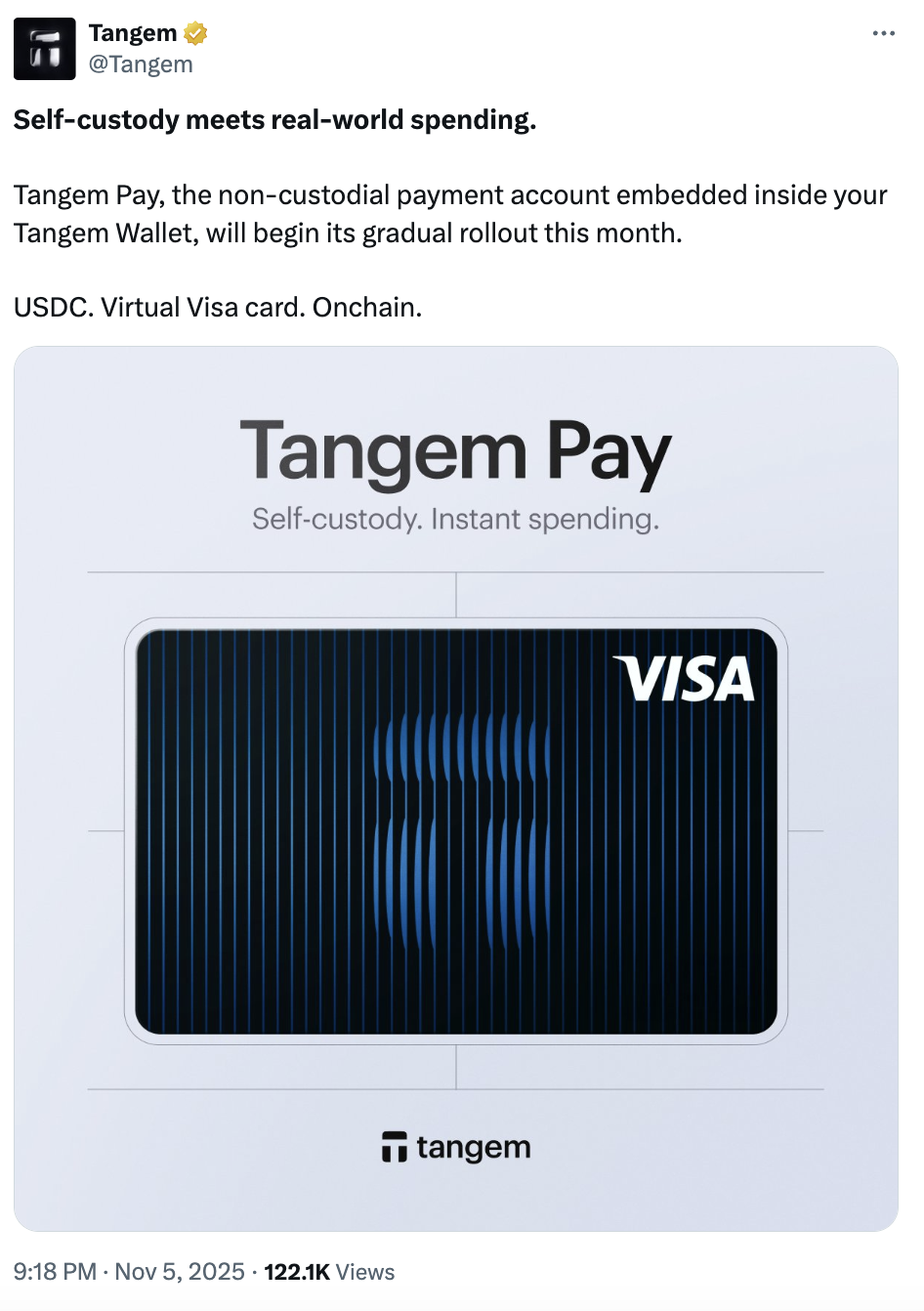
Tangem Pay and self-custody | Source: X @Tangem
Bridging Traditional Finance and Crypto Through Visa Integration
When asked about Tangem Pay’s integration with Visa and the friction points it solves, Nunes was direct.
“I don’t think we are reinventing the wheel,” he said.
“What makes Tangem very unique in this process is combining security with this convenience and frictionless experience.”
He explained how Tangem’s approach focuses on making blockchain technology compatible with the traditional financial ecosystem.
Nunes said that after spending 15 years in the traditional payments industry and helping to shape regulations across global networks, he sees more similarities than differences between traditional and blockchain-based systems.
He explained that the underlying principles of payments remain the same, even if the technologies differ.
He said that in traditional finance, companies like Visa have already built mature networks to address everyday transaction challenges, while in the crypto space, experts often focus more on technical aspects than on solving user problems.
“I basically plugged in this technology with the right terminology and the right process within this existing network, so it’s more about breaking barriers”.
“You still have traceable transactions. You still have known users. You still have known merchants, and they are just interacting with one another.”
Self-Custody Meets Real-World Spending
Tangem Pay brings everyday usability to self-custodied crypto. The non-custodial payment account, seamlessly embedded inside every Tangem Wallet, allows users to hold and manage their assets securely on-chain and now, spend them just as easily.
The gradual rollout begins this month, starting with USDC support and a Visa virtual card that works anywhere Visa is accepted online. No centralized exchange custody. No surrendering keys. No complicated conversions.
Just your crypto, your wallet, your purchase, all onchain.
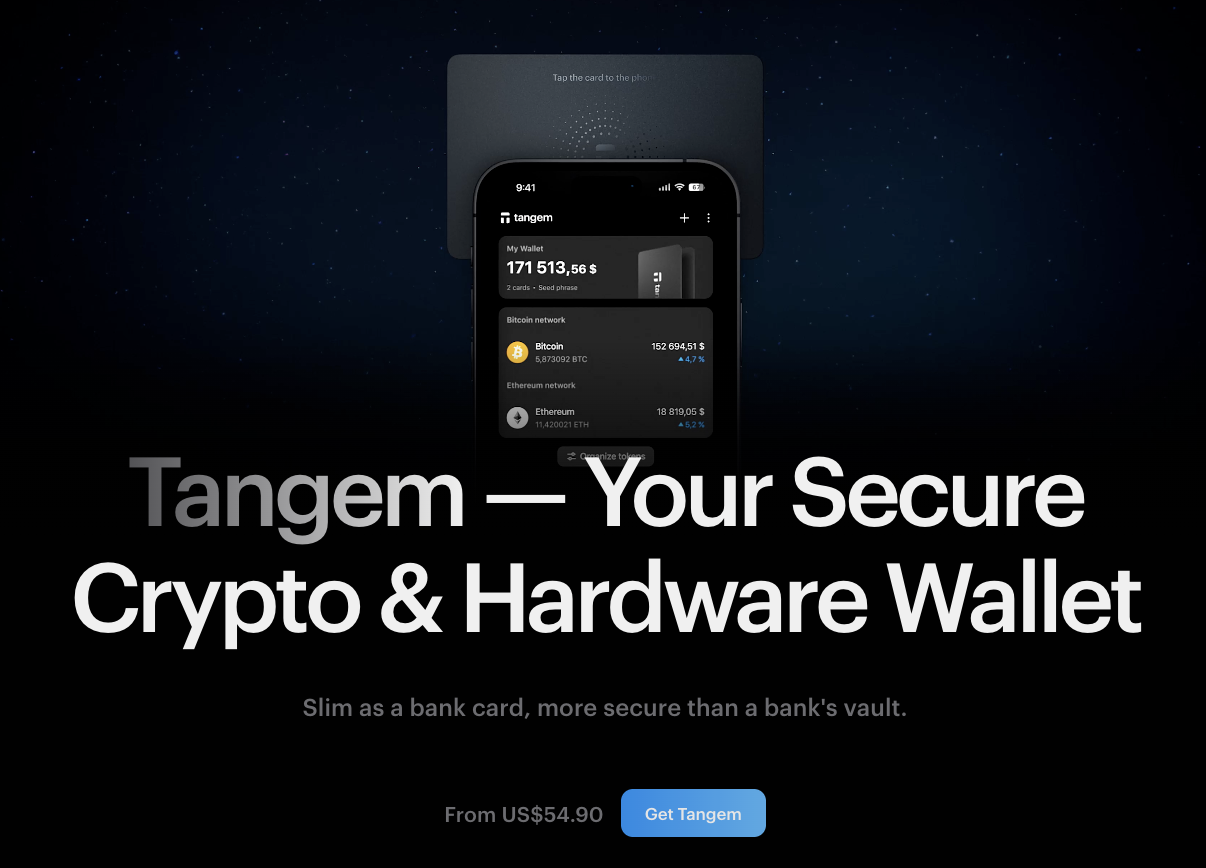
Tangem wallet | Source: Tangem
With support for USDC and a Visa virtual card operating fully on-chain, Tangem Pay delivers self-custody designed for real-world spending.
From Hardware Wallet Security to a Full Financial Ecosystem
Tangem began as a company focused on hardware wallet security, but over time, it has evolved into a broader financial platform.
Nunes said this shift was driven by a simple idea: secure storage must eventually connect to real-world usability.
“The founders of Tangem were amazing in thinking about secure storage and removing complexity for you to keep your funds in a safe way,” he said.
He compared Tangem’s evolution to the Swiss banking system, noting how the concept of safeguarding assets has modernized over time.
“Imagine Switzerland back in the 1800s. The world needed to put money in a safe location and they decided to build up the most secure vaults in the world,” he said.
“Tangem is Swiss and it’s exactly the same, just 200 years later.”
He explained that just as banks evolved from safekeeping to helping clients grow and spend their wealth, Tangem followed a similar path. “It’s a logical step from storing, then growing, and now spending,” he said.
According to Nunes, Tangem’s expansion into payments has effectively made it “one of the first few DeFi banks in the world.”
“Security must come with convenience and must come with an easy flow,” he said. “If it works for my dad, it should work for everyone.”
Making Crypto Payments Feel as Simple as Banking
Nunes said Tangem Pay’s upcoming Visa-enabled card aims to make crypto spending feel as natural as traditional banking.
“What we’re launching now is the card and basically it’s a very similar experience to a bank account,” he said. “You can get digital assets converted into a stable dollar and then spend exactly the same.”
He explained that fiat deposits convert instantly into USDC at a one-to-one ratio. “$10 is $10 USDC, $100 is $100 USDC,” he said.
Currently, the card supports USDC, but Nunes confirmed that multi-currency functionality will follow as users adapt.
“Yes, it will become multi-currency cards,” he said. “We’re just not doing that yet because we need to go on a journey where people understand slowly the things you can do.”
He emphasized that Tangem’s vision goes beyond serving crypto enthusiasts and it aims to reach the global mainstream. The expectations are high.
“This product is to serve 8 billion people,” he said. “It’s not a great party in the desert that attracts a group of privileged people.”
How Tangem Wallet Prioritizes Security and Everyday Convenience
Nunes said Tangem’s approach is guided by the principle that security and convenience must coexist.
“You are putting your money where you trust, which is the hardware wallet, and that gives you full control at any point in time,” he said.
He explained that users can safely store most of their wealth and instantly move small amounts for daily transactions.
“The whole point is about bringing a piece of that wealth to your day-to-day,” he said. “You’re just one click away, no longer 20,000 documents, six months of KYC.”
Nunes added that the company’s philosophy is built around simplicity and accessibility.
“Everything must be one click away,” he said.
How Tangem Pay Enables Low-Cost Cross-Border Payments Using Crypto
Regarding the role of crypto payments in developing economies, Nunes emphasized how Tangem Pay can help reduce high remittance costs.
“People only do remittances between currencies. Now remittance on-chain means you hedge using digital assets,” he said.
Using Tanzania as an example, Nunes explained that the demand for digital assets such as Bitcoin can solve liquidity challenges in smaller markets.
“As long as there is an asset, there is liquidity in that market,” he said. “No more $120 for $20.”
How Tangem Ensures User Fund Protection With Advanced Hardware and Security Leadership
Discussing Tangem’s commitment to security, Nunes credited the company’s technical team for staying ahead of threats.
“We have the most technical person on earth, Andrey Kurennykh, behind us, who created multiple patents inside Tangem,” he said. “He’s globally recognized for his security expertise.”
Nunes said that hardware wallets continue to be one of the most reliable defenses in crypto.
“Hardware wallets were always one step ahead compared to everything else,” he said. “As long as I keep my hardware safe, nobody should be able to touch my funds.”
Tangem Targets 10 Million Users by 2026 Through Scalable, Compliant Global Expansion
On scaling and regulatory expansion, Nunes said the challenge lies in balancing network compatibility with jurisdictional compliance.
“You have different networks, every country has its own jurisdiction,” he said. “Then you have 22 very large payment schemes like MasterCard and Visa.”
He explained that Tangem’s global rollout prioritizes scalability, low fees, and smooth integration.
Looking ahead, Nunes expects Tangem Pay’s user base to rise from 350,000 monthly active users to 10 million by the end of 2026.
Disclaimer:
The information provided in this article is for informational purposes only. It is not intended to be, nor should it be construed as, financial advice. We do not make any warranties regarding the completeness, reliability, or accuracy of this information. All investments involve risk, and past performance does not guarantee future results. We recommend consulting a financial advisor before making any investment decisions.
Dr. Lorena Nessi is an award-winning journalist and media technology expert with 15 years of experience in digital culture and communication. Based in Oxfordshire, UK, she combines academic insight with hands-on media practice.
She holds a PhD in Communication, Sociology, and Digital Cultures, and an MA in Globalization, Identity, and Technology.
Lorena has taught at Fairleigh Dickinson University, Nottingham Trent University, and the University of Oxford. She is a former producer for the BBC in London, with additional experience creating television content in Mexico and Japan.
Her research focuses on digital cultures, social media, technology, capitalism, and the societal impact of blockchain innovation.
She has written extensively on digital media and emerging technologies, with her work featured in both academic and media platforms. Her Web3 expertise explores how blockchain technologies shape culture, economics, and decentralized systems.
Outside of work, Lorena enjoys reading science fiction, playing strategic board games, traveling, and chasing adventures that get her heart racing. A perfect day ends with a relaxing spa and a good family meal.
Dr. Guneet Kaur is a senior editor at CCN.com and a Science Fellow at Exponential Science. She is a fintech and blockchain expert with extensive experience in digital finance education, blockchain ecosystems, and cryptocurrency markets. She has worked with global media such as Cointelegraph, as well as education and blockchain platforms, to design and lead strategic content and learning initiatives. As an educator and assessor for top-tier executive programs, she bridges real-world fintech trends with academic insight.
Dr. Kaur is also a published researcher and peer reviewer across fintech and data science journals, including Financial Innovation Journal and International Journal of Big Data Intelligence and Applications. Her work spans data-driven analysis, Web3 innovation, and technical content development. With a strong foundation in both industry and academia, she translates complex financial technologies into practical applications, empowering learners, professionals, and institutions across the rapidly evolving digital finance landscape.


 Easy
Easy