“The sudden revival of interest in 'privacy coins' has sparked a wave of commentary across the industry.”| Image credit: Derek Fenech /CCN
Share
Key Takeaways
Institutions are not adopting privacy coins as assets but seeking privacy infrastructure that supports real on-chain activity.
Fully transparent blockchains do not meet institutional needs, but pure anonymity also fails regulatory requirements.
Institutions are investing in confidential infrastructure such as encrypted smart contracts, ZKPs, and private settlement layers.
The future of crypto privacy lies in foundational infrastructure, not in token performance or market cycles.
Institutions are not interested in privacy coins as tradable assets. They require a privacy infrastructure that enables genuine economic activity to occur on-chain while remaining compliant.
The sudden revival of interest in “privacy coins” has sparked a wave of commentary across the industry. Rising prices and new institutional products have convinced many that traditional finance is finally warming up to anonymous cryptocurrencies.
But this narrative misunderstands what institutions are actually pursuing. They are not chasing Zcash or Monero as assets to trade. They are searching for the privacy infrastructure required to move real economic activity on-chain.
The future of crypto privacy is not about tokens. It is about programmable, compliant privacy stitched into the very architecture of Web3.
Bet on ESports with These Partners
Sponsored
Disclosure
We sometimes use affiliate links in our content, when clicking on those we might receive a commission at no extra cost to you. By using this website you agree to our terms and conditions and privacy policy.
Why Institutions Are Not Really Interested in Privacy Tokens
For institutions, confidentiality is not optional.
In traditional finance, transaction details, trading flows, and business logic are shielded from public view.
No asset manager would broadcast proprietary strategies to the open internet. Yet this is precisely what public blockchains do today.
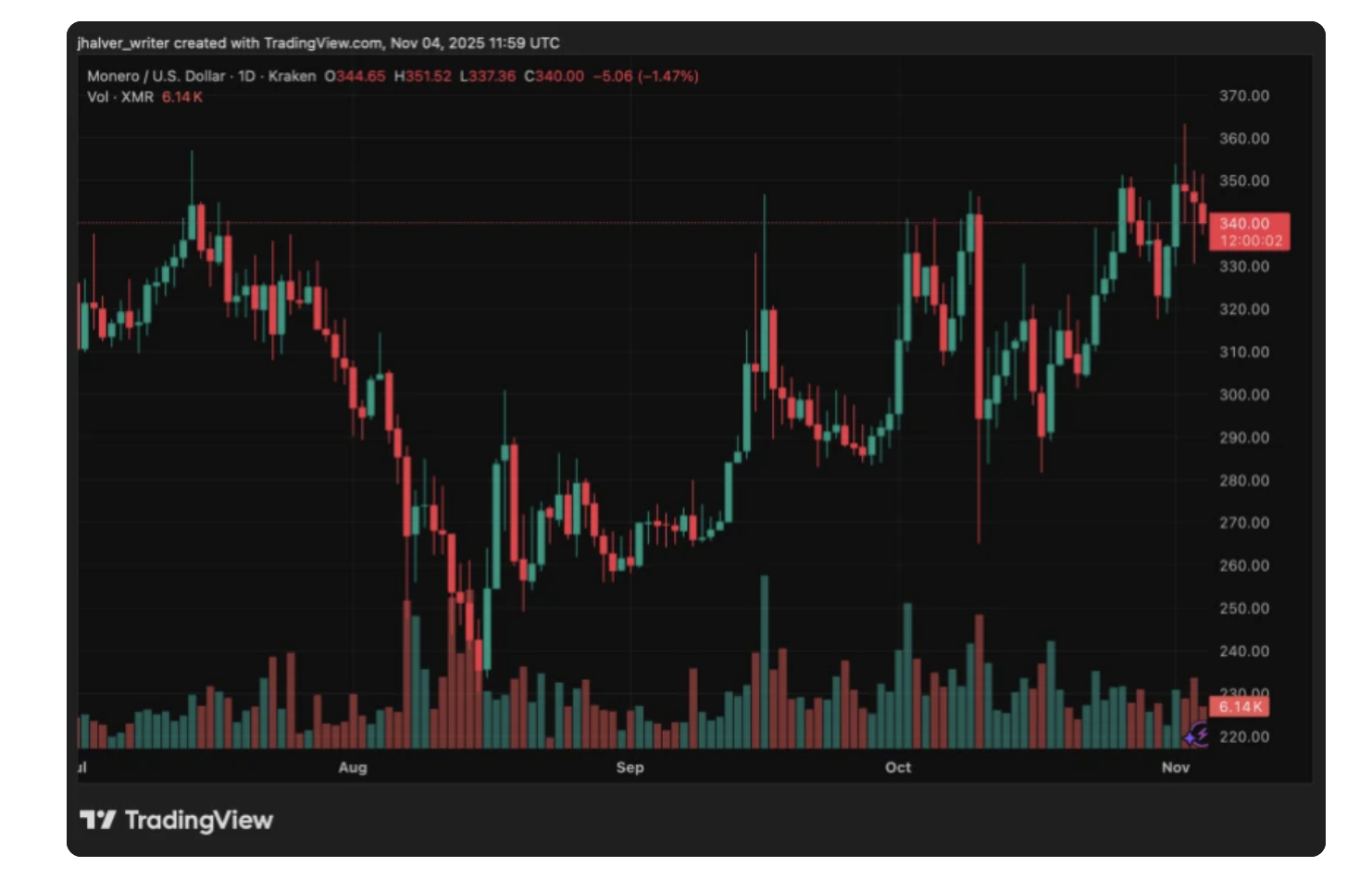
Headlines may focus on the renewed momentum of privacy coin markets, but the real driver behind institutional behavior is the need for systems that preserve confidentiality while allowing compliance.
TradingView on the renewed focus on privacy coins | Source: TradingView
Institutions cannot operate on a fully transparent ledger, and they also cannot adopt technology that regulators cannot audit.
Privacy tokens were an early attempt at solving this tension, but they never addressed the deeper structural requirements.
What Institutions Are Actually Building
If you look closely at where institutions are actually deploying resources, the pattern becomes obvious. The activity is concentrated not at the token level but in confidential infrastructure.
Large financial institutions are experimenting with privacy-preserving decentralized finance (DeFi) transactions, encrypted data tokenization and secure identity frameworks.
They want to run workflows on-chain without revealing sensitive information to competitors or to the public.
The Shift Toward Programmable Privacy Layers
That means smart contract platforms capable of processing encrypted data, privacy layers that interoperate across chains and secure execution environments that guarantee confidentiality during computation.
The market has already validated this direction. Zero-knowledge identity proofs, built using zero-knowledge proofs (ZKPs), are gaining traction as a way to keep user data private while meeting regulatory requirements.
Even stablecoin issuers are exploring private settlement channels, recognizing that enterprises cannot adopt digital assets without confidentiality guarantees.
Meanwhile, Ethereum researchers, major exchanges, and Web3 developers are accelerating work on privacy-preserving protocol layers because they understand that public by default is incompatible with institutional scale.
Why Privacy Tokens Do Not Meet Institutional Requirements
Privacy tokens, by contrast, face constraints that make them unlikely candidates for institutional adoption.
Both their appeal and weakness lies in their anonymity.
Pure anonymity offers no mechanism for selective disclosure or auditability. It also isolates the asset from the compliance pipelines institutions rely on.
Will Wendt says, “The future of crypto privacy is not about tokens. It is about programmable, compliant privacy”. | Source: Will Wendt
Many exchanges have delisted the most private coins because they cannot meet reporting obligations.
Even when institutions gain exposure through trusts or funds, these vehicles strip out the privacy features entirely. What remains is only a price instrument, not a functional privacy solution.
Challenges in Institutional Adoption of Privacy Tokens
The real obstacle is not a lack of interest in privacy itself, but the mismatch between simple token-based anonymity and the programmable, compliant privacy that enterprises require.
Institutions need the ability to shield data from the public while revealing it to regulators or auditors when necessary.
They also need interoperability that extends across the multi-chain environment where most economic activity now occurs.
Token-centric privacy systems were never built for this world.
Looking ahead, the structural need is privacy infrastructure. As more high-value activity moves on-chain, demand for private, verifiable, and compliant computation will grow rapidly.
The next cycle won’t come until there’s infrastructure that can provide confidential smart contract execution, secure hardware-backed computation, selective disclosure frameworks, and privacy layers that work seamlessly across ecosystems.
What Will Actually Perform Going Forward is Privacy Infrastructure
Privacy tokens helped spark the conversation, but they won’t stay at the center of it. The real opportunity now lies in building the layers that will make privacy a standard feature of Web3 applications, more so than an add-on.
As institutions and developers adopt confidential runtimes, encrypted state, cross-chain privacy messaging, and verifiable off-chain computation, privacy will become part of the default stack.
These technologies solve real problems for enterprises. They also expand the design space for developers by making it possible to build applications that behave more like the secure systems companies use today.
The market is beginning to recognize the difference. The future of crypto privacy is much bigger than tokens.
It lives in the foundational layers that allow enterprises and users to bring real operations on-chain without sacrificing confidentiality or compliance.
Disclaimer:
The views, thoughts, and opinions expressed in the article belong solely to the author, and not necessarily to CCN, its management, employees, or affiliates. This content is for informational purposes only and should not be considered professional advice.
About the Author
Will Wendt
Will Wendt is Head of Ecosystem at Oasis Protocol. Will transitioned from a career in pharmacy to pursue his passion for Web3, driven by a vision of advancing decentralized infrastructure, privacy, and open-source technology. He is now dedicated to building a robust ecosystem where these principles thrive. At Oasis Protocol, an infrastructure service provider focused on privacy and AI.