SBI CEO Rejects $10B XRP Rumor, Confirms 9% Ripple Stake — Bullish or Bearish for XRP Price?
Share
Key Takeaways
SBI’s CEO denied claims of a $10B XRP reserve, clarifying that SBI holds a 9% equity stake in Ripple Labs instead.
The 9% share is referred to as a “hidden asset” that can provide exposure to Ripple’s whole ecosystem, while avoiding direct token volatility.
In 2016, SBI and Ripple partnered through SBI Ripple Asia, a joint venture that uses XRP to facilitate cross-border payments in Asia.
Despite these hurdles, XRP has the potential to benefit from institutional support through SBI’s shareholding, as well as Japan’s FSA’s plans for XRP.
When a major financial powerhouse speaks, the global markets listen. A recent wave of speculation stated that Japanese financial firm SBI Holdings held a massive $10B Ripple (XRP) reserve. Although the leadership promptly intervened to explain the true nature of their assets, the reality exposed a deeper institutional connection: a sizeable equity stake in Ripple Labs.
This correction shifts the narrative from simple token ownership to long-term structural integration. By maintaining a 9% ownership in the company behind the technology, SBI isn’t just betting on a price ticker; they are anchoring themselves to the future of global payment infrastructure. This article breaks down the facts, market reactions, and potential XRP price implications.
What Triggered the SBI $10B XRP Rumor?
The rumor originated from social media buzz and misinterpretations of SBI’s crypto activities. Posts on X amplified claims that SBI’s acquisition of Singapore-based exchange Coinhako implied massive XRP holdings. For instance, a trending topic on X suggested SBI was stockpiling XRP for cross-border payments, fueling speculation of a $10B stash.
This tied into broader excitement about Japan’s financial transformation, where XRP Ledger is positioned for roles in tokenized assets and stablecoins. Given SBI’s role as a primary partner in the Ripple ecosystem, the claim was initially met with excitement by market participants hoping for an institutional supply shock.
However, the claim lacked official backing. It was an outcome of SBI’s ongoing blockchain projects, such as collaborations for yen-dominated stablecoins, but there was no proof that XRP was directly accumulated to that extent.
SBI’s Direct Response and Clarification
On February 15, 2026, SBI’ CEO Yoshitaka Kitao addressed the rumor directly on X: “Not $10 bil. in XRP but around 9% of Ripple Lab. So our hidden asset could be much bigger.”
This came amid SBI’s announcement of intent to acquire a majority stake in Coinhako, a move to expand crypto infrastructure in Asia, but unrelated to XRP hoarding. Such a massive holding would be impractical for a regulated financial institution due to the high volatility and capital requirements associated with maintaining such a position.
WOW! 💥
JAPAN’S SBI CEO YOSHITAKA KITAO SAYS FIRM OWNS 9% OF RIPPLE LABS! 💰
Kitao’s statement clarified that SBI’s exposure is equity-based, not token-based. He hinted at undervalued “hidden assets” in Ripple’s ecosystem, potentially exceeding $10B if Ripple’s valuation grows toward CEO Brad Garlinghouse’s $1T projection.
By holding a direct stake in Ripple Labs, SBI gains exposure to the company’s entire suite of services, including its software, global partnerships, and the tens of billions of tokens currently held in escrow.
Long-Standing SBI-Ripple Partnership
SBI and Ripple first collaborated in 2016 when they formed SBI Ripple Asia, a joint venture with SBI owning 60% and Ripple owning 40%. This entity specializes in blockchain-based cross-border payment solutions, employing XRP as a bridge asset between countries such as Japan, the Philippines, and Vietnam.
Since 2021, SBI Remit has used Ripple’s On-Demand Liquidity (ODL) to shorten settlement times and reduce expenses. Given its past, SBI is positioned to drive XRP’s practical applications throughout Asia.
XRP Price Predictions For 2026
The present XRP market is a study in contradictions, with institutional support competing with larger economic pressure.
XRP’s Bearish Case
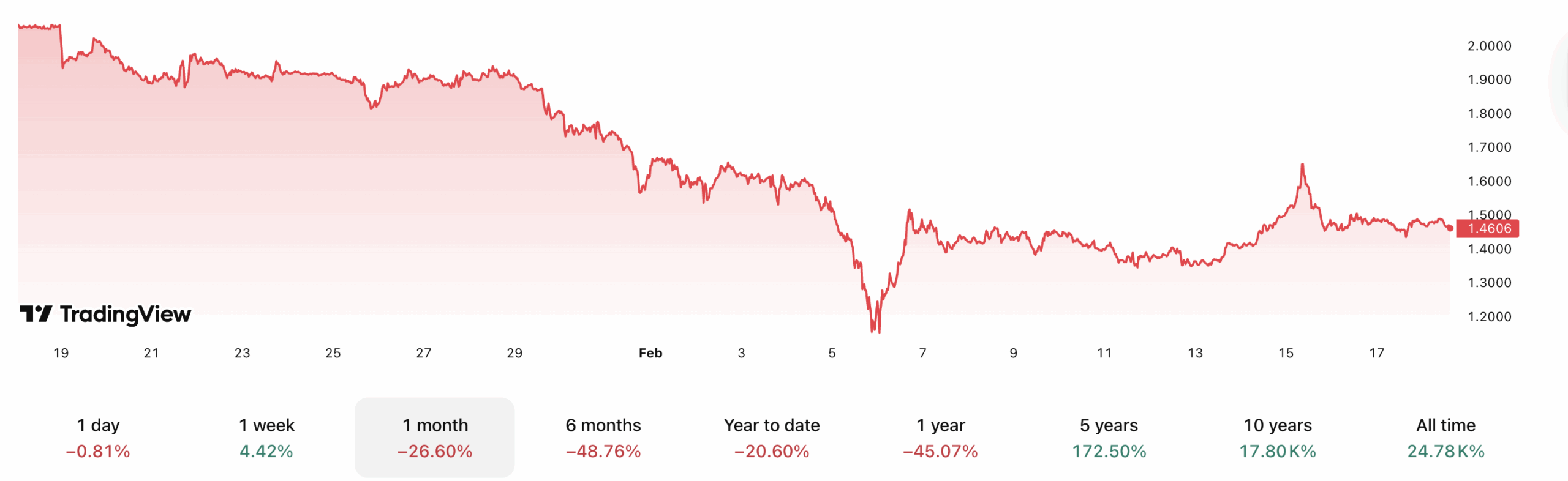
While SBI Holdings’ equity stake serves as a powerful vote of confidence in Ripple’s long-term infrastructure, it has been unable to shield the XRP from the immediate pressure of heavy institutional outflows and a wave of technical panic selling. Wall Street cuts, like Standard Chartered’s 65% reduction, signal capitulation. The bank cited a 40% drop in ETF holdings since January and a “brutal” market selloff as reasons for their revised outlook.
XRP price chart for 2026 | Credit: TradingView
XRP’s “February curse”, declining in 7 of 11 Februarys, persists, with 30% losses this month. Correlation with Bitcoin near $65,000 adds risk. A drop below $1.12 could invalidate rebounds.
XRP’s Bullish Signals Amid the Noise
SBI’s stake signals institutional backing, potentially valuing at $4.5B. XRP saw $33 million in weekly inflows while other major assets experienced outflows. Furthermore, SBI is moving forward with a combined BTC and XRP ETF for the Tokyo Stock Exchange. This regulatory progress suggests that while the short-term price may be under pressure, the long-term floor is being raised by institutional adoption.
Japan’s FSA plans to reclassify XRP as a regulated financial product by Q2 2026, enabling bank custody. ETF inflows of $1.3 billion since November 2025 provide demand. If XRP reclaims $1.85, targets could hit $2.40.
The Future of the XRP Ecosystem
The market is receiving a reality check from SBI leadership’s clarification: a multi-year equity commitment, not a $10B “pump,” is what gives this partnership value. SBI’s 9% stake in Ripple Labs aligns them with the company’s survival and success across all fronts, from payments to identity protocols.
As Japan positions itself at the forefront of financial transformation, the XRP Ledger is increasingly seen as the core engine for this change. For those following the story, the “hidden asset” may be the most important number on SBI’s balance sheet.
It arose from misinterpretations of SBI’s Coinhako acquisition and blockchain activities, amplified on social media.
Does SBI hold $10B in XRP?
No, the CEO confirmed the firm holds a 9% equity stake in Ripple Labs rather than $10B in tokens.
Is SBI’s stake positive for XRP?
It contributes to Ripple’s growth, perhaps increasing XRP’s utility, but does not immediately raise token demand.
What is the significance of the Coinhako deal?
It allows SBI to expand its regulated payment infrastructure into Singapore and Southeast Asia.
Disclaimer:
The information provided in this article is for informational purposes only. It is not intended to be, nor should it be construed as, financial advice. We do not make any warranties regarding the completeness, reliability, or accuracy of this information. All investments involve risk, and past performance does not guarantee future results. We recommend consulting a financial advisor before making any investment decisions.
Curious about how technology and crypto reshape global finance, Elizaveta Savenko explores blockchain, AI, decentralized systems, their applications, and regulatory requirements. She contributes to research, educational initiatives, and industry collaborations, examining trends in digital assets and fintech innovation, increasing awareness of the crypto space and its impact on financial systems.


 Easy
Easy