Roaring Kitty Linked Memecoin Crashes 67% After Viral X Post: What Happened?
Share
Key Takeaways
Roaring Kitty’s verified X account suddenly promoted Solana memecoin RKC, triggering suspicion because his previous content focused on GameStop investing.
RKC surged above $11 million market capitalization before crashing 67% within minutes after promotional posts were quickly deleted online.
Blockchain analysis revealed developer-linked wallets controlled nearly 40% of RKC supply before retail investors entered, enabling massive profit extraction.
The incident highlighted dangers of celebrity-driven memecoin hype, emphasizing onchain research, supply verification, and skepticism before investing decisions significantly.
Keith Gill, better known online as Roaring Kitty, became one of the most recognizable names in retail investing after his detailed analysis of GameStop (GME) stock helped spark the historic short squeeze of January 2021.
Through his YouTube channel and X account, Gill attracted over 1.6 million followers by sharing value-investing commentary and long-form market breakdowns. His posts have historically moved markets in a measurable way, making his verified X account a high-profile target for bad actors.
That reputation is exactly what made the events of May 11, 2026 so striking.
What Happened on May 11, 2026?
After more than 16 months of complete silence, activity appeared on Gill’s verified X account. The post carried no caption beyond a token address and a short cartoon clip, a format that sharply broke from his history of long GameStop livestreams and detailed market commentary.
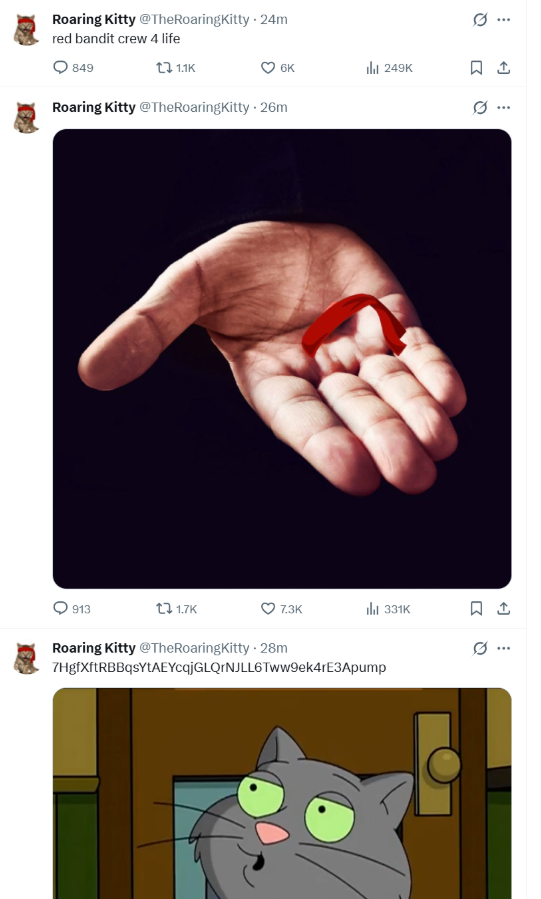
Two posts appeared on Gill’s verified X account. One included a Pump.fun contract address for a Solana-based memecoin called Red Kitten Crew, or RKC, while another showed a short cartoon with the phrase “red bandit crew 4 life.” Both posts were deleted within an hour.
🚨 Roaring Kitty’s X account reportedly got hacked yesterday and within minutes a $SOL memecoin called $RKC launched on Pumpfun.
The token went from launch to $12.2M market cap in under 30 minutes.
Then chaos started: • $10M+ wiped from ATH • Hackers reportedly made $500K+ •… pic.twitter.com/ZM1PlvG7r2
Many in the GME community, particularly on Reddit’s r/Superstonk, immediately flagged the post as suspicious due to the abrupt change in tone and the unrelated Solana memecoin promotion. The promotional posts were later deleted, consistent with account recovery after a breach.
At the time of publication, neither Gill nor his representatives had publicly confirmed whether the posts were authentic or whether the account had been compromised.
How RKC Surged and Crashed in Under 30 Minutes
The market reaction was fast and brutal.
Following the now-deleted X posts, Red Kitten Crew briefly surged to an $11 million market capitalisation before falling about 67% to $3.6 million, according to Dexscreener.
Within just 20 minutes, the token surged to an $11 to $12 million market cap before crashing sharply after the posts disappeared. That is a full pump-and-crash cycle compressed into the span of a single lunch break.
Onchain Data Reveals Pre-Loaded Wallets
Beyond the crash itself, blockchain analytics told a deeper and more troubling story about how the token was structured from the very start.
Lookonchain reported that the developer initially used 10 wallets to buy 395.18 million RKC tokens, representing 39.52% of the total supply, raising concerns that the launch was dominated by creator-linked wallets before retail traders ever entered.
Think about what that means in practical terms.
Before a single retail buyer purchased one token, nearly 40% of the total supply was already sitting in wallets connected to the person who deployed the contract. When buying pressure arrived thanks to the viral post, those wallets were already positioned to sell directly into the demand wave.
The token’s developer sold about $611,000 worth of RKC and collected another $118,000 in creator fees through Pump.fun, bringing the total exit to roughly $729,000.
The profit was not accidental. It was structural.
Retail Traders Paid the Price
While the developer walked away with nearly three quarters of a million dollars, many retail traders who bought the hype faced devastating losses.
One trader spent $250,000 to buy 31.15 million RKC tokens just before Gill’s X post was deleted, leading to a $188,600 loss after selling those coins for only $62,200.
That single trader lost more than $188,000 in under an hour. This was not an isolated outcome. It reflected the broader reality of buying into a low-liquidity token with highly concentrated supply, at peak hype, with no understanding of the onchain structure beneath it.
Analysts warned that bundle concentration appeared extremely high, meaning insiders may have controlled most of the token supply from the very start.
Was Roaring Kitty’s Account Hacked?
This is the question most people were asking on May 11, and it still does not have a definitive answer.
Gill has never publicly promoted a memecoin or used Pump.fun. His public footprint has centered on options trading, value investing themes, and ad hoc YouTube livestreams. GameStop holders and onchain analysts flagged the post almost immediately, citing the abrupt return and the lack of any explanation. The pattern mirrors recent takeovers of high-profile crypto accounts, including the breach of Michael Saylor’s MicroStrategy handle.
Not everyone agreed with the hack theory. Market researcher Jake Wujastyk highlighted: “GME People think this guy’s account is hacked. I don’t. I think it’s part of the plan. IMO he first posted the tweet looking like a hacked tweet for ultimate confusion. That’s his M.O.”
No verified evidence has been presented proving any specific individual’s involvement in the posts, the possible account breach, or the token sales. Until Gill speaks publicly, it remains unconfirmed either way.
GameStop Stock Got Caught in the Chaos Too
One detail that underscores how much market power Gill’s name still carries: this event did not stay contained to crypto.
GameStop shares surged up to 13% on Monday after the posts appeared on Keith Gill’s X account, then reversed lower as the posts vanished within an hour. This shows how the same dynamics that crash low-liquidity memecoins can create reverberations in regulated equity markets when a famous name is involved.
Key Red Flags Every Crypto Trader Should Recognize
The RKC incident is a textbook case study in how celebrity-linked memecoin launches exploit trader psychology. Here is what was visible before the crash even happened:
Dormant account suddenly posting: When any public figure returns from an extended absence only to promote a brand-new token with no context, that warrants immediate skepticism. Legitimate projects do not rely on surprise announcements from inactive accounts.
High supply concentration: Nearly 40% of the supply was reportedly concentrated in linked wallets before the rally, creating a high-risk setup for late buyers. Tools like Lookonchain and Bubblemaps allow anyone to check token distribution before buying.
No verification across multiple channels: Before trading any token associated with a public figure, confirm that person has endorsed the project on YouTube, their official website, or separate social media accounts. One post from one account is never sufficient.
Post deletion timing: Deleted posts are a signal that something went wrong, whether from account recovery or a deliberate exit. By the time posts disappear, early wallets have often already sold.
Low liquidity plus viral hype: Solana memecoins launched on Pump.fun often have thin order books. A small wave of buying can push the price up dramatically, creating the illusion of strong demand. That same thin liquidity means prices crash just as fast when large holders exit.
Broader Pattern: Celebrity Accounts and Memecoin Scams
This was not an isolated incident. In February 2025, a cryptocurrency sniper made nearly $28 million on the Broccoli memecoin shortly after Binance co-founder Changpeng Zhao revealed that his dog was named Broccoli, sparking a wave of community-driven memecoin listings on Pump.fun.
Separately, Bubblemaps warned that 90 newly funded wallets bought 90% of the Mystery token supply at launch, describing the concentration as a textbook scam. That token subsequently crashed by over 98%, erasing most of its peak $7.5 million market capitalization.
High-profile social media accounts tied to celebrities and retail investing icons are actively targeted because their follower bases respond quickly and emotionally to posts. For malicious actors, a verified account with millions of followers is simply a mechanism for triggering fast, uninformed buying into pre-loaded token positions.
Protecting Yourself: Practical Steps Before Buying Any Memecoin
Understanding what happened with RKC is only useful if it translates into better decision-making going forward:
Verify across at least two separate platforms: If a public figure is genuinely promoting a token, they will confirm it through multiple channels. One X post is never confirmation.
Check supply distribution immediately: Use Lookonchain, Bubblemaps, or Solscan to see what percentage of total supply sits in the top wallets. Anything above 20% to 30% in a single cluster is a serious warning.
Look at wallet funding history: If the wallets holding most of the supply were all funded from the same source within hours of launch, that is a bundled launch structured to extract profits from retail buyers.
Avoid buying during the initial hype spike: The moments immediately after a viral post are the most dangerous entry point. Pre-loaded wallets are actively selling into that demand.
Use hardware-based two-factor authentication on your own accounts: Security matters for participants too. App or hardware-based 2FA is significantly more resistant to the credential attacks that compromise high-profile accounts.
Social Media Power and Market Responsibility
The RKC crash compressed several important lessons into less than 30 minutes of market action. This episode highlights the risks around celebrity-linked memecoin launches, where a single social media post or a suspected account compromise can send thinly traded tokens sharply higher before concentrated early holders sell into later buyers.
A famous name, a dormant account, a freshly deployed token, pre-loaded wallets, and a viral post resulted in roughly $729,000 in profits for those who structured the trade and significant losses for retail buyers who reacted without analysis.
In crypto markets, speed of reaction without analysis is the single biggest risk factor for retail traders. Celebrity association is not a due diligence process. Onchain data is.
The crash happened after deleted promotional posts triggered panic selling while concentrated insider wallets exited positions rapidly after prices surged.
Was Roaring Kitty’s X account hacked?
There is no confirmed evidence yet, but many analysts and GameStop community members strongly suspect the verified account was compromised.
How much money did insiders reportedly make?
The developer allegedly earned around $729,000 through token sales and Pump.fun creator fees during the rapid pump-and-dump cycle.
What lesson should crypto traders learn here?
Always verify endorsements across multiple platforms and inspect token distribution before buying hyped memecoins linked to celebrities or influencers.
Disclaimer:
The information provided in this article is for informational purposes only. It is not intended to be, nor should it be construed as, financial advice. We do not make any warranties regarding the completeness, reliability, or accuracy of this information. All investments involve risk, and past performance does not guarantee future results. We recommend consulting a financial advisor before making any investment decisions.
Onkar Singh has three years of experience as a digital finance content creator. Throughout his career, he has collaborated with various DeFi projects and crypto media outlets. In his leisure time, he enjoys fitness activities at the gym and watching movies across different genres. Balancing his professional and personal interests, Onkar continues to contribute to the digital finance landscape while pursuing his hobbies.


 Easy
Easy