What to expect from GME if GameStop purchases eBay | Credit: Hameem Sarwar
Share
Key Takeaways
GameStop’s $56 billion bid for eBay signals a major shift toward becoming a holding company, boosting its stock price.
Bitcoin has also reclaimed $80,000, reflecting institutional-driven momentum, as retail sentiment remains cautious.
Both moves highlight a broader market shift toward proactive capital deployment and positioning for future growth.
GameStop, the retailer-turned-market phenomenon, has stunned Wall Street with a $56 billion proposal to acquire eBay, offering $125 per share in a deal split 50% cash and 50% stock.
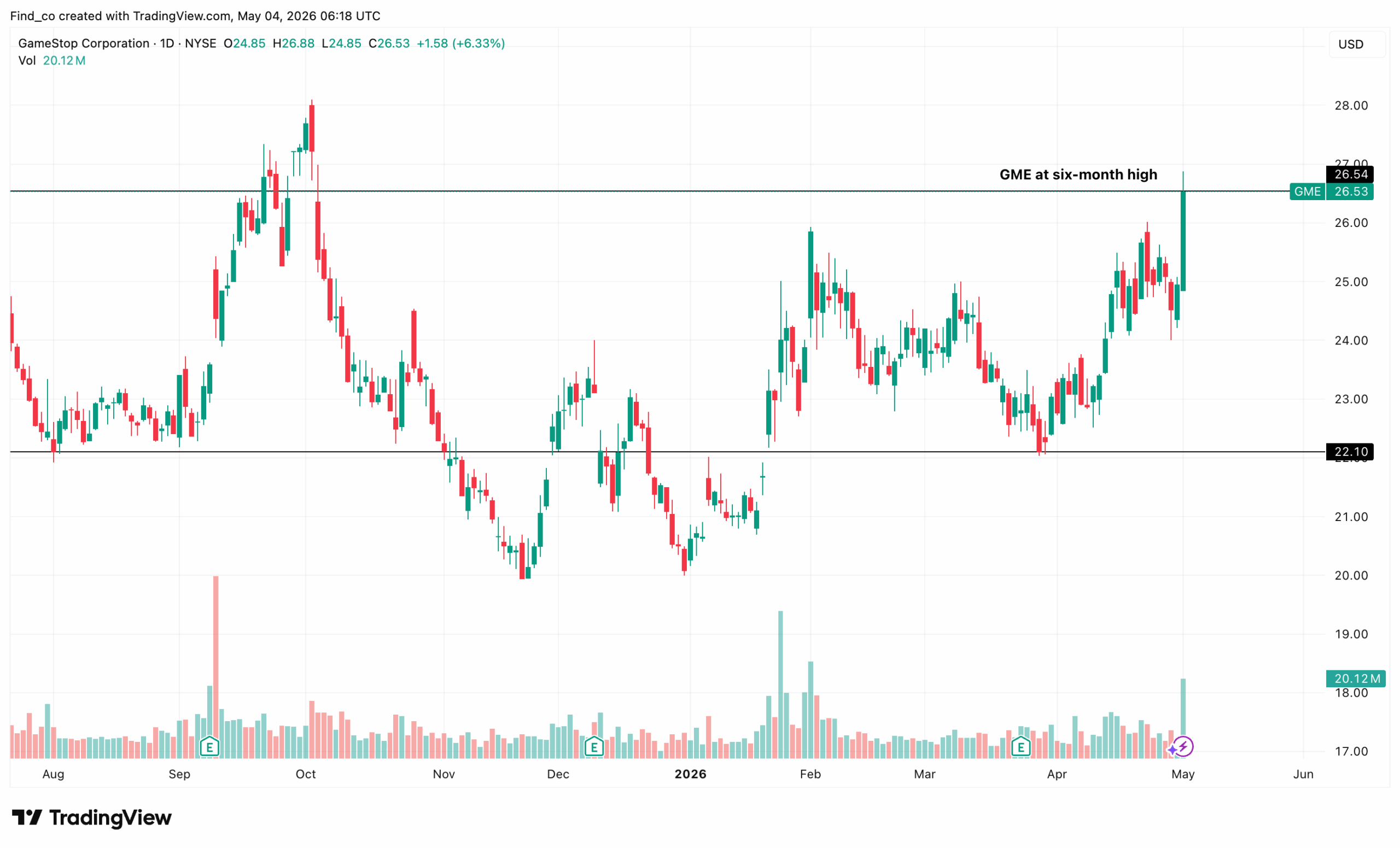
Following the move, GME’s price per share surged to a six-month high near $33.50. The price of the eBay stock, on the other hand, climbed roughly 20%.
Interestingly, this happened as Bitcoin’s price also retested $80,000 for the first time since Jan. 31.
But the market reaction wasn’t just about the numbers. It was about what GameStop is trying to become.
Here is a breakdown of all that has happened, and what could be next for GME’s price.
GameStop Is Trying to Redefine Itself
For years, GameStop has lived in two worlds.
To retail traders, it was a symbol — a battleground between WallStreetBets and hedge funds.
To institutions, it remained a struggling brick-and-mortar retailer with an uncertain future.
Get These Top Crypto Casino Offers Now!
Sponsored
Disclosure
We sometimes use affiliate links in our content, when clicking on those we might receive a commission at no extra cost to you. By using this website you agree to our terms and conditions and privacy policy.
The vision is ambitious: build a platform that can compete directly with Amazon, while extracting $2 billion in annual cost efficiencies within the first year.
But the deeper shift is happening beneath the surface.
Investors are beginning to treat GameStop not as a retailer but as a capital allocator — a company capable of deploying large-scale balance-sheet strategies to reshape its business.
That’s a very different valuation framework, and it explains why the stock moved quickly.
Meanwhile, Bitcoin Is Sending Its Own Signal
At the same time, another market is quietly but meaningfully moving.
Bitcoin has reclaimed the $80,000 level, trading near $80,133 after breaking out from a months-long descending channel.
The move was accelerated by a short squeeze after BTC cleared the $72,800 resistance, signaling a new phase of price discovery.
But what stands out isn’t just the price. It’s the sentiment.
Despite the rally, the Fear & Greed Index remains at 40, suggesting retail investors remain cautious.
This suggests the move is being driven more by positioning and institutional flows than by broad retail enthusiasm.
What makes this moment more interesting is that it wasn’t entirely unexpected.
Michael Burry is back in GameStop.
The investor who first built a position in 2019, long before the meme-stock frenzy, disclosed in early 2026 that he had once again begun accumulating GME shares.
But this time, the thesis is different, as Burry is no longer betting on volatility or retail mania. He’s betting on value.
In his Cassandra Unchained newsletter on May 2, Burry outlined two key reasons for his return.
First, asset-backed value.
He noted that at certain price levels, investors were effectively paying $1 for $1 of tangible assets, including cash and inventory.
That creates a floor — something meme stocks rarely have.
Second, the holding company transformation.
Burry openly praised Ryan Cohen’s strategy, arguing that GameStop had successfully turned its meme-era capital into a $9.4 billion war chest, giving it the ability to act, not just survive.
“If eBay isn’t receptive, Cohen could decide to take the offer directly to eBay’s shareholders, one of the people added. Details of the potential offer for eBay couldn’t be learned,” Burry emphasized.
That’s exactly what’s happening now. While Burry has not yet commented publicly on the eBay bid, his earlier positioning tells a clear story.
He didn’t see GameStop as a company waiting to be acquired. He saw it as a company preparing to acquire, and that’s precisely what this $56 billion move represents.
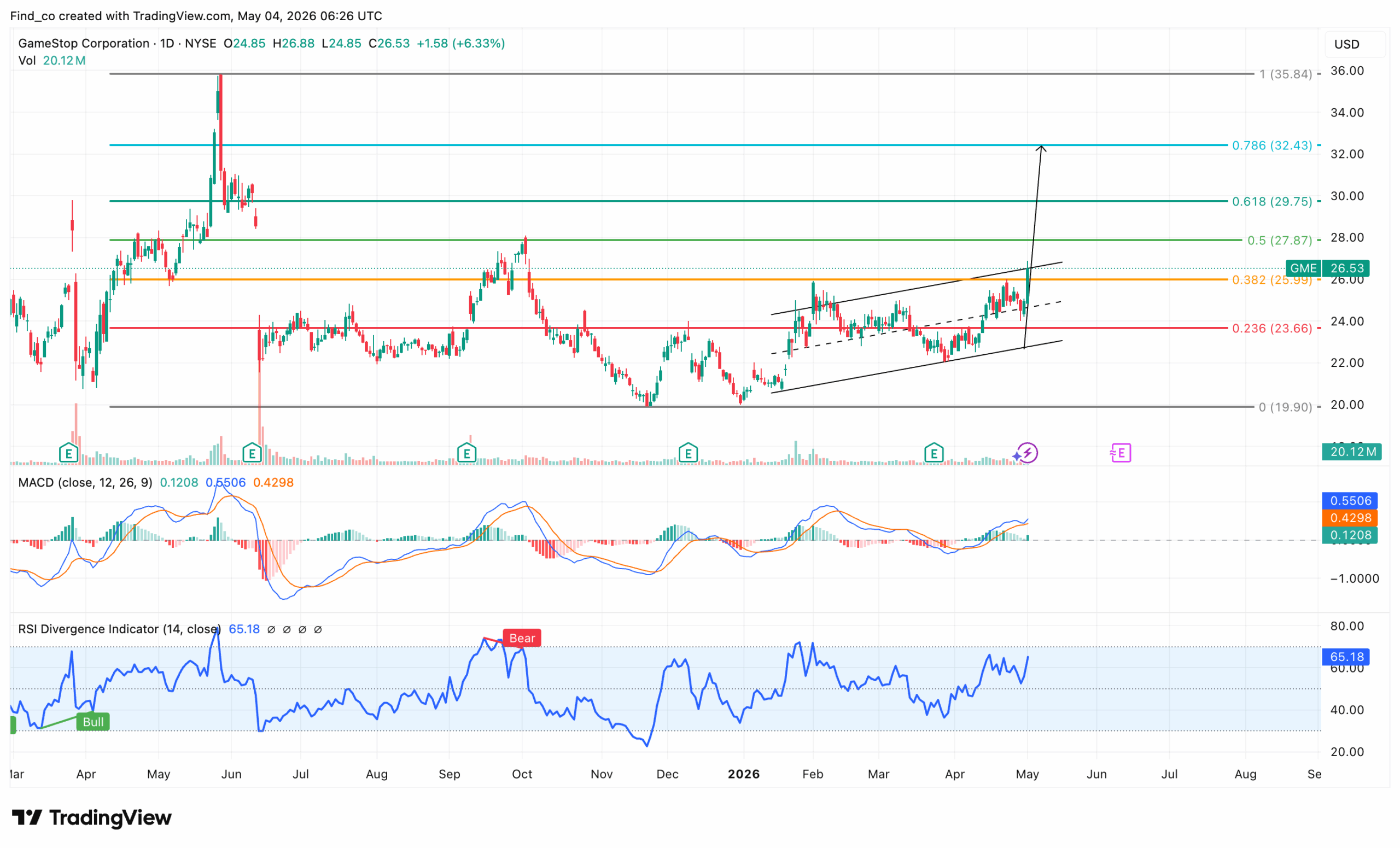
This has eventually created an ascending channel that is pushing directly into the 0.382 level around $26.99 per share.
This level has served as a consistent ceiling in recent GameStop price action and now aligns with the channel’s upper boundary, making it a critical breakout point.
What’s important here is the steady compression. Instead of sharp rejections, GME’s price is holding near resistance while printing higher lows.
Interestingly, momentum indicators are also supporting this. For instance, the Moving Average Convergence/Divergence (MACD) is trending higher, with a bullish crossover.
Also, the Relative Strength Index (RSI) is in the mid-60s, indicating strength but not yet exhaustion. This combination suggests there’s still room for continuation if resistance breaks.
If GME’s price can push and hold above the $26 area, the next upside levels are clearly defined. The first target sits around $27.87 at the 0.5 retracement, followed by $29.5 at the 0.618 golden ratio.
Disclaimer:
The information provided in this article is for informational purposes only. It is not intended to be, nor should it be construed as, financial advice. We do not make any warranties regarding the completeness, reliability, or accuracy of this information. All investments involve risk, and past performance does not guarantee future results. We recommend consulting a financial advisor before making any investment decisions.
Victor Olanrewaju is a crypto analyst and reporter at CCN with deep roots in on-chain research and technical analysis. His crypto journey began in 2017, but it was the 2020 Uniswap airdrop that sparked a full-time pivot into the space.
With a foundation in copywriting, Victor honed his craft creating high-converting content for leading crypto brokers — most notably an XRP price prediction that ranked #1 on Google during the 2021 bull run.
He later joined AMBCrypto in 2022, where he combined storytelling with technical and on-chain analysis to cover key market narratives.
In 2024, he expanded his expertise at BeInCrypto, collaborating with analysts and using tools like Glassnode, Santiment, and IntoTheBlock to break down Bitcoin and altcoin trends.
At CCN, Victor covers the top cryptocurrencies, memecoins, macro shifts, blending real-time insights with deep-dive metrics.
He holds a Bachelor’s degree in Physics from the University of Ibadan, equipping him to simplify complex data for a wide audience. Follow his work or connect on LinkedIn or X.