How Ripple Reinvented Itself After SEC Battle With $2.7B+ Acquisitions| Credit: Veronica Cestari /CCN
Share
Key Takeaways
Ripple spent about $4 billion in acquisitions from 2023 to 2025, expanding beyond payments into prime brokerage, custody, and treasury services.
The company’s purchases of Hidden Road, GTreasury, and Rail positioned it as a full-scale institutional crypto-finance provider.
Ripple launched RLUSD, its U.S. dollar–pegged stablecoin, now exceeding $1 billion in circulation, and used for onchain Mastercard settlements.
At Ripple Swell 2025, the company announced a $500 million investment from major global firms and confirmed plans to stay private with no IPO.
Ripple’s 2025 trajectory marks one of the boldest shifts in financial technology history. After resolving its long legal battle with the U.S. Securities and Exchange Commission (SEC), the company gained the regulatory clarity needed to attract major institutional players.
Ripple then shifted from legal defense to aggressive expansion, positioning itself as a full-scale institutional crypto finance leader rather than just a cross-border payments firm.
Ripple has deployed over US $2.7 billion in acquisitions in 2025, including the Hidden Road (US $1.25 billion) and GTreasury (approximately US $1 billion) deals, as well as the purchase of stable-coin platform Rail for US $200 million.
By November 2025, Ripple had invested around $4 billion across the crypto sector through strategic acquisitions, mergers, and investments, including reported deals such as Palisade, a wallet and custody infrastructure firm.
Industry reports suggest Ripple’s expanding portfolio reflects its intent to create a fully integrated institutional ecosystem anchored by the XRP Ledger (XRPL).
This move reflects its central mission to build a unified institutional financial stack powered by the XRPL. While early reports focused on Ripple’s major acquisitions, the broader strategy reveals a clear intent to make XRPL indispensable to global banks, hedge funds, and multinational corporations.
This article explains how Ripple’s multibillion-dollar acquisition spree transformed it from a payments company into a crypto-finance empire.
2023: Building Institutional Trust Through Custody and Regulation
Ripple’s transformation into a crypto-finance powerhouse did not happen overnight. Its rise began in 2023, a year that laid the foundation for regulatory trust and institutional credibility.
Ripple’s 2023 strategy centered on building institutional trust through two major acquisitions in crypto custody and regulation.
Key Point: Ripple Builds Institutional Trust with Metaco and Fortress Trust Acquisitions
Metaco deal (announced May 2023): Acquired Switzerland-based Metaco for $250M to gain bank-grade custody tech used by Citi, BNP Paribas, and Societe Generale’s Forge unit. Over 50% paid in cash. CEO Brad Garlinghouse said it strengthened Ripple’s institutional infrastructure amid U.S. legal challenges.
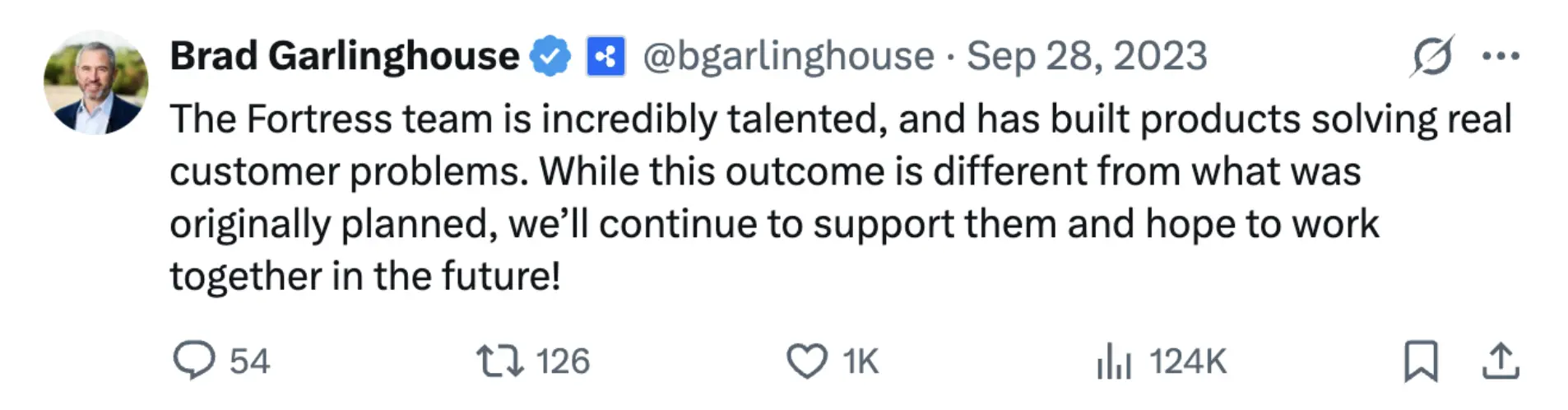
Fortress Trust deal (Sept 2023): Ripple announced a planned acquisition of Nevada-chartered Fortress Trust but withdrew the outright purchase just weeks later, continuing as an investor. The decision followed a vendor-related hack, causing an estimated US$12-15 million in losses. Nevada halted operations Oct. 22, 2025, over unrelated insolvency.
After establishing trust through early acquisitions, Ripple shifted focus in 2024 to regulation and stablecoin development, preparing the groundwork for its next phase of institutional growth.
2024: Strengthening Compliance and Building the Stablecoin Ecosystem
Ripple’s 2024 strategy focused on deepening regulatory compliance and building the foundation for its stablecoin ecosystem.
Key Point: Ripple Expands Regulatory Reach and Prepares for Stablecoin Growth
Acquisition of Standard Custody and Trust Company (February 2024): Ripple announced plans to acquire the New York–based digital asset custodian, one of only nine firms holding a New York limited-purpose trust charter at the time. It became one of the few crypto companies licensed in New York, Nevada, and other jurisdictions.
Global compliance growth: By late 2024, Ripple held over 75 licenses and registrations worldwide, reinforcing its compliance-first strategy and positioning itself as a trusted partner for banks and enterprises.
Launch of Ripple USD (RLUSD): In December 2024, Ripple introduced its U.S. dollar–pegged stablecoin for institutional clients on the XRP Ledger. RLUSD quickly gained traction, reaching a $500 million market cap by July 2025 and surpassing $600 million by August 2025. By early Nov 2025, it hit $1 billion.
Integration with Ripple acquisitions: Hidden Road, the prime broker Ripple would later acquire, began accepting RLUSD as collateral. The stablecoin payment platform Rail, also acquired by Ripple, supported RLUSD’s use in cross-border transactions. This partnership validated Ripple’s risk and compliance framework while strengthening its reputation among traditional financial institutions.
Strategic outcome: By the end of 2024, Ripple had built the legal, operational, and technological framework needed to expand into prime brokerage and enterprise-grade stablecoin services in 2025.
By 2025, Ripple’s earlier groundwork paid off. The company entered its most ambitious stage yet, expanding into prime brokerage, treasury management, and cross-border payment systems.
2025: Expanding into Prime Brokerage, Payments, and Treasury Management
With a solid regulatory and operational foundation already in place, Ripple made 2025 its breakout year, executing a series of major transactions that transformed its business scope from payments specialist to full-service institutional crypto finance provider.
Key Point: Ripple Scales Institutional Finance Through Strategic 2025 Acquisitions
Major acquisition of Hidden Road (April 2025): Ripple agreed to acquire Hidden Road for approximately US $1.25 billion. Hidden Road is a global, multi-asset prime broker clearing roughly US $3 trillion annually and serving more than 300 institutional clients. This deal made Ripple the first crypto firm to own a global multi-asset prime broker and the only non-bank entity positioned to compete with traditional Wall Street prime-brokerage firms.
Integration of stablecoin collateral: Hidden Road began using Ripple’s U.S. dollar–pegged stablecoin, Ripple USD (RLUSD), as collateral across its prime brokerage services. This strengthened RLUSD’s role in institutional trading and expanded its real-world utility.
BNY Mellon partnership extension: Ripple continued its partnership with Bank of New York Mellon, which remained the primary custodian of RLUSD reserves throughout 2025. The arrangement ensured institutional-grade reserve protection, transparent audits, and segregation of assets.
Acquisition of GTreasury (October 2025): Ripple acquired GTreasury for about US $1 billion, gaining direct access to a treasury management software platform used by major corporations such as American Airlines, Goodyear and Volvo. The platform processes more than US $12.5 trillion in payments volume annually, marking Ripple’s entry into the corporate treasury market and real-time liquidity management.
Acquisition of Rail – Stablecoin payments infrastructure (August 2025): Ripple purchased Rail, a Toronto-based stablecoin payments platform, for approximately US $200 million. Rail provides virtual accounts and automated back-office systems for businesses using stablecoins in cross-border payments, reportedly processing around 10 % of global stablecoin transaction volume at the time of the deal. This acquisition enhanced Ripple’s RLUSD-based network and reinforced its position in the global payments ecosystem.
Ripple’s strategic evolution came full circle at Swell 2025, where the company presented its biggest milestones and outlined how its multi-billion-dollar acquisitions were reshaping global finance.
Ripple Swell 2025: Major Announcements and Global Partnerships
Ripple Swell 2025 took place on November 4 and 5 in New York City, bringing together fintech leaders from BlackRock, Nasdaq, Bloomberg, and a White House official.
The invite-only event showcased Ripple’s major milestones, including the acquisition of Palisade to strengthen XRP custody and the rollout of RLUSD, its stablecoin, which now exceeds $1 billion in circulation. It is used in partnership with Mastercard, WebBank, and Gemini for onchain credit card settlements.
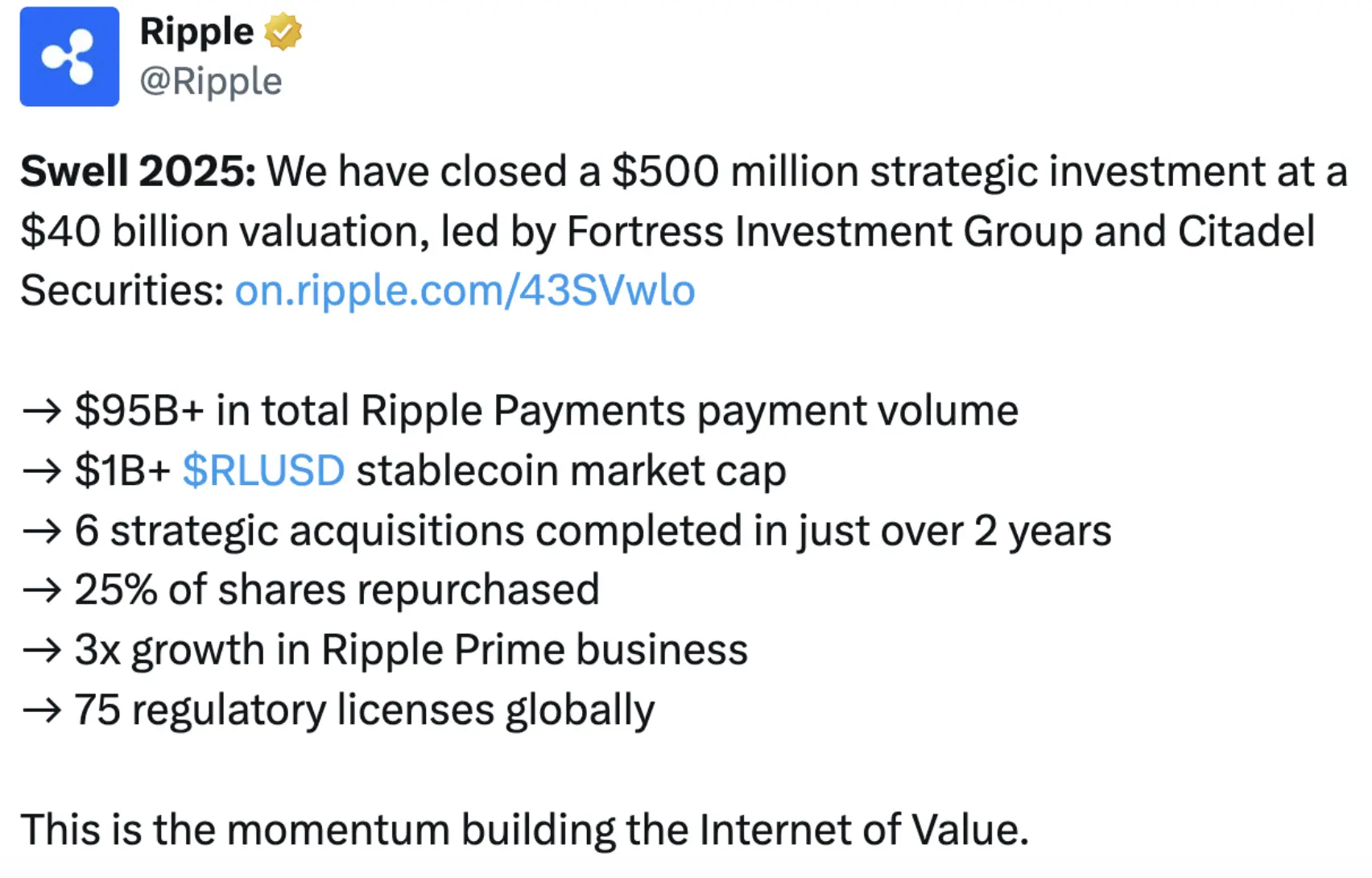
Ripple also outlined its 2026 roadmap to expand XRP adoption and institutional integration. CEO Brad Garlinghouse announced a $500 million investment from Fortress, Citadel, Pantera, Galaxy, Brevan Howard, and Marshall Wace, calling it validation of Ripple’s long-term vision.
Ripple’s statement | Source: X
President Monica Long emphasized collaboration, transparency, and innovation, confirming that the company has no plans for an IPO. Following the event, XRP gained 3.5 percent amid growing optimism about potential ETF approvals.
What Is Next for Ripple: Expanding RLUSD and Institutional Reach
As of November 2025, Ripple has assembled a fully integrated institutional finance stack that combines custody, prime brokerage, treasury management, stablecoins, and payments.
This evolution strengthens the company’s position as a credible institutional financial infrastructure provider serving banks, hedge funds, treasurers, and multinational corporations.
Ripple’s expansion also reflected the broader transformation of crypto finance. Its acquisitions coincided with increasing U.S. regulatory clarity, the introduction of stablecoin oversight laws, and rising institutional adoption of blockchain-based systems, among others.
These conditions created the right environment for Ripple to scale its offerings and integrate blockchain technology into traditional financial operations.
Looking ahead, Ripple is expected to focus on expanding RLUSD’s global utility, deepening institutional partnerships, and broadening its role in corporate treasury and liquidity management.
Its 2025 momentum indicates a clear direction, building the bridge between traditional finance and blockchain-powered infrastructure that supports global financial innovation.
Why did Ripple start acquiring companies like Hidden Road and GTreasury?
Ripple aimed to transition from a payments-focused firm into a diversified institutional crypto-finance provider offering custody, brokerage, and treasury services.
What is RLUSD and how does it fit into Ripple’s ecosystem?
RLUSD is Ripple’s U.S. dollar–pegged stablecoin designed for institutional clients, used for onchain settlements and liquidity management.
How large is Ripple’s total investment in acquisitions since 2023?
Ripple has invested around $4 billion across acquisitions and partnerships to expand its institutional financial infrastructure.
What makes the Hidden Road acquisition so significant?
Hidden Road gives Ripple access to a global multi-asset prime brokerage platform clearing about $3 trillion annually, enabling deeper integration with traditional markets.
Disclaimer:
The information provided in this article is for informational purposes only. It is not intended to be, nor should it be construed as, financial advice. We do not make any warranties regarding the completeness, reliability, or accuracy of this information. All investments involve risk, and past performance does not guarantee future results. We recommend consulting a financial advisor before making any investment decisions.
Dr. Lorena Nessi is an award-winning journalist and media technology expert with 15 years of experience in digital culture and communication. Based in Oxfordshire, UK, she combines academic insight with hands-on media practice.
She holds a PhD in Communication, Sociology, and Digital Cultures, and an MA in Globalization, Identity, and Technology.
Lorena has taught at Fairleigh Dickinson University, Nottingham Trent University, and the University of Oxford. She is a former producer for the BBC in London, with additional experience creating television content in Mexico and Japan.
Her research focuses on digital cultures, social media, technology, capitalism, and the societal impact of blockchain innovation.
She has written extensively on digital media and emerging technologies, with her work featured in both academic and media platforms. Her Web3 expertise explores how blockchain technologies shape culture, economics, and decentralized systems.
Outside of work, Lorena enjoys reading science fiction, playing strategic board games, traveling, and chasing adventures that get her heart racing. A perfect day ends with a relaxing spa and a good family meal.


 Easy
Easy