How Pyth Network Delivers Real-Time Data to DeFi (And Why It Matters Now). | Credit: Hameem Sarwar
Share
Key Takeaways
Oracles act as vital bridges that allow smart contracts to access real-world data, enabling DeFi applications to function beyond blockchain-only outputs.
Pyth Network differentiates itself by delivering on-demand, low-latency data directly from institutional trading firms and exchanges.
Its design addresses the “oracle problem” through three pillars: security, availability, and incentive.
Challenges remain, including reliance on Solana, potential concentration of data providers, and the risks of cross-chain infrastructure.
Smart contracts execute complex financial logic and are the backbone of any decentralized protocol. But they cannot access information outside of the blockchain.
Oracles are bridges that connect blockchain networks to real-world data, allowing decentralized applications (dApps) to access off-chain information, such as stock prices or real-world events like election results.
Think of an oracle like a weather app that tells your smart thermostat the temperature outside. Your smart thermostat can’t pull the weather itself, but can only adjust if it knows the temperature. That weather app is an intermediary.
Oracles serve a critical role in decentralized finance (DeFi), providing data to a protocol’s smart contracts for it to process. Some examples:
Price feeds: The decentralized exchange Synthetix utilizes synthetic digital assets to track real-world stock prices through oracles.
Supply chain: Internet of Things (IoT) sensors on shipping containers can report temperature, location, or handling data, which an oracle then feeds into a blockchain.
Real-world events: Prediction markets like Polymarket pull election results, end-of-game sports scores, and more through oracles.
With over $156 billion in total value locked (TVL) across DeFi protocols as of September 2025, it’s clear that accurate price information is more important than ever. If oracles provide the wrong data, the consequences can be severe. Wrong prices can result in unfair liquidations, trading losses, or even arbitrage attacks that drain protocol funds.
The June 2022 Inverse Protocol disaster is one such example of oracle manipulation, resulting in $15.8 million lost over two attacks. In both cases, the hacker used a flash loan to manipulate prices in a pool that the Inverse oracle draws from.
This wasn’t some zero-day exploit. This was a predictable consequence of depending on easily manipulated price information. The fact that Inverse Finance suffered from the exact same exploit pattern twice demonstrates how important oracle security is for DeFi’s survival.
Try Our Recommended Crypto Exchanges
Sponsored
Disclosure
We sometimes use affiliate links in our content, when clicking on those we might receive a commission at no extra cost to you. By using this website you agree to our terms and conditions and privacy policy.
The Oracle Problem: Why Current Solutions Fall Short
Current oracles, such as Chainlink’s, rely on a “push” system that automatically updates data at fixed intervals. Imagine a newspaper being delivered to your door every hour. It’s great if you’re constantly reading the news, but frustrating if you only need occasional updates, yet you must still pay the delivery person each time. On blockchain networks, this translates to constant transaction costs for data that the network may not even use.
Latency is another issue. By the time a push system aggregates and validates data, market prices have already shifted. Latent market prices can be especially problematic during times of high volatility.
This isn’t to mention data validity. According to Ethereum documentation, the “oracle problem” revolves around three key factors:
Security: How does a protocol verify that oracle data is accurate and hasn’t been tampered with
Availability: How does an oracle ensure it is always available and always up-to-date?
Incentive: How do providers incentivize oracles to provide the right information? How do you hold them accountable?
Different networks have different solutions. Chainlink, for instance, uses decentralized node networks to bring in data, reducing the risk of relying on one source of security while sacrificing speed and cost.
Pyth Network: Real-Time, Low-Latency Data Feeds
Networks like Pyth have risen as an answer to these problems. Unlike traditional oracles, which often pull delayed market information, Pyth specializes in real-time, low-latency feeds that pull (as opposed to push) data directly from institutional sources.
That pull is specific, only providing a price update when requested, rather than at set intervals, no matter what. It’s a lot like switching from cable to on-demand streaming. Instead of pushing data out regardless of who’s consuming it, Pyth provides prices only when requested.
Here’s how it works:
Data publication: Publishers, like established trading firms and exchanges,provide information to Pyth oracles. This direct relationship, rather than a reliance on third-party node operators, helps ensure data validity.
Aggregation: Pyth combines this information into a single price feed, consolidating data from multiple sources.
Delivery: Through Pyth’s integration with the Wormhole cross-chain bridge, Pyth broadcasts this information to over 50 blockchains.
Consumption: DeFi protocols, also known as consumers, pull from these oracles on demand, reducing costs while promoting accuracy.
The benefits? It’s cheaper and faster than traditional oracle processes:
Cheaper fees: Traditional oracles charge a gas fee for every price update, requested or not. These fees add up over time. Pyth oracles only charge when requested, saving the protocol money.
Lower latency: This means that traders and DeFi protocols can access market information nearly as fast as professional Wall Street investment firms, while only paying for what they use.
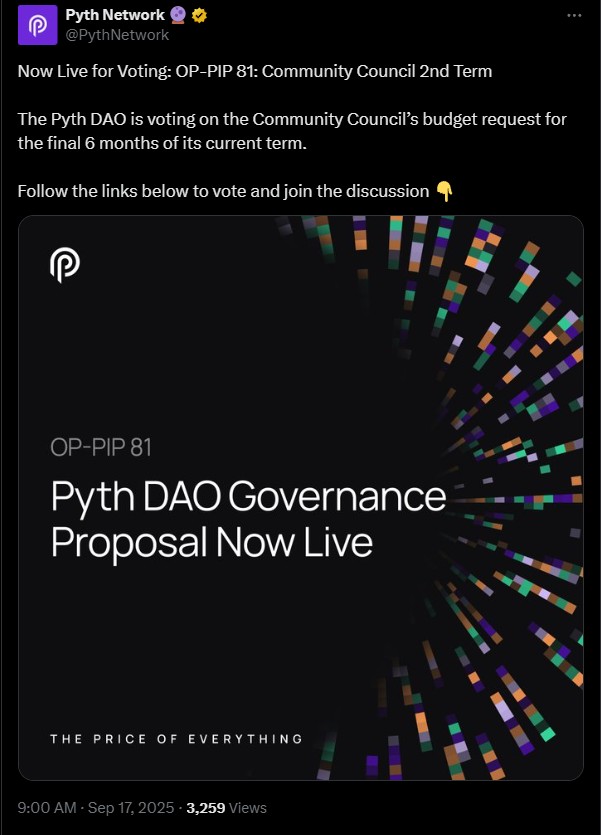
The Pyth Network X account posts about current voting issues. | Source @PythNetwork on X
But Pyth doesn’t just stop at “pull” mechanics. Where it stands out is how its unique architecture directly addresses the oracle problem’s three pillars:
Security
Pyth partners with over 120 institutions, such as trading firms and exchanges like Revolut and Cboe. These are large entities that trade billions of dollars daily in traditional markets. Since they’re the ones setting and seeing real prices as investors make trades, their data is the “closest” to the truth, making it much harder for bad actors to manipulate. Either way, Pyth aggregates inputs from multiple price feeds in case one publisher presents the wrong information.
Pyth Network’s Oracle Program then combines these inputs into a single, comprehensive price, along with a confidence interval. The confidence interval, written as “$20,000 ± $20,” for example, shows potential price uncertainty and accounts for volatility.
Availability
In terms of availability, Pyth’s “Pythnet” is an application-specific network that each provider operates on. While Pythnet is powered by Solana, it’s an independent network with its own DAO.
To move price updates across multiple blockchains with minimal latency, Pyth Network uses Hermes, a web service that combines Pythnet and Wormhole Network price information. Publishers can then utilize Pyth Lazer, the network’s low-latency oracle, for faster price delivery. Think of Lazer as upgrading from standard shipping to express, while Hermes is a reliable address book with minimal errors, ensuring every delivery driver has the right address.
Before Pyth, a token might trade at different prices on Ethereum vs. Solana, creating arbitrage opportunities. Pyth’s unified approach helps normalize cross-chain pricing.
Incentivization
Finally, data publishers have a reputation to uphold. To generate additional income, publishers can stake PYTH tokens as collateral to earn interest.
However, providing false or manipulated data can result in reward slashing and a hit to reputation, meaning dApps may choose to pull from other publishers. It’s not unlike how Uber drivers are rated after each trip. The better the driver’s reliability, the more demand they receive.
dApps can also use the Express Relay, which allows protocols to eliminate the Maximal Extractable Value (MEV). MEV refers to the additional profit that validators can extract by reordering or even excluding transactions within blocks they produce.
Instead of allowing for this control, Pyth’s Express Relay has validators (searchers, in Pyth’s case) bid in an auction to access these transactions for validation. Auction proceeds are distributed back to users or used to fund operations within the Pyth protocol.
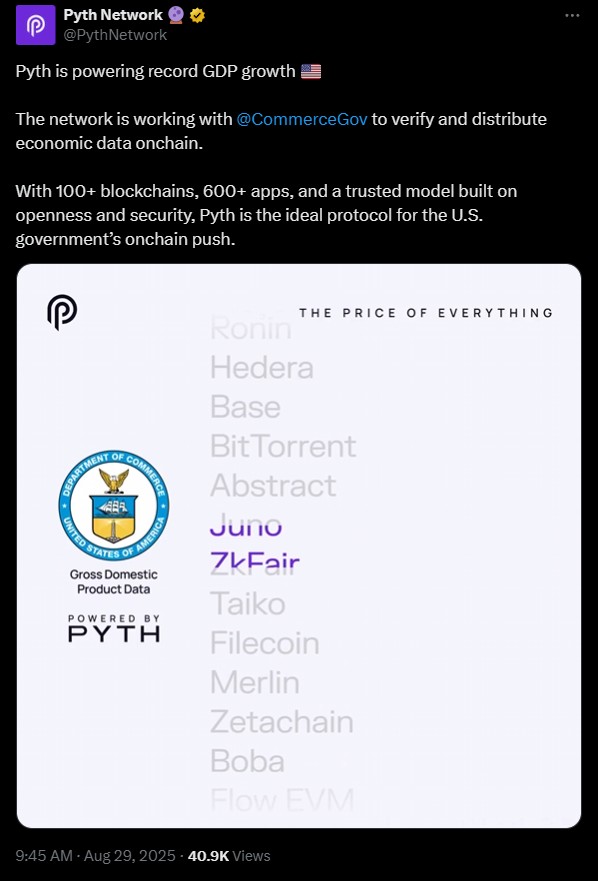
Pyth works with the US Commerce Department to bring economic data on-chain. | Source: @PythNetwork on X
Despite Pyth’s innovative approach, the network faces issues that users should be aware of.
An analysis by mutual fund manager VanEck questions Pyth’s overall reputation. If one publisher causes problems, it could damage trust in the entire Pyth network and its PYTH token, ultimately leading other publishers to drop out. It also points out that Pyth’s reliance on Solana’s architecture creates a single point of failure risk, while partnerships limited to large financial institutions raise concerns about centralization.
That said, the ultimate test is Pyth’s consistency. Should Pyth maintain its real-time, secure path from traditional price feeds to DeFi, it could lead the way toward supporting central bank digital currencies (CBDCs), hybrid financial products, and much more.
This solution could form the infrastructure needed to merge traditional finance and DeFi, marking a significant step toward financial convergence.
How does Pyth compare in adoption and market share to Chainlink and other established oracles?
Chainlink still leads in adoption, but Pyth is gaining ground in fast-moving DeFi markets thanks to its low-latency, institutional data model.
What role might Pyth play in supporting tokenized real-world assets (RWAs) as that market expands?
Pyth can provide the real-time, verifiable pricing that RWAs need, helping to keep tokenized assets aligned with traditional markets.
How could regulatory changes around data providers or financial institutions impact Pyth’s publisher model?
Stricter rules could limit publisher participation, while clearer frameworks might legitimize and expand Pyth’s institutional partnerships.
How does Pyth incentivize new data publishers to join the network?
Pyth rewards publishers through staking and revenue-sharing mechanisms, while also relying on reputation. Accurate publishers earn more demand, and dishonest ones risk being slashed.
Max Moeller is a Chicago‑based writer and video editor passionate about games, tech, and crypto. Whether it’s crafting clear, insightful articles or piecing together engaging video retrospectives, he’s driven by curiosity and takes pride in keeping things human. Since 2017, Max has been published in a variety of notable crypto magazines.


 Easy
Easy