Pi Network Rich List: 22 Whales Control Over 10 Million Coins Each
Share
Key Takeaways
Just 22 wallets hold over 10 million Pi each, worth more than $3.5M per account, highlighting major wealth concentration.
The Pi Foundation’s top wallet alone holds over 52B coins, raising questions about decentralization and ecosystem control.
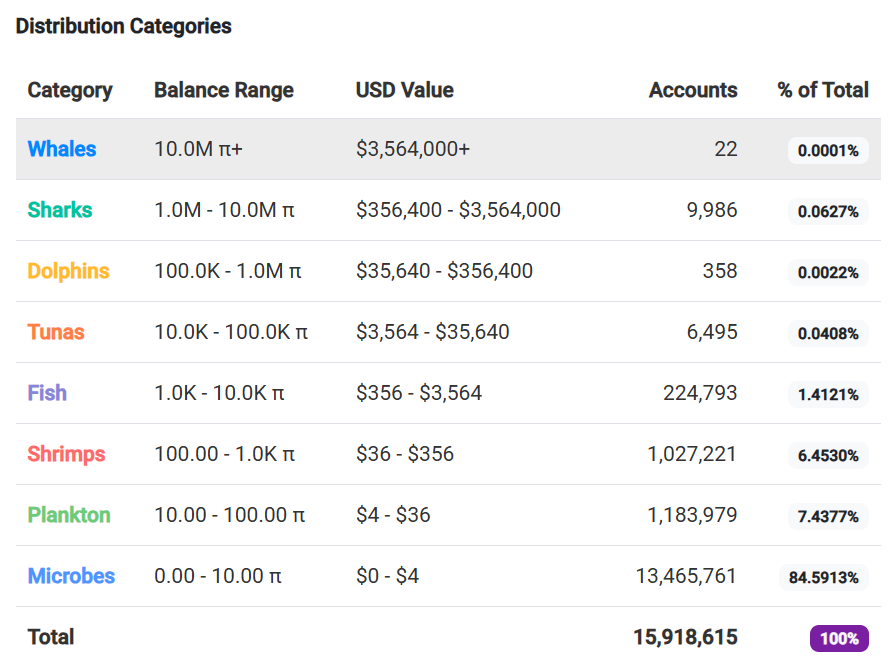
While 15.9M accounts exist, 84% are “microbes” with less than 10 Pi, exposing a sharp imbalance between whales and everyday miners.
Theories point to the Pi Core Team, centralized exchanges, or long-term investors accumulating during price dips.
The Pi Network has long marketed itself as a “people’s cryptocurrency” , a coin that anyone can mine from their smartphone without the need for expensive hardware. But fresh data from PiScan paints a very different picture of ownership: a network where wealth is heavily concentrated in the hands of a few.
According to the PiScan, just 22 wallets qualify as whales, each holding over 10 million Pi coins, with values exceeding $3.5 million per wallet. At the same time, millions of smaller accounts hold mere fragments of the cryptocurrency, highlighting a striking imbalance in distribution.
This article takes a closer look at the Pi Network Rich List, exploring who the top holders are, how the distribution breaks down, and what this wealth concentration means for the future of Pi.
Try Our Recommended Crypto Exchanges
Sponsored
Disclosure
We sometimes use affiliate links in our content, when clicking on those we might receive a commission at no extra cost to you. By using this website you agree to our terms and conditions and privacy policy.
The Pi Network Rich List as per the PiScan reveals the dominance of foundation-controlled and whale wallets.
Top 10 Pi Accounts. | Source: PiScan
Pi Foundation 1 leads the pack with a staggering 52.2 billion Pi coins, valued at over $18.6 billion USD. This wallet alone accounts for nearly 481% of supply, suggesting that large foundation-controlled reserves dominate the ecosystem.
Pi Foundation 14 and Pi Foundation 3 hold 9.5 billion and 4.6 billion Pi coins respectively, worth billions more.
Other major wallets include a Liquidity Reserve (974M Pi) and exchange-associated accounts like Gate.io and Bitget.
The dominance of foundation wallets raises questions about decentralization and whether Pi is truly a community-driven project.
Microbes (0 – 10 Pi): 13.4 million accounts, worth less than $4 each.
The data shows that while over 15.9 million Pi accounts exist, the vast majority hold tiny balances, with 84% of all accounts categorized as microbes.
Why Does Pi Network Ownership Concentration Matter?
1. Centralization Risks
One of crypto’s core principles is decentralization. Yet in Pi’s case, a handful of wallets, mostly controlled by the Pi Foundation, dominate supply. This raises concerns about whether Pi functions more like a centrally managed token than a decentralized currency.
2. Market Manipulation Concerns
When whales hold outsized portions of supply, they can heavily influence market behavior. A sudden sell-off by a single whale wallet could crash prices, leaving small holders exposed.
3. Community Perception
Pi Network’s marketing has always emphasized inclusivity, anyone can mine Pi from their phone. But the rich list shows that despite millions of miners, a small elite controls most of the wealth, undermining that narrative.
Speculation Around Pi Whales
With the Pi Network Rich List revealing that 22 “whale” wallets hold over 10 million Pi each, amounting to several millions of dollars worth of tokens per wallet, the community has naturally turned its attention to who these major holders might be and what their motives are.
Recent on-chain analytics and news reports provide some clues, though no definitive identities have been confirmed.
Here are the leading theories and observations:
Key Whale Activity
A wallet labelled GAS…ODM has emerged as a particularly aggressive accumulator. Over the past few months, this address has acquired 331 million Pi coins, putting its holding value at about $148 million USD.
In parallel, this accumulation has been happening even while Pi’s price has dropped sharply (by 70% from its highs around May 2025), suggesting that this buyer is not short-term or purely speculative, but possibly operating on a longer timeline.
Who Could These Whales Be?
While there’s no official confirmation of who owns these large wallets, several plausible theories have emerged in the community and in crypto-analysis reports.
Pi Core Team / Infrastructure Holders
Wallets may be tied to Pi’s development team.
Could be used for buy-backs or stabilizing supply.
Large transfers (550M+ Pi) from foundation wallets observed in 2025.
Major Exchanges / Pre-Listing Accumulation
Whales may be exchanges building inventory ahead of listings.
Multi-million Pi transfers seen from exchanges like OKX, Gate.io, and MEXC.
Long-Term Investors / Strategic Holders
Some whales could be wealthy individuals or funds.
Accumulating during price dips, not peaks.
Suggests long-term conviction in Pi’s growth and future adoption.
What Is the Pi Network?
Launched in 2018 by Stanford graduates Nikkolas Kokkalis and Chengdiao Fan, Pi Network set out to make cryptocurrency mining accessible to the masses. Unlike Bitcoin, which requires energy-intensive mining rigs, Pi coins can be mined via a mobile app.
Pi’s vision went beyond mining. The team promised to build an ecosystem of apps, services, and payment solutions powered by Pi. They rolled out features like:
Pi Ad Network – for app monetization.
Pi App Studio – to help developers launch applications.
KYC verification – to allow transfers from the enclosed mainnet to the open network.
Despite these ambitious goals, Pi Network has been criticized as a “ghost chain” with limited adoption and little real-world utility. To date, no major businesses accept Pi as payment, and most of its ecosystem remains underdeveloped.
The Future of Pi Network: Can It Deliver?
Despite criticism, Pi still has millions of engaged miners worldwide. Its eventual listing on major exchanges could spark renewed interest, especially if whales decide to hold rather than dump.
However, Pi’s future depends on:
Building real utility – apps, payments, and partnerships.
Improving transparency – clearer reporting on foundation reserves.
Decentralizing supply – reducing whale dominance over time.
If Pi fails to address these challenges, it risks remaining a “ghost chain” despite its large user base.
The Pi Network Rich List tells a story of extremes: millions of users mining tiny fractions of Pi, while just 22 whales dominate the supply with over 10 million coins each.
This stark imbalance raises big questions about decentralization, fairness, and Pi’s long-term credibility. For pioneers who joined Pi hoping for a truly inclusive cryptocurrency, the data may feel discouraging.
Still, the Pi experiment isn’t over. If the developers can deliver on their promises, creating real-world utility and building trust, Pi could yet prove its doubters wrong. But until then, the rich list remains a sobering reminder of how crypto ideals can clash with reality.
The Pi Network Rich List is a data report that shows the largest Pi wallets, their holdings, and how Pi coins are distributed across whales and smaller users.
Who are the biggest Pi Network holders?
The largest wallets are controlled by the Pi Foundation, with over 52 billion Pi coins in a single account. Beyond that, 22 whales hold more than 10 million Pi each.
Why is whale concentration in Pi Network important?
When a small number of wallets control most of the supply, it raises concerns about decentralization, market manipulation, and the project’s credibility.
Could Pi Network whales be exchanges or investors?
Yes. Some whales may be exchanges preparing for listings, while others could be long-term investors or even insiders accumulating Pi during price dips.
Disclaimer:
The information provided in this article is for informational purposes only. It is not intended to be, nor should it be construed as, financial advice. We do not make any warranties regarding the completeness, reliability, or accuracy of this information. All investments involve risk, and past performance does not guarantee future results. We recommend consulting a financial advisor before making any investment decisions.
Onkar Singh has three years of experience as a digital finance content creator. Throughout his career, he has collaborated with various DeFi projects and crypto media outlets. In his leisure time, he enjoys fitness activities at the gym and watching movies across different genres. Balancing his professional and personal interests, Onkar continues to contribute to the digital finance landscape while pursuing his hobbies.


 Easy
Easy