Stablecoins’ Oops Moment: From Paxos’ $300 Trillion PYUSD Glitch to Other Costly Minting Mistakes.
Share
Key Takeaways
Paxos accidentally minted $300 trillion in PYUSD, about 2.5 times global GDP.
The error cost only $2.66 in gas fees, exposing how one transaction can distort supply.
Paxos burned the entire amount in 20 minutes, preventing market chaos.
The event reignited debate on stablecoin safety and centralized system risk.
Paxos accidentally minted $300 trillion worth of PayPal’s PYUSD stablecoin on October 15, 2025. This represents the most dramatic evidence to date of a structural deficiency.
The event revealed a deeper challenge for centralized exchanges (CEXs): concentrated operational power within systems modeled after traditional finance (TradFi) but having to shape their institutional safety nets.
Even licensed firms, bound by Know Your Customer (KYC) and Anti-Money Laundering (AML) requirements, remain exposed to internal errors that can destabilize digital markets.
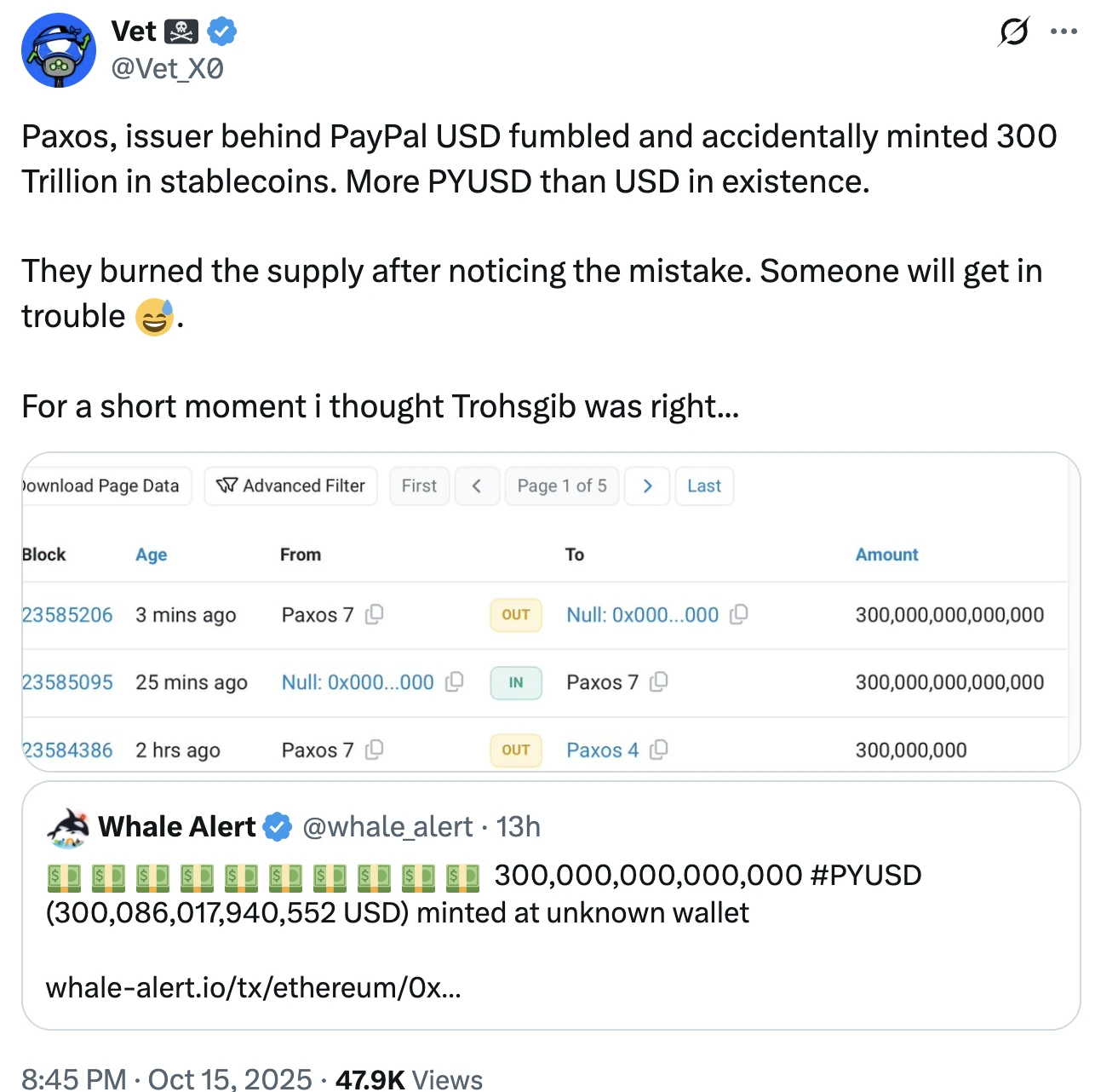
In Paxos’ case, a glitch during an internal transfer created 300 trillion PYUSD (worth $300T), more than 100 times the global money supply. The community viewed it as a massive mistake that was quickly corrected.
Post on social media | Source: X
This article explains the huge Paxos minting mistake that created $300 trillion in PYUSD and compares it with other historic errors, revealing how CEXs continue to face structural and operational challenges that threaten stability across digital finance.
The $300 Trillion Question: Unpacking the Paxos PYUSD Minting Glitch
Paxos confirmed that the $300 trillion PYUSD mint resulted from an internal transfer error, not a security breach. The company said all user funds remained safe.
At 3:12 PM EST, Paxos mistakenly minted excess PYUSD as part of an internal transfer. Paxos immediately identified the error and burned the excess PYUSD.
This was an internal technical error. There is no security breach. Customer funds are safe. We have addressed the root…
Origin of the error: Likely a data entry mistake, decimal misalignment, or failed automated limit check during a routine operation.
Nature of the failure: A gap between token creation and collateral verification allowed unbacked tokens to appear on-chain.
Impact on the model: The incident revealed how stablecoin minting and reserve auditing operate separately, exposing a single point of failure.
Systemic risk: The event proved that even fully regulated issuers can unintentionally disrupt digital finance through basic internal errors.
However, the accidental issuance of PYUSD on the Ethereum blockchain drew worldwide attention, setting a new record for the largest unintentional mint in crypto history.
How an “Internal Error” Created $300 Trillion in PYUSD — Exceeding Global GDP
The scale of the mistake underscored how digital money creation, once the domain of central banks, can now occur instantly through code and private keys.
The $300 trillion worth of PYUSD figures was extraordinary, roughly 2.5 times greater than the world’s total Gross Domestic Product (GDP), which stood at around $117 trillion in 2024 according to the World Bank, and more than 100 times larger than the total U.S. dollar supply, estimated at $2.4 trillion in circulation by the Federal Reserve.
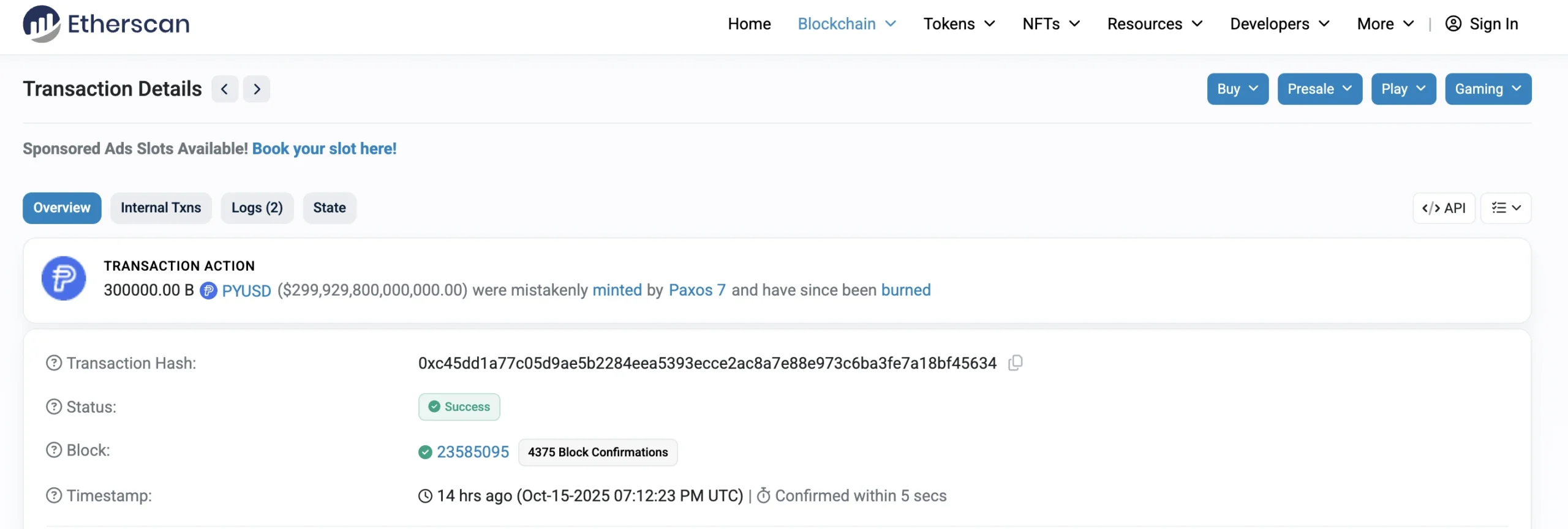
In terms of gas fees, the Etherscan record showed that the minting process cost only $2.66.
Major Crypto Minting Mistakes: From Paxos’s PYUSD to Binance, Bitcoin, and Tether
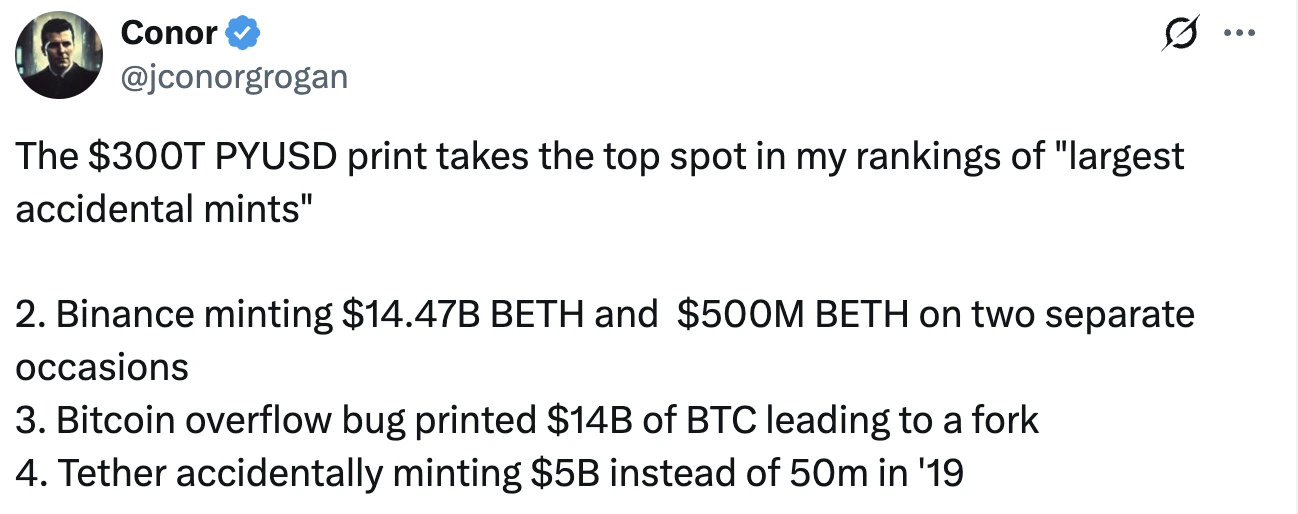
Coinbase executive, Conor Grogan, posted on X about the accidental mint by Paxos, ranking it the largest unintended token creation. He also listed other notable minting errors for context.
Connor Grogan announcement | Source: X
Binance’s BETH Blunders: Multiple Multi-Billion Dollar Exchange Chain Errors
When: September, 2023
Network: Ethereum blockchain, where BETH represents staked ETH.
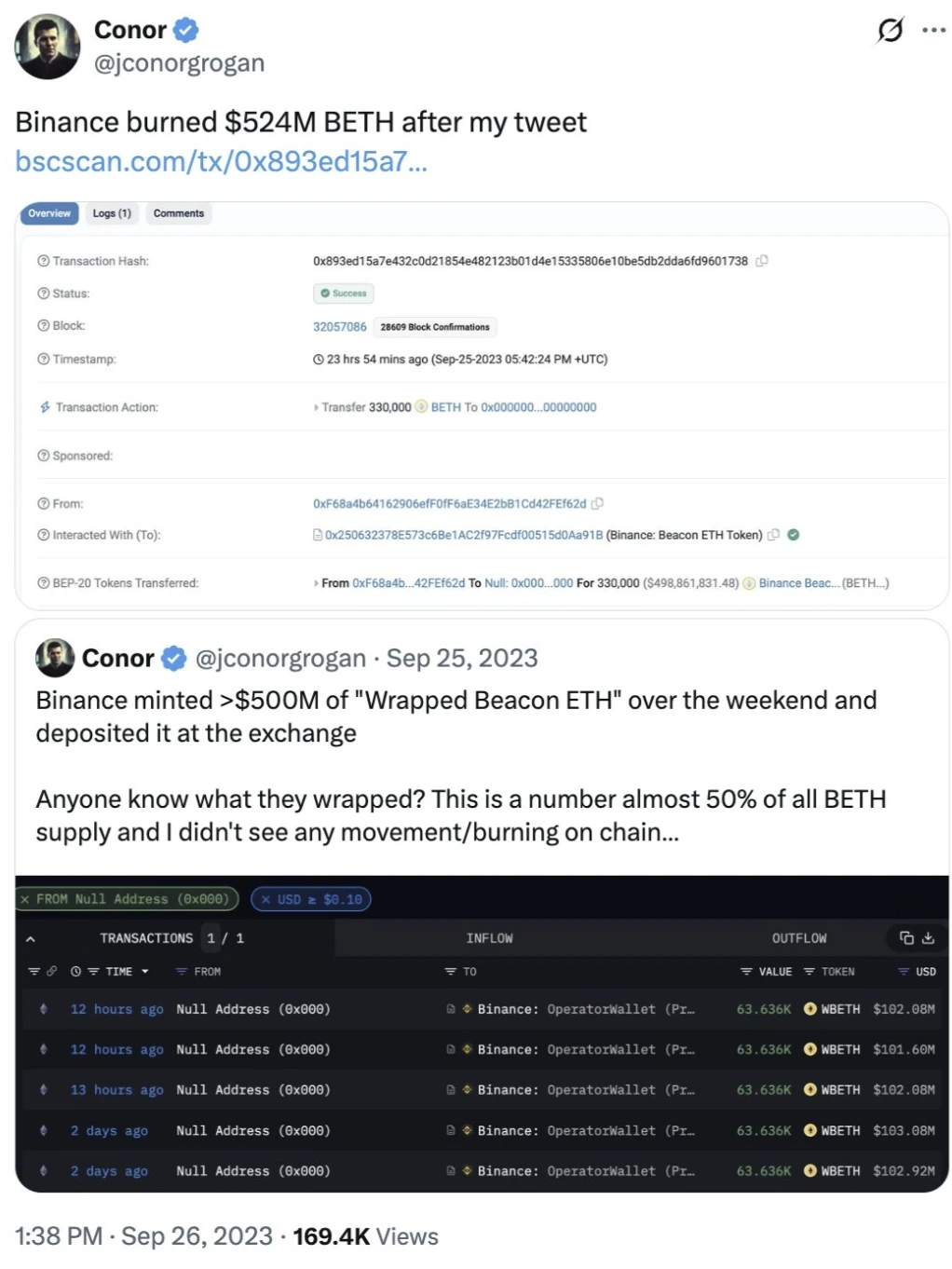
What Happened: Binance, one of the world’s largest crypto exchanges, mistakenly minted $14.47 billion and $500 million in BETH (Beacon ETH, a token tied to Ethereum staking) in two separate incidents. These errors likely resulted from misconfigured smart contracts or operational oversights during staking processes. Binance resolved both issues by burning the excess tokens before they could impact the market.
Impact: The events revealed how even top exchanges can face operational vulnerabilities in staking management, but quick corrective action helped prevent financial fallout.
Mistake on Binance | Source: X
The Bitcoin Overflow Bug: Remembering the $14 Billion BTC Security Vulnerability
What happened: In 2010, a coding flaw in Bitcoin’s protocol allowed a single transaction to mint more than 184 billion BTC, worth around $14 billion at the time, violating Bitcoin’s 21 million cap. Developers and miners swiftly intervened by forking the blockchain, reversing the invalid transaction, and patching the vulnerability.
Impact: This incident became a defining moment for Bitcoin, proving the power of open-source collaboration and community oversight in securing decentralized systems.
Tether’s $5 Billion Typo: The USDT Minting Mistake of 2019
Network: Ethereum blockchain, where USDT primarily operated.
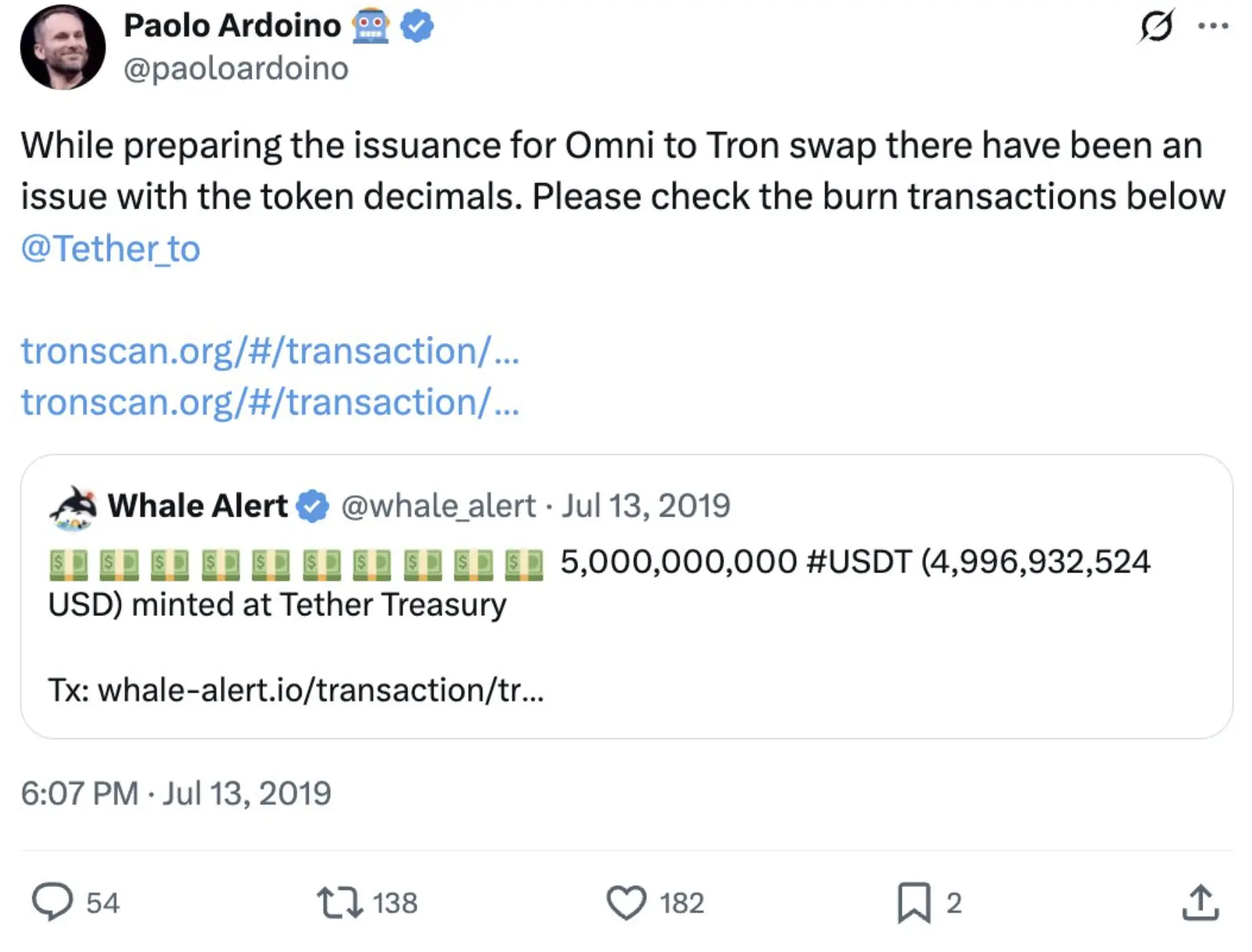
When and what happened: On July 13, 2019, Paolo Ardoino announced that Tether intended to mint $50 million in USDT but accidentally created $5 billion instead due to a configuration error. The surplus tokens were burned almost immediately, avoiding market turbulence.
Impact: The minting error underscored the importance of stringent internal controls in stablecoin management, showing how fast intervention can protect user trust and market stability.
Tether’s mistake | Source: X
These examples show that large-scale minting mistakes are not rare in crypto, underscoring the magnitude of the PYUSD incident.
Blockchain transparency often exposes these glitches, and rapid responses such as token burns usually prevent lasting damage.
Lessons from the Paxos PYUSD Glitch: Rethinking Stability, Governance, and Trust in Digital Finance
The Paxos PYUSD glitch sparked more than market alarm; it forced the crypto industry to reexamine its foundations, applying to both centralized and decentralized finance (DeFi).
The incident showed how quickly a technical or human mistake, even within a regulated environment, can challenge the stability of an entire financial network. While automation streamlines transactions, it also magnifies errors when controls fail.
Stablecoin systems, much like traditional finance, rely on accuracy and verification. Yet, many issuers still operate with minimal fail-safes.
Simple “fat-finger” mistakes or misconfigured smart contracts can mint billions in seconds, turning coding precision into a global risk factor. The concept that “code is law” proved incomplete when human oversight failed to match technological speed. Therefore it is important to bear in mind that code might alse be flawed.
As Shahar Madar, VP of Security and Trust Products at Fireblocks, points out: “Minting $300 trillion is a preventable mistake. Stablecoin adoption is rising, and every issuer should make sure their security policies are properly set to govern the entire token lifecycle. Mint, transfer, and burn are highly sensitive operations, and there is no reason to settle for ‘soft’ enforcement of processes and manual checks.”
Madar emphasized that the PYUSD glitch reflects a deeper issue of operational security rather than a lack of regulation. He explained that, unlike traditional banking systems, crypto infrastructure already offers tools capable of preventing such incidents before they reach the blockchain.
“Comparisons to the banking system are irrelevant. We have the opportunity to build something more secure and trustworthy here. In both cases — traditional finance and PYUSD — what enabled remediation and rollback was centralized control over assets. Crypto systems such as wallets and token management platforms have built-in policy engines that could have blocked this transaction before signing and broadcasting. This is a case of operational security — we shouldn’t need to rely on rollbacks since there’s technology to prevent these errors versus fixing them after the fact. With the increased flood of new stablecoins entering the market, this incident is a stark realization that beyond proof of reserves, stablecoin issuers need to double down on their approval workflows across every part of the token lifecycle.”
To prevent similar events, issuers must adopt stricter tiered minting controls and real-time auditing tools that detect irregular supply changes before they reach the blockchain.
Clear accountability between technical and compliance teams is essential. Regulators, meanwhile, are expected to increase scrutiny, pushing for standardized reporting and transparent collateral verification across stablecoin projects.
Despite the shock, the Paxos case may ultimately serve as a catalyst for reform. It underscored that the stability of digital money depends not only on innovation but also on governance, responsibility, and public trust.
As stablecoins continue to link crypto with real-world finance, restoring confidence will define the next phase of their evolution.
Conclusion
The Paxos PYUSD glitch became one of the most shocking moments in stablecoin history. What was meant to be a routine internal transfer turned into a $300 trillion mint that briefly reshaped how the world viewed digital finance. Even though the tokens were burned within minutes, the scale of the error exposed how concentrated power in centralized systems can turn into systemic risk.
The incident also reminded regulators and users that compliance alone does not guarantee stability. While Paxos met all KYC and AML requirements, a simple technical slip proved that operational resilience remains a weak link. The blockchain’s transparency allowed the error to be caught quickly, but it also revealed how easily such events can occur.
As the crypto industry expands, the Paxos event will stand as a turning point for accountability and design reform. It showed that trust in digital money depends not only on technology but on the discipline and integrity of the institutions behind it.
FAQs
Why is the $300 trillion PYUSD mint significant?
This mint error is the largest accidental token creation in crypto history, revealing operational fragility in centralized systems.
How much did the erroneous transaction cost to execute?
The minting process cost just $2.66 in Ethereum gas fees, showing how powerful and risky blockchain automation can be.
Did the PYUSD glitch affect PayPal’s users?
No, the tokens never entered circulation, and PayPal confirmed that its stablecoin reserves were unaffected.
What lessons did the Paxos error reveal about stablecoins?
It showed that technical efficiency must be balanced with human oversight and stronger minting controls.
Disclaimer:
The information provided in this article is for informational purposes only. It is not intended to be, nor should it be construed as, financial advice. We do not make any warranties regarding the completeness, reliability, or accuracy of this information. All investments involve risk, and past performance does not guarantee future results. We recommend consulting a financial advisor before making any investment decisions.
Dr. Lorena Nessi is an award-winning journalist and media technology expert with 15 years of experience in digital culture and communication. Based in Oxfordshire, UK, she combines academic insight with hands-on media practice.
She holds a PhD in Communication, Sociology, and Digital Cultures, and an MA in Globalization, Identity, and Technology.
Lorena has taught at Fairleigh Dickinson University, Nottingham Trent University, and the University of Oxford. She is a former producer for the BBC in London, with additional experience creating television content in Mexico and Japan.
Her research focuses on digital cultures, social media, technology, capitalism, and the societal impact of blockchain innovation.
She has written extensively on digital media and emerging technologies, with her work featured in both academic and media platforms. Her Web3 expertise explores how blockchain technologies shape culture, economics, and decentralized systems.
Outside of work, Lorena enjoys reading science fiction, playing strategic board games, traveling, and chasing adventures that get her heart racing. A perfect day ends with a relaxing spa and a good family meal.


 Easy
Easy