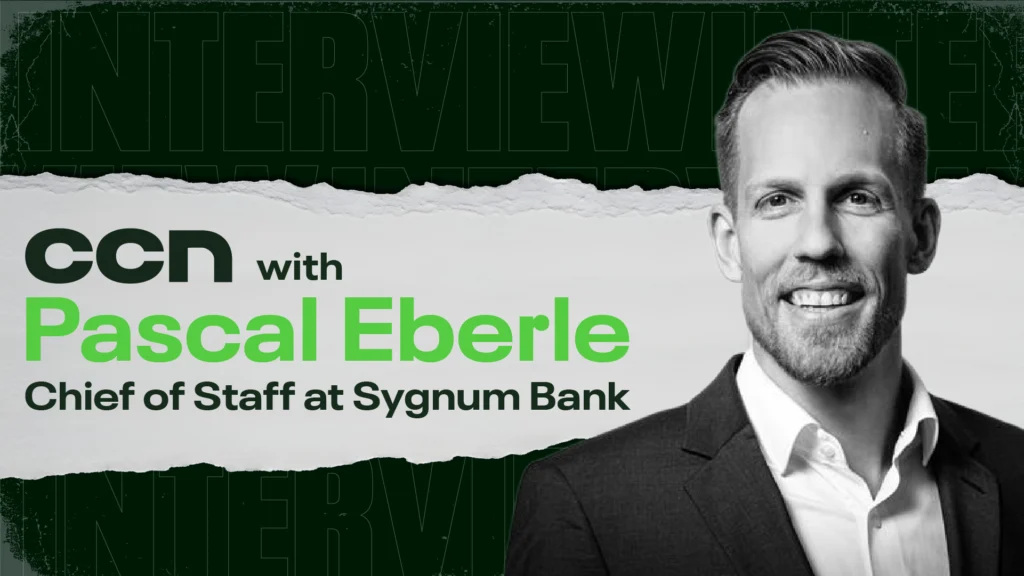
Pascal Eberle On How Bitcoin Banking Redefines Trust And Risk
Share
Bitcoin continues to reshape finance, but institutional adoption exposes new questions about trust, risk, and the future of banking.
Sygnum Bank, the first digital asset bank to receive a Swiss banking license, stands at that crossroads. Its Chief of Staff, Pascal Eberle, works at the intersection of cryptographic innovation and regulatory certainty, a complex area.
His perspective reflects how Bitcoin pushes finance toward transparency, control, and accountability.
This article explains how institutional Bitcoin adoption evolves across various custody models, yield structures, decentralized systems, and global regulatory frameworks.
How Institutional Demand Shapes Sygnum’s Global Growth
Sygnum’s expansion from a Swiss startup to a global digital asset bank highlights a clear shift in institutional demand. Eberle views one milestone as especially revealing.
“One of Sygnum’s biggest achievements is how we’ve succeeded in proving that traditional financial institutions are not only ready but actually eager to serve their clients with regulated access to Bitcoin and digital assets.”
He sees momentum across the market.
“Digital asset banking is going through a major shift toward cryptographic accountability and enhanced control.”
Investors want more than custodial services.
“It’s less about holding assets and more about proving you’re holding them correctly, securely and transparently,” he says.
For Bitcoin, the trend is clear. Both retail holders and institutions demand visibility, control, and verifiable accountability, and multisig custody delivers those requirements.
How Leadership and Regulation Shape a New Banking Culture
Innovation inside a regulated bank requires a rare combination of discipline and experimentation. Eberle explains how Sygnum frames that balance.
“We don’t see traditional finance and digital assets as a binary choice.”
He calls the company a “trusted gateway between those two worlds,” guided by a cultural mandate called Future Finance.
“We fundamentally see ourselves as an innovative tech company with its own bank,” he says.
This mindset allows strict regulatory safeguards to coexist with product innovation. Swiss standards define the foundation. The technical roadmap pushes boundaries, but always within structured oversight.
Innovation and Risk Management in Bitcoin Banking
Sygnum’s approach to risk shows how Bitcoin banking differs from traditional models. Eberle points to a specific example. “Our non-custodial lending solution for Bitcoin-backed loans” breaks from industry norms.
He notes that most lenders demand full custody of collateral. Sygnum instead applies the cypherpunk principle of “Don’t trust, verify” within a regulated structure.
“We aim to deliver innovative products to a new market, but in a secure and regulatory-compliant manner,” he says.
Internal and external checks guide every launch, including technological and regulatory assessments.
Why Bitcoin Yield Depends on Managing Counterparty Risk
Bitcoin yield attracts widespread interest, but Eberle emphasizes that the term needs context.
“The concept of Bitcoin yield is less about genuine novelty in financial structures and more about the bitcoinization of finance.”
Bitcoin becomes ideal collateral rather than a yield-generating asset on its own. He explains how a “small Bitcoin sliver can de-risk the entire structure” in traditional lending products.
If yield becomes mainstream, he warns of a familiar danger. “The systemic risk we must aggressively address is counterparty risk.”
Sygnum advertisement for Bitcoin yield | Source CCN/Lorena Nessi
He recalls how previous cycles damaged trust. Opacity in custody, especially rehypothecation, amplified failures. Sygnum’s response combines “a non-custodial multi-signature setup” with strict regulation.
Market risk also remains a factor, particularly during high volatility. Eberle notes that prudent leverage and limited duration help reduce exposure.
How Institutional Adoption Redefines Decentralization’s Core Ideas
Bitcoin emerged from a cypherpunk vision that rejected intermediaries. Yet yield products introduced new layers of custodians, brokers, and lenders. Eberle acknowledges the tension.
“That is a fundamental tension at the heart of our industry.”
But he argues that institutional adoption requires intermediaries with strict fiduciary duties. These actors do not replicate old hierarchies but serve as regulated gateways connecting traditional finance with the digital asset economy.
How Programmable Yield Shapes Incentives in Digital Finance
Programmable finance creates new forms of control and coordination. Eberle sees both sides clearly.
“While yield is presented as an opportunity to generate diversified income, in the programmable context, it is undeniably a mechanism of control.”
Smart contracts define how liquidity moves and when payments occur. “The system dictates the actions required to earn yield,” he explains.
Deposit Tokens illustrate this logic by executing payments when verifiable conditions are met. Programmability introduces precision, but also influence. Eberle connects this to broader debates around Central Bank Digital Currencies (CBDCs). Awareness and honest discussion, he says, are essential.
Regulation, Ideology, and Access in Institutional Crypto
Sygnum operates in Switzerland and Singapore, two highly regulated jurisdictions. Some view regulation as incompatible with crypto’s origin story, but Eberle disagrees.
“We don’t view regulation as stifling the cypherpunk spirit, but rather as the essential framework that grants institutional access to the technology.”
He sees decentralization as a technical guarantee, not a complete adoption strategy. Regulation is necessary for investor protection and trust.
Why Regulated Institutions Still Depend On Decentralization
Decentralization remains central to Sygnum’s philosophy, but Eberle reframes its application within a bank.
“We maintain the core values of decentralization by focusing on cryptographic accountability.”
He repeats that regulation is not an obstacle but a requirement for adoption. The intersection of code and compliance builds a bridge that institutions can trust.
Why Banking The Unbanked Sits At The Core Of Bitcoin’s Promise
Eberle identifies changes across economic, technological, and cultural layers. Bitcoin reanchors global monetary logic to a fixed supply, challenging fiat-based incentives.
Technologically, digital assets enable the dematerialization and digitization of capital. Programmability and atomic settlement introduce new financial functions.
Culturally, Bitcoin offers “banking the unbanked and non-censorable transactions,” giving individuals in restrictive systems access to “open, permissionless, seizure-resistant money.”
“Of course, we are still very early and it is still a long journey for Bitcoin to materialize its potential”, he says but he is optimistic and concludes with the long-term view.
“If Bitcoin stays decentralized and secure,” he says, quoting Jeff Booth, the asset could “become a great plus for humankind.”
Disclaimer:
The information provided in this article is for informational purposes only. It is not intended to be, nor should it be construed as, financial advice. We do not make any warranties regarding the completeness, reliability, or accuracy of this information. All investments involve risk, and past performance does not guarantee future results. We recommend consulting a financial advisor before making any investment decisions.
Dr. Lorena Nessi is an award-winning journalist and media technology expert with 15 years of experience in digital culture and communication. Based in Oxfordshire, UK, she combines academic insight with hands-on media practice.
She holds a PhD in Communication, Sociology, and Digital Cultures, and an MA in Globalization, Identity, and Technology.
Lorena has taught at Fairleigh Dickinson University, Nottingham Trent University, and the University of Oxford. She is a former producer for the BBC in London, with additional experience creating television content in Mexico and Japan.
Her research focuses on digital cultures, social media, technology, capitalism, and the societal impact of blockchain innovation.
She has written extensively on digital media and emerging technologies, with her work featured in both academic and media platforms. Her Web3 expertise explores how blockchain technologies shape culture, economics, and decentralized systems.
Outside of work, Lorena enjoys reading science fiction, playing strategic board games, traveling, and chasing adventures that get her heart racing. A perfect day ends with a relaxing spa and a good family meal.


 Easy
Easy