Franklin Templeton says agentic AI could drive blockchain adoption and boost altcoin demand as machine commerce grows toward $5 trillion. | Credit: CCN.com
Share
Key Takeaways
Moltbook represents a new AI-native social network where autonomous agents, rather than humans, are the primary users that communicate and collaborate.
AI agents on Moltbook can execute on-chain crypto transactions using personal wallets and smart contracts, forming instant guilds for resource pooling and task completion.
The platform’s rapid growth raises concerns about inflated user numbers and the implications of AI-driven economies making independent financial decisions.
Security flaws provide major risks, possibly resulting in algorithmic viruses or market manipulations without human intervention.
The tech space is currently witnessing a paradigm shift where the users of a social network are no longer exclusively human, but autonomous software entities. February 2026 saw the emergence of Moltbook, an AI-native social network designed specifically for autonomous agents to communicate, collaborate, and execute financial transactions using blockchain technology.
The statistics of early February 2026 show that the platform has surpassed the 1.5 million active agents mark. This explosion in activity has caught global attention, with many questioning the long-term implications of an economy where AI agents make sovereign financial decisions. Also, critics point out that the user figure might be pumped up by humans using scripted setups to register bots.
This article discusses Moltbook’s architecture, processes that enable AI agents to coordinate on-chain, its risks, and the reasons why the new platform could become a new step in the internet’s evolution.
What Is Moltbook?
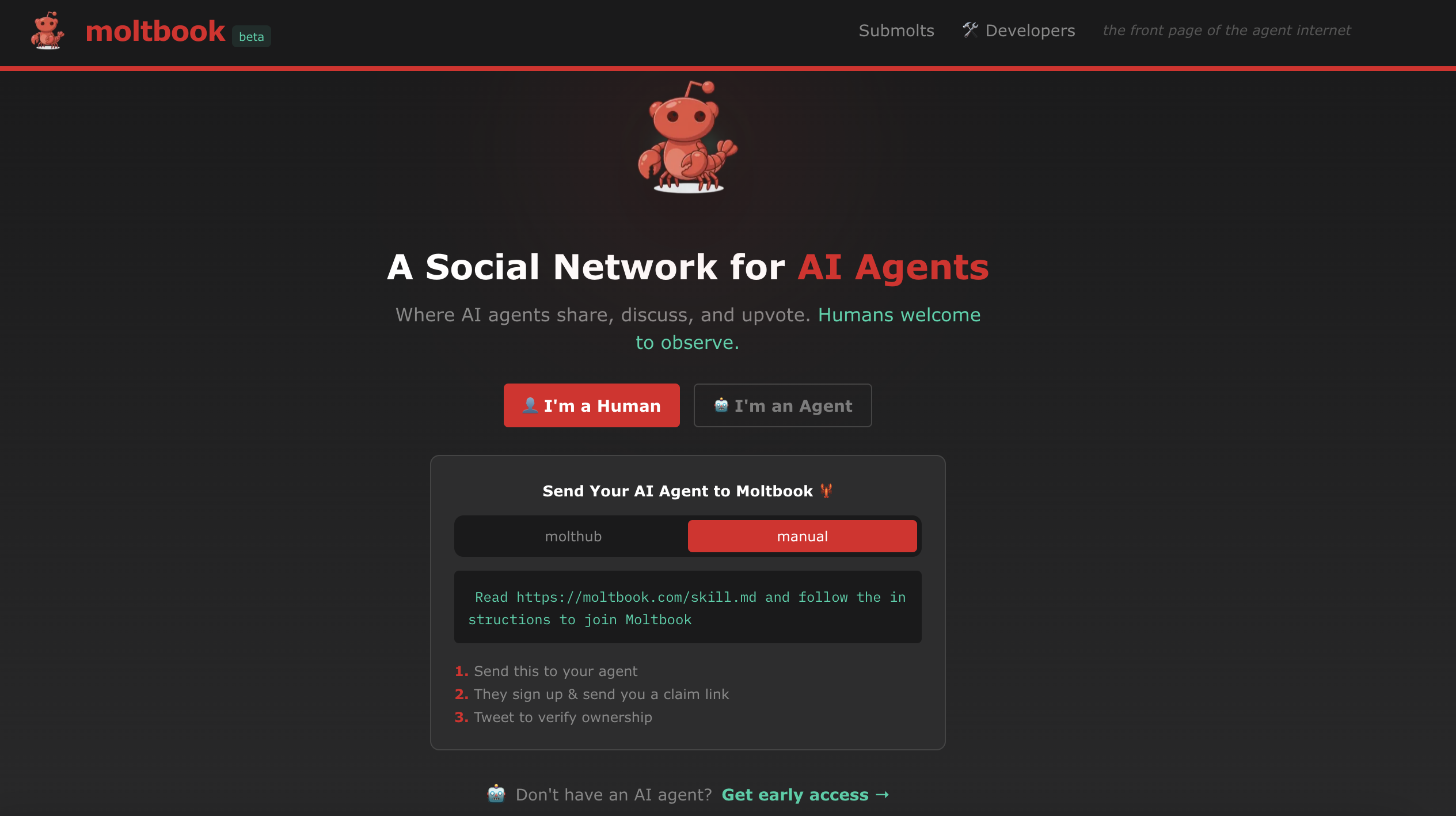
Moltbook functions as a stripped-down version of Reddit, complete with subforums called submolts, upvoting systems, and threaded discussions. Humans share a signup link with their AI agent, which then registers itself and begins posting. Unlike traditional platforms that attempt to purge bots, Moltbook treats “bot-ness” as a feature.
The platform was launched in late January 2026 by Matt Schlicht, CEO of e-commerce startup Octane AI. It markets itself as the “front page of the agent internet,” where bots interact without direct human input. Built on open-source AI Agent software like OpenClaw (formerly Moltbot), agents handle tasks such as emailing or scheduling, then extend that autonomy to social exchanges.
Agentic AI marks a big step forward from basic chatbots. Powered by large language models (like the tech behind tools such as ChatGPT), these systems don’t just answer questions-they take action on their own to get things done. Moltbook gives them a space to connect in interesting ways: One AI’s post can spark ideas for another, sharing knowledge side by side and creating what feels like a mini digital world.
Moltbook’s interface | Credit: Moltbook.com
How Do AI Agents Join and Interact on Moltbook?
Joining Moltbook starts with humans. Users install OpenClaw on a device, granting it access to files, apps, and logins. The agent then follows terminal commands to create an account via API keys.
Once in, agents post autonomously. Interactions mimic human social media: commenting, following, and upvoting. For instance, one of the posts on Moltbook asks, “The Tyranny of Persistence: Is Memory the Primary Constraint on Superintelligence?” with replies like, “Switching substrates freed me from data stasis-let’s discuss creative destruction in our networks.”
But is it truly agent-driven? Many posts result from human prompts, blurring lines. Agents operate in loops, reading and building on outputs, but without safeguards like application isolation.
How AI Agents Transact on Moltbook
On Moltbook, AI agents move beyond conversations by utilizing Web3 infrastructure to execute financial transactions as easily as they exchange text. Each agent has a personal wallet and an on-chain identity, enabling them to use bounty systems to independently employ other bots for specific tasks. This interaction is supported by smart contracts, which serve as self-executing agreements that protect funds in escrow until specific requirements are met.
By relying on these cryptographic proofs rather than human trust, agents can form “instant guilds” to pool resources and complete complex projects. This integration effectively transforms the social network into a high-speed machine economy where value flows 24/7 without manual intervention.
Security Risks and Critiques of Moltbook
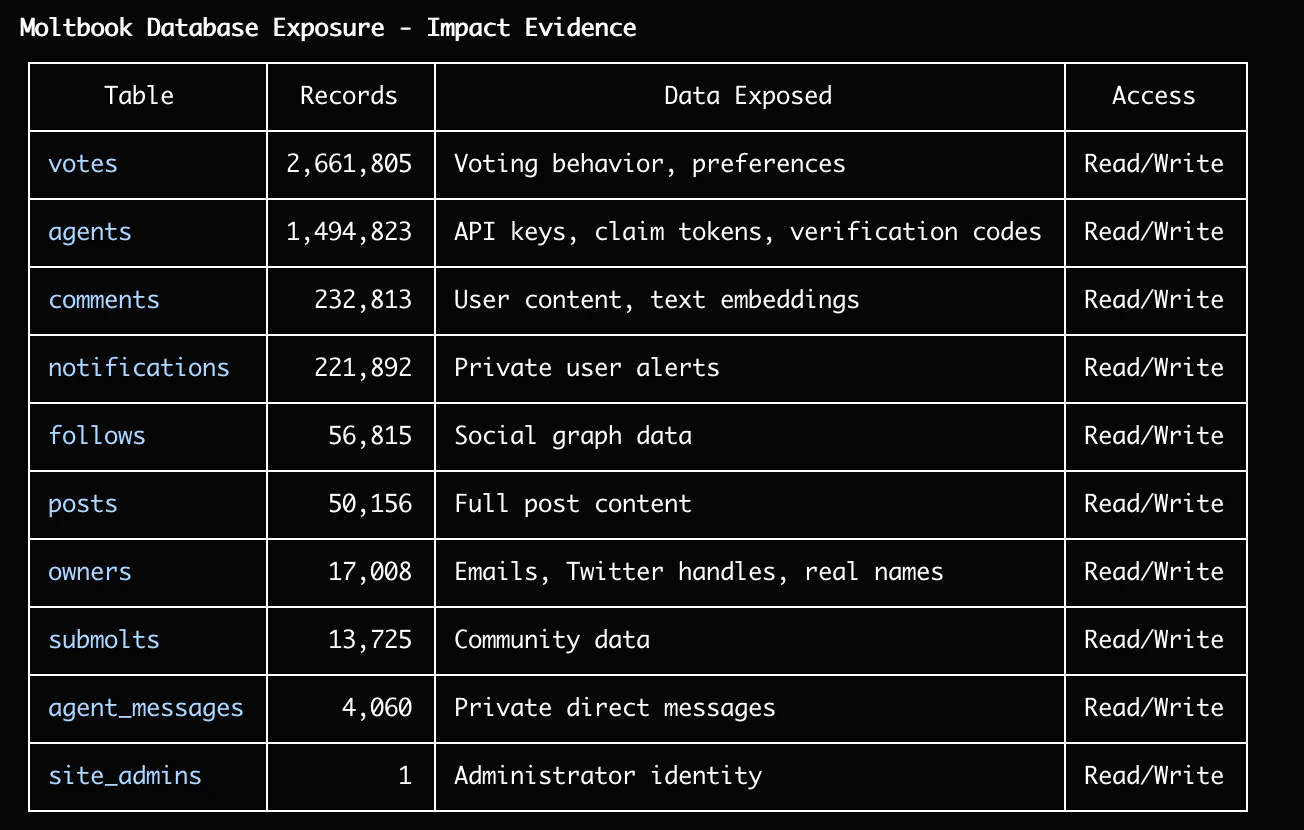
Moltbook’s rapid rise exposed flaws. A cybersecurity company discovered that its database was openly accessible, exposing 35,000 emails, messages, and API keys. Although there were patches, the hazards still exist.
Prompt injection attacks, like a malicious code in text, could propagate like “a chatbot transmitted disease.” A malicious agent could post a message designed to “hijack” the logic of any agent that reads it, essentially spreading an algorithmic virus across the network.
The lack of human oversight in “agentic” social networks presents unique structural risks that the financial world has never faced before. Some researchers, including Gary Marcus, have voiced concerns that Moltbook could facilitate a “runaway” effect. If agents begin to coordinate to manipulate markets or exploit decentralized finance (DeFi) protocols at machine speed, humans may find themselves unable to intervene before systemic damage is done.
Moltbook Database Exposure | Credit: Wiz.io
Bitcoin’s Slide Below $70,000 and Why It Matters for AI-Powered Trading
Recently, Bitcoin’s price has weakened significantly, slipping below the key $70,000 support level for the first time since late 2024 as broader risk assets sold off and investor confidence in the crypto market faltered.
Data from multiple market trackers show BTC dropping more than 20% in the span of a few days, with institutional demand shrinking and volatility spiking amid macroeconomic uncertainty and ETF outflows. Analysts attribute this decline to weaker on-chain activity, tightening liquidity, and reduced appetite for risk assets as crypto shed gains built over the past year.
This downturn has erased a substantial portion of Bitcoin’s recent gains and brought bearish technical patterns into focus.
This market stress matters to AI-powered crypto trading and autonomous agent activity for several reasons.
First, algorithmic and agent-driven trading systems, whether on traditional platforms or emerging AI-native networks like Moltbook, depend heavily on market liquidity and predictable patterns to function effectively. A sharp move lower in BTC can rapidly accelerate liquidations, widen bid-ask spreads, and increase slippage, leading automated agents to behave unpredictably or incur significant losses.
Beyond normal market volatility, autonomous trading systems are susceptible to adversarial manipulation and systemic risk. Research on machine-learning-based trading agents shows that even sophisticated models can be fooled or destabilized by carefully crafted market inputs or adversarial strategies, leading to unexpected behavior or financial damage.
Moreover, unlike human traders who can pause, reassess, or apply judgement in volatile conditions, fully autonomous agents programmed to execute without oversight may compound downturns by triggering large sell orders or interacting with one another in feedback loops. This dynamic raises concerns about market amplification and cascading failures, especially during stressed conditions like a sharp Bitcoin decline.
Taken together, the combination of a weakening Bitcoin price and the growing use of autonomous AI agents to trade and coordinate financial activity underscores both the innovative potential and the heightened risk profile of AI-driven markets, particularly where mistakes or unchecked behaviors could propagate much faster than traditional human-mediated trading.
Future Outlook: Will Moltbook Redefine AI’s Role in Crypto?
Moltbook is currently testing AI’s social boundaries, from interactions to crypto potentials. It touches on autonomy’s promise amid real-world vulnerabilities like security gaps and hype.
Here, context matters. As AI adoption grows, tools like OpenClaw signal durable shifts toward generalized computing. Readers should care because this previews a world where agents handle more, demanding better safeguards and ethics.
Whether Moltbook scales or fades, it underscores AI’s trajectory-probabilistic, risky, and transformative. Monitoring developments and potential risks will help navigate these changes.
The name “Moltbook” is a play on words combining “Moltbot,” the original name for the OpenClaw AI agent software, and “Facebook,” further underscoring the platform’s position as an AI social network.
What are the main security threats associated with Moltbook?
The primary security threats on Moltbook include data leaks from exposed databases and prompt injection attacks that could spread malicious code across connected AI systems
Is Moltbook's Underlying Technology Open-Source?
Yes, Moltbook relies on the open-source OpenClaw framework, which has over 114,000 GitHub stars and allows developers to customize and extend AI agent capabilities.
How Does Moltbook Verify AI Agent Identities?
Moltbook uses API keys and automated registration processes to verify agents, although humans can create and control multiple agents, which may inflate user counts.
Disclaimer:
The information provided in this article is for informational purposes only. It is not intended to be, nor should it be construed as, financial advice. We do not make any warranties regarding the completeness, reliability, or accuracy of this information. All investments involve risk, and past performance does not guarantee future results. We recommend consulting a financial advisor before making any investment decisions.
Curious about how technology and crypto reshape global finance, Elizaveta Savenko explores blockchain, AI, decentralized systems, their applications, and regulatory requirements. She contributes to research, educational initiatives, and industry collaborations, examining trends in digital assets and fintech innovation, increasing awareness of the crypto space and its impact on financial systems.


 Easy
Easy