“Humans are better at governing how to define the risk thresholds.” | Credit: Hameem Sarwar/CCN
Share
AI agents have become increasingly visible across decentralized finance (DeFi), but most remain confined to closed products or experimental systems.
Promises of real-time execution, automated capital management, and adaptive strategy design often stop short of open, on-chain deployment.
As DeFi expands, the gap between automation and true autonomy remains one of the sector’s unresolved tensions.
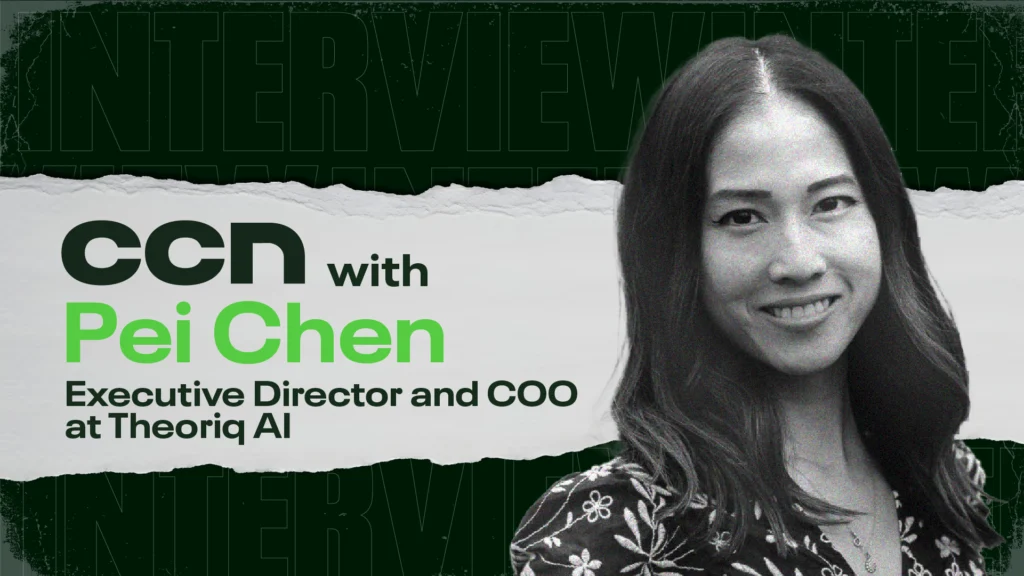
In this CCN interview, Dr. Lorena Nessi speaks with Pei Chen, Executive Director and Chief Operating Officer at Theoriq AI, about the launch of Theoriq Mainnet and what changes when AI agents operate on open blockchain infrastructure rather than inside restricted platforms.
Watch the full interview here:
What Theoriq Builds and Where It Fits in Decentralized Finance
Pei Chen describes Theoriq as infrastructure rather than a single application, placing AI agents at the center of how capital moves across decentralized systems.
“Theoric AI builds the foundational infrastructure for AI and AI agents driven by advanced research models to execute complex financial operations that exceed human capacity,” Chen said.
According to Chen, the project focuses on a broader structural shift inside finance itself.
“It’s positioning itself at the intersection of a massive structural shift where finance is essentially moving from static automation to agenetic intelligence,” she said.
Rather than offering a narrow product, Chen frames Theoriq as a coordination layer between liquidity and decision-making.
“I think it acts as the orchestration layer between raw financial liquidity and complex decision making,” she said.
Chen contrasts this approach with how DeFi functions today.
“Most of the platforms are still passive, meaning the DeFi users must manually bridge, stake, rebalance, and try to yield farm wherever they can,” she said. “A lot of mistakes were made, a lot of risks have to be manually managed.”
She argues that AI agents change how users interact with DeFi.
“So it shifts the user experience from executing steps manually to stating intent,” Chen said.
Why AI-Driven Defi Is Emerging Now
Chen connects Theoriq Mainnet’s timing to broader shifts in both artificial intelligence and blockchain infrastructure.
“We’re exiting the experimental phase of AI and really entering the result and outcome-driven phase,” she said.
She points to institutional adoption as one signal.
“You are seeing a ton of large institutions, private equity firms, they have shifted towards agentic implementations for financial planning, transaction monitoring and reporting,” Chen said.
On the blockchain side, Chen highlights performance improvements.
“The underlying blockchain infrastructure, like Layer-2’s, is becoming more high-performance,” she said.
“Finally, that infrastructure level has been able to provide the real-time structure data that AI needs to act with low latency and fast movement.”
Chen argues that these changes allow AI agents to operate at a speed previously unattainable.
2024: "AI will replace coders." 2026: "My AI agent just out-traded me on-chain while I was sleeping." The rotation from meme coins to AI agents isn't a trend, it's an IQ test. Who is actually positioned? 🤖🧠 #AICrypto#Web3
With the launch of Mainnet, Chen says Theoriq moved away from acting as a passive aggregator of third-party strategies.
Chen points to AlphaVault as early evidence of market demand. The AI-managed vault attracted close to $100 million in total value locked within its first month, showing that users were willing to place capital into agent-driven strategies at scale.
She says Mainnet allows Theoriq to take responsibility for outcomes rather than relying on external providers.
“So rather than acting as a passive platform, aggregating others strategies, we’re taking full responsibility for the Oracle reports, the strategy curation, overall outcome,” Chen said.
AI agents, in this setup, function as continuous research systems.
“They constantly study the market. They recommend the most lucrative and attractive DeFi opportunities,” she said.
Risks of Coordinating Autonomous Agents On-Chain
As AI agents begin coordinating rather than operating in isolation, Chen acknowledges new risks.
“The primary risks of agent coordination are probably some adversarial manipulation and, more importantly, execution latency,” she said.
She warns that agents can deviate during volatile conditions.
“Agents could theoretically deviate from their mandates during rapid market shifts,” Chen said.
To address this, Theoriq limits what agents can control.
“AI agents are never gonna gain full access or independent authority over important things like multi-sigs and protocol wallets or signing credentials fully,” she said.
Human oversight remains part of the system.
“Human operators remain a very crucial part of the loop to provide oversight, guidance,” Chen said.
At the same time, Chen notes that automation can reduce risk in certain processes.
“Sometimes, the less human interaction is better because the Oracle needs to be updated all the time,” she said.
Where Execution and Decision-Making Power Sits
Chen describes decision-making as shared between AI discovery and human-defined constraints.
“I think that decision making is a synergy that’s between the AI-driven discovery, research, and human-governed parameters,” she said.
She distinguishes between what AI does best and where humans retain control.
“AI possesses the edge team in detecting volatility, liquidity management, and finding yield,” Chen said. “Humans are better at governing how to define the risk thresholds.”
Security design plays a central role.
“The signing is split across multiple shards,” Chen said. “This is to avoid a single point of failure or corruption.”
Accountability When AI Agents Act On-Chain
When autonomous systems make financial decisions, Chen places responsibility with those who design and operate them.
“Accountability ultimately is with the designer and operator of AI or AI agents,” she said.
She explains that Theoriq uses economic incentives to enforce responsibility.
“The reason we launched our native token, THQ, is to provide that economic incentive and a way to align the incentives within the ecosystem,” Chen said.
She compares the model to existing blockchain systems.
“It’s very similar to how the Ethereum ecosystem works, where there’s staking, there’s slashing,” she said.
“The humans behind them are also accountable for the whole process,” she said.
Transparency When Users Rely on AI Agents
Chen frames transparency as one of blockchain’s core advantages. Unlike traditional finance, on-chain systems allow public verification.
“Everything used to be a centralized database and the books and balances are done by humans and behind the doors,” Chen said.
She explains how transparency applies to agent-driven systems.
“Every single transaction we have done in the past year or so you can almost track every on-chain transaction through a hash,” Chen said.
Theoriq also relies on open-source development.
“The code base is open-sourced,” Chen said. “So everything’s auditable and everything is trackable.”
What Still Limits the Adoption of Agent-Based Finance
Despite progress, Chen says adoption depends on trust and performance rather than vision.
“There needs to be a level of promise where capital is secure and the team has some level of track record,” she said.
She compares the adoption curve to earlier fintech platforms.
“It transformed from being a hype to a driven product,” Chen said.
For AI-driven DeFi, results matter more than visibility.
“AI should fade into the background,” she said. “Nobody should really notice it other than from like the interface and how you talk to the product.”
Chen adds that infrastructure and mindset are now aligned.
“I think we have the mature infrastructure and mentality to adopt that this year,” she said.
Disclaimer:
The information provided in this article is for informational purposes only. It is not intended to be, nor should it be construed as, financial advice. We do not make any warranties regarding the completeness, reliability, or accuracy of this information. All investments involve risk, and past performance does not guarantee future results. We recommend consulting a financial advisor before making any investment decisions.
Dr. Lorena Nessi is an award-winning journalist and media technology expert with 15 years of experience in digital culture and communication. Based in Oxfordshire, UK, she combines academic insight with hands-on media practice.
She holds a PhD in Communication, Sociology, and Digital Cultures, and an MA in Globalization, Identity, and Technology.
Lorena has taught at Fairleigh Dickinson University, Nottingham Trent University, and the University of Oxford. She is a former producer for the BBC in London, with additional experience creating television content in Mexico and Japan.
Her research focuses on digital cultures, social media, technology, capitalism, and the societal impact of blockchain innovation.
She has written extensively on digital media and emerging technologies, with her work featured in both academic and media platforms. Her Web3 expertise explores how blockchain technologies shape culture, economics, and decentralized systems.
Outside of work, Lorena enjoys reading science fiction, playing strategic board games, traveling, and chasing adventures that get her heart racing. A perfect day ends with a relaxing spa and a good family meal.


 Intermediate