MocaProof lets you prove facts (like “I’m human”) using verifiable credentials, without sharing all your personal details.
Rewards come from campaigns, where projects pay users who complete specific verification tasks in a time window.
Privacy is the main pitch: Shek says MocaProof doesn’t store raw user data and only records verification outcomes as zk-proofs.
Anti-fraud depends on issuers and verifiers: trusted issuers, deduplication, and liveness checks aim to reduce bots and farming.
Digital identity often involves apps requesting that you “prove” who you are, and then storing your personal data in a virtual silo. As you continue using multiple apps and services, your achievements, purchase history, reputation, and account status begin to split across dozens of services, often in databases you have no control over.
Moca Network’s new offering, MocaProof, is trying a different approach: it’s turning digital identity into something you can collect, reuse, and even earn rewards from, all while keeping your information private. MocaProof is currently live in beta on the Moca Chain testnet, with a mainnet launch planned for 2026.
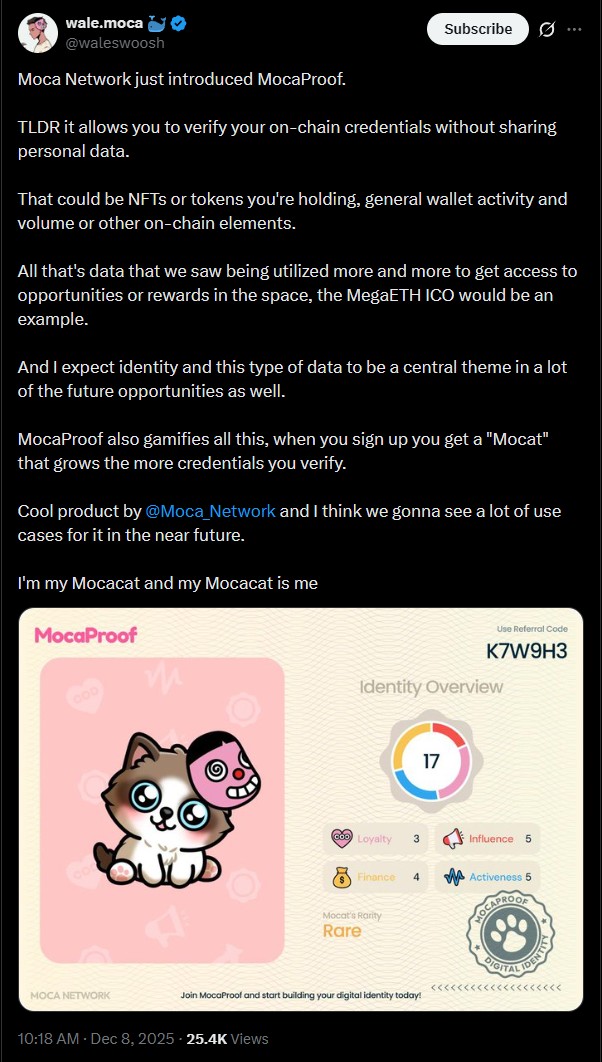
Source: @waleswoosh on X
Instead of treating identity like a form you fill out once per website or app, MocaProof makes it feel more like progress in a game. You complete “proof tasks,” build up your profile, and unlock opportunities over time. That’s where rewards come in: projects can run campaigns that pay out to users who complete certain verifications during a set window.
Essentially, MocaProof operates around these concepts:
You can prove facts about yourself, like “I own this account” or “I did this on-chain activity.”
You can then use those proofs to qualify for rewards, access, or special campaigns on a decentralized application (dApp).
Basically, you’re validating identity through MocaProof, and dApps can plug into the layer to verify you upon sign-up.
New Trending Crypto Wallet Offers
Sponsored
Disclosure
We sometimes use affiliate links in our content, when clicking on those we might receive a commission at no extra cost to you. By using this website you agree to our terms and conditions and privacy policy.
What MocaProof Actually Is and Why “Verifiable Credentials” Matter
MocaProof is a part of Moca Network’s broader identity stack, which is made up of the Moca Chain and its AIR Kit. Moca Network describes MocaProof as a “reputation platform” that helps users “build, control, and verify their digital identity.” The AIR Kit is a software development kit (SDK) that integrates decentralized identity features into dApps and wallets across chains.
From there, the dApps use verifiable credentials, but what are such credentials in the first place?
What are Verifiable Credentials?
Think of a verifiable credential as a sort of badge for your identity. Like a doctor’s note that proves you’re sick:
A company can say, “this is a real account.”
A partner can say, “this user has X history.”
A service can say, “this person has met a rule.”
MocaProof separates credentials across various categories like activity, loyalty, finance, and influence. That separation matters because you can prove one thing without sharing all of your info.
Have you ever wondered why something like a calculator app might need your location?
It’s odd, right?
Through MocaProof, a dApp can ask for the proof it needs, and nothing more.
How MocaProof Works, Step-by-Step
Say you want to play a new blockchain-based game, but it only wants humans, not bots. Here’s how you’d sign up using MocaProof:
You sign into MocaProof and pick a “human verification” credential, or some other trusted anti-bot credential.
A preview will tell you what the credential issuer wants to do, be it a camera liveness check or a similar process. You will also learn who the issuer is, so you can decide if you’re comfortable moving forward.
You approve or cancel the process.
The issuer runs the check and issues your credential.
You sign into the crypto game, and it asks for proof of liveness.
You tap “share proof” and MocaProof sends a zero-knowledge proof that verifies you as human.
The game’s verifier learns if you’re human, but does not learn anything about you. You get access to the game.
MocaProof stores credentials in its MocaID system.
How MocaProof Gamifies Identity
Through Moca ID, MocaProof tries to make identity verification feel like a game rather than filling out paperwork. As you verify more credentials, you build a more reliable profile and can qualify for campaigns, which reward you for completing certain sets of proofs during a set time period.
This approach matters because it tells you what MocaProof is really trying to do. It’s not just “identity for identity’s sake,” the platform uses identity to unlock perks, allowlists, airdrops, and access to app features, all without third-party networks hoarding all of your data.
Think of it like a checklist: each verification is a completed step, and finishing a set can unlock rewards, perks, or early access to a certain dApp. This also gives projects a way to incentivize rewarding real users instead of bots, because they can require specific proofs before someone can claim anything.
Take Moca Network’s “Theme of the Month” campaign. In its first month, running from December 1 to December 30, 2025, Moca Network said it would highlight NFT credentials and offer $50,000 in $MOCA rewards, with the prize pool tied to how many credentials get verified across selected projects.
Source: Mocaverse
There’s also a beta referral campaign with a $10,000 $MOCA prize pool, which shows how MocaProof can reward specific behaviors, such as inviting new users.
What Data Does MocaProof Store?
This is the most important question for any identity application.
Kenneth Shek, project lead of Moca Network, said to CCN, “MocaProof does not store raw user data.” Instead, he says users see “a clear preview of the exact data points included,” and must approve issuance from there. He also stresses that “credentials can only be used with the user’s consent,” which is meant to keep the user in control at every step.
He explains that those data points are encrypted and stored via decentralized storage on Moca Chain, while MocaProof “only processes and records the verification outcome as a zero-knowledge proof,” such as a true/false result. As Shek put it, MocaProof is designed so “neither MocaProof nor third parties can access the underlying data.”
How Long Does the Data Last?
Shek says credentials are currently issued on testnet, which “does not yet enforce expiration.” On the mainnet, issuers will be able to set expiration rules based on credential type. He added that “issuers can define and enforce expiration rules by credential type,” and that the team is building revocation and lifecycle tools to streamline credential management systems over time.
What Stops People From Faking Credentials or Farming Them?
If rewards exist, scammers and bots will try to cheat them. How does MocaProof prevent this?
Shek states that credentials are only issued by trusted issuers that control real records, like a game developer issuing credentials that you’ve played a game for X hours, verifying your human status. According to Shek, verifiers judge “issuer reputation and data quality rather than relying on a single centralized source.”
Otherwise, MocaProof includes something called “built-in deduplication,” which Shek claims will prevent multiple credentials from being generated via the same data. MocaProof is also working with partners like zkMe to introduce liveness and human-verification credentials. Shek said these human-check credentials help verifiers filter “bots, Sybil attacks, and large-scale credential farming.”
It also prevents phishing by supporting only whitelisted issuers and official domains, alongside limiting wallet actions to login-style signatures. In Shek’s words: “Wallet interactions are limited to authentication signatures (no spending approvals or transaction permissions).”
All this to say, MocaProof is aiming at a real problem. The internet has no simple way to prove your identity without also leaking personal data. The network’s pitch is that verifiable credentials and zero-knowledge proofs let you prove facts while keeping the underlying details private.
For you, approach the network’s identity verification with caution. Verify only what you need, pay attention to issuer names and domain links, and treat the rewards as a bonus, not the main reason to share your data.
FAQs
What is MocaProof in plain English?
It’s an identity and reputation tool that lets you collect verifiable credentials and share private “yes/no” proofs with apps.
Do I have to share my personal data to use it?
Not necessarily. Shek says you approve exactly what data points go into a credential, and apps get a proof result instead of raw data.
How do rewards work?
Projects run campaigns that reward users who complete certain credential verifications during a set period.
Can I revoke or delete credentials?
Full revocation tools are part of the planned rollout. For now, users can delete their AIR Account, and mainnet will support stronger expiration and lifecycle controls.
Disclaimer:
The information provided in this article is for informational purposes only. It is not intended to be, nor should it be construed as, financial advice. We do not make any warranties regarding the completeness, reliability, or accuracy of this information. All investments involve risk, and past performance does not guarantee future results. We recommend consulting a financial advisor before making any investment decisions.
Max Moeller is a Chicago‑based writer and video editor passionate about games, tech, and crypto. Whether it’s crafting clear, insightful articles or piecing together engaging video retrospectives, he’s driven by curiosity and takes pride in keeping things human. Since 2017, Max has been published in a variety of notable crypto magazines.


 Intermediate