“There’s a fine line between what’s actually decentralized” | Source: CCN
Share
Crypto trading continues to shift toward decentralized infrastructure, where access, speed, and data shape how users interact with markets.
As decentralized exchanges (DEXs) expand and derivatives gain traction, platforms now play a central role in how users discover tokens, assess risk, and execute trades.
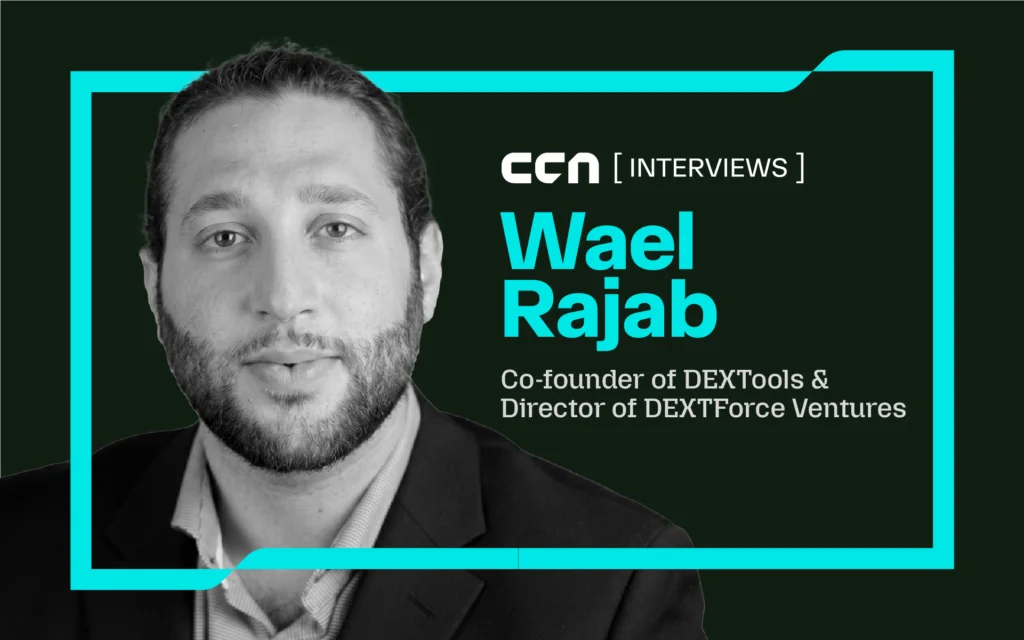
In an interview with CCN, Wael Rajab, Director of DEX Ventures, explains how DEXTools approaches market data, the rise of perpetual futures, and the structural limits that still define the adoption of decentralized finance (DeFi).
What DEXTools Is And How It Shapes Trading Decisions
DEXTools has grown into one of the largest DeFi analytics platforms, integrating close to 150 blockchains and serving millions of users.
“Dextools has almost 150 different blockchains integrated,” Rajab says. “That means you could trade, do research and do whatever you want over hundreds of different blockchains.”
The platform aggregates blockchain data and presents it in a way that simplifies decision-making for traders.
“So what DEXTools is, it gives you all that information. It’s done and ready,” he explains.
Instead of relying on multiple platforms, users can access charts, liquidity data, transaction history, and token metrics in one place.
“At DEXTools it’s all there for you and it’s really easy to use,” Rajab says.
How DEXTools Aggregates Data Without Influencing Trades
DEXTools highlights trending tokens and activity across blockchains, but Rajab stresses that the platform does not direct users toward specific investments.
“We don’t influence per se on purchasing,” he says.
Features such as “hot pairs” surface tokens with high activity, giving users visibility into market trends.
“It’ll show you the top 10 or the top 20 trending tokens,” Rajab explains.
At the same time, the platform focuses on transparency rather than promotion.
“We just offer the data,” he says.
Risk indicators also play a role, helping users identify potential threats such as low liquidity or malicious contracts.
“You can see, okay, it’s giving me a warning or there’s low liquidity,” Rajab says.
Perpetual Futures Explained: How Perps Differ From Spot Trading
Perpetual futures allow users to speculate on price movements without owning the underlying asset.
“So spot trading is when you actually own the asset and with perps, you can speculate on an asset without actually having ownership,” Rajab says.
One of the main advantages lies in capital efficiency through leverage.
“If you have a high conviction of market direction, you can take a higher position than you normally could,” he explains.
However, leverage also increases risk.
“It’s a double-edged sword,” Rajab says.
For that reason, he notes that inexperienced users should approach perps carefully.
“We don’t ever recommend people that are just starting to trade to use perps.”
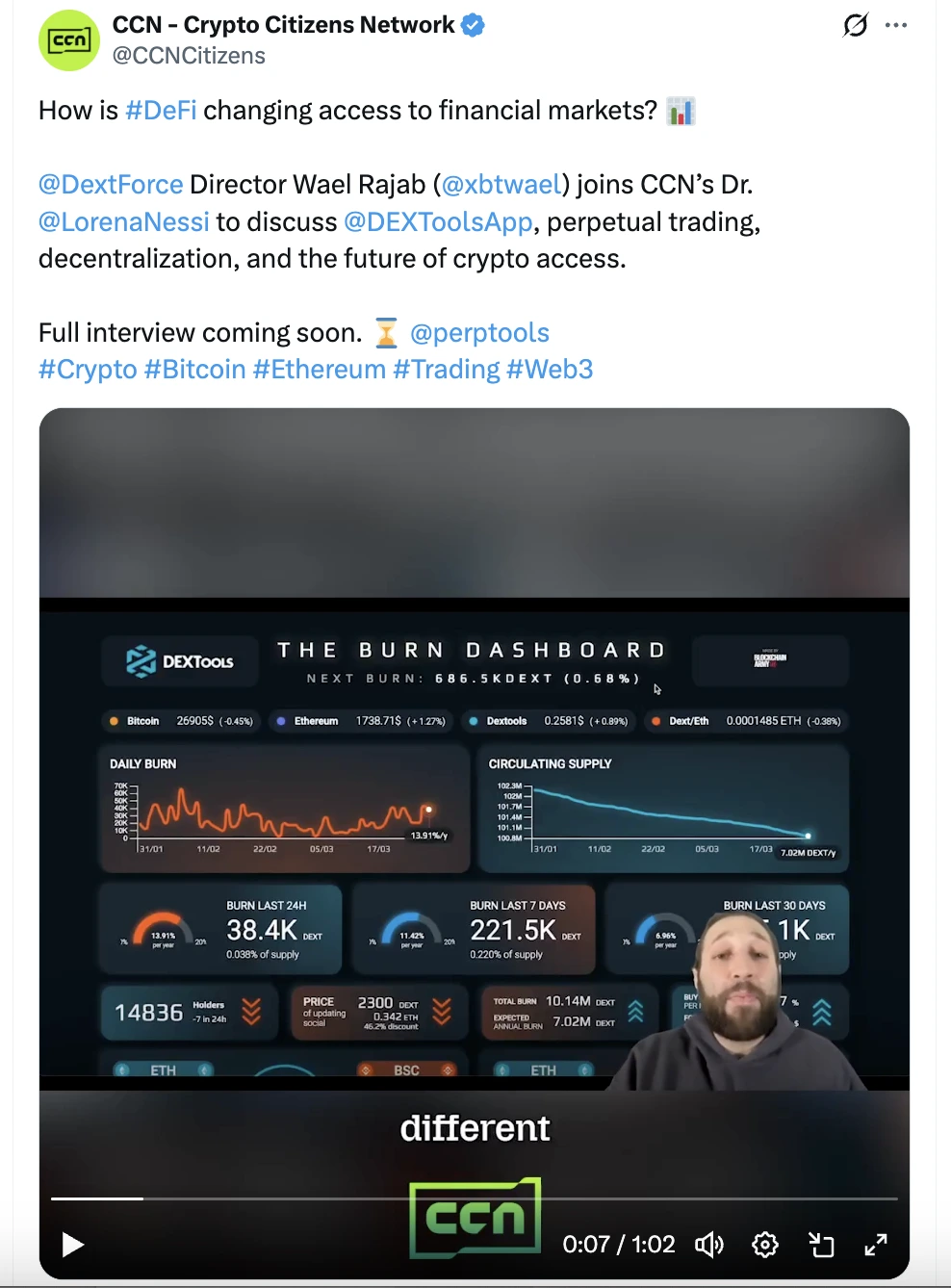
Watch the full interview here:
PerpTools Launches To Combine Analytics And Execution
DEXTools has expanded into derivatives trading through PerpTools, a platform designed to integrate research and execution.
“Through perp tools, they’re able to trade,” Rajab says.
The goal is to remove friction by allowing users to operate within a single environment.
“Everything’s just going to be in-house so they can do the research and then they can execute the trades,” he explains.
This approach reflects a broader trend toward full-stack trading terminals within DeFi.
Early-Stage Growth And Risks Behind PerpTools Adoption
PerpTools remains in an early phase, but adoption has started quickly.
“We are reaching close to 50,000 users,” Rajab says.
The platform includes features such as gamified incentives and upcoming AI trading agents.
Rajab does not see additional structural risk compared to other platforms, although he highlights the importance of responsible trading.
“I’m not enticing people to just 10, 20, 50, 100x leverage,” he says.
DeFi Access And The Role Of Removing Gatekeepers
Rajab argues that decentralized platforms expand access to financial markets by removing traditional barriers.
“Anybody with internet access can do it,” he says.
Unlike traditional finance, DeFi does not require geographic restrictions or formal banking access.
“You don’t need to live in a certain specific part of the world,” he explains.
This shift creates a more open system where participation depends only on connectivity.
“It’s equalized. Everybody has access to the same tools.”
Despite its advantages, full decentralization remains difficult to achieve.
“There’s a fine line between what’s actually decentralized,” Rajab says.
Security risks and user protection still shape how platforms operate.
“These platforms are subject to extreme malicious actors,” he explains.
As a result, some level of safeguards remains necessary, particularly for less experienced users.
“There needs to be a lot of education,” Rajab adds.
Why Many DeFi Projects Fail After Launch
Rajab attributes the failure of many DeFi projects to a combination of factors rather than a single issue.
“You can have the perfect product, but it won’t be exposed to people unless you have great marketing,” he says.
Execution, timing, and partnerships all play a role in long-term success.
“I’m a big believer in investing in people,” Rajab explains.
Market conditions also influence outcomes, especially when projects launch too early or too late.
“People are either late to the market or early to the market,” he says.
Building Early: How Projects Can Survive Market Cycles
Projects that continue building during downturns often demonstrate stronger fundamentals.
“People that are building now… are serious,” Rajab says.
He highlights the importance of adapting to market trends, including the rise of artificial intelligence.
“It’s just staying relevant to the market,” he explains.
Persistence remains a key factor in survival.
“The only way you’ll lose is if you stop,” Rajab says.
Why Community Still Drives Crypto Growth
Community remains a central element of crypto projects, influencing adoption, liquidity, and credibility.
“If you don’t have any raving fans… who’s going to support it?” Rajab says.
Strong engagement helps projects meet the metrics required by investors and exchanges.
“These are all things VCs look at,” he explains.
Maintaining trust also requires consistency and delivery.
“Anything you promise needs to be delivered,” Rajab adds.
AI In Crypto: Where Automation Meets Human Interaction
Artificial intelligence continues to shape operations across crypto platforms, particularly in automation and support.
However, Rajab draws a clear distinction between AI efficiency and human interaction.
“A human is just so much more immediate and it’s so much more comforting,” he says.
In high-risk scenarios, users often prefer direct human support over automated systems.
“You don’t want to talk to an AI bot,” Rajab explains.
AI remains valuable for efficiency, but human interaction still defines trust.
Despite recent expansion, Rajab believes the crypto market still has significant room to grow.
“We’re still quite early,” he says.
Ongoing development in DeFi, derivatives, and infrastructure continues to reshape how users access and interact with financial systems.
“We all have a unique opportunity to be in this marketplace,” Rajab adds.
Disclaimer:
The information provided in this article is for informational purposes only. It is not intended to be, nor should it be construed as, financial advice. We do not make any warranties regarding the completeness, reliability, or accuracy of this information. All investments involve risk, and past performance does not guarantee future results. We recommend consulting a financial advisor before making any investment decisions.
Dr. Lorena Nessi is an award-winning journalist and media technology expert with 15 years of experience in digital culture and communication. Based in Oxfordshire, UK, she combines academic insight with hands-on media practice.
She holds a PhD in Communication, Sociology, and Digital Cultures, and an MA in Globalization, Identity, and Technology.
Lorena has taught at Fairleigh Dickinson University, Nottingham Trent University, and the University of Oxford. She is a former producer for the BBC in London, with additional experience creating television content in Mexico and Japan.
Her research focuses on digital cultures, social media, technology, capitalism, and the societal impact of blockchain innovation.
She has written extensively on digital media and emerging technologies, with her work featured in both academic and media platforms. Her Web3 expertise explores how blockchain technologies shape culture, economics, and decentralized systems.
Outside of work, Lorena enjoys reading science fiction, playing strategic board games, traveling, and chasing adventures that get her heart racing. A perfect day ends with a relaxing spa and a good family meal.


 Easy
Easy