Ethereum’s Glamsterdam Upgrade Explained: Key Changes, Timeline and Why It Matters
Share
Key Takeaways
Glamsterdam represents a shift toward backend performance improvements. By redesigning how blocks are built and executed, Ethereum aims to scale layer-1 safely while maintaining decentralization and validator accessibility.
ePBS moves block building directly into Ethereum’s protocol, reducing reliance on external MEV relays. BALs allow Ethereum to preload state data and execute non-conflicting transactions simultaneously.
By improving layer-1 performance, Glamsterdam strengthens Ethereum’s rollup-centric roadmap.
Ethereum developers are preparing what may become one of the network’s most consequential upgrades since the transition to proof-of-stake. Known as Glamsterdam, the upcoming fork is designed to reshape how blocks are built, validated, and executed — core mechanics that determine Ethereum’s scalability, decentralization, and long-term competitiveness.
Unlike previous upgrades that focused heavily on user-visible features, Glamsterdam centers on infrastructure-level improvements. These changes may not be obvious to everyday users immediately, yet they could fundamentally improve Ethereum’s performance ceiling.
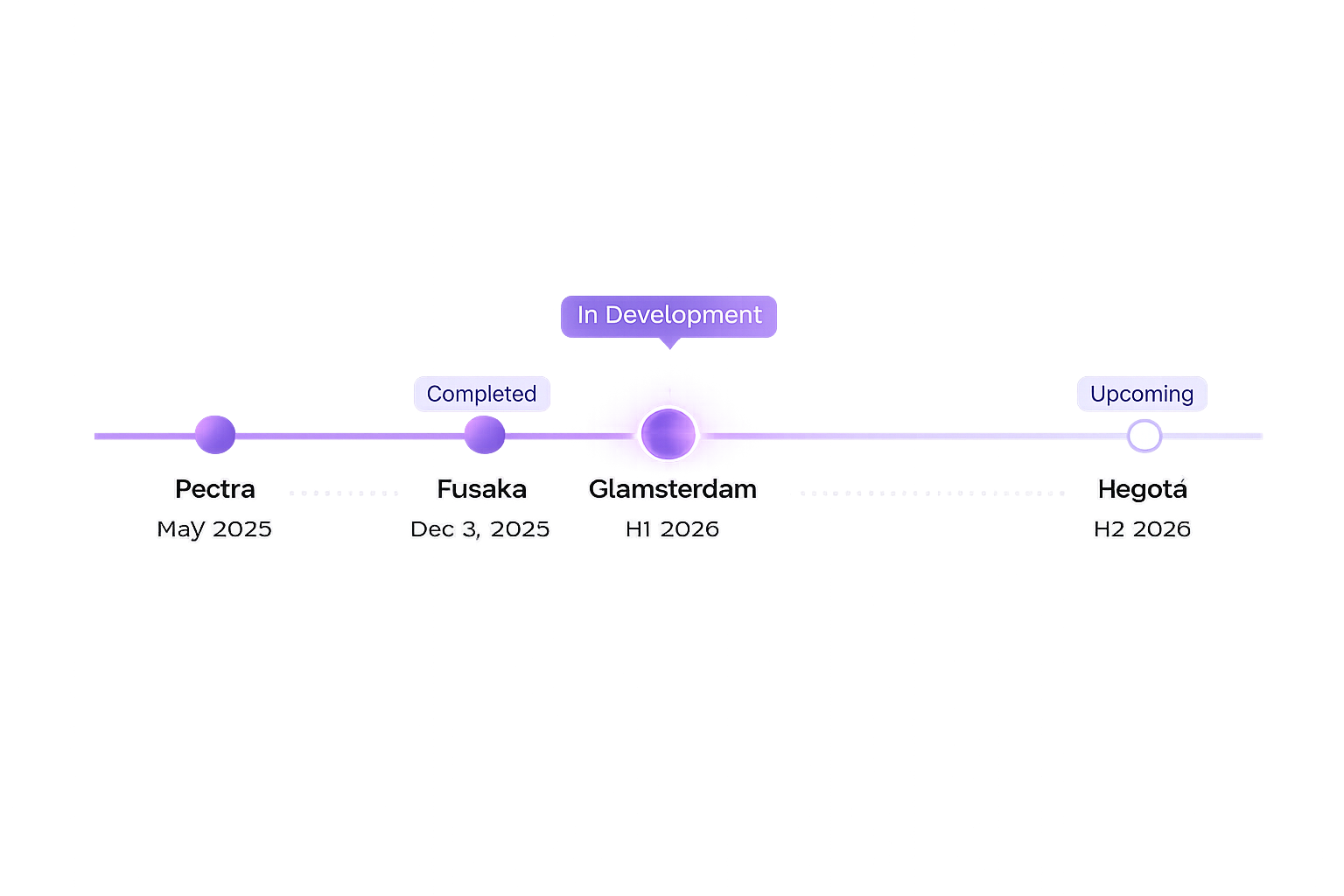
Developers currently target the first half of 2026, with Glamsterdam following the Fusaka upgrade and preceding the Hegotá upgrade later in 2026.
Ethereum upgrades
However, timelines remain fluid as implementations mature across clients. The Ethereum Foundation describes Glamsterdam as the next major step toward parallel execution, higher gas limits, and improved layer-1 scaling.
ethereum hit another ALL-TIME HIGH today.
2,595,176 transactions in 1 day.
this is only the beginning of ETH scaling.
glamsterdam update later this year will:
> reduce gas costs > improve block-level execution efficiency > reduce per-block processing overhead for nodes
Additional proposals, including gas repricing, validator optimizations, and cryptographic improvements, remain under discussion and may expand the upgrade’s scope.
Glamsterdam signals Ethereum’s next phase: scaling layer-1 responsibly without sacrificing decentralization.
Why Ethereum Needs Glamsterdam
Ethereum’s demand has increased dramatically over the past few years. Growth is coming from several areas:
Ethereum already relies heavily on layer-2 networks for scaling. However, layer-1 still plays a critical role:
Final settlement layer
Security anchor for rollups
Data availability layer
Validator consensus mechanism
As layer-2 adoption grows, pressure on Ethereum’s base layer also increases. Glamsterdam is designed to strengthen layer-1 so Ethereum can support long-term growth.
Key Features of Ethereum Glamsterdam Upgrade
Glamsterdam introduces infrastructure-level changes rather than user-facing features. These changes operate behind the scenes but could significantly improve performance.
Features
EIP
Purpose
Expected Impact
Enshrined Proposer-Builder Separation
EIP-7732
Move block building into protocol
Better decentralization and faster propagation
Block-Level Access Lists
EIP-7928
Enable parallel execution
Higher throughput and faster block processing
Parallel Execution Foundations
Multiple
Allow simultaneous transactions
Improved performance
Gas Limit Expansion Support
Under Discussion
Enable higher block capacity
Lower congestion and improved scaling
These features collectively aim to improve Ethereum’s layer-1 performance without sacrificing decentralization.
Ethereum block production currently involves multiple actors:
Validators (proposers)
Block builders
Relays
Builders create optimized transaction bundles, and validators choose which block to publish. This system emerged alongside MEV (Maximal Extractable Value) — profits generated by ordering transactions strategically.
However, this system relies heavily on external infrastructure such as Flashbots relays. This introduces centralization risks and increases validator complexity.
What ePBS Changes
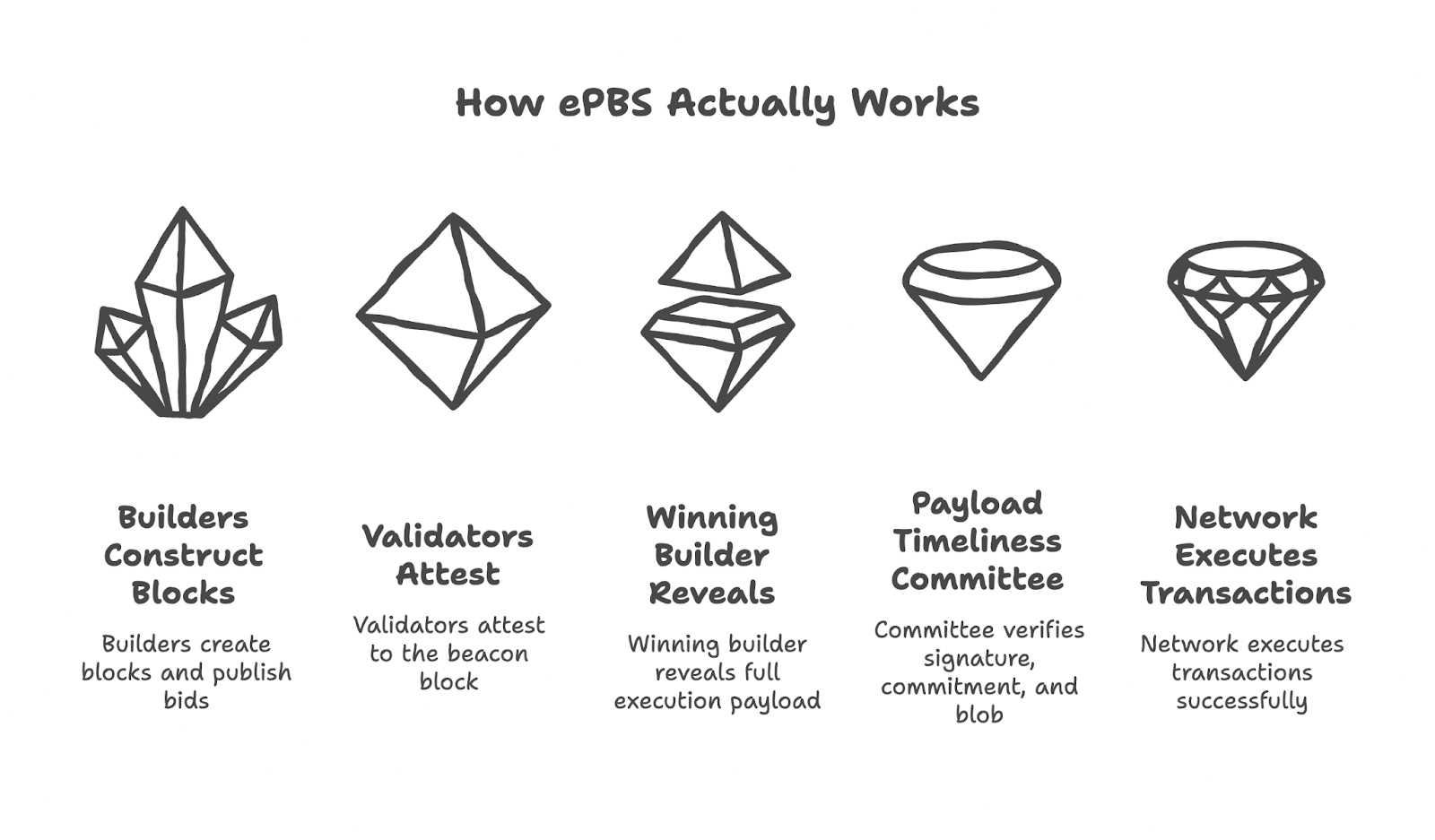
Glamsterdam introduces enshrined proposer-builder separation, which moves this system directly into Ethereum’s protocol.
Under ePBS:
Builders create blocks
Validators select winning bids
Execution happens after selection
External relays become less important
This removes reliance on trusted intermediaries and improves decentralization.
Recent analysis describes ePBS as the centerpiece of Glamsterdam, eliminating dependency on off-chain relayers and improving fairness in block construction.
First, it strengthens decentralization by allowing more builders to compete directly within protocol rules. This reduces the risk of a few relays controlling block production.
Second, it improves block propagation speed. By separating execution from proposal, validators can confirm blocks faster.
Third, it improves censorship resistance. With more decentralized block construction, filtering transactions becomes more difficult.
Together, these changes help Ethereum scale while preserving decentralization.
What Are Block-Level Access Lists
Block-Level Access Lists introduce a new way for Ethereum to process transactions.
Currently, Ethereum executes transactions sequentially. Each transaction must complete before the next begins. This limits throughput.
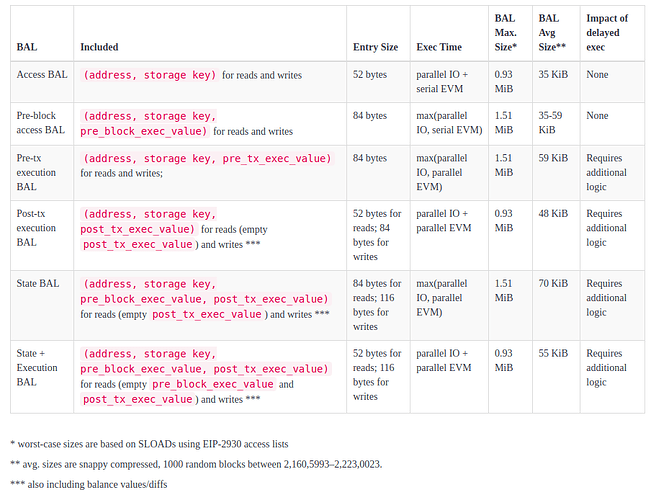
BALs allow Ethereum to declare which accounts and storage slots a block will access before execution begins. Nodes can then preload data and execute transactions in parallel.
12/ 🆙 Glamsterdam (Gloas + Amsterdam) upgrade is next
EIP-7928 defines BALs as structured lists specifying which storage slots and accounts transactions will access, enabling parallel execution and faster block processing.
Why BALs Improve Performance
Block-Level Access Lists enable:
Parallel execution
Faster block validation
Reduced disk bottlenecks
Improved sync performance
Blocks include a pre-declared map of state access, allowing nodes to process non-conflicting transactions simultaneously.
This approach significantly improves layer-1 throughput.
Some projections suggest Glamsterdam could dramatically increase transaction capacity while maintaining decentralization.
This reflects Ethereum’s structured long-term scaling roadmap.
Impact on Ethereum Users
For everyday users, Glamsterdam’s improvements may appear gradually rather than immediately.
However, the upgrade could lead to:
More stable gas fees
Faster transaction processing
Reduced congestion
Improved reliability
Parallel execution and improved validator performance reduce bottlenecks, improving overall user experience.
Some reports suggest the upgrade may significantly reduce transaction costs and increase throughput if implemented successfully.
Impact on Validators
Validators are among the most affected participants.
Glamsterdam changes validator responsibilities by introducing:
Native block builder selection
New validation timing
Execution separation
However, validators also benefit:
Reduced reliance on external relays
Lower infrastructure complexity
Better decentralization
Research suggests enshrining MEV infrastructure improves trustlessness and reduces operational risk for validator operators.
Impact on Node Operators
Glamsterdam introduces structural improvements that could significantly change how Ethereum nodes operate. Today, node operators must process transactions sequentially, which increases disk input/output operations and slows block execution. As Ethereum usage grows, this sequential processing creates performance bottlenecks and raises hardware requirements — a concern for decentralization because fewer individuals can afford to run full nodes.
Block-Level Access Lists, one of Glamsterdam’s core upgrades, aim to address this challenge. By allowing blocks to declare which accounts and storage slots will be accessed before execution begins, nodes can preload required data and process transactions in parallel. This reduces waiting time for disk reads and improves overall execution efficiency. Developers expect this to improve sync performance, reduce resource strain, and allow nodes to handle larger blocks without significantly increasing hardware requirements.
Improved execution efficiency also means node operators may experience faster block validation and smoother network performance. As Ethereum moves toward higher gas limits in future upgrades, these improvements become increasingly important. Without changes like BALs, higher gas limits could make running nodes too expensive, potentially leading to centralization. Glamsterdam’s approach helps maintain accessibility for home node operators and smaller infrastructure providers, preserving Ethereum’s decentralized nature.
Additionally, enshrined proposer-builder separation could simplify node operations by reducing reliance on external MEV relay infrastructure. Currently, many validators and node operators interact with third-party relay systems to maximize block rewards. With ePBS integrated directly into Ethereum’s protocol, some of this complexity moves into the network itself, potentially reducing operational overhead and improving reliability.
Impact on Layer-2 Ecosystem
Layer-2 networks depend heavily on Ethereum’s base layer for security, settlement, and data availability. As rollups continue to scale, pressure on Ethereum layer-1 increases. Glamsterdam is designed to strengthen layer-1 performance, which indirectly benefits the entire layer-2 ecosystem.
Parallel execution enabled by Block-Level Access Lists can improve block throughput and reduce congestion. This allows rollups to submit batches more efficiently and reduces delays in settlement. Faster settlement improves user experience across layer-2 networks, particularly for applications such as decentralized exchanges, lending protocols, and cross-chain bridges.
Improved layer-1 performance also supports Ethereum’s rollup-centric roadmap. Ethereum developers increasingly expect most transaction execution to occur on layer-2 networks, while layer-1 focuses on security and settlement. Glamsterdam enhances this model by improving the efficiency of the settlement layer, allowing rollups to scale without being constrained by layer-1 bottlenecks.
Furthermore, enshrined proposer-builder separation may improve fairness and reliability in transaction inclusion. Rollups often depend on predictable block inclusion to finalize transactions quickly. A more decentralized block construction process reduces the risk of delays or censorship, improving reliability for layer-2 users and developers.
As layer-2 adoption continues growing, Glamsterdam’s improvements to layer-1 infrastructure may become increasingly important. Stronger base layer performance allows rollups to expand without compromising security or user experience, reinforcing Ethereum’s long-term scaling strategy
Risks of Ethereum Glamsterdam Upgrade
Ethereum’s Glamsterdam upgrade introduces major architectural changes to block production and execution. While these improvements aim to increase scalability and decentralization, they also introduce new technical, economic, and coordination risks. Because Glamsterdam touches core consensus and execution layers simultaneously, developers are approaching the upgrade cautiously.
Below is a detailed breakdown of the most important risks associated with Glamsterdam.
Risk Category
Description
Impact
Protocol Complexity
New consensus mechanics
Implementation challenges
Builder Free-Option Risk
Builders may not deliver blocks
Liveness concerns
MEV Centralization
Large builders dominate
Reduced decentralization
BAL Consensus Risk
Client disagreement on access lists
Consensus failure
Block Size Increase
Larger blocks from metadata
Propagation delays
Gas Repricing Effects
Smart contract changes
DeFi instability
Validator Complexity
New validator responsibilities
Operational risk
Parallel Execution Bugs
New execution paths
Edge-case failures
Overscoping
Multiple major features
Integration risk
Increased Protocol Complexity
Glamsterdam fundamentally changes how Ethereum builds and validates blocks. Enshrined proposer-builder separation (ePBS) introduces new roles, new communication steps, and new validation logic. This expands Ethereum’s consensus surface area and increases implementation complexity across different clients.
Complex upgrades create risk because all Ethereum clients, such as Geth, Prysm, Lighthouse, and Nethermind, must implement the same logic precisely. Even small inconsistencies between clients could lead to consensus splits, where parts of the network disagree on block validity.
Researchers note that ePBS introduces commit-reveal mechanics and fallback rules, which increase coordination complexity and make cross-client implementation more difficult.
Because Glamsterdam modifies both execution and consensus layers, testing requirements are significantly higher than previous upgrades.
2. Builder Non-Delivery and “Free Option” Risk
One of the most discussed risks of ePBS involves builder behavior. Under enshrined proposer-builder separation, builders commit to delivering an execution payload after their bid is selected. However, builders may sometimes choose not to deliver the payload.
This is known as the free-option risk.
If a builder decides not to deliver:
Block becomes empty
Network throughput decreases
Validator revenue becomes unstable
Network liveness may degrade
Research shows this risk becomes more significant during high market volatility, when builders may gain advantage by delaying or abandoning blocks. In extreme conditions, this behavior could affect multiple blocks during volatile trading periods, precisely when Ethereum activity is highest.
Developers are actively studying mitigation mechanisms such as penalties or shorter timing windows.
3. MEV Centralization Risk
Although ePBS aims to improve decentralization, some research suggests it could unintentionally increase concentration among large builders.
Because building profitable blocks requires:
Sophisticated infrastructure
Low latency connectivity
Large capital resources
Large builders may dominate auctions and capture most MEV rewards. Research simulations suggest ePBS could increase profit concentration among a small number of builders, potentially reinforcing centralization in block construction.
This creates a paradox:
ePBS reduces relay centralization
But may increase builder centralization
Developers are still evaluating how to balance these tradeoffs.
Block-Level Access Lists introduce another major change to Ethereum execution.
BALs require nodes to agree exactly on:
Storage reads
Account accesses
Execution dependencies
If different clients interpret access lists differently, this could lead to consensus issues.
Additionally, the proposal introduces validation overhead, since nodes must verify access lists alongside execution. Increased validation complexity can raise CPU usage and increase failure scenarios.
Another concern involves malicious access lists. A malicious proposer could include phantom storage reads that force nodes to download unnecessary data. This increases bandwidth usage and could degrade performance until the block is validated.
Developers propose mitigation checks, but the risk remains a key area of testing.
5. Larger Block Size and Network Propagation Risk
Block-Level Access Lists increase block size by adding metadata. Even though estimates suggest moderate overhead, larger blocks still affect network propagation.
These risks become more important if Ethereum later raises gas limits after Glamsterdam.
Even modest increases in block size can impact:
Validators with slower connections
Home node operators
Decentralization levels
This is why developers emphasize careful testing before deployment.
6. Gas Repricing and Smart Contract Risks
Glamsterdam may also include gas repricing changes. These adjustments aim to better reflect computational costs, but they can introduce unintended consequences.
Smart contracts often rely on precise gas assumptions. Repricing may expose previously hidden inefficiencies or vulnerabilities.
Developers must carefully evaluate backward compatibility.
7. Validator Operational Risks
Glamsterdam changes validator responsibilities.
New validator tasks include:
Builder selection
Payload timing verification
New consensus duties
This increases validator operational complexity.
Although long-term improvements are expected, short-term risks include:
Validator misconfiguration
Increased operational errors
Reduced participation during transition
Validator coordination is particularly important because Ethereum depends on thousands of distributed participants.
8. Parallel Execution Edge-Case Risks
Parallel execution introduces new execution paths that did not exist previously.
Potential issues include:
Race conditions
Execution ordering bugs
Unexpected state dependencies
Sequential execution is simpler and easier to reason about. Parallel execution improves performance but increases complexity.
Developers must carefully test edge cases before deployment.
9. Multi-Feature Upgrade Risk
Glamsterdam combines several major changes:
ePBS
BALs
Gas repricing
Execution improvements
Combining multiple major features increases integration risk. Researchers refer to this as overscoping risk, where too many changes in one upgrade increase fragility and delay potential.
Notably, most risks are technical rather than economic, and Ethereum developers typically mitigate these through extensive testing, devnets, and staged rollouts. Still, because Glamsterdam changes core network mechanics, it is considered one of Ethereum’s most technically challenging upgrades.
If implemented successfully, Glamsterdam could unlock major scalability improvements. But like many ambitious infrastructure upgrades, success depends on careful coordination and rigorous testing.
Why Glamsterdam Matters for Ethereum’s Future
Glamsterdam marks an important shift in Ethereum’s development strategy. Earlier upgrades often introduced visible improvements such as staking withdrawals, fee market changes, or rollup-focused enhancements. Glamsterdam, however, focuses on foundational infrastructure — the underlying mechanics that determine how Ethereum scales over the long term.
This shift reflects a broader evolution in Ethereum’s roadmap. As adoption grows, the network’s biggest challenges are no longer adding new features but improving performance, reliability, and decentralization at scale. Glamsterdam addresses these challenges by redesigning how blocks are built, validated, and executed.
One of the most significant outcomes of Glamsterdam is the foundation for parallel execution. Ethereum currently processes transactions sequentially, which limits throughput. Block-Level Access Lists introduce a mechanism that allows transactions to be processed simultaneously when they do not conflict. This improvement could significantly increase processing efficiency and help Ethereum handle growing demand without sacrificing decentralization.
Glamsterdam also prepares Ethereum for higher gas limits. Increasing gas limits allows more transactions per block, but doing so without improving execution efficiency could strain node operators and reduce decentralization. By improving execution performance first, Glamsterdam creates a safer path for increasing throughput while maintaining accessibility for smaller validators and node operators.
Another key benefit is improved decentralization. Enshrined proposer-builder separation reduces reliance on off-chain block building infrastructure and integrates these processes directly into the Ethereum protocol. This helps distribute block production more evenly across participants and reduces the risk of centralization among large builders or relay providers.
Glamsterdam may also strengthen censorship resistance, a core design goal for Ethereum. A more decentralized block construction process makes it harder for any single entity or group to influence transaction inclusion. This becomes increasingly important as Ethereum supports more financial infrastructure and institutional use cases.
Together, these improvements position Ethereum for its next phase of growth. Rather than relying solely on layer-2 scaling, Glamsterdam strengthens the base layer itself. This reinforces Ethereum’s long-term roadmap, where a scalable and decentralized layer-1 supports an expanding ecosystem of rollups, applications, and institutional adoption.
How is Glamsterdam different from previous Ethereum upgrades?
Glamsterdam differs from earlier upgrades because it focuses on core infrastructure rather than user-facing features. While upgrades like Dencun improved rollup scaling and Shanghai enabled staking withdrawals, Glamsterdam redesigns how Ethereum builds and executes blocks. These foundational changes aim to improve performance, decentralization, and scalability at the protocol level.
Will Glamsterdam reduce Ethereum gas fees?
Glamsterdam is not designed specifically to reduce gas fees, but it could indirectly help stabilize or lower fees over time. By enabling parallel execution and preparing for higher gas limits, the upgrade may reduce congestion during periods of high demand, which typically leads to lower transaction costs.
How will Glamsterdam affect Ethereum validators?
Validators may see changes in how blocks are selected and validated. Enshrined proposer-builder separation moves block-building mechanics into Ethereum’s protocol, reducing reliance on external relays. This could simplify validator infrastructure while also introducing new responsibilities related to block timing and payload validation.
Does Glamsterdam impact Ethereum layer-2 networks?
Yes, Glamsterdam could significantly benefit layer-2 networks. Improved layer-1 throughput and faster block processing allow rollups to settle transactions more efficiently. This strengthens Ethereum’s rollup-centric scaling strategy and supports continued growth across layer-2 ecosystems.
Disclaimer:
The information provided in this article is for informational purposes only. It is not intended to be, nor should it be construed as, financial advice. We do not make any warranties regarding the completeness, reliability, or accuracy of this information. All investments involve risk, and past performance does not guarantee future results. We recommend consulting a financial advisor before making any investment decisions.
She is a fintech writer based in Canada with an academic background in psychology and project management. She has previously contributed to crypto media platforms, including Cointelegraph. Her professional experience includes work as a relationship manager in the telecommunications industry, and her writing since 2020 has focused on digital assets, blockchain technology, and artificial intelligence, with attention to their interaction with traditional finance.


 Easy
Easy