Trump Media’s Truth Predict merges crypto, politics, and finance, a new Polymarket competitor reshaping prediction markets and digital betting. | Credt: CCN.com
Share
Key Takeaways
Emotional events like tragedies (e.g., Charlie Kirk’s death) can spark sudden, risky memecoin booms.
Tokens without real use cases usually collapse once hype fades.
Profiting from grief damages crypto’s reputation and public trust.
Understanding pump-and-dump dynamics helps investors avoid major losses.
The shooting of political activist Charlie Kirk on Sept. 10, 2025, triggered a wave of meme cryptocurrency tokens using his name. Coins like RIPCharlieKirk, JusticeForCharlie, and CHARLIE skyrocketed by tens of thousands of percent before crashing.
Rest in peace Charlie Kirk. And shame on the leftist blue checks trying to profit on https://t.co/JHE9cH0unP by posting cheap jokes making light of his death.
We’ve made a memecoin in his honor so he will live on forever in the blockchain. pic.twitter.com/74YAgAHmlF
This boom-and-bust cycle illustrates the dangers of speculative crypto investing and highlights recurring issues of hype, ethics, and regulation.
What Are Charlie Kirk Memecoins?
Charlie Kirk memecoins are digital tokens created by anonymous developers within hours of the news of his shooting. They had no official connection to Kirk or his organization. Built on fast-deployment platforms like Solana’s pump.fun, these tokens capitalized on viral headlines and investor FOMO.
Try Our Recommended Crypto Exchanges
Sponsored
Disclosure
We sometimes use affiliate links in our content, when clicking on those we might receive a commission at no extra cost to you. By using this website you agree to our terms and conditions and privacy policy.
Unlike established cryptocurrencies such as Bitcoin or Ethereum, these coins offered no real-world utility, governance, or product, only speculative value driven by hype.
The creators of hype-linked memecoins remain largely unknown because:
Many of these crypto tokens are deployed anonymously or with pseudonyms; blockchain addresses don’t always map to real, public identities.
Memecoin platforms often don’t enforce identity verification for creators or goodwill attribution.
The projects are speculative, short-lived, and often not intended for long-term utility; there’s less incentive for the creators to publicize ownership (which might expose them to legal or reputational risk).
X user expressed concern over Charlie Kirk memecoins. | Source: @CryptoTony__
Why Did Charlie Kirk Crypto Tokens Skyrocket?
The surge of these tokens followed a predictable pattern common in memecoin markets:
Headline shock: The news of Kirk’s shooting created emotional and political reactions online.
Instant token creation: Developers launched dozens of tokens with his name to attract attention.
Social media amplification: Posts about “RIPCharlie” coins went viral, encouraging traders to buy.
FOMO trading: Investors rushed in, hoping for quick 10x or 100x returns.
Insider profit-taking: Early holders sold at the peak, earning huge gains.
This cycle mirrors countless pump-and-dump schemes in crypto, where prices soar on hype and collapse once momentum fades.
According to X user @nichxbt, the fees earned from launching the $CHARLIE memecoin, also referred to as Justice For Charlie Kirk, on @pumpdotfun amounted to around $156,090 (approximately 700.851 SOL) in creator rewards. This highlights how quickly tragedy-linked tokens can generate substantial profits for their creators, even in a short span of time, by capitalizing on hype and speculation.
History of Tragedy-Linked Tokens in Crypto
In early 2020, the COVID-19 pandemic gave rise to numerous cryptocurrency scams that exploited global tragedy. Researchers identified nearly two hundred confirmed COVID-19 crypto scams, with close to half involving newly launched tokens.
Many of these projects claimed to donate proceeds to victims or tied their mechanics to case and death numbers, but most were speculative or fraudulent.
One notable example was CoronaCoin, a token that reduced its supply in proportion to rising infection numbers, marketed under the idea that scarcity would increase value. While developers pledged a portion for charity, critics widely condemned the concept as unethical.
A similar pattern repeated in September 2022 following the death of Queen Elizabeth II. Within hours, more than forty memecoins using her name were created, with titles such as Queen Elizabeth Inu and God Save The Queen.
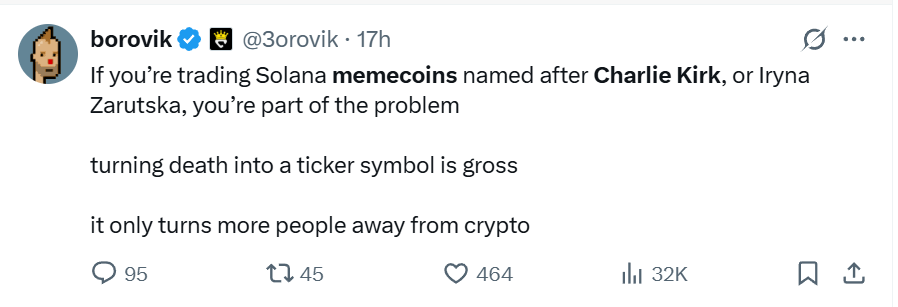
$IRYNA is another Solana-based “tribute” memecoin launched on Pump.fun following the fatal stabbing of Ukrainian refugee Iryna Zarutska. The token’s narrative quickly morphed as the community accused its original developer of not fulfilling promises; in response, holders attempted a “community takeover,” redirecting trading fees toward a GoFundMe set up for Iryna’s family.
Turning death into a ticker symbol is gross. | Source: @3orovik on X
At its peak in early September 2025, IRYNA reached an all-time high market cap of about $4.9 million, before falling to around $3.8 million during subsequent volatility. The token has seen high trading volume, though it remains highly speculative and risky.
Some of the above-discussed memecoins saw enormous but short-lived price surges before collapsing, leaving late investors with steep losses.
Risks of Investing in Tragedy-Linked Tokens
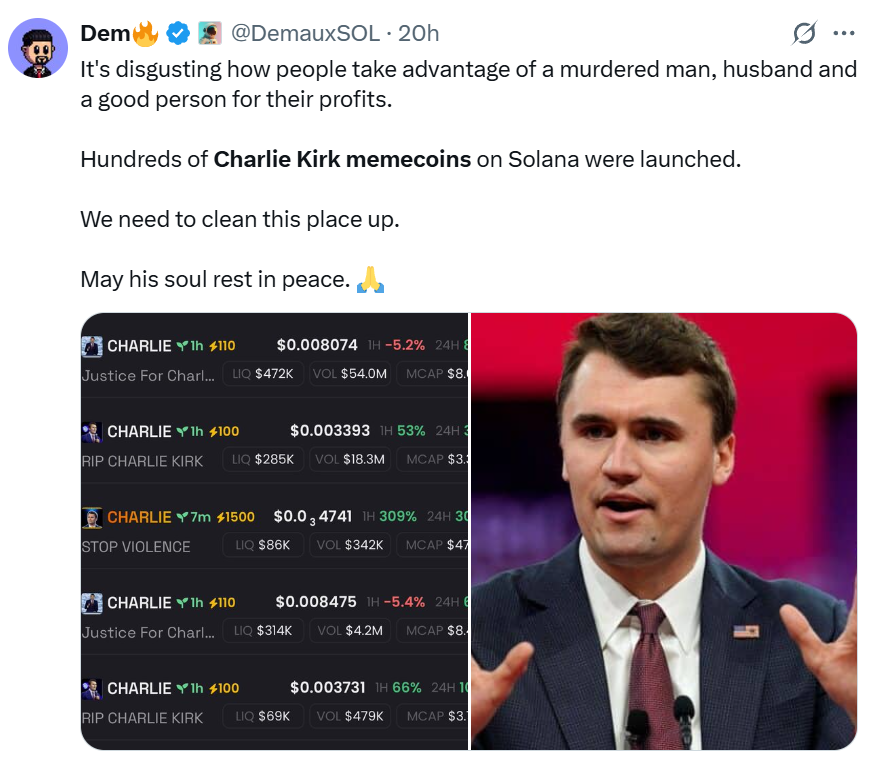
Tokens like $CHARLIE and JusticeForCharlie skyrocketed by more than 50,000%, briefly reaching multi-million-dollar market caps before crashing sharply.
Crypto’s dark side. | Source: @DemauxSOL on X
According to on-chain data and crypto analysts, one creator reportedly earned around $300,000 in fees within an hour, while combined developer profits across several tokens may have approached $2 million.
Extreme volatility: Charlie Kirk coins rose by more than 50,000% in under an hour, but collapsed almost as quickly. Late buyers often lost nearly everything.
Lack of transparency: Developers were anonymous. There was no roadmap, no liquidity guarantee, and no accountability for losses.
Ethical concerns: Turning a tragedy into a profit vehicle raises questions about exploitation and respect. Many observers condemned the coins as opportunistic.
Regulatory grey area: Most memecoins are unregulated, leaving investors without protection. In some countries, tokens may qualify as securities, but enforcement is inconsistent.
What Investors Can Learn From the Charlie Kirk Crypto Craze
The Charlie Kirk memecoin surge is more than a curiosity, it’s a reminder of how fragile, unregulated, and ethically complex parts of the crypto market can be.
For some, these coins brought quick profits. For many more, they ended in financial loss. For educators and regulators, the case highlights the urgent need for investor awareness, ethical reflection, and smarter safeguards in the fast-moving world of crypto.
No. The tokens were launched by anonymous developers with no official ties to Kirk.
Why do people buy tragedy-linked memecoins?
Mostly due to FOMO and the dream of fast profits. Some also claim symbolic reasons, but financial speculation is the main driver.
Are these tragedy-linked memecoins legal?
They exist in a regulatory grey zone. While creating tokens isn’t illegal, deceptive or exploitative tokens may fall under fraud or securities law.
How can investors protect themselves?
Only invest what you can afford to lose, avoid tokens tied to breaking news or tragedy, and focus on projects with transparent teams and real utility.
Disclaimer:
The information provided in this article is for informational purposes only. It is not intended to be, nor should it be construed as, financial advice. We do not make any warranties regarding the completeness, reliability, or accuracy of this information. All investments involve risk, and past performance does not guarantee future results. We recommend consulting a financial advisor before making any investment decisions.
Onkar Singh has three years of experience as a digital finance content creator. Throughout his career, he has collaborated with various DeFi projects and crypto media outlets. In his leisure time, he enjoys fitness activities at the gym and watching movies across different genres. Balancing his professional and personal interests, Onkar continues to contribute to the digital finance landscape while pursuing his hobbies.


 Easy
Easy