The rise of memecoins proves that attention is the most valuable commodity in crypto.
Memecoins lower the barriers to entry in crypto by wrapping speculation in humor and culture. Still, that accessibility bypasses cognitive load and encourages FOMO-driven, herd-like behavior instead of thoughtful analysis.
Memecoin launchpads and developers function like houses, taking fees and profits while the crowd provides exit liquidity.
Pump.fun and Bonk.fun wallet data for August shows that most traders walked away with losses.
Memecoins can be the gateway to serious investing, or the reason someone never learns to invest.
Memecoins represent one of the most explosive, controversial, and paradoxical phenomena within the digital asset landscape.
By relying on the viral power of internet culture rather than technical utility, memecoins significantly lower the barriers to entry, making crypto more accessible and less intimidating for the average person.
Their narratives are simple, their communities are vibrant, and their potential for astronomical gains creates a powerful allure that traditional financial assets rarely match.
Get These Top Crypto Casino offers Now!
Sponsored
Disclosure
We sometimes use affiliate links in our content, when clicking on those we might receive a commission at no extra cost to you. By using this website you agree to our terms and conditions and privacy policy.
Beneath this veneer of fun lies a system that strips finance down to pure speculation. Unlike traditional forms of speculation, such as penny stocks or forex trading—where at least some fundamentals like corporate earnings or macroeconomic factors can be analyzed—memecoins operate with no intrinsic anchors.
By weaponizing psychological triggers like fear and greed, the memecoin market creates a near-zero-sum game, often locking participants in predictable and brutal lifecycles of pump-and-dump or a slow fade into obscurity.
This creates a “Trojan Horse” dilemma. While memecoins successfully attract users, they risk poisoning the ecosystem from within by conditioning participants for short-term, dopamine-driven behavior rather than patient, research-intensive participation. The consequence is a trail of disillusioned entrants.
This issue of CCN Reports turns its focus to that danger, dissecting the paradox of memecoins as cultural onramps and financial traps. The question is whether they accelerate adoption or smuggle in an addiction that corrodes markets from within.
Background: The Rise of Memecoins
A memecoin is a cryptocurrency whose value is derived almost exclusively from the cultural relevance of its associated internet meme, community hype, and social media virality, rather than from any underlying technical utility or cash flow.
Unlike assets like Bitcoin (BTC) or Ether (ETH), memecoins like Dogecoin (DOGE) treat attention as their primary commodity. Their capacity to capture and retain attention is directly translated into market capitalization.
Thus, Memecoins represent the ultimate fusion of culture and capital, where the memetic transmission engine becomes the engine of value creation.
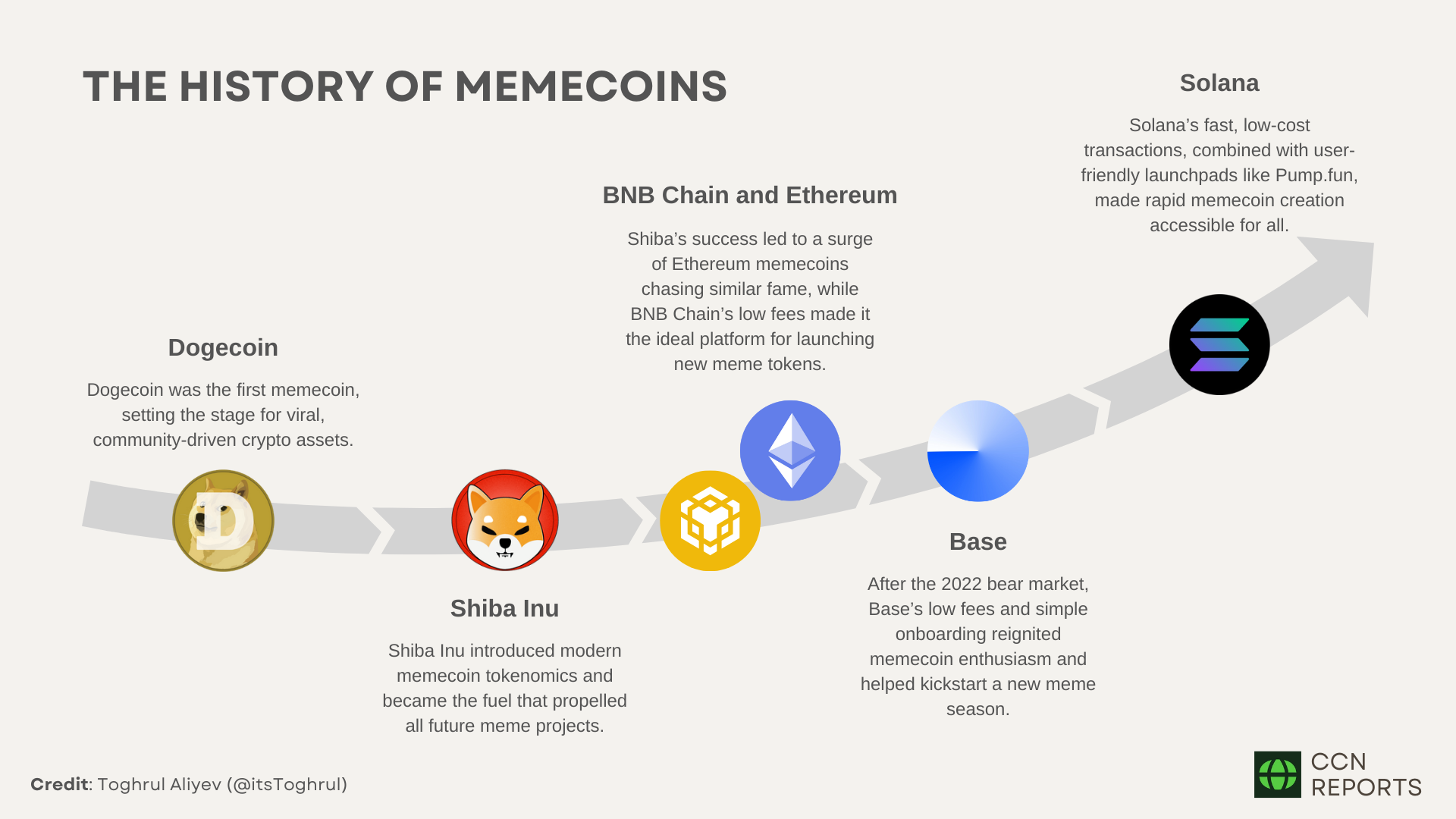
Their history can be seen as a five-phase evolution, with each stage making speculation more rapid and accessible.
Figure 1: The History of Memecoins | Credit: Toghrul Aliyev (@itsToghrul)
Phase 1 — Dogecoin (2013–2020): Born in 2013 as a parody of Bitcoin, Dogecoin (DOGE) aimed to make crypto approachable through humor, low fees, and fast transactions. It cultivated a grassroots tipping culture on Reddit and Twitter (now X) and funded small charities. For most of its existence, it remained a niche cultural phenomenon rather than an investment narrative, but it demonstrated that internet culture could mobilize users and liquidity around a meme-first asset.
Phase 2 — Shiba Inu (2020–2021): Launched on Ethereum in August 2020 and branded the “Doge-killer,” Shiba Inu (SHIB) paired unit-bias tokenomics with relentless social distribution and a DeFi wrapper via ShibaSwap. The 2021 bull cycle transformed SHIB into a multi-billion-dollar token and reframed memecoins as communities that could ship products. SHIB’s surge validated the category and set the template that others tried to replicate on various chains.
Phase 3 — Ethereum and BNB Chain proliferation (2020–2021): SHIB’s success, reinforced by Dogecoin’s strong price performance, triggered a wave of dog-themed tokens on both chains. On Ethereum, builders chased a “new SHIB” using ERC-20 mechanics, burns, and branding. On BNB Chain, near-zero fees and easy token deployment on PancakeSwap enabled rapid retail participation and a flood of copycats. The bear market of 2022 then compressed liquidity, exposed low-quality projects, and slowed issuance across both ecosystems.
Phase 4 — Base chain wave (2023–2024): After the 2022 drawdown and a broad 2023 recovery, Coinbase’s Base provided a low-friction EVM on-ramp with cheap blockspace and direct fiat access. Communities iterated faster and at lower cost, and meme tokens such as Degen (DEGEN) and Brett (BRETT) gained traction through social media. Base reactivated retail experimentation, tightened the loop from creation to liquidity, and primed user cohorts for the next phase of speed-driven meme markets.
Phase 5 — Solana and launchpads (2024–2025): Strong performance of Solana (SOL), sub-cent fees, and high throughput, combined with Bonk’s (BONK) cultural spark, positioned Solana as the venue for real-time, small-ticket speculation. Launchpads like Pump.fun and later Bonk.fun turned token creation into a button-click with bonding curves and instant Raydium liquidity, making issuance cheap and accessible to non-developers. The result was industrial-scale meme production, rapid meta shifts, and casino-like outcome distributions.
Why Memes Work as a Vehicle
The effectiveness of memes as vehicles for financial products is rooted in their ability to exploit fundamental aspects of human psychology. They function as sophisticated instruments that leverage well-documented cognitive biases to bypass rational analysis and trigger impulsive, emotion-driven behavior.
Of course, not every participant is naïve or unaware—many engage with memecoins fully conscious of the risks, treating the speculation as a form of entertainment rather than an investment. Still, the psychological levers are powerful enough that even seasoned participants often find themselves drawn into the same behavioral traps.
First, memes excel at reducing the cognitive load required to engage with a complex subject like cryptocurrency. The technical intricacies of blockchain technology, from cryptographic security to scaling solutions, present a barrier to entry for novice participants. A memecoin circumvents this barrier by packaging itself in a straightforward, emotionally resonant narrative, a “funny dog coin” or a culturally relevant cartoon frog.
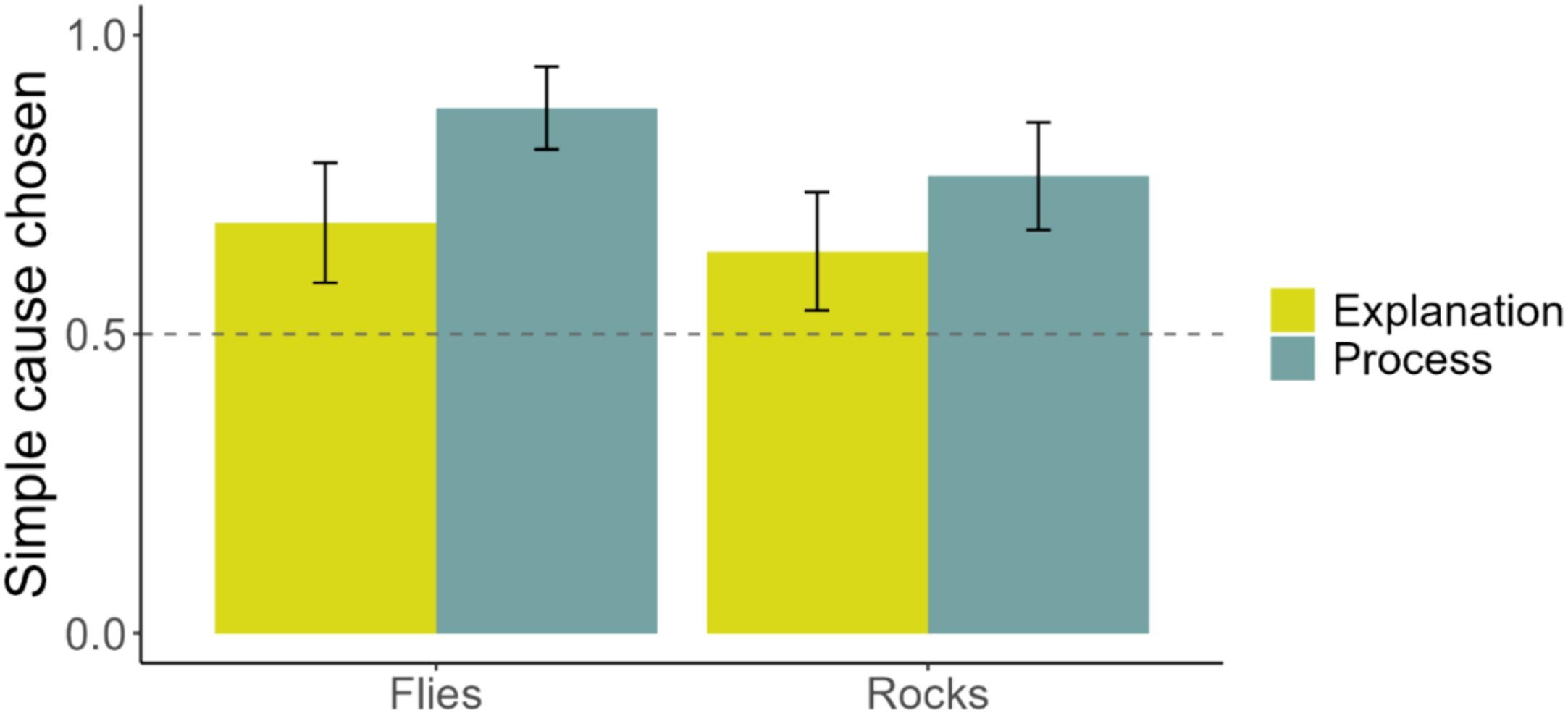
Academic research confirms that the human brain strongly prefers simple explanations over complex ones, cognitively demanding analysis, even when those simple explanations are less accurate.
Figure 2: Preference for Simple Explanations Over Complex Ones | Note: Participants favored simple causes over complex ones | Credit: Cushman et al., Cognition, 2024
Memes are the epitome of this principle, compressing a complex idea or emotion into an instantly digestible and often humorous format. It is indispensable for memecoins, which typically lack any fundamental value and therefore benefit from a transmission vehicle that actively discourages deep analysis and promotes intuitive, emotional engagement.
Once attention is captured, emotion takes over. A key predictor of a meme’s success is its ability to elicit high-arousal emotions, whether positive (humor, excitement, joy) or negative (anger, outrage, disgust).
Research indicates that content that triggers a strong emotional response is shared with significantly greater frequency. Memes are engineered to deliver these emotional payloads with maximum efficiency, and in the context of memecoins, they are used to activate specific psychological triggers conducive to speculation.
The strong emotional response then cascades into behavior. Among the various impulses it fuels, none is more powerful than the Fear of Missing Out (FOMO). Social media platforms act as amplification chambers for success stories, where viral posts showcasing astronomical gains create an intense sense of urgency and social pressure. This triggers powerful FOMO, compelling individuals to make impulsive investment decisions, often at market peaks, to avoid the anticipated pain of regret.
Memes are also exceptionally effective generators of social proof, the psychological phenomenon where individuals assume the actions of others reflect correct behavior for a given situation. When a meme is shared widely across social networks, it creates a powerful perception of consensus and legitimacy, encouraging others to conform.
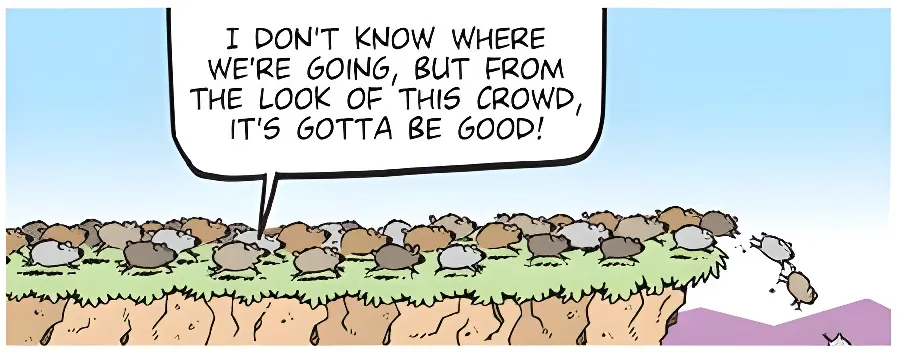
This directly taps into herd behavior, where investors follow the actions of a larger group rather than relying on their own independent analysis. The pattern becomes especially visible in volatile and uncertain markets like cryptocurrency, where the absence of fundamental anchors leaves retail investors more vulnerable to social influence.
Figure 3: The Herd Behavior | Credit: Unknown
Research has further shown that information is perceived as more believable when it is accompanied by an image and viewed repeatedly, two core characteristics of how memes are transmitted on social media feeds.
Furthermore, memes can shift how people evaluate risk through the affect heuristic, where positive emotions lower risk perception and inflate expected rewards. Scholarly studies show that when people feel favorable toward an activity, they judge it as safer and more advantageous, especially under time pressure that limits reflection. The effect is also present in financial settings.
At the same time, memecoin trading gamifies the whole experience. Profit screenshots on X or Discord function as leaderboards, real-time price feeds provide instant feedback, and rapid rotation from one token to another creates streak-like behavior. Behavioral finance experiments have shown that gamification boosts trading volume, especially among traders with lower financial literacy.
Traders who prefer gamified platforms tend to trade more often and make decisions quickly, without much careful thinking.
Memetic Mechanism
Underlying Psychological Principle
Manifestation in Memecoin Trading
Narrative Simplicity
Cognitive Load Reduction
Bypassing fundamental analysis, investment decisions are based on a simple joke or image (“funny dog coin”).
Impulsive buying at market peaks to avoid regret; chasing trends seen on social media.
Repetitive Sharing
Social Proof & Herd Behavior
Following the crowd and buying a token simply because it is popular, reliance on influencer endorsements.
Gamified Humor
Lowered Psychological Barriers to Risk
Framing high-risk speculation as a form of entertainment or a game reduces perceived financial danger.
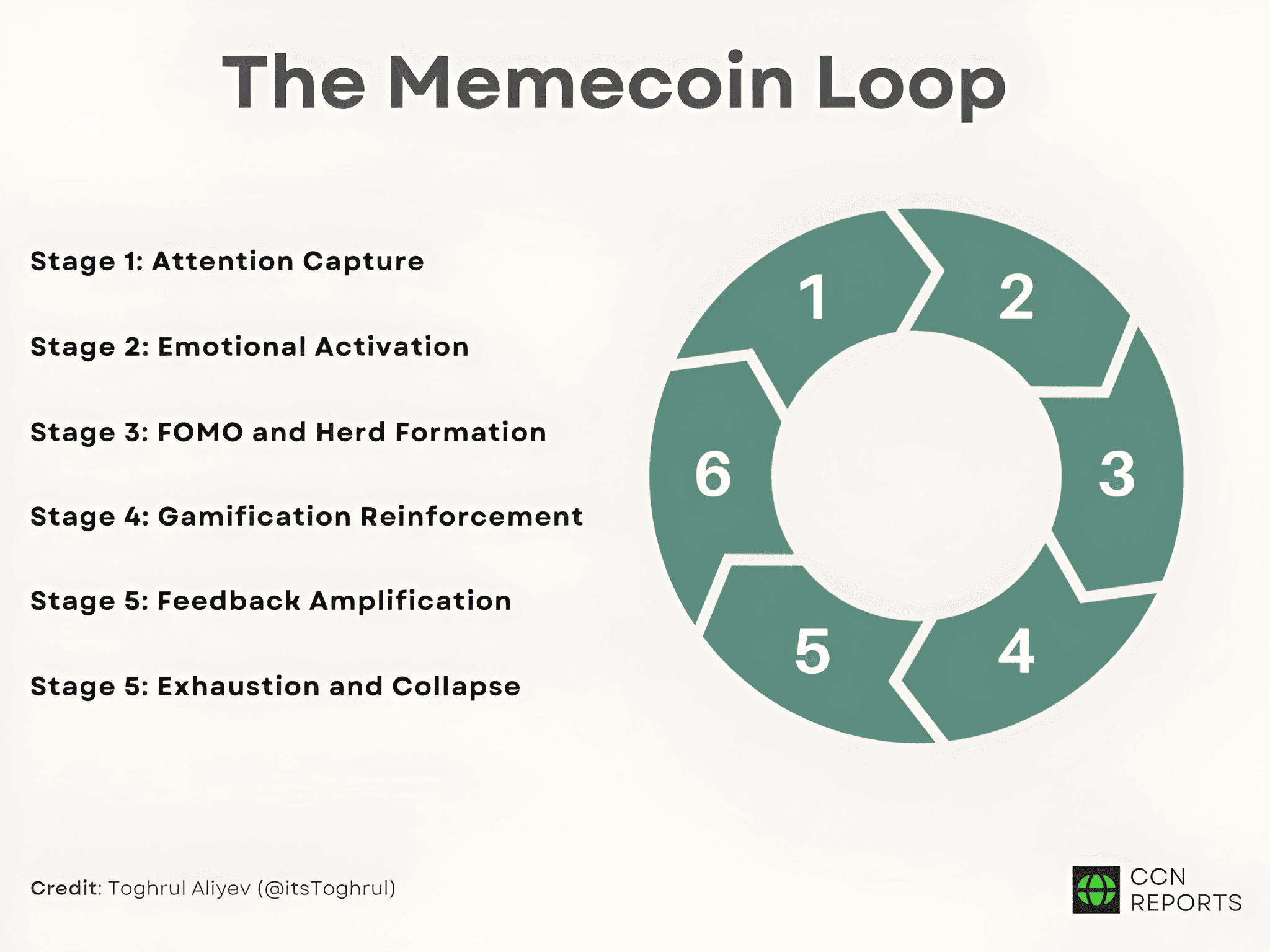
The psychological mechanisms described earlier do not operate in isolation. Instead, they form a powerful, self-reinforcing feedback loop that constitutes the fundamental engine of a speculative bubble.
Attention capture: A meme sparks curiosity through humor, irony, or cultural relevance. It lowers the cognitive barrier to entry, making a complex financial product instantly approachable.
Emotional activation: The meme elicits high-arousal emotions such as excitement or amusement. Positive affect lowers perceived risk, while negative affect (outrage, mockery) still amplifies sharing. Both increase the meme’s viral reach.
FOMO and herd formation: Early adopters broadcast their gains on social media. Visibility of profits triggers FOMO, drawing in a broader audience. As participation swells, herd behavior emerges, creating powerful social proof that validates the rush.
Gamification reinforcement: Platforms and communities transform trading into a game. Gamification accelerates impulsive trading, especially among less experienced participants.
Feedback amplification: Positive emotions from rising prices and gamification feed back into lower risk perception (affect heuristic), which fuels even bolder speculation.
Exhaustion and collapse: Each stage strengthens the next, tightening the loop until the cycle overheats and ultimately collapses.
Figure 4: The Memecoin Loop | Credit: Toghrul Aliyev (@itsToghrul)
Economic Lifecycle of Memecoins
All six stages of memecoin speculation can be simplified into three elements: fear, greed, and dopamine. Memecoin markets weaponize these elements to form another loop, this time an economic lifecycle that runs its course through a limited set of outcomes.
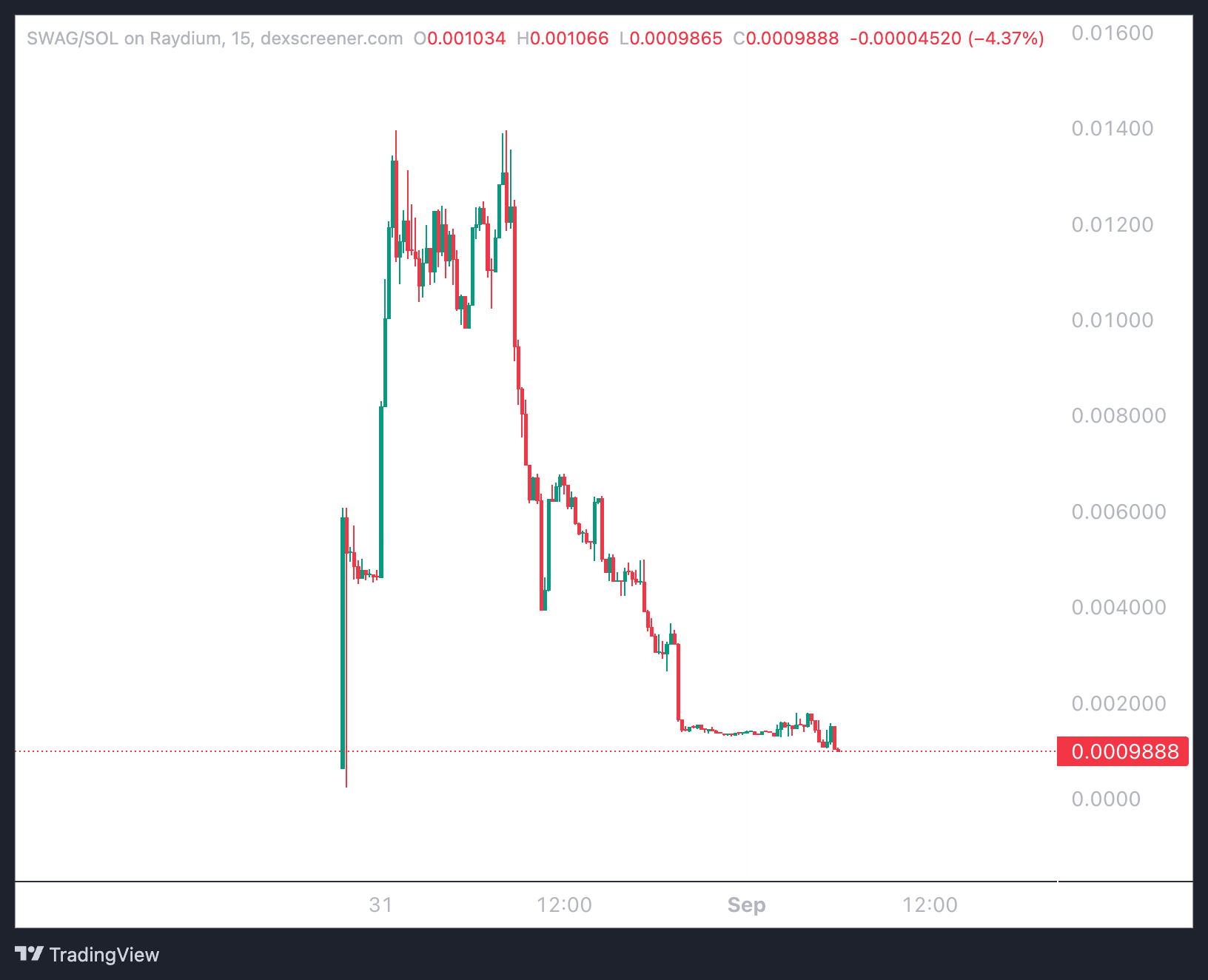
The most common is the classic pump-and-dump, where a rapid “pump” gives way to an abrupt “dump” as early participants liquidate their holdings. Many characterize this price action as a “rug pull,” where developers abandon the project and vanish with investor funds.
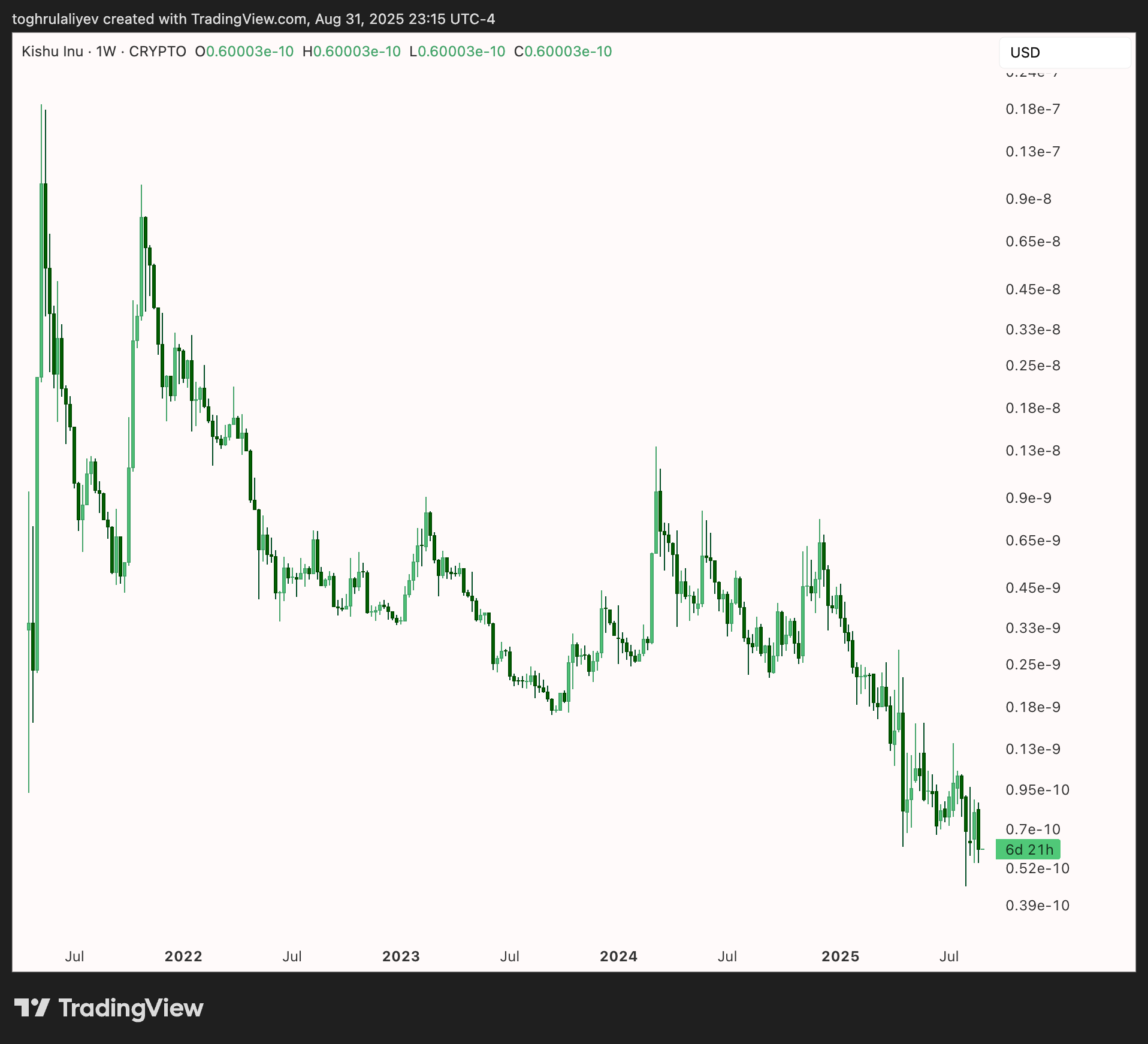
A second outcome follows a slower decay. A token rallies long enough to attract temporary interest, but once attention shifts, its liquidity evaporates, and it gradually fades into obscurity.
Regardless of the path, an inevitable crash erases over 80% of a token’s peak value, creating an almost zero-sum game for the majority.
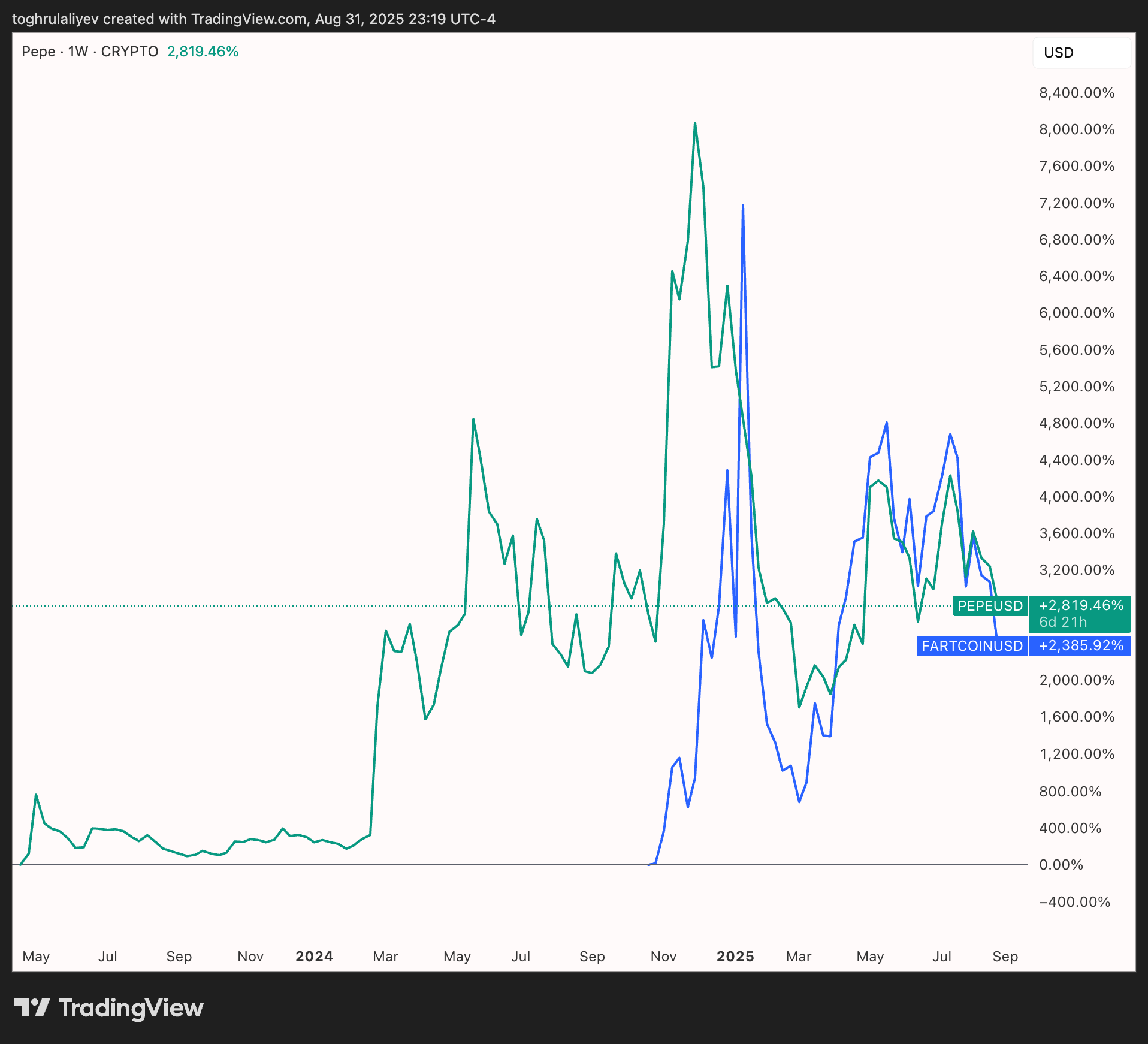
Only as a rare anomaly do outliers like Pepe (PEPE) or Fartcoin (FARTCOIN) defy this pattern and reach multi-billion-dollar valuations.
Unfortunately, traders often point to these exceptions as proof that success is possible, a classic case of survivorship bias that overlooks the thousands of projects that failed.
The Slot Machine Effect: Intermittent Variable Rewards
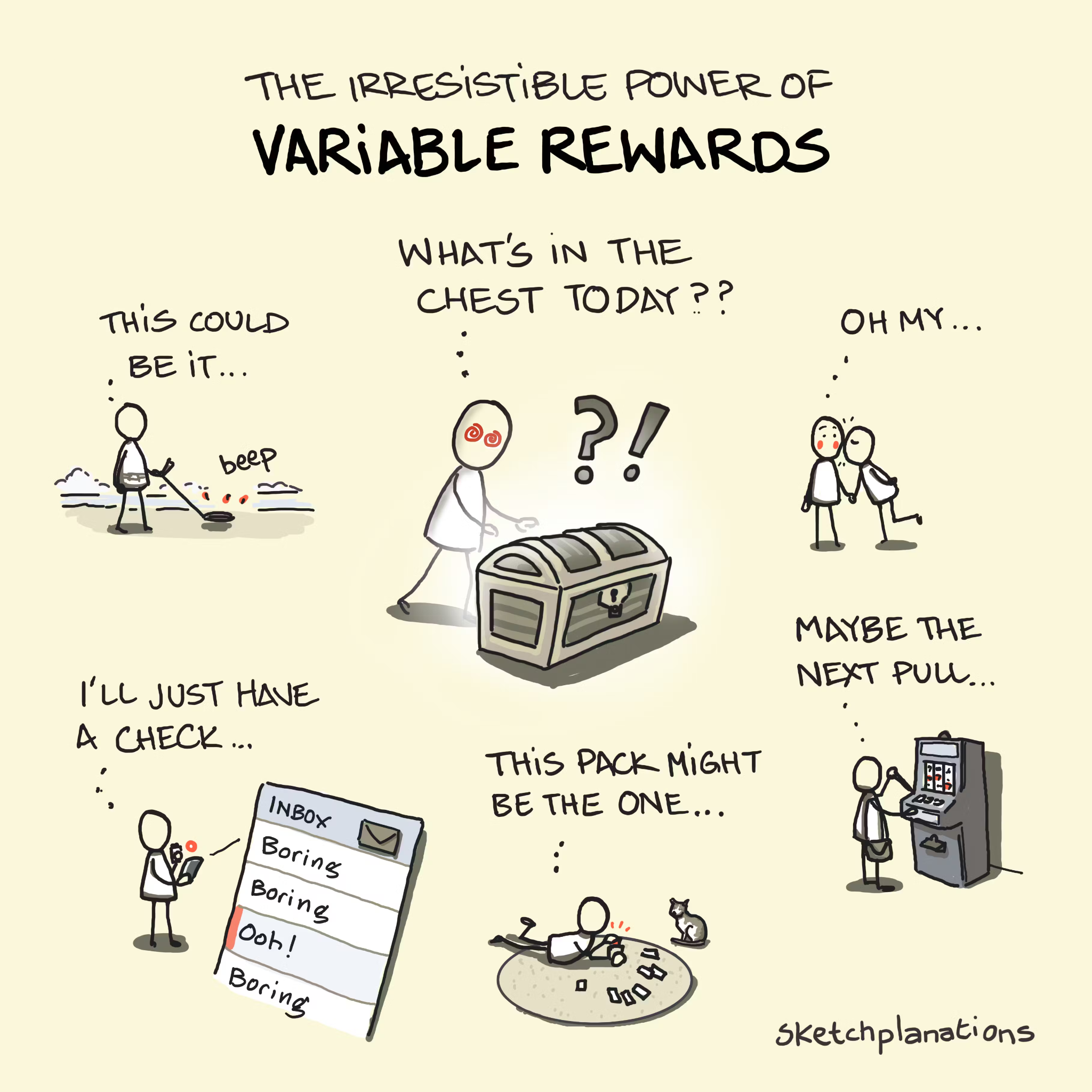
At the core of the memecoin market’s appeal is one of the most powerful drivers of compulsive behavior known to neuroscience: intermittent variable rewards. When rewards arrive unpredictably, they reinforce behavior far more strongly than consistent ones.
Figure 8: The Irresistible Power of Variable Rewards | Credit: Sketchplanations
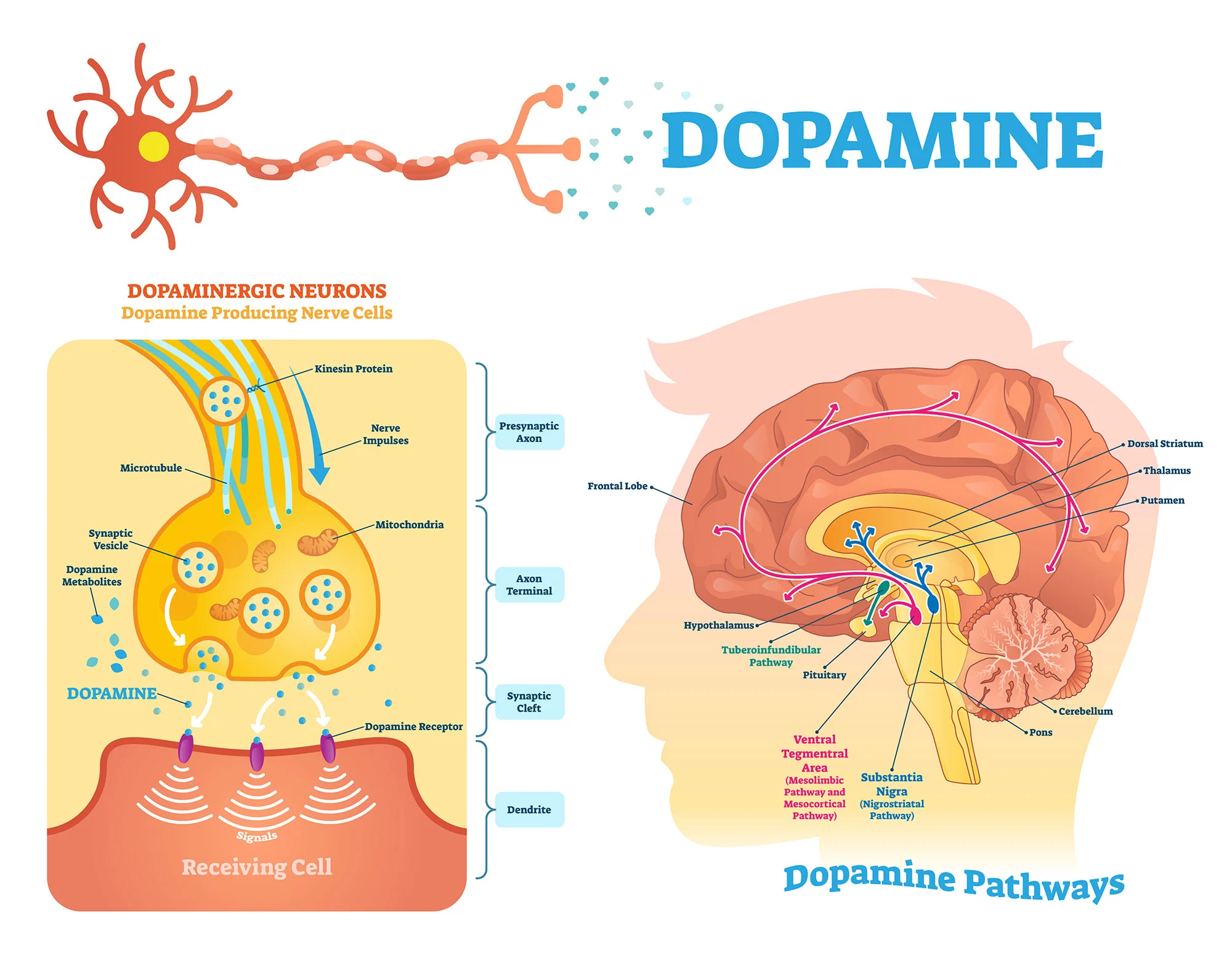
The mechanism is rooted in the brain’s dopamine system. Dopamine, the neurotransmitter associated with motivation and pleasure, is released not upon receiving a reward, but in anticipation of it.
If a reward is uncertain, the dopamine release can double, creating a potent neurological drive to repeat the behavior in hopes of securing the prize.
Figure 9: Dopamine Pathways in the Brain | Credit: Simply Psychology
This is the exact mechanism that makes slot machines, social media notifications, and video game loot boxes so compelling and, for some, addictive. Memecoin markets replicate the very same environment with near-perfect fidelity.
The unpredictable timing and astronomical magnitude of price “pumps” function as the variable reward.
Traders are not motivated by a steady, predictable return but by the ever-present possibility of a 100x “jackpot”.
The 24/7 nature of cryptocurrency markets, easily accessible via mobile applications, intensifies this effect by eliminating any “closed casino” downtime, thus creating a state of constant engagement and compulsive price monitoring.
The entire experience is gamified, with frequent price changes and the potential for overnight gains directly mimicking the structure of gambling and activating the same reward-seeking neural pathways.
Together, these forces create a powerful feedback loop where the thrill of anticipation, meaning the possibility of the next big win, keeps participants “pulling the lever” by executing trades, even in the face of repeated losses. The system has evolved from one that incidentally attracted gamblers to one that is technologically optimized to induce and exploit gambling-like behaviors at an industrial scale.
Cognitive Biases in Hyperdrive
On top of the mechanisms described earlier, such as FOMO, herd behavior, and emotional triggers, memecoins activate additional cognitive biases that intensify speculation.
One of the most prominent is the illusion of control paired with overconfidence. Traders develop an inflated sense of their ability to predict or influence outcomes. The “degen” subculture reinforces that belief by celebrating high-risk wagers and dismissing conventional analysis. Once overconfidence takes hold, it shapes decision-making. Risks are dismissed, funds that should remain untouchable get gambled away, and fundamental weaknesses such as broken tokenomics are ignored. The end result is financial distress on a severe scale.
Equally influential is confirmation bias. Investors seek out information that validates existing positions and avoid data that might contradict them. Community spaces reward optimistic narratives, so traders absorb positive posts and group enthusiasm while disregarding warning signs like suspicious advertisements and bot-like followers. Thus, confidence grows stronger as contrary evidence fades from view.
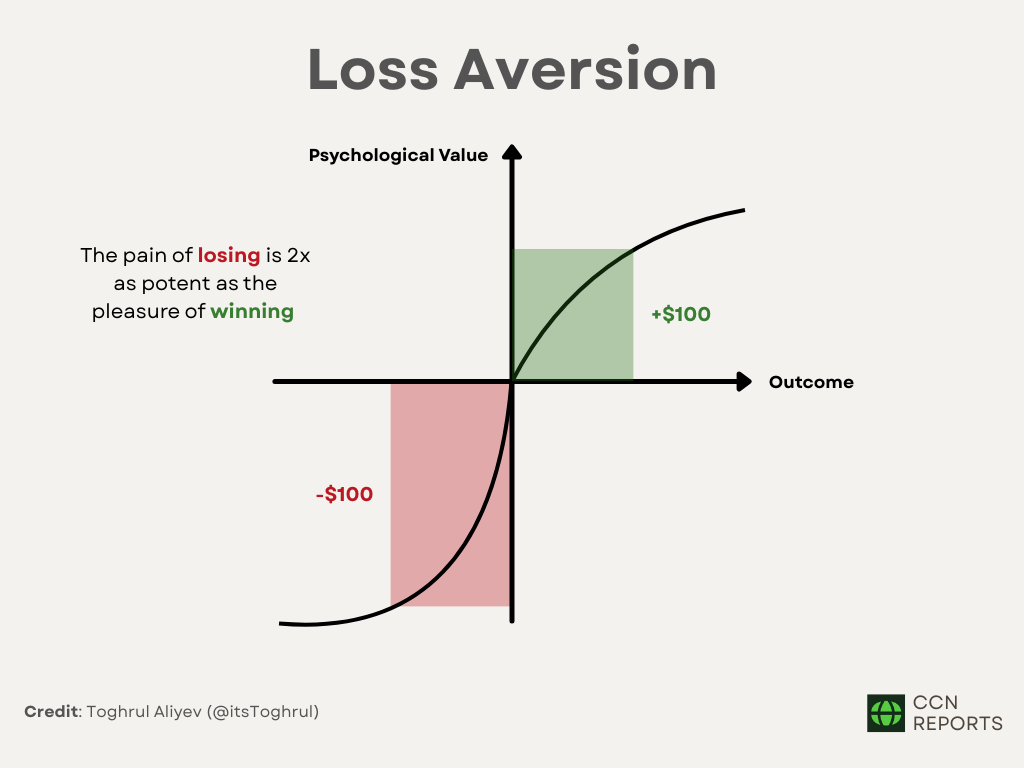
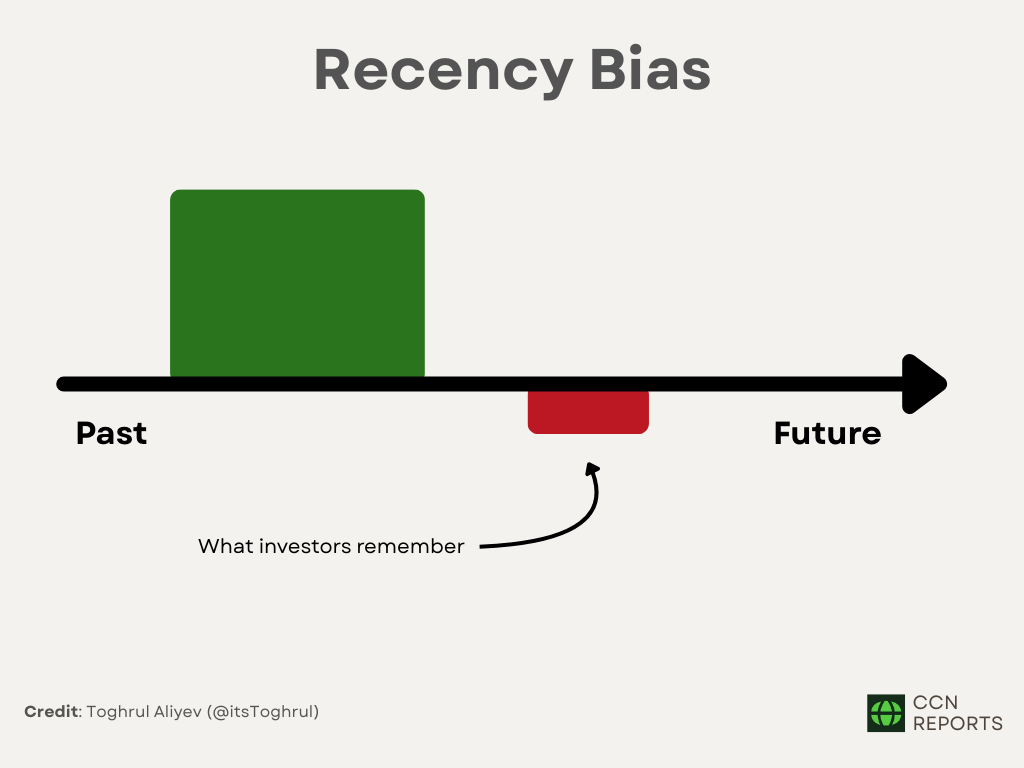
The chain of biases does not stop there, as loss aversion and recency bias come into play. The pain of losing outweighs the satisfaction of securing gains, which leads traders to hold declining assets in the hope of recovery.
None of the biases described in this report are accidents of behavior or brief inefficiencies. They form the foundation of memecoin markets. Prices emerge from collective irrationality that is amplified by social and technological infrastructure, turning speculation into the only source of value. In traditional markets, sentiment follows value. In memecoin markets, sentiment is value, and the system can operate only because irrationality is built into its design.
Mechanical Resemblance to Betting
Beyond the psychological drivers, the fundamental mechanics of memecoin trading bear a stronger resemblance to placing a wager in a casino than to making a financial investment in a productive asset. The structure of the “game” itself is one of chance rather than calculated risk based on underlying value.
First, memecoin speculation is overwhelmingly a low-information activity. Traditional investment involves fundamental analysis, which means examining an asset’s cash flows, utility, competitive landscape, and management team.
In contrast, memecoin decisions are typically based on the virality of a meme, the perceived influence of a social media account, or the momentum of a price chart. These are criteria more aligned with betting on a horse because of its catchy name than analyzing a company’s balance sheet.
Second, the extreme price volatility functions as the implicit “odds” in a betting contract. An asset with the potential for a 100x return but a 99% probability of collapsing to zero is not an investment in the traditional sense. It is a long-shot wager with defined, albeit unstated, odds. The potential payout is directly proportional to the immense risk of total loss, mirroring the structure of a lottery ticket or a high-odds sports bet.
Finally, the archetypal lifecycle of a memecoin, the pump-and-dump, is structurally analogous to a spin of a roulette wheel. A rapid, unpredictable price surge is followed by a devastating crash as early insiders and traders liquidate their positions. A few players who placed their bets early (on the “right number”) walk away with massive winnings. The vast majority of players who arrive late, drawn in by the hype, lose their entire stake, serving as the exit liquidity for the winners.
On-Chain Evidence: The “House” Always Wins
The narrative of gambling gains weight when tested against the on-chain data. It provides empirical, quantitative proof that the memecoin market functions with the economic structure of a casino.
All results were derived using Dune Analytics with a custom SQL query, inspired by @Adam_Tehc on X and Dune. The query aggregated trades at the wallet level, filtered for Pump.fun and Bonk.fun tokens, and calculated realized and unrealized P&L between August 1 and August 27. Percentages were computed by dividing the number of wallets in each P&L bracket by the total wallets in the dataset.
Wallet profitability analysis of Solana launchpads such as Pump.fun and Bonk.fun reveals a highly uneven distribution of outcomes, where most participants lose money while only a tiny fraction walk away with gains.
P&L Bracket
Total Wallets
Percentage of Total Wallets
Total Pump.fun Wallets
15,764,920
100.00%
Negative P&L
8,983,293
56.98%
Positive P&L
5,976,835
37.91%
> $1 P&L
4,515,385
28.64%
> $10 P&L
2,610,122
16.56%
> $100 P&L
715,003
4.54%
> $1,000 P&L
59,886
0.38%
> $10,000 P&L
4,008
0.0254%
> $100,000 P&L
254
0.0016%
> $1,000,000 P&L
88
0.00056%
Across both Pump.fun and Bonk.fun, the results are nearly identical. A clear majority of wallets lose money—57% on Pump.fun and nearly 65% on Bonk.fun.
The assumption that participation can lead to meaningful gains is not supported by the data at all. Only 0.38% of wallets on Pump.fun and 0.34% on Bonk.fun earned more than $1,000 in profit.
As profit thresholds increase, the odds of success decline even further, shrinking the pool of winners to a fraction of a fraction while the overwhelming majority of participants record realized losses.
P&L Bracket
Total Wallets
Percentage of Total Wallets
Total Bonk.fun Wallets
4,948,312
100.00%
Negative P&L
3,206,120
64.80%
Positive P&L
1,724,408
34.84%
> $1 P&L
1,287,583
26.02%
> $10 P&L
626,897
12.67%
> $100 P&L
200,687
4.06%
> $1,000 P&L
16,778
0.34%
> $10,000 P&L
920
0.0186%
> $100,000 P&L
34
0.00069%
> $1,000,000 P&L
0
0%
The probabilities are so skewed that they are hard to grasp. For memecoin traders, the chances of becoming a millionaire are lower than being accepted into an Ivy League college (3.4%–8.4%) or making it to Major League Baseball (0.2%–0.5%). They are also slimmer than hitting a hole-in-one as an amateur golfer (0.008%) or even being struck by lightning in a lifetime (0.005%–0.007%).
So, the odds are overwhelmingly against the average trader. No matter how strong their conviction is or how loud the noise is in their community channels, the math is merciless.
In reality, memecoins are a casino where the house always wins. And the house consists of only two parties:
The launchpads that extract fees from every listing, and
The creators or insiders who engineer supply, set the rules, and decide when to exit.
No one except them holds the winning tickets.
The vast majority will never see life-changing gains in a legitimate way. Unless someone is armed with insider information, running an industrial-grade sniper bot, orchestrating a coordinated rug pull, or simply catching a once-in-a-decade streak of dumb luck, their chances of escaping with substantial profits are significantly small. The more they believe otherwise, the deeper they feed their own confirmation bias, mistaking isolated success stories for replicable paths.
Not to mention the sheer scare of the competition. In late 2019, there were only about 5,000 cryptocurrencies. By 2022, that number had almost tripled to 22,000. Once the launchpads like Pump.fun accelerated token creation, the supply exploded.
According to CoinMarketCap (archived via Wayback Machine), the number of cryptocurrencies surpassed 2M in 2023, 2.4M by late 2024, and by August 2025 had ballooned to more than 20.37M. Finding the rare “gem” in that flood is less like investing and more like searching for a needle in a haystack, an almost impossible task.
Year
Cryptocurrencies
YoY Increase
2014
496
N/A
2015
632
27.42%
2016
649
2.7%
2017
1,514
146.58%
2018
2,094
38.31%
2019
4,986
138.11%
2020
8,153
63.52%
2021
16,238
99.58%
2022
22,157
36.45%
2023
2M+
8,926.49%+
2024
2.4M+
20%+
Aug 2025
20.37M+
748.75%+
The Moral Debate: Is Memecoin Adoption Worth the Price
So, if the structure is rigged, should the industry tolerate memecoins at all? The answer is both yes and no.
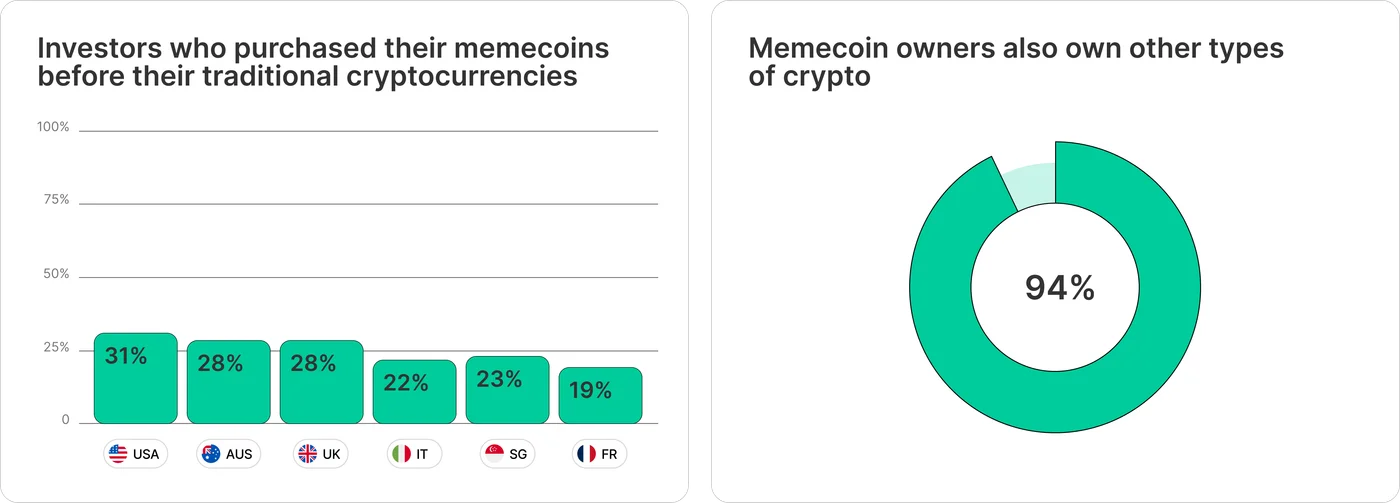
According to Gemini’s 2025 Global State of Crypto report, 94% of memecoin owners globally also hold other types of crypto, which shows transparent migration from memes into the broader asset class.
In the United States, 31% of investors who own both categories started with a memecoin first. Similar patterns appear in the UK and Australia (28%), Singapore (23%), Italy (22%), and France (19%).
Figure 12: Adoption and Ownership Trends Among Memecoin Investors | Credit: Gemini Exchange
In many ways, memes function as a necessary evil for the industry. They bring in newcomers. Some get lucky a few times and keep playing the rigged game, while others start losing immediately.
Either way, most eventually tire of burning money and look for a safer ground in fundamental assets like Bitcoin, Ethereum, or Solana. For some, the realization comes within weeks. For others, it takes months or even years. And for the unfortunate, it never comes at all.
Which is why the practical answer is yes: tolerate them. Not as an endorsement of the game, but because the pipeline from memecoins to meaningful ownership exists and converts at scale.
However, conversion comes at a steep cost. Most newcomers end up losing money. The structure of memecoins ensures that the majority act as exit liquidity for early buyers.
Beyond the financial hit, there is a human toll. Traders report rising stress, anxiety, and poor sleep as they chase price swings around the clock. The constant stimulation of notifications and volatile price charts fosters compulsive checking. For some, that cycle deepens into patterns that mirror gambling addiction: chasing losses, ignoring other responsibilities, and putting family or work life at risk.
Scam projects thrive in this environment, draining not only wallets but also credibility. From the outside, the spectacle of constant rug pulls and wild price crashes damages the reputation of crypto itself, reinforcing the belief that Bitcoin and blockchain are nothing more than scams.
But the dynamic can be seen in two distinct ways.
The positive view is that pain can be instructive. Losing money forces many to confront risk management for the first time. It exposes the need for discipline, position sizing, and sober reflection on probability.
For those willing to learn, early speculation becomes a brutal but effective teacher. It compresses years of lessons into months, showing why patience, research, and long horizons matter. That struggle, while costly, often leads people to more stable ground in Bitcoin, Ethereum, or Solana, where they find a framework better suited to building wealth over time.
The pessimistic view is that not everyone learns. Some enter a streak of early wins and mistake luck for skill. Others refuse to change, convinced that the next token will finally deliver the jackpot. These habits harden into a style of thinking that carries over into every investment decision.
In that scenario, memecoin speculation does not remain an entry-level mistake; it poisons the entire journey. The same mindset can wreck portfolios in Bitcoin or traditional equities, where risky trades replace long-term planning. Instead of teaching resilience, the experience breeds recklessness.
Taken together, the outcome resembles a coin toss. For some, memecoins serve as an expensive initiation that ultimately drives them toward better habits. For others, they cement destructive behavior that undermines every future investment choice.
However, if the Trojan Horse metaphor holds any truth, the deciding factor is where participants arrive after the chaos. If, after hardship, the funnel delivers people into fundamental assets and long-term thinking, the balance leans toward tolerance. The pain becomes part of the process, and the outcome counts as a win.
Toghrul Aliyev is the Head of Research who began his journey in crypto in 2021. It all started with a Reddit post that went viral, leading to a writing position while he was still in medical school. As he learned more about crypto, he became deeply interested in it and decided to focus entirely on this field after completing his medical degree and becoming a doctor.
Toghrul specializes in thorough research, always aiming to find details others might miss. He also has a strong understanding of stocks, real-world asset tokenization, and related areas. He is skilled in Python and SQL, which he uses to improve his crypto analysis through data analytics and data science.
When he’s not working, Toghrul enjoys sports, hiking, reading philosophy, such as Seneca's works, and playing story-driven video games.