The Bithumb incident highlights a weakness that persists even at large, regulated platforms.
Share
Key Takeaways
The Bithumb incident did not alter Bitcoin’s supply or blockchain activity, but it showed how easily exchange-side accounting errors can distort what users see and trade.
Centralized exchanges rely on internal ledgers that operate separately from the blockchain, meaning balances can appear on-screen without on-chain backing.
The brief price drop reflected a local failure, not a market-wide breakdown, underscoring how exchange mechanics can mislead price signals without affecting the protocol.
Regulators are now examining operational controls rather than cybersecurity alone, shifting attention to how exchanges validate balances and manage internal systems.
A promotional error briefly credited 620,000 Bitcoin that never existed. The blockchain remained untouched. However, the exchange layer did not, exposing a major vulnerability.
Bithumb mistakenly credited 695 users with at least 2,000 Bitcoin each during a customer reward campaign intended to distribute small cash bonuses worth around 2,000 Korean won, or roughly $1.37-$1.40.
Community post on the Bithumb error | Source: @cryptofundix
In total, user accounts showed about 620,000 BTC, representing close to 3% of Bitcoin’s maximum supply of 21 million and $44 billion at prices at the time of the incident.
Some local reports noted that only a portion of affected users opened their promotional “Random Boxes” before the exchange froze accounts, meaning only a fraction of the credited balances became actively accessible.
The error did not involve hacking, stolen private keys, or any compromise of the Bitcoin network.
Bithumb said the incident resulted from an internal mistake in its promotional distribution system.
Trading and withdrawals for affected accounts were restricted shortly after detection.
The exchange reported that it had recovered 99.7% of the credited BTC, covering the remaining amount with corporate funds and pledging 110% compensation.
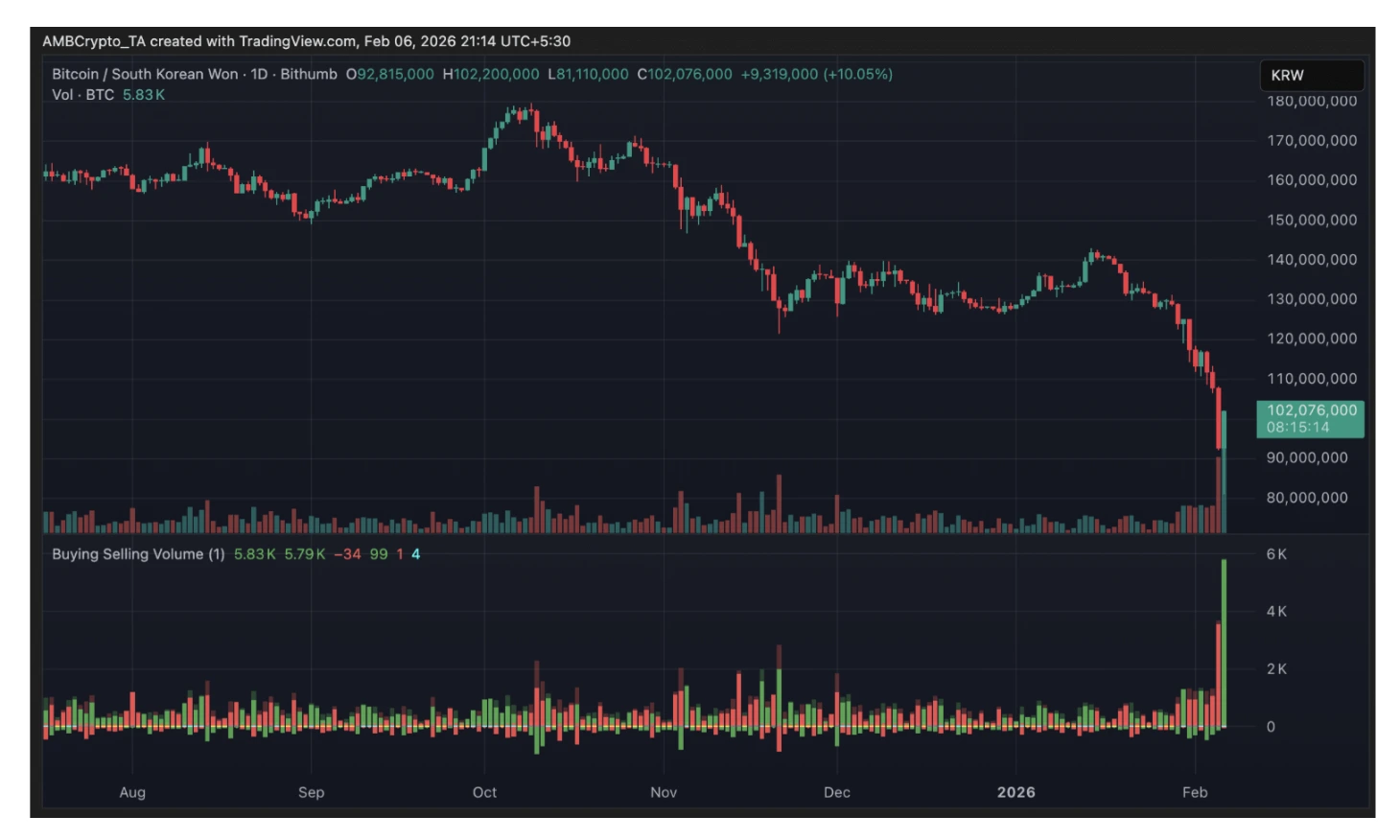
Bitcoin prices on Bithumb briefly fell by around 17% before stabilizing, while prices on other global exchanges continued trading normally, according to exchange-reported data.
On-chain metrics showed no unusual activity. Bitcoin reserves remained unchanged.
For many observers, the episode appeared to be a contained operational error. Markets moved on quickly.
Yet the incident exposed a deeper structural issue inside centralized exchanges (CEX) that has little to do with Bitcoin itself.
This article explains what happened, why it matters, and what the Bithumb error reveals about the risks embedded in centralized crypto infrastructure.
What Actually Happened at Bithumb
The sequence of events began with a marketing promotion. Bithumb planned to distribute small cash rewards to selected users as part of a customer engagement campaign.
Instead of crediting Korean won, an internal script credited Bitcoin. The system did not limit the amount. It did not cross-check balances against reserve and it did not flag the discrepancy.
The promotion was designed to distribute 2,000 Korean won per user, but the script applied the same numeric value to Bitcoin, effectively crediting 2,000 BTC instead of 2,000 won.
As a result, hundreds of users suddenly saw balances showing thousands of Bitcoin.
According to reports, roughly 1,786 BTC were sold into Bithumb’s order books before the exchange halted trading for affected accounts.
Bitcoin price movement on Bithumb following the error | Source: TradingView
The price drop occurred only on Bithumb, not across the broader market, signaling that the problem was isolated to the exchange’s internal systems.
The exchange identified the error within minutes and reversed most balances the same day. No Bitcoin moved on-chain.
Bithumb said there were no issues with system security or customer asset management. South Korean regulators disagreed that the matter could end there.
How South Korean Regulators Responded to the Bithumb Bitcoin Error
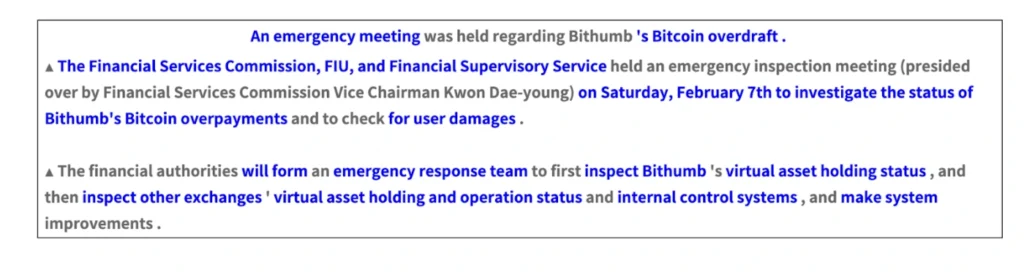
Following the incident, the Financial Services Commission (FSC), together with the Financial Intelligence Unit (FIU) and the Financial Supervisory Service (FSS), held an emergency inspection meeting on Feb. 7, 2026, to assess the Bithumb incident and determine next steps.
Emergency meeting announcement | Source: FSC
Regulators said the inspection could expand to other exchanges and escalate to formal on-site examinations if they identify violations or irregularities.
Rather than concentrating only on hacks or market volatility, authorities are increasingly examining the internal mechanics of exchanges, including accounting controls, validation logic, and operational safeguards,among others.
That shift mirrors lessons regulators and users in South Korea have learned before.
Bithumb’s Compensation Framework After the Error
Bithumb structured its response around multiple restitution measures aimed at stabilizing user confidence and addressing regulatory concerns.
Targeted price compensation: The exchange committed to compensating users who sold Bitcoin at depressed prices during the incident window 1 around 10:00 UTC on Feb. 6. Bithumb said it would cover the full price difference compared with the global average and add an additional 10% compensation.
Platform-wide user credit: Bithumb credited 20,000 Korean won, or about $14, to every user who logged into the platform during the roughly 20-minute period when the error occurred.
Temporary fee suspension: The exchange implemented a zero-fee trading policy across all listings for seven days starting Feb. 9, aiming to restore liquidity and normalize trading activity.
Beyond immediate restitution, Bithumb also announced plans to establish a customer protection fund worth 100 billion won, or about $68 million. The fund is intended to act as a standing buffer against future operational errors, including input and system failures.
Why the Samsung Securities Case Still Matters
The Bithumb incident immediately revived comparisons to a 2018 failure that remains fresh in the minds of South Korean regulators.
In April 2018, Samsung Securities mistakenly issued 2.81 billion shares, worth 112.6 trillion won shares after an employee entered a dividend payment as shares instead of cash.
The error temporarily valued the phantom shares at around $105 billion, far exceeding the company’s market capitalization.
Some employees sold millions of those shares before the detection of the mistake. Samsung Securities lost about 12% of its market value permanently.
At Samsung Securities, the firm allowed the mistakenly issued shares to enter the Korea Exchange settlement system, which let the error spread beyond the company and trigger legal and reputational damage.
At Bithumb, the exchange kept the phantom Bitcoin inside its internal ledger. The platform never settled those balances on the blockchain, so the error remained contained.
That containment limited market fallout while exposing a structural weakness inside the exchange itself.
The Analyst Perspective: Why This Was Not “FTX 2.0”
Much of the early reaction on social media framed the incident as a potential replay of past exchange collapses. Independent researcher Shanaka Anslem Perera rejected that comparison and explained the facts.
Perera works at the intersection of monetary theory, physics, and systems design. His research spans Bitcoin’s monetary properties, thermodynamics, and institutional failure modes.
In a detailed analysis published on Feb. 8, 2026, Perera argued that Bithumb’s failure was operational.
$44 billion in Bitcoin that never existed just traded on a live exchange for 20 minutes and the entire market is drawing the wrong conclusion.
Friday, 7pm Seoul. Bithumb runs a promo where winners get 2,000 Korean won.
FTX collapse: The exchange intentionally misused customer funds, concealed liabilities, and triggered an insolvency that spread across counterparties.
Bithumb incident: The exchange recorded a database error that remained confined to its internal ledger and never reached the blockchain.
Bitcoin’s supply never changed, and the Bitcoin blockchain continued to operate as designed.
How Centralized Exchange Ledgers Create the Illusion of Bitcoin Balances
At the core of the Bithumb incident lies a mechanism most users rarely question: the internal ledger.
Every centralized crypto exchange maintains its own accounting system that tracks user balances independently of the blockchain.
When users open an exchange app and see a Bitcoin balance, they are not viewing Bitcoin on-chain. They are seeing a database entry controlled entirely by the exchange.
That entry becomes real Bitcoin only when a withdrawal occurs and the transaction settles on the blockchain.
In Bithumb’s case, a promotional script credited balances that exceeded the exchange’s actual Bitcoin holdings by more than 14 times. No automated safeguard prevented the mismatch. No reserve verification blocked the entries before they appeared in user accounts.
For a short period, the system treated those balances as legitimate.
The trading engine accepted them.
Orders executed against them.
Phantom Bitcoin interacted with real liquidity.
South Korean lawmaker Na Kyung-won summarized the issue succinctly, according to local media, stating that if an exchange merely shifts figures within its internal ledger without any corresponding movement on the blockchain, it is effectively selling assets it does not possess.
That description applies broadly across the CEX industry.
Why Bithumb’s Bitcoin Error Was an Internal Control Failure, Not a Hack
Market reaction focused on the brief price drop visible on Bithumb’s order books.
Prices on other exchanges remained stable, and on-chain data showed no unusual activity throughout the incident.
Several factors explain why the price signal proved misleading:
Localized price impact: The price drop occurred only on Bithumb, where phantom balances interacted with real liquidity inside the exchange’s order books.
No cross-exchange contagion: Other exchanges continued trading normally, indicating the absence of broader market stress.
On-chain stability: On-chain metrics remained unchanged, confirming that no real Bitcoin moved or settled during the incident.
Bitcoin’s supply schedule never shifted, and the Bitcoin blockchain continued to function as designed. The instability emerged from the CEX layer that displays balances and routes trades, not from the protocol itself.
That distinction reframes the event as an exchange-side failure rather than an asset-level crisis and leads directly to the next question: if the blockchain did not fail, what broke inside the exchange?
Centralized exchanges remain essential to crypto markets. They provide liquidity, fiat access, and ease of entry. They also concentrate risk.
The Bithumb incident highlights a weakness that persists even at large, regulated platforms.
Internal ledgers lack native mechanisms that bind user balances to on-chain reserves in real time. Most safeguards rely on:
Operational discipline: Exchanges rely on internal procedures and human oversight to ensure systems behave as intended during routine operations and promotions.
Internal audits: Firms conduct periodic reviews to identify discrepancies between recorded balances and actual holdings after activity has occurred.
After-the-fact reconciliation: Exchanges correct errors retrospectively by matching internal ledger entries with on-chain assets once an issue surfaces.
These measures function under normal conditions. They break down due to errors, misconfiguration, or unexpected interactions between systems.
When failures occur, exchanges can often reverse transactions quickly, as Bithumb did. The danger lies in assuming that reversibility removes exposure when it does not.
What the Bithumb Error Signals About Future Exchange Risk
The Bithumb incident remained operationally contained, but it exposed a risk pattern that CEXs have not fully addressed.
As long as platforms rely on internal ledgers that operate independently from on-chain settlement, errors can surface in ways that users, regulators, and markets only recognize after the fact. Reversibility limits damage, but it does not prevent disruption.
This places growing pressure on exchanges to redesign how internal systems interact with trading engines, custody infrastructure, and promotional tools. Validation logic, reserve checks, and system segregation now sit at the center of regulatory and operational scrutiny.
For regulators, the episode strengthens the case for closer oversight of internal controls rather than focusing solely on cybersecurity breaches.
For users, it reinforces the distinction between exchange balances and on-chain assets.
The incident challenged assumptions about the reliability of the intermediaries built around it.
How CEXs respond to that challenge will shape trust, regulation, and infrastructure design in the next phase of crypto markets.
What would have happened if the phantom Bitcoin had settled on-chain?
If the balances had reached on-chain settlement, the error could not have been reversed unilaterally and would have triggered legal, liquidity, and possibly systemic consequences.
Could similar errors happen on other centralized exchanges?
Yes. Most centralized exchanges use comparable internal ledger architectures, which means similar operational failures remain possible without stronger validation constraints.
Do proof-of-reserves disclosures prevent this type of incident?
No. Proof-of-reserves snapshots show asset holdings at a point in time but do not stop internal systems from crediting incorrect balances in real time.
Does this incident affect Bitcoin’s monetary credibility?
No. Bitcoin’s issuance, supply cap, and settlement rules remained unchanged throughout the incident.
Disclaimer:
The information provided in this article is for informational purposes only. It is not intended to be, nor should it be construed as, financial advice. We do not make any warranties regarding the completeness, reliability, or accuracy of this information. All investments involve risk, and past performance does not guarantee future results. We recommend consulting a financial advisor before making any investment decisions.
Dr. Lorena Nessi is an award-winning journalist and media technology expert with 15 years of experience in digital culture and communication. Based in Oxfordshire, UK, she combines academic insight with hands-on media practice.
She holds a PhD in Communication, Sociology, and Digital Cultures, and an MA in Globalization, Identity, and Technology.
Lorena has taught at Fairleigh Dickinson University, Nottingham Trent University, and the University of Oxford. She is a former producer for the BBC in London, with additional experience creating television content in Mexico and Japan.
Her research focuses on digital cultures, social media, technology, capitalism, and the societal impact of blockchain innovation.
She has written extensively on digital media and emerging technologies, with her work featured in both academic and media platforms. Her Web3 expertise explores how blockchain technologies shape culture, economics, and decentralized systems.
Outside of work, Lorena enjoys reading science fiction, playing strategic board games, traveling, and chasing adventures that get her heart racing. A perfect day ends with a relaxing spa and a good family meal.


 Easy
Easy