A tiny agri-tech firm is attempting to become a NASDAQ-listed proxy for AVAX exposure.
The $550M is planned, not closed, meaning the deal terms can change at any time.
This move is part of Avalanche’s broader push to generate public digital asset treasuries.
Real progress looks like closed financing, disclosed wallets, and a certified purchase cadence.
In a surprising twist at the intersection of traditional finance and blockchain, a tiny agri-tech firm is reinventing itself as Wall Street’s newest crypto proxy. AgriFORCE Growing Systems Ltd. (NASDAQ: AGRI), once focused on sustainable agriculture technologies, has announced plans to pivot entirely toward digital assets, positioning itself as the first NASDAQ-listed company offering direct exposure to Avalanche’s native token, AVAX.
Rebranding under the “AVAX One” banner, the firm intends to raise more than half a billion dollars to acquire and stake AVAX, effectively transforming from a niche agricultural innovator into a publicly traded vehicle for Avalanche ecosystem exposure.
The move, unprecedented in scope for a micro-cap company, underscores how far the lines between traditional equities and crypto assets have begun to blur.
Try Our Recommended Crypto Exchanges
Sponsored
Disclosure
We sometimes use affiliate links in our content, when clicking on those we might receive a commission at no extra cost to you. By using this website you agree to our terms and conditions and privacy policy.
AgriFORCE’s Pivot to AVAX One: A New Model for Public Market Crypto Exposure
On Sept. 22, 2025, sustainability-focused Bitcoin mining entity AgriFORCE Growing Systems (AGRI) announced a name change to AVAX One and its plans to raise around $550 million with the goal of investing it all in AVAX tokens. This plan, should it succeed, would make AVAX One the first NASDAQ-listed company “with a dedicated strategy to maximize ownership of AVAX.”
Skybridge Capital founder Anthony Scaramucci and Head of Coinbase Institutional Brett Tejpaul joined to lead the firm’s advisory board. Both plan to invest.
Basically, think of the company as a token-accumulation entity. It will raise money in traditional markets, buy AVAX, then market itself as the method of Avalanche exposure. A digital asset treasury (DAT).
What is a Digital Asset Treasury (DAT)?
If AgriFORCE’s approach sounds like Strategy buying Bitcoin with stock and debt sales, that’s the point. Public “crypto treasuries” give investors a way to profit from a token without holding it directly.
AgriFORCE’s play is deliberate, not a random ecosystem play. It coincides with Avalanche’s push to seed DAT companies, targeting $1 billion in investments. DAT Avalanche Treasury Co. (AVAT), an entity working with the Avalanche Foundation, announced a $675 million strategic arrangement with the Mountain Lake Acquisition Corp (MLAC) to list on NASDAQ in Q1 2026.
Every move emphasizes public AVAX exposure.
Separating Hype from Reality: Evaluating AVAX One’s Ambitious Pivot
Now, the announcement sounds exciting for AVAX holders, no doubt. But you must separate the announcement’s hype from its reality:
Speculative value: Before this announcement, AGRI was a small company in terms of market cap. This makes its 135% boost a little less impressive, though still notable. But investors are speculating on its plan becoming a success. The entity has to raise the money.
The raise isn’t done: AGRI’s SEC filing notes an intended raise, not a completed, fully funded balance sheet. Anything can happen between now and completion, including the deal falling through. Terms can change, numbers can decrease.
Think about it like this: imagine a small town bakery announcing plans to raise hundreds of millions to become a nationwide coffee chain. This may attract investors, but the plan is currently in its ambition stage until it earns the money.
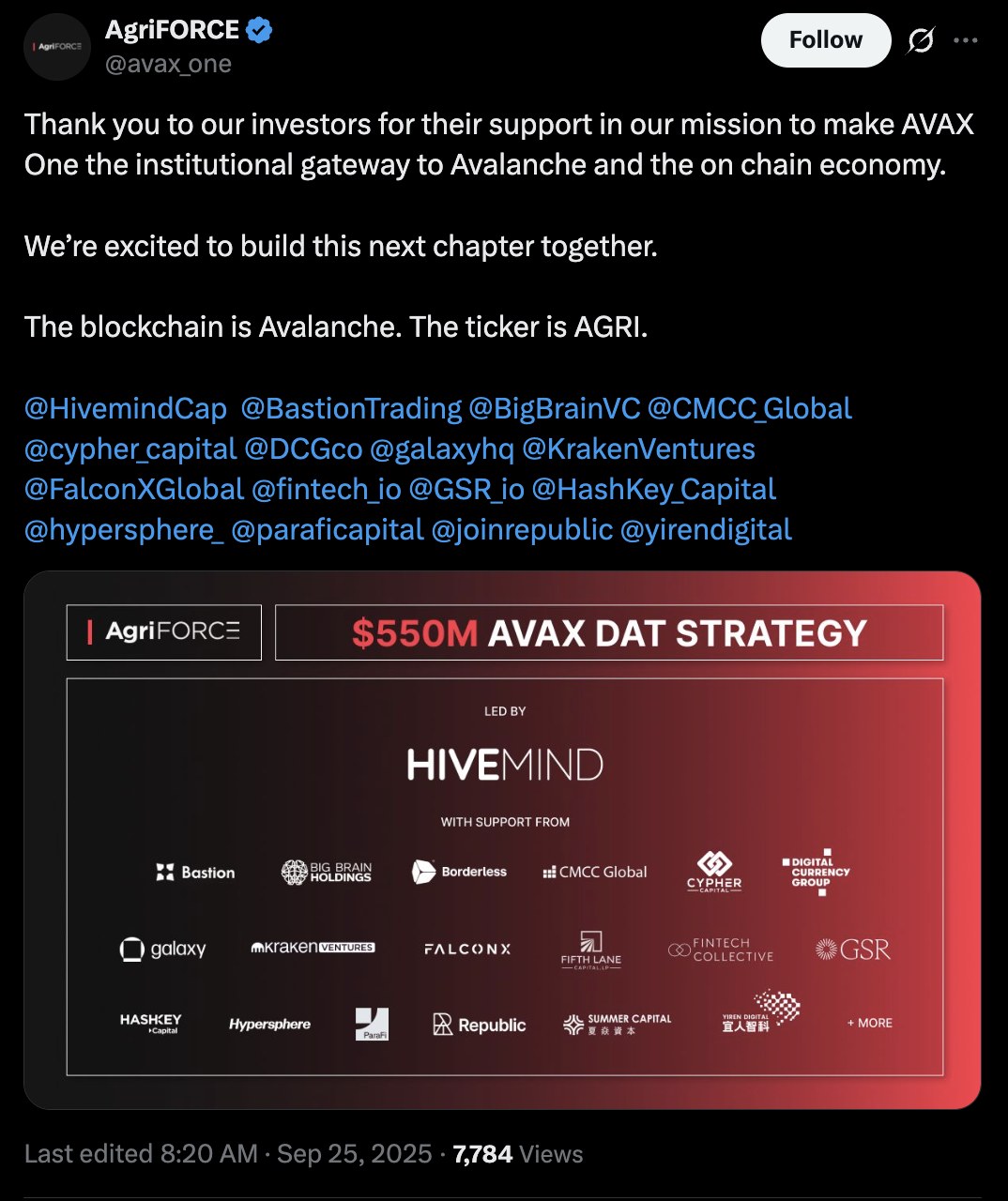
The AGRI DAT strategy. | Source: @avax_one on X
Why Avalanche and What to Watch Next in AVAX One’s Bold Experiment
As mentioned, Avalanche has been positioning itself as a capital-markets-friendly chain, meaning it offers fast transaction finality, subnetworks for app-specific flows, and a push into tokenization of real-world assets (RWAs). A public company accumulating AVAX could then, in theory, bring more attention to the network’s strategy, especially if it plans to tokenize assets or bring more companies into its fold, which “AVAX One” intends to do.
What Could Go Right?
A lot can go right with this recent movement:
Signal value: If the raise actually lands near where it needs to, that’s a significant, public endorsement of the AVAX network, adding market depth and contributing to positive sentiment.
Public-market access: As a DAT, AVAX One investors gain exposure to AVAX without holding the token itself. This can expand the market to institutional investors who are too scared to buy crypto by itself.
Ecosystem support: If AVAX One successfully pursues tokenization, it could create real economic activity within the network, backing the value-add beyond a simple number going up.
What Could Go Wrong?
All of that said, a lot can go wrong as well:
Shareholder dilution: Again, AGRI is a micro-cap company. Issuing a ton of new shares can dilute the holdings of early investors, lowering their value and creating negative sentiment among the entity’s first buyers.
Concentration risk: Tying a significant amount of AVAX’s value to a corporation can have dire consequences. AVAX One must still operate a successful business, and if AVAX sells off or crashes, the company is at risk.
Consider another bakery analogy: if management borrows and sells a lot of new shares to buy coffee beans, the stock is, in a way, tied to the value of said beans. Should beans drop in value, the company’s stock will likely follow.
What to Watch Next
If you’re keeping an eye on this story, watch out for the following developments:
Deal structure and terms: If AVAX One raises the $550M, is it coming from a few investors or many? Additional investors may alter the deal, and can even dilute holdings.
Governance and roles: Who’s on the finalized advisory board? DAT policies decide how to allocate assets, after all.
Custody and risk: Which custodian manages the assets? How is it insured? Will the entity buy AVAX programmatically, or all at once?
Tokenization roadmap: If AVAX One and its partners are to tokenize, what’s the long-term execution plan?
A Bold but Unfinished Step in Avalanche’s Capital Markets Vision
AgriFORCE’s pivot to AVAX One isn’t a fluke. It fits a wider Avalanche strategy to bring DATs into public markets and make AVAX a native asset for capital markets investors. It’s a bold move that’s not too dissimilar from Strategy or BitMine’s approach to digital assets.
But it’s also unfinished. Until the money closes and on-chain wallets are filled, treat this as an ambitious plan, not a finished deal.
How can I verify if AVAX is actually being purchased?
Look for disclosed custodian/wallet addresses. On-chain activity should match these reports.
What happens if the raise only partially closes?
The strategy can still proceed at a smaller scale. However, dilution, project timeline, and its market impact will shrink accordingly.
How does this differ from Strategy’s Bitcoin approach?
AVAX One focuses on a different asset, and Avalanche is a decentralized finance platform, meaning liquidity will provide more utility than an asset like Bitcoin.
Can the company lend AVAX to earn yield?
Possibly, but this does add additional smart-contract risk. Look for explicit mentions of this in the treasury policy.
Disclaimer:
The information provided in this article is for informational purposes only. It is not intended to be, nor should it be construed as, financial advice. We do not make any warranties regarding the completeness, reliability, or accuracy of this information. All investments involve risk, and past performance does not guarantee future results. We recommend consulting a financial advisor before making any investment decisions.
Max Moeller is a Chicago‑based writer and video editor passionate about games, tech, and crypto. Whether it’s crafting clear, insightful articles or piecing together engaging video retrospectives, he’s driven by curiosity and takes pride in keeping things human. Since 2017, Max has been published in a variety of notable crypto magazines.


 Easy
Easy