As decentralized finance matures, the challenges facing sophisticated traders are beginning to resemble those of traditional markets. Liquidity is no longer scarce, but it is scattered.
Capital is spread across perpetual exchanges, lending protocols, and yield venues, each operating in isolation. While DeFi has made rapid progress in security, infrastructure, and market depth, the absence of unified risk and margin management has left users managing fragmented positions across multiple platforms.
Project 0 was built to address this exact problem. Designed as the first DeFi-native prime broker, the platform aims to unify margin, risk, and credit across venues, bringing an institutional-grade layer to on-chain trading without sacrificing self-custody or permissionless access.
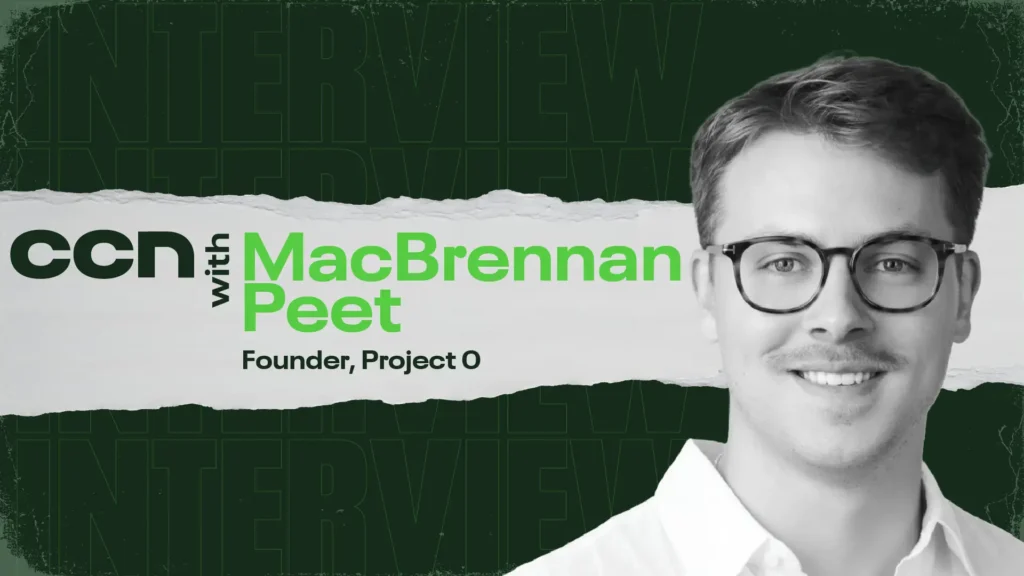
Project 0 founder MacBrennan Peet told CCN that the company solves capital fragmentation issues by letting the user borrow against their entire portfolio across multiple venues. It also accounts for combined exposure.
Let’s find out how.
A Market Finally Ready for Unified Risk
Peet explains that two major shifts in the DeFi landscape set the stage for Project 0. First, security and risk management have meaningfully improved. DeFi programs now rely on heavily audited code frameworks, work closely with independent security firms, and apply extensive internal testing. These practices have significantly reduced hacks across the industry.
At the same time, market risk has declined as DeFi venues have consolidated. Rather than a constant churn of short-lived platforms, a small number of venues have emerged as long-term winners in their respective markets. Users now keep funds on platforms with staying power, which makes cross-venue integrations far less risky and far more durable.
According to Peet, these developments exposed a structural issue that had long gone unsolved: most DeFi users operate across two or more venues, leaving their capital fragmented.
Turning Fragmented Capital Into Unified Borrowing Power
Peet says traditional finance solved this problem decades ago through prime brokers, but DeFi lacked an equivalent. Project 0 was created to fill that gap.
Instead of evaluating risk on a venue-by-venue basis, Project 0 lets users borrow against their entire portfolio across multiple platforms. The protocol also accounts for combined exposure. If a user is long on one venue and short on another, those positions may offset each other at the portfolio level, even though each venue independently views them as risky.
Project 0 recognizes this reduced risk and allows users to borrow more than they could on any single platform.
“This transforms fragmented capital into unified borrowing power, unlocking liquidity that would otherwise remain idle,” explains Peet.
Self-Custodial Accounts and Cross-Venue Margin
At the core of Project 0 is a system of self-custodial, permissionless accounts that sit between users and integrated venues. These accounts enable the protocol to liquidate positions when they breach thresholds defined by its risk engine, protecting both borrowers and lenders.
Because users access venues through Project 0, the platform has visibility into positions across all connected venues. This allows its credit engine to extend loans against a user’s full portfolio rather than isolated balances. Peet compares the model to lending protocols like Aave, where lenders deposit into a credit pool and borrowers take loans against collateral, with one key distinction: Project 0 supports borrowing and lending across multiple venues instead of being limited to a single protocol.
While all lending remains overcollateralized, Project 0 changes how collateral is calculated by looking at total portfolio value. If account health drops to critical levels, liquidators can close positions across venues, beginning with partial liquidations to minimize impact and prevent bad debt.
Security, Audits and the Brutus Risk Engine
Peet emphasizes that security is foundational to Project 0’s design. The protocol has been audited 11 times and is built on code that has survived all major Solana market events over the past three years without security incidents or bad debt. Alongside this, the team maintains a strong internal testing culture.
Powering the system is Project 0’s risk engine, Brutus, which produces production-grade risk variables using crypto-native market data pipelines. Today, Brutus informs static parameters such as LTVs, deposit caps, and interest rate curves, which are updated manually- standard practice across DeFi.
The next phase will push this further. In 2026, Project 0 plans to evolve Brutus to deliver real-time, on-chain updates to risk variables in response to changing market conditions, allowing risk parameters to adapt immediately as liquidity and volatility shift,” says Peet.
A Multi-Chain Future for Prime Brokerage in DeFi
Looking ahead, Peet says the same architecture that enables Project 0 to cross-margin venues on Solana can work across any blockchain. Expanding to new chains requires native liquidators and a messaging layer to monitor account health and trigger liquidations across networks.
For now, Project 0 is focused on integrating additional Solana venues on its roadmap, with cross-chain assessments planned after that phase. Longer term, Peet envisions unified margin across chains and venues, allowing capital on one blockchain to serve as collateral for products on another.
He also points to automation as a key area of growth. Recent launches already enable users to execute multi-venue rate, carry, and basis strategies with unified margin in a single click. More automations, he says, will follow starting in 2026 as Project 0 continues to simplify complex DeFi strategies while maintaining robust risk controls.
The information provided in this article is for informational purposes only. It is not intended to be, nor should it be construed as, financial advice. We do not make any warranties regarding the completeness, reliability, or accuracy of this information. All investments involve risk, and past performance does not guarantee future results. We recommend consulting a financial advisor before making any investment decisions.

Dr. Guneet Kaur is a senior editor at CCN.com and a Science Fellow at Exponential Science. She is a fintech and blockchain expert with extensive experience in digital finance education, blockchain ecosystems, and cryptocurrency markets. She has worked with global media such as Cointelegraph, as well as education and blockchain platforms, to design and lead strategic content and learning initiatives. As an educator and assessor for top-tier executive programs, she bridges real-world fintech trends with academic insight.
Dr. Kaur is also a published researcher and peer reviewer across fintech and data science journals, including Financial Innovation Journal and International Journal of Big Data Intelligence and Applications. Her work spans data-driven analysis, Web3 innovation, and technical content development. With a strong foundation in both industry and academia, she translates complex financial technologies into practical applications, empowering learners, professionals, and institutions across the rapidly evolving digital finance landscape.


 Easy
Easy