Canary Capital filed an S-1 with the SEC on April 8 to launch a spot PEPE ETF, adding the memecoin to a shortlist of meme assets available through regulated investment wrappers.
Despite the filing, PEPE dropped double digits after a brief 2% rally, with trading volume contracting 35%, social metrics retreating from seven-day highs, and open interest sliding.
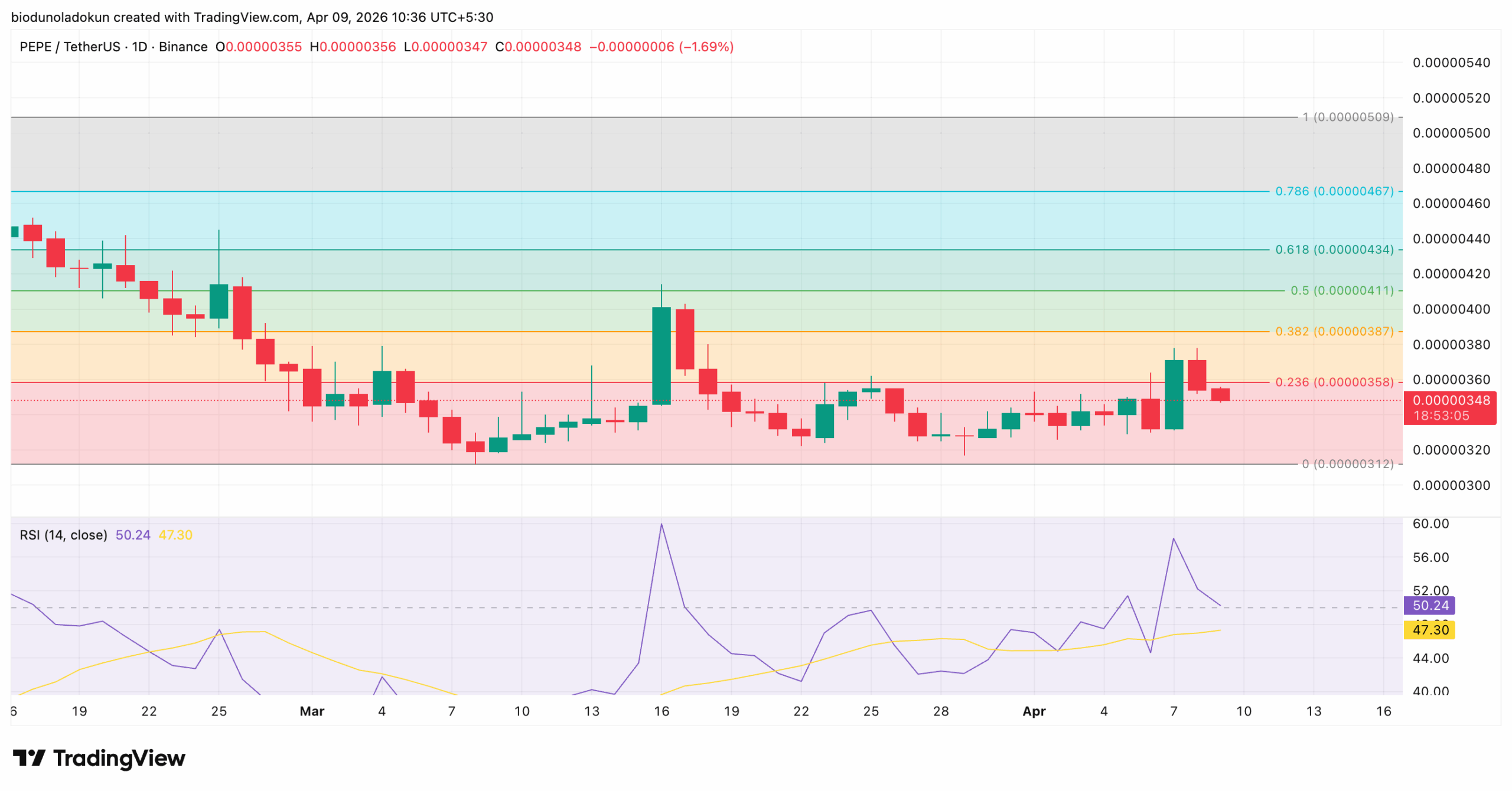
PEPE’s RSI is on the verge of breaking below the neutral 50 line, with a confirmed close under that level opening the door to a retest of the 30-day low at $0.00000312.
Frog-themed memecoin PEPE has joined the growing league of digital assets with exchange-traded fund products for institutional investors.
On April 8, investment firm Canary Capital Group LLC filed an S-1 registration statement with the U.S. Securities and Exchange Commission seeking approval to launch a spot ETF tied directly to the token’s price.
Interestingly, PEPE’s price reaction to this development has been underwhelming.
The token managed only a 2% gain on Wednesday before reversing sharply, shedding 6% over the past 24 hours. At press time, the popular meme coin trades at $0.0000034, with on-chain and technical indicators hinting at further dip.
ETF Filing Fails to Hold PEPE
The proposed Canary PEPE ETF is designed to track the spot price of PEPE, giving traditional investors regulated exposure to the altcoin without requiring direct custody of the asset.
With the filing, PEPE now joins a shortlist of meme assets — including Dogecoin and BONK — that institutional investors have gained exposure to through regulated ETF wrappers.
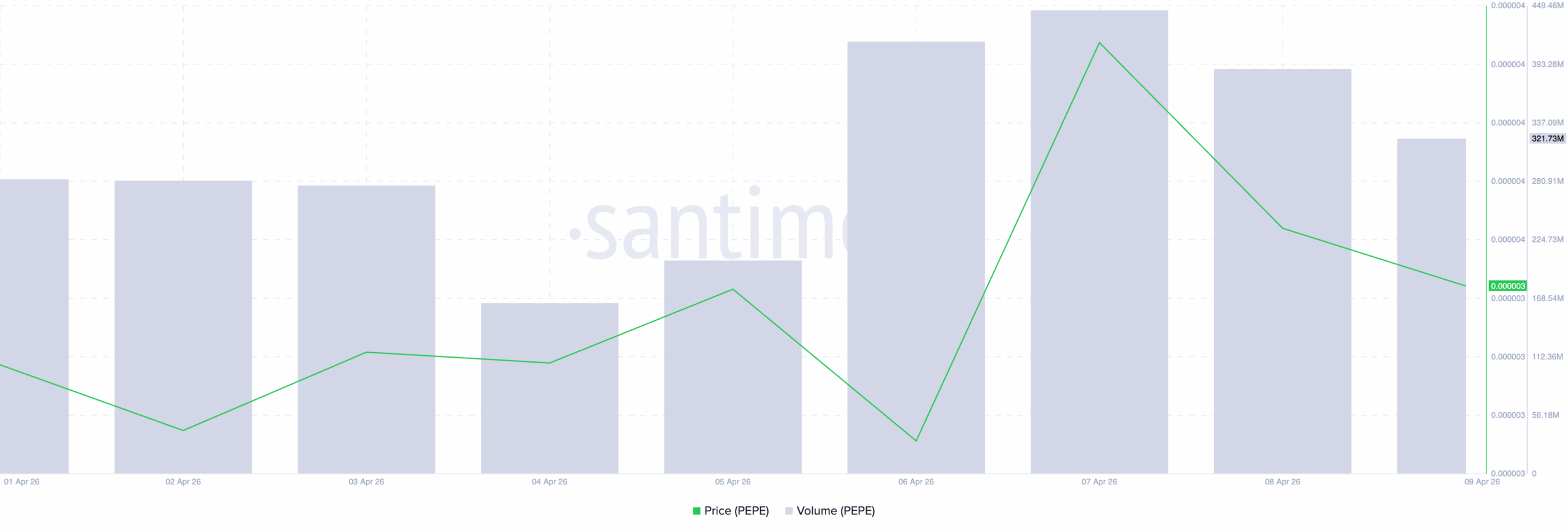
Yet the announcement has done little to lift market sentiment among PEPE holders over the past day. After climbing 2% on the filing news to an intraday high of $0.00000378 on Wednesday, the token has since reversed sharply.
It has shed double digits amid broader market weakness, clouding any ETF-driven momentum.
PEPE’s daily trading volume has also declined. Over the past 24 hours, its trading volume has contracted by 35%, sitting at $322 million at press time.
The simultaneous decline in both price and trading volume is a significant bearish signal. falling volume during a price decline indicates that buyers are stepping back rather than absorbing the downside.
For PEPE, this trend suggests the ETF filing has failed to generate the kind of genuine demand needed to sustain even a modest rally.
Social Hype Spiked, Then Faded
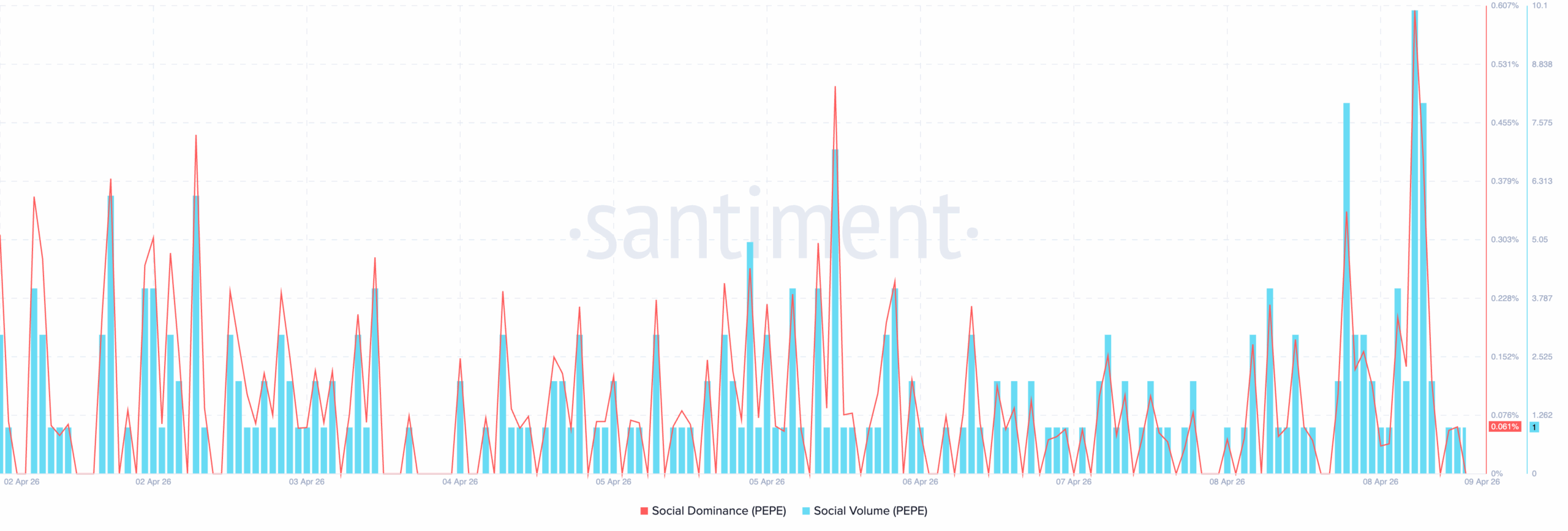
PEPE’s social dominance and social volume both spiked sharply following the news of the ETF filing.
According to Santiment, the token’s social dominance and social volume closed at respective seven-day highs of 61 and 0.13% on Wednesday.
PEPE Social Dominance and Social Volume | Credit: Santiment
An asset’s social dominance tracks how often it is mentioned across social platforms relative to the rest of the market, while social volume looks at the total number of unique posts and discussions mentioning the asset across those same channels on any given day.
Both metrics spiked sharply following Canary Capital’s filing, as traders and retail participants flooded timelines with speculation about what a PEPE ETF could mean for the token’s longer-term trajectory.
But the surge was short-lived. The token’s social dominance and social volume have since retreated with price, and are fading back toward pre-announcement levels.
When social metrics spike on an announcement and then retrace like this, it signals a market running on speculation rather than genuine conviction.
It shows us that PEPE traders merely reacted to the news, engaged briefly, and may have since moved on.
Derivatives Signal Weak Conviction
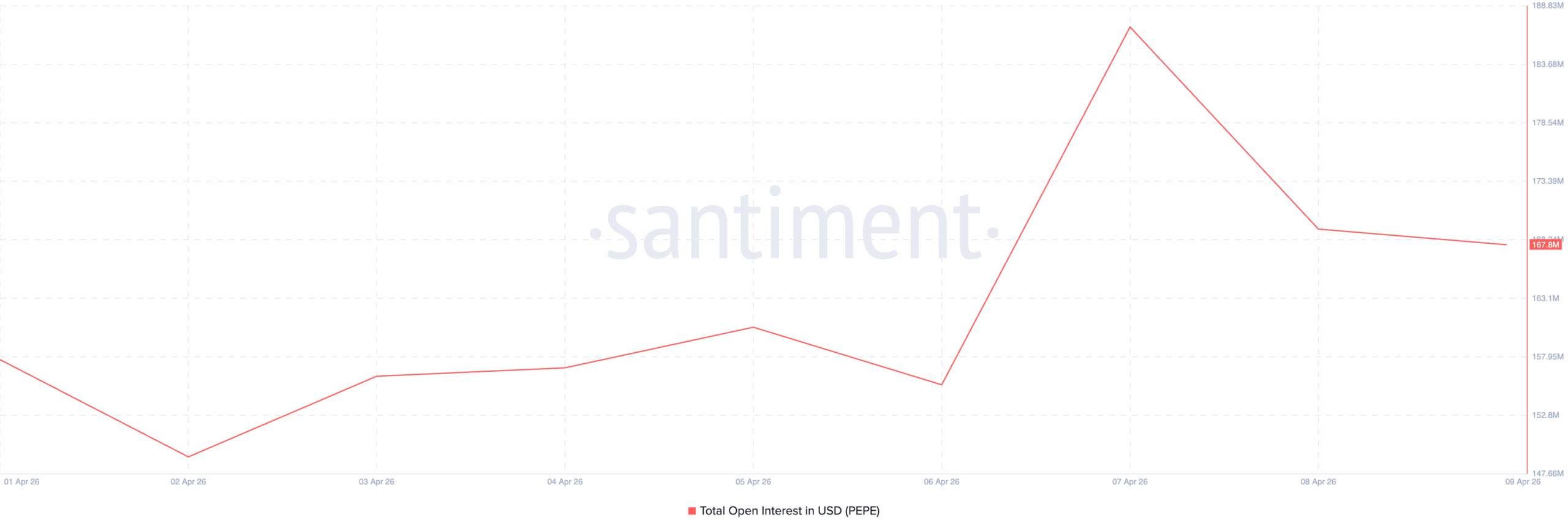
Since reaching a seven-day high of $187 million on April 7, PEPE’s open interest has since dwindled. Over the past day, it has tumbled by 2% and now sits at $168 million.
Open interest measures the total number of outstanding derivative contracts that have not yet been settled. It is a gauge of how much capital is actively deployed in leveraged positions on an asset at any given moment.
When it falls alongside an asset’s price, it signals that traders are closing out their positions rather than opening new ones. This signals waning conviction among derivatives traders and leaves the token vulnerable to further downside.
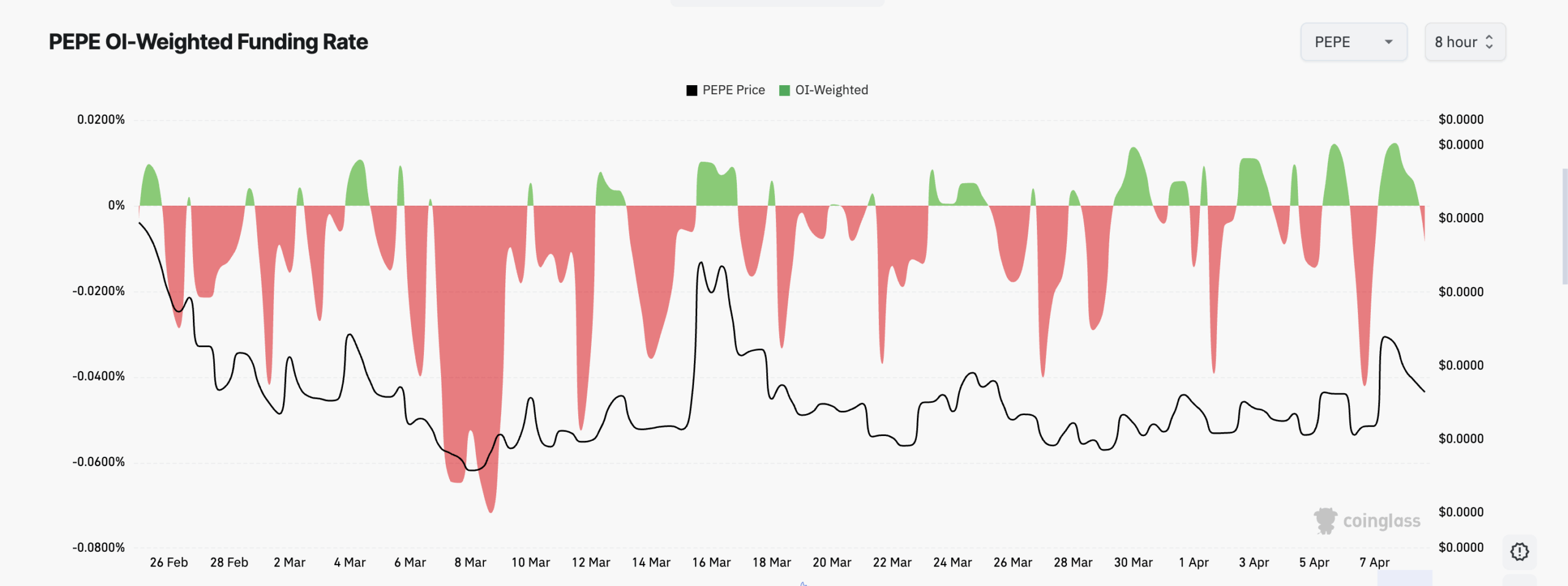
Moreover, funding rates for PEPE have turned negative, indicating that short sellers are currently paying a premium to maintain their positions. This shows a market dominated by bearish sentiment.
On the daily chart, PEPE’s Relative Strength Index (RSI) is poised to break below the neutral 50 line, confirming the strengthening sell-side pressure. As of this writing, this key momentum indicator is at 50.24.
The RSI indicator measures an asset’s overbought and oversold market conditions. It ranges between 0 and 100.
Values above 70 suggest the asset is overbought and due for a price decline, while values below 30 indicate the asset is oversold and due for a rebound.
At 50.24 and ready to breach the neutral line, PEPE’s RSI sits at a critical level.
A confirmed close below 50 would mark a shift in momentum from neutral to bearish, signaling that sellers have formally taken control of price action.
Should that happen, it could push its price to a 30-day low of $0.00000312.
However, if demand returns to the market and sentiment improves, PEPE could break past its $0.00000358 resistance and rally toward $0.00000387.
[You-may-like]
Disclaimer:
The information provided in this article is for informational purposes only. It is not intended to be, nor should it be construed as, financial advice. We do not make any warranties regarding the completeness, reliability, or accuracy of this information. All investments involve risk, and past performance does not guarantee future results. We recommend consulting a financial advisor before making any investment decisions.
Abiodun Oladokun is a Research Analyst at CCN, where he covers cryptocurrency markets with a focus on on-chain analysis, technical assessments, and emerging trends across decentralized finance (DeFi), real-world assets (RWA), artificial intelligence (AI), decentralized physical infrastructure networks (DePIN), Layer 2s, and meme coins.
Prior to CCN, he served as a Senior On-Chain Analyst at BeInCrypto, producing market reports spanning diverse crypto sectors.
Before that, he conducted technical analysis and market assessments of various altcoins at AMBCrypto, where he also contributed long-form quarterly research papers on DeFi, NFTs, DAOs, and scaling architectures, leveraging on-chain platforms including Messari, Santiment, DefiLlama, and Dune Analytics.
He began his crypto career as a research analyst at SixthSense DAO, developing blockchain forensic tools to trace the history of stolen assets.
Abiodun is a lawyer called to the Nigerian Bar and the founder of Ilé Ijó, a Lagos-based electronic dance music collective.