Home / Analysis / Crypto / Technical Analysis / Successful Ethereum Migration Helps Nillion (NIL) Price Shatter 159-Day Resistance — This Is What Could Happen Next
Nillion broke a 159-day resistance after completing its migration from Cosmos to Ethereum.
NIL’s new token model is tightening the circulating supply and boosting long-term demand.
The breakout remains bullish while Nillion’s price holds above key support near $0.070.
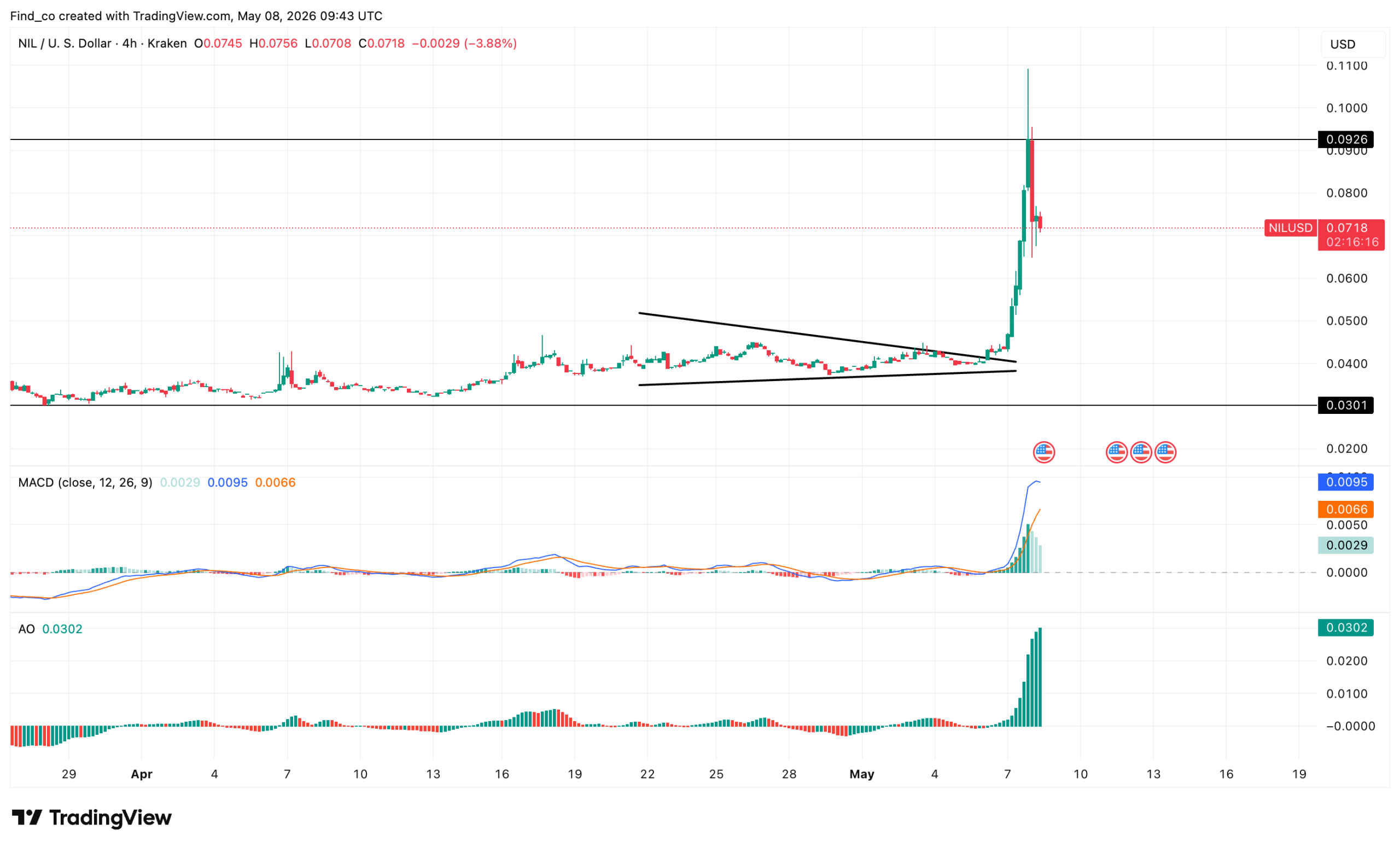
After months of compressed price action, Nillion (NIL) has finally broken above a resistance level that held the token back for 159 consecutive days.
But this breakout is not being driven solely by speculation. The token’s structure has fundamentally changed.
The biggest catalyst came from Nillion’s transition into what the team now calls Nillion 2.0.
The project officially completed its migration away from its Cosmos-based architecture, shutting down the original nilChain and moving fully into Ethereum’s Layer-2 ecosystem.
Here are all the details and what could be next for Nillion’s price.
Nillion Token Tests Psychological Barrier
From the image below, NIL delivered one of the strongest breakouts on the market, rising from $0.040.
The rally came after weeks of sideways accumulation, signaling that bulls had been quietly building positions.
Try Our Recommended Crypto Exchanges
Sponsored
Disclosure
We sometimes use affiliate links in our content, when clicking on those we might receive a commission at no extra cost to you. By using this website you agree to our terms and conditions and privacy policy.
The project officially completed its migration away from its Cosmos-based architecture, shutting down the original nilChain and moving fully into Ethereum’s Layer-2 ecosystem through the ERC-20 standard.
By directly integrating into Ethereum’s ecosystem, Nillion immediately gained deeper exchange liquidity, greater developer accessibility, and easier integration with the broader DeFi ecosystem.
Trading activity surged rapidly across Binance, Uniswap, and Ethereum-native venues following the migration, helping fuel the breakout above long-standing resistance.
But the migration itself is only part of the story.
The larger catalyst came from a complete overhaul of NIL’s utility model.
Previously, NIL functioned primarily as a governance and ecosystem participation token.
Under the new structure, it has become an embedded medium of exchange inside Nillion’s core product ecosystem.
At the same time, supply dynamics are tightening aggressively.
The launch of the Blacklight verification protocol now requires node operators to stake exactly 70,000 NIL to participate in computation verification.
That requirement is already removing millions of tokens from active circulation, and when demand increases, Nillion’s price could trade much higher.
NIL Price Prediction: Breakout To Continue
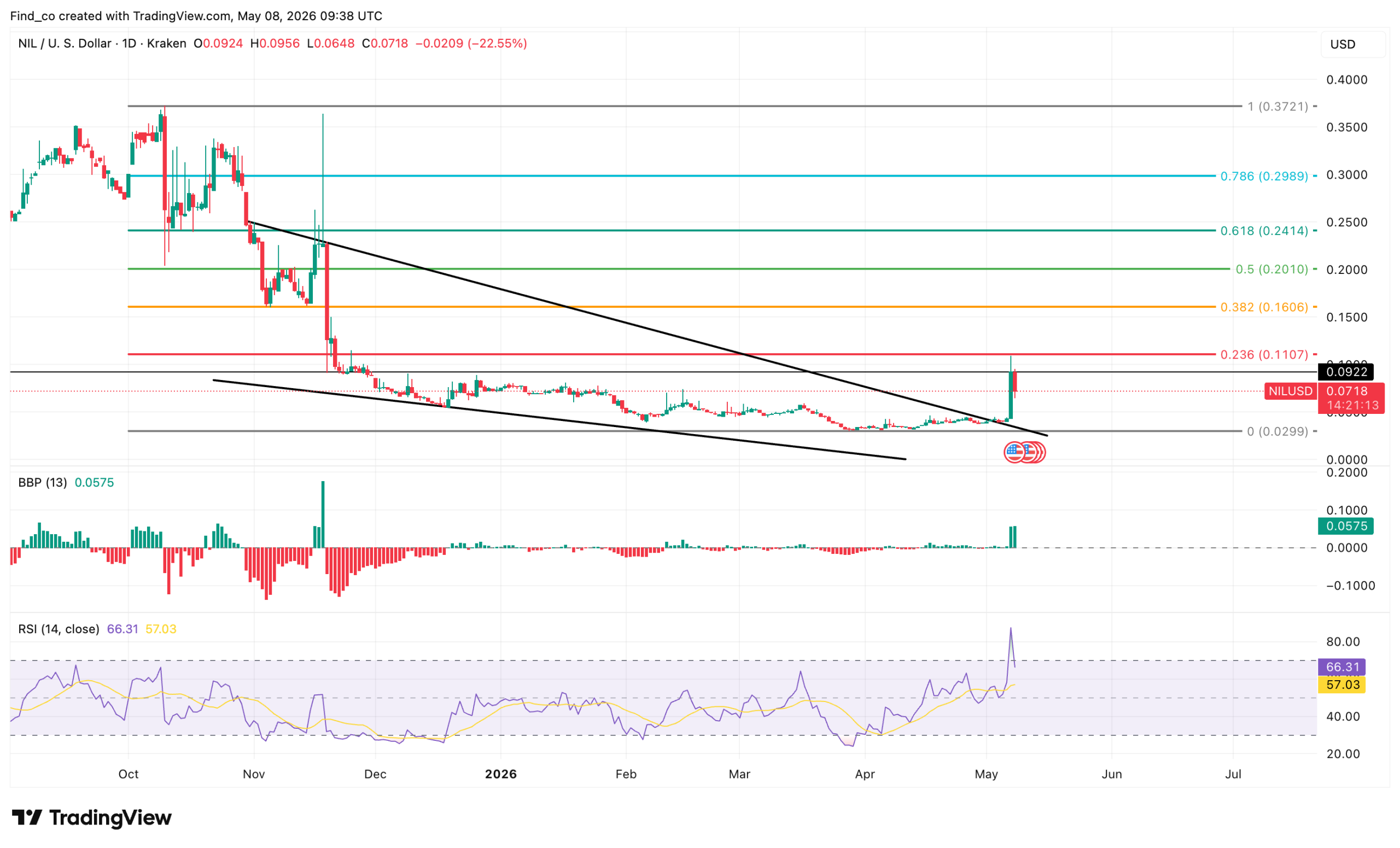
Nillion’s price has surged 43.86% over the past 24 hours, breaking out of a prolonged falling wedge that had suppressed price action for months.
The rally briefly pushed the asset toward the $0.11 resistance zone before sellers stepped in, triggering a retracement back below key intraday highs.
Even so, the move signals speculative interest after an extended period of weak momentum and low volatility.
Technically, the breakout above the descending trendline shifts short-term sentiment in favor of the bulls.
The Relative Strength Index (RSI) climbed to 68, approaching overheated territory, while Bull Bear Power (BBP) flipped positive, reflecting stronger buyer dominance across recent sessions.
However, the rejection near the Fibonacci resistance suggests the market has not yet fully confirmed a sustainable trend reversal.
Meanwhile, the $0.03 level remains the key macro support holding the entire structure intact.
Disclaimer:
The information provided in this article is for informational purposes only. It is not intended to be, nor should it be construed as, financial advice. We do not make any warranties regarding the completeness, reliability, or accuracy of this information. All investments involve risk, and past performance does not guarantee future results. We recommend consulting a financial advisor before making any investment decisions.
Victor Olanrewaju is a crypto analyst and reporter at CCN with deep roots in on-chain research and technical analysis. His crypto journey began in 2017, but it was the 2020 Uniswap airdrop that sparked a full-time pivot into the space.
With a foundation in copywriting, Victor honed his craft creating high-converting content for leading crypto brokers — most notably an XRP price prediction that ranked #1 on Google during the 2021 bull run.
He later joined AMBCrypto in 2022, where he combined storytelling with technical and on-chain analysis to cover key market narratives.
In 2024, he expanded his expertise at BeInCrypto, collaborating with analysts and using tools like Glassnode, Santiment, and IntoTheBlock to break down Bitcoin and altcoin trends.
At CCN, Victor covers the top cryptocurrencies, memecoins, macro shifts, blending real-time insights with deep-dive metrics.
He holds a Bachelor’s degree in Physics from the University of Ibadan, equipping him to simplify complex data for a wide audience. Follow his work or connect on LinkedIn or X.