MEGA price fails to breakout following Robinhood listing | Credit: Veronica Cestari
Share
Key Takeaways
MegaETH’s TVL has surged to nearly $800 million, far surpassing Monad and signaling strong ecosystem growth.
Robinhood listing momentum failed to lift the token immediately, but rising adoption is renewing market attention.
MEGA’s price remains technically bearish for now, with a breakout above key resistance needed to confirm recovery.
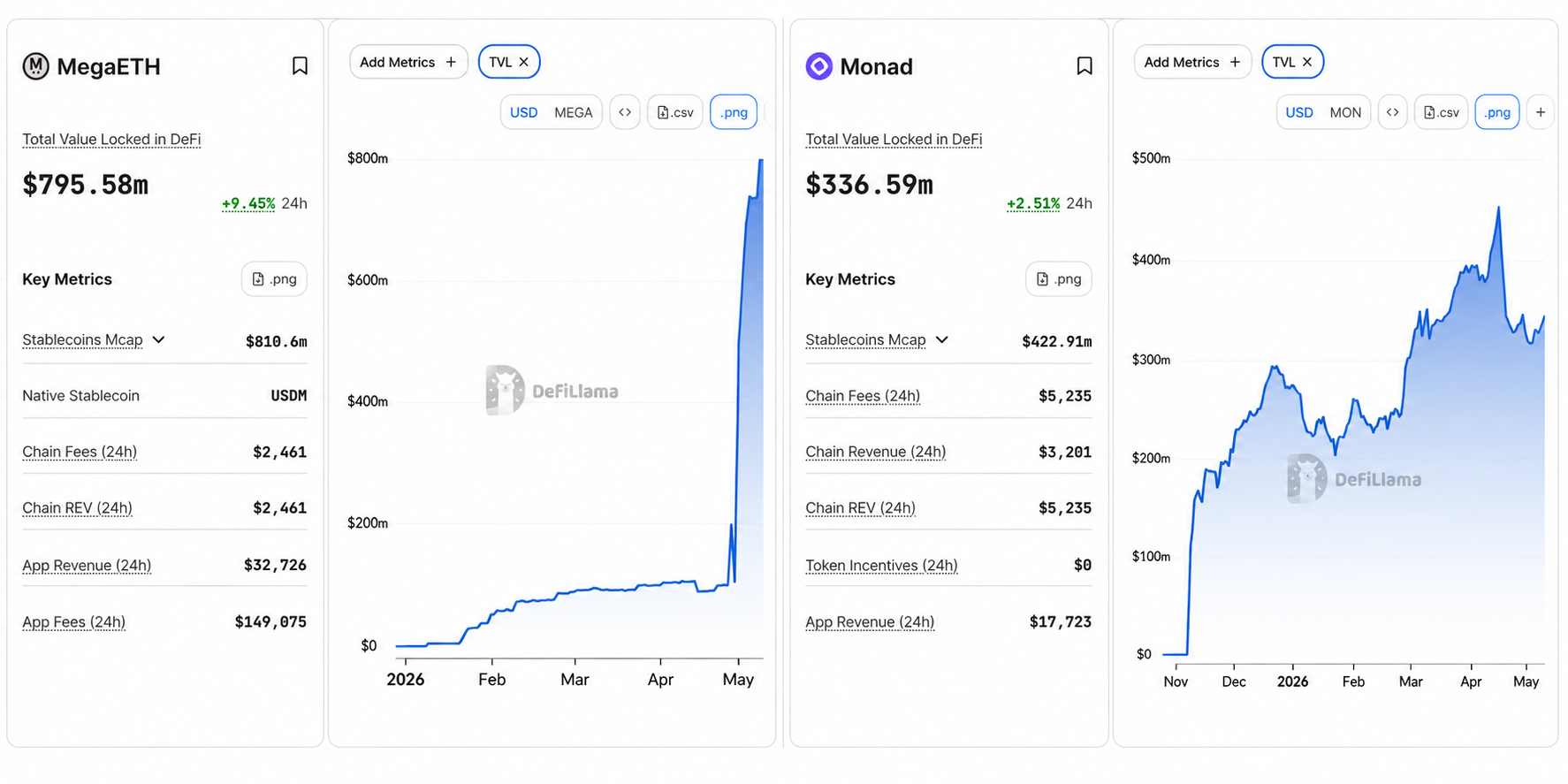
After securing a major Robinhood-related listing, MegaETH has surged past rival Monad by roughly $460 million in Total Value Locked (TVL) — a massive lead that has repositioned the network among the top chains in crypto.
But despite the growth, MEGA remains down roughly 45% from its post-launch highs. And that raises the bigger question.
Is ecosystem growth finally strong enough to pull the price of MegaETH back up?
MegaETH’s TVL Explosion Is Changing the Conversation
MegaETH’s token price may still be struggling, but activity inside the ecosystem is telling a very different story.
Although the network’s mainnet launched in February, the MEGA token only began trading on April 30.
Try Our Recommended Crypto Exchanges
Sponsored
Disclosure
We sometimes use affiliate links in our content, when clicking on those we might receive a commission at no extra cost to you. By using this website you agree to our terms and conditions and privacy policy.
Since then, the token has fallen roughly 45%, even after Robinhood added support yesterday amid expectations the listing could boost momentum.
That rally never came. But while price action remains weak, the network’s growth has become harder to ignore.
At the time of writing, DeFiLlama data shows MegaETH’s total value locked (TVL) has climbed to nearly $796 million.
This is surprisingly high for a token that just launched.
Typically, newly launched ecosystems see TVL cool off after the initial hype fades. MegaETH appears to be doing the opposite.
The contrast becomes even more noticeable when compared to rival high-performance Layer-1 projects.
Monad, for example, has seen its TVL fall to around $335 million over the same period.
According to CCN’s analysis, the market may be starting to reprice MegaETH’s broader ecosystem potential, even if the token itself has yet to reflect that shift fully.
Despite that decline, the market is starting to separate token weakness from network strength.
This matters because the growth of the MegaETH crypto ecosystem has become difficult to dismiss.
At the time of writing, the network has:
Surpassed 100,000 TPS.
Integrated major protocols like Aave V3 and GMX.
Added Chainlink Scale support.
And seen Aave deposits exceed $575 million through incentive-driven activity.
MEGA vs Monad: Two Very Different Approaches
While MegaETH and Monad are both designed to solve Ethereum scalability, their architectures are fundamentally different.
MegaETH
MegaETH operates as an Ethereum Layer 2, focused on ultra-fast execution, low latency, and “real-time” blockchain performance.
For those unfamiliar, it uses a highly optimized sequencer, and the goal is simple: push blockchain performance closer to Web2 applications.
Monad
However, Monad takes a different route. It operates as a Layer 1 blockchain, emphasizing decentralization, software efficiency, and parallel execution
Instead of hardware-heavy scaling, Monad focuses on optimistic execution and custom consensus innovations like MonadBFT
Its targets include:
10,000 TPS.
400ms block frequency.
and 800ms finality.
While slower than MegaETH on raw throughput, Monad has focused heavily on stablecoin integration and Bitcoin liquidity.
TVL Doesn’t Always Mean Token Strength
This is where things get complicated. High TVL doesn’t automatically translate into higher token prices.
This is the case because, especially when early investors are still distributing, unlock schedules remain active, and market confidence hasn’t fully recovered after launch volatility.
So, this seems to be the reason the price of MegaETH crypto remains under pressure despite the ecosystem’s growth.
MEGA Price Analysis
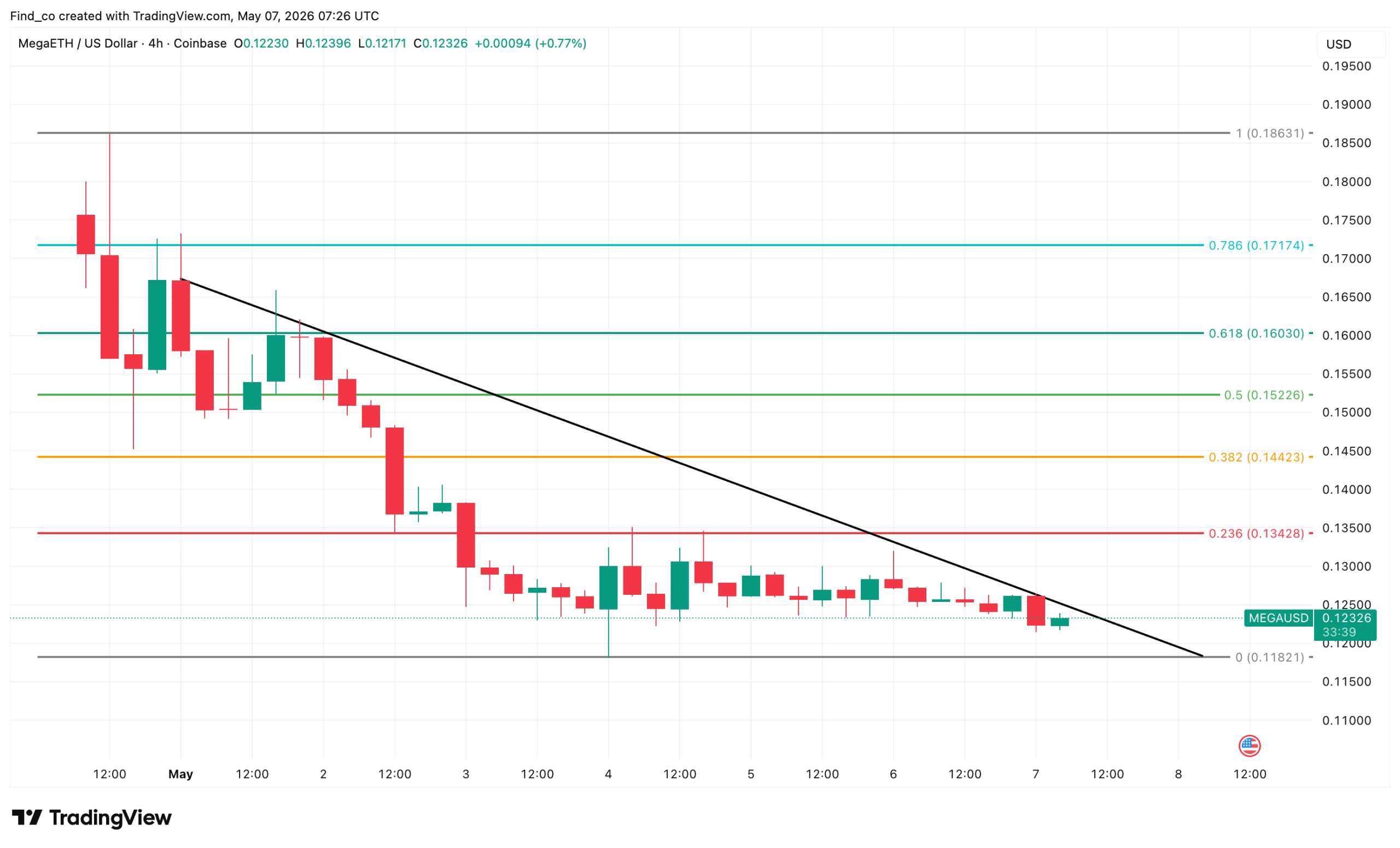
On the 4-hour chart, MegaETH crypto remains in a clear short-term downtrend, with price continuing to respect the descending resistance trendline since the local top near $0.17.
The rejection from the 0.5 Fib region around $0.152 accelerated the selloff, and MEGA’s price is now consolidating just above the major support zone near $0.118.
What stands out here is the compression near the support.
Volatility has declined significantly over the last few sessions, showing that sellers are losing momentum after the aggressive breakdown.
If bulls manage to reclaim the descending trendline and push above the $0.134 resistance zone (0.236 Fib), MegaETH could attempt a recovery toward $0.14 and potentially $0.15.
However, the structure is still technically bearish until that breakout happens.
Disclaimer:
The information provided in this article is for informational purposes only. It is not intended to be, nor should it be construed as, financial advice. We do not make any warranties regarding the completeness, reliability, or accuracy of this information. All investments involve risk, and past performance does not guarantee future results. We recommend consulting a financial advisor before making any investment decisions.
Victor Olanrewaju is a crypto analyst and reporter at CCN with deep roots in on-chain research and technical analysis. His crypto journey began in 2017, but it was the 2020 Uniswap airdrop that sparked a full-time pivot into the space.
With a foundation in copywriting, Victor honed his craft creating high-converting content for leading crypto brokers — most notably an XRP price prediction that ranked #1 on Google during the 2021 bull run.
He later joined AMBCrypto in 2022, where he combined storytelling with technical and on-chain analysis to cover key market narratives.
In 2024, he expanded his expertise at BeInCrypto, collaborating with analysts and using tools like Glassnode, Santiment, and IntoTheBlock to break down Bitcoin and altcoin trends.
At CCN, Victor covers the top cryptocurrencies, memecoins, macro shifts, blending real-time insights with deep-dive metrics.
He holds a Bachelor’s degree in Physics from the University of Ibadan, equipping him to simplify complex data for a wide audience. Follow his work or connect on LinkedIn or X.