Ether is consolidating after a 12% weekly surge as traders watch key support, ETF flows, technical indicators, and upcoming Fed move. | Credit: CCN.com
Share
Key Takeaways
Ethereum has lost a critical psychological level at $1,800, shifting market focus to the important $1,700-$1,750 support zone.
A decisive break below $1,700 could accelerate downside momentum, increasing the likelihood of ETH revisiting the $1,500 support region.
The broader technical trend remains bearish, with Ethereum continuing to trade inside a long-term descending channel and below major moving averages.
Ethereum is once again approaching a pivotal moment after losing its grip on the $1,800 level, a key psychological threshold that had helped stabilize sentiment in recent weeks.
The second-largest cryptocurrency by market capitalization is trading around $1,760, placing increased attention on the $1,700-$1,750 support zone that analysts now view as the market’s most important near-term battleground.
While Ethereum recently staged a recovery from lows near $1,500, the broader technical structure remains fragile. Traders are closely monitoring whether buyers can defend current support levels or if another wave of selling could drive ETH toward sub-$1,500 territory.
We sometimes use affiliate links in our content, when clicking on those we might receive a commission at no extra cost to you. By using this website you agree to our terms and conditions and privacy policy.
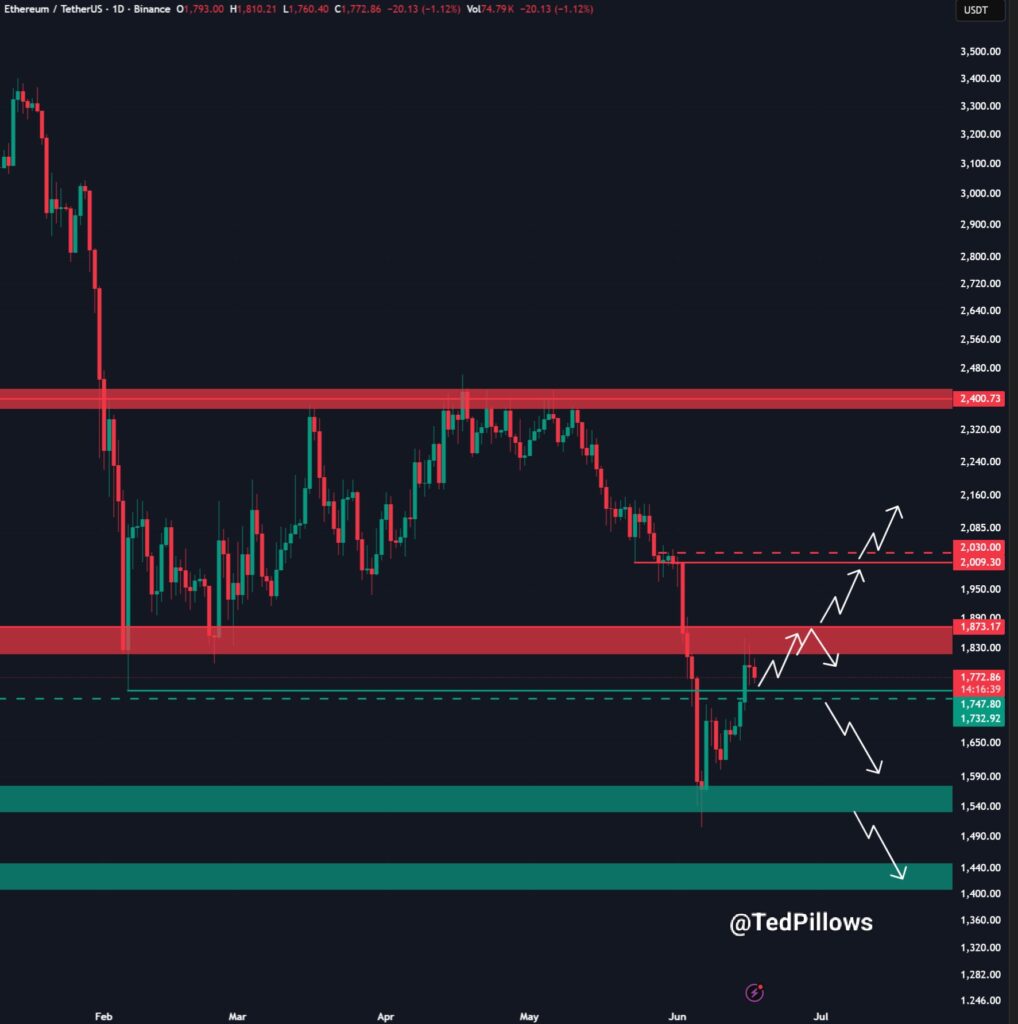
The $1,700-$1,750 range now represents the most critical support zone for ETH, serving as the first major line of defense for bulls attempting to prevent a deeper correction.
Round-number price levels often play an outsized role in crypto markets because traders frequently use them for stop-loss placement, leverage management, and short-term positioning.
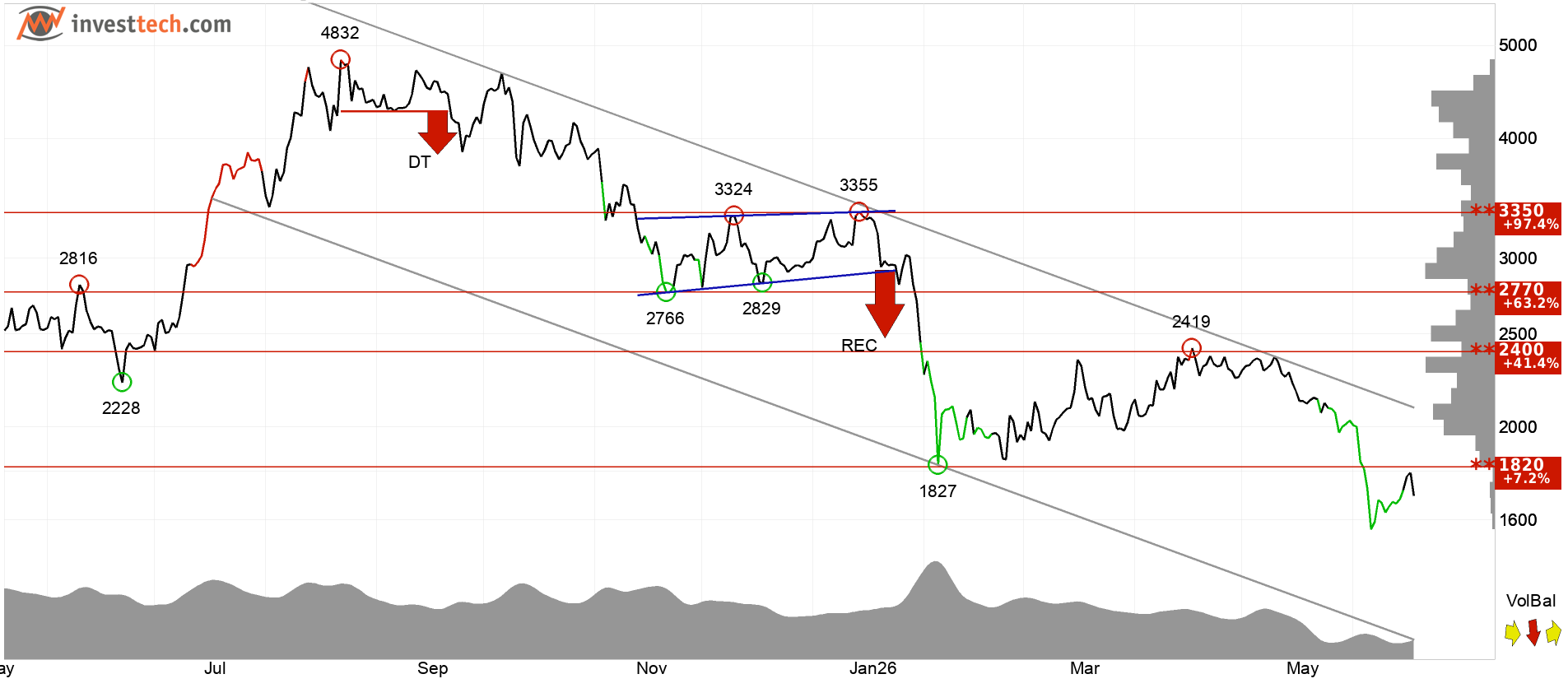
Ethereum shows weak development in a falling trend channel. | Credit: InvestTech
The $1,800 loss has therefore weakened market confidence and increased the likelihood of heightened volatility around lower support levels.
If buyers successfully defend the $1,700 region, Ethereum could attempt to reclaim $1,800 and potentially challenge resistance levels between $2,000 and $2,100.
Such a move would be important because June opened near $2,004, making that area a key reference point for determining whether the current pullback is merely corrective or part of a larger downtrend.
However, the failure to hold current levels would likely trigger a shift in market sentiment. A decisive breakdown below $1,700 could intensify selling pressure and open the door to a retest of the recent $1,500 lows.
Technical Structure Continues to Favor Sellers
Despite the recent rebound from the $1,500 support zone, Ethereum remains trapped within a long-term descending channel that has defined price action for several months.
On the daily chart, ETH continues to trade below both the 100-day and 200-day moving averages, indicating that sellers retain control of the broader trend.
The most significant resistance lies between $2,000 and $2,200, where a major supply zone converges with the 100-day moving average. Until Ethereum can reclaim this region, the market is likely to continue producing lower highs and lower lows.
The key support zone is $1,700-$1,750, which should hold for another bounceback. | Credit: Ted Pillows
Shorter-term charts offer a slightly more constructive picture. Following the sharp selloff into the $1,500 demand zone, ETH formed a series of higher lows supported by an ascending trendline.
However, the recovery stalled near $1,850, where sellers quickly re-entered the market, preventing further upside.
Ethereum is now approaching a crucial inflection point. Maintaining the ascending trendline could support another attempt to break above $1,850 and improve near-term sentiment.
Conversely, losing the trendline would invalidate the recent recovery structure and increase the probability of another move toward $1,500.
Macro Conditions and On-Chain Trends Create Mixed Signals
Beyond technical factors, macroeconomic conditions continue to influence Ethereum’s outlook.
Although the Federal Reserve left interest rates unchanged as expected, crypto markets showed little enthusiasm following the announcement. Investors appear to be waiting for stronger catalysts before committing to risk assets.
The upcoming June monthly close may also prove significant. Some analysts have pointed to Ethereum’s large lower wick on the monthly chart as a potential hammer candle formation, a pattern often associated with reversals. However, without a strong close above current levels, the signal remains unconfirmed.
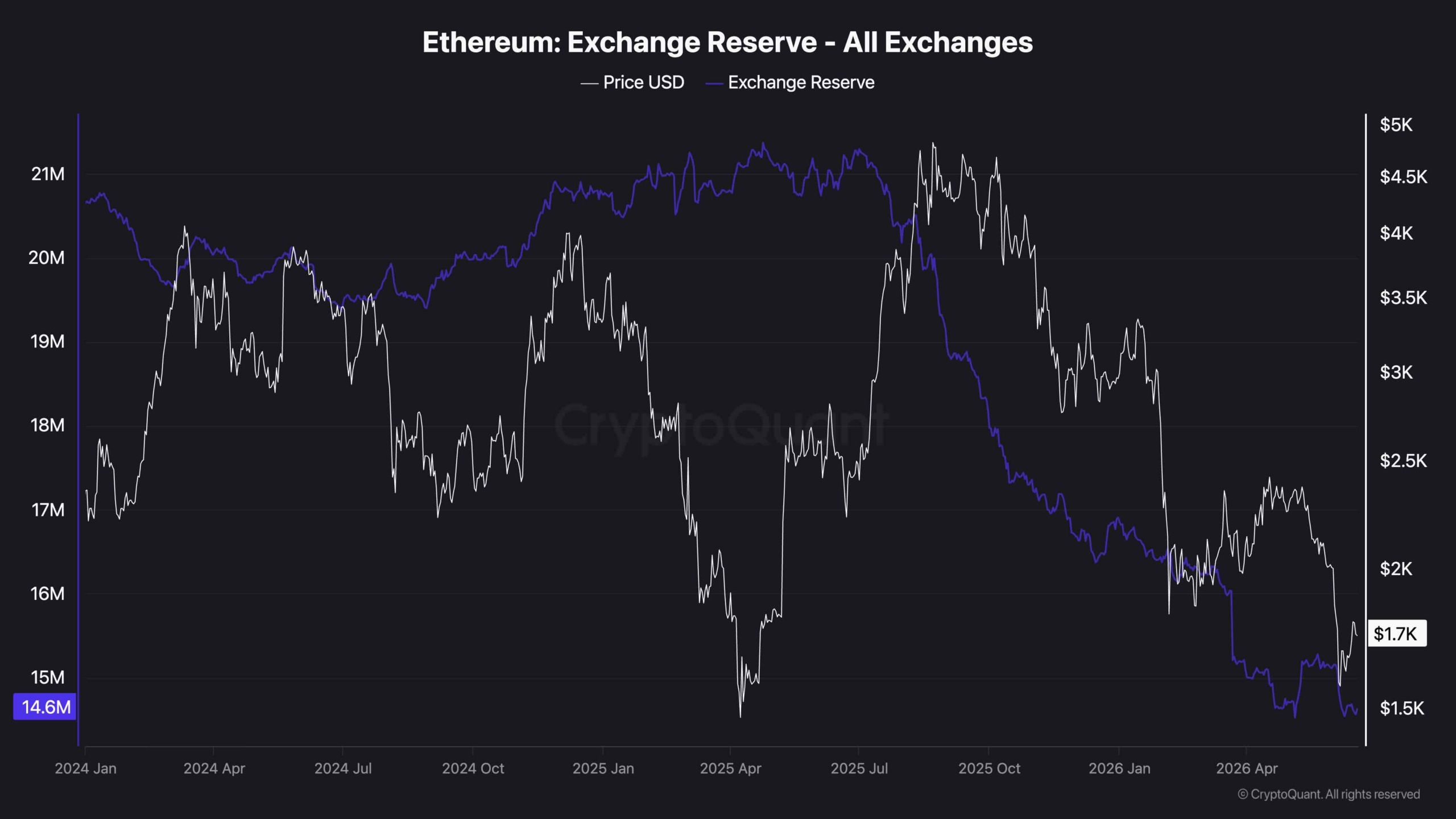
Ethereum’s exchange reserve continues to decline notably. | Credit: CryptoQuant
Interestingly, on-chain data presents a more optimistic long-term narrative. Ethereum exchange reserves have continued to decline, falling to approximately 14.6 million ETH.
Historically, shrinking exchange balances indicate that investors are moving coins into self-custody rather than preparing them for sale, reducing available market supply.
This creates a notable divergence between weak price action and improving supply dynamics. While macro uncertainty and bearish technical trends currently dominate market behavior, reduced exchange reserves could amplify future upside if demand returns.
For now, Ethereum’s immediate fate hinges on whether bulls can successfully defend the $1,700-$1,750 support zone.
A breakdown could expose sub-$1,500 levels and reinforce bearish momentum, while a successful defense could lay the foundation for a recovery toward $2,000.
Giuseppe Ciccomascolo began his career as an investigative journalist in Italy, where he contributed to both local and national newspapers, focusing on various financial sectors.
Upon relocating to London, he worked as an analyst for Fitch's CapitalStructure and later as a Senior Reporter for Alliance News. In 2017, Giuseppe transitioned to covering cryptocurrency-related news, producing documentaries and articles on Bitcoin and other emerging digital currencies. He also played a pivotal role in establishing the academy for a cryptocurrency exchange website. Crypto remained his primary area of interest throughout his tenure as a writer for ThirdFloor.













 Ethereum Users Could Add Quantum-Resistant Protection for $0.07 as ETH Eyes Key $2K Breakout