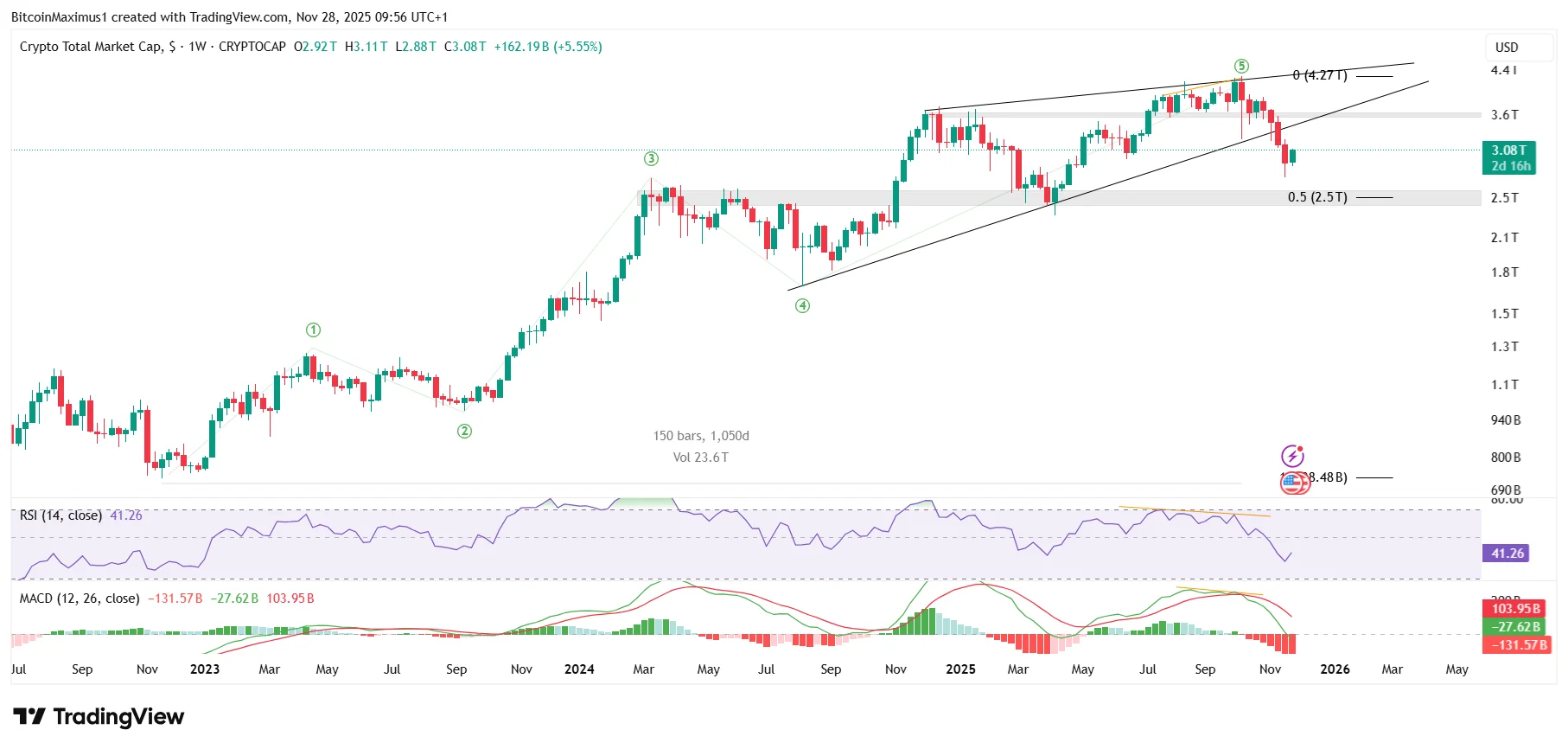
Why is the Crypto Market Going Down? | Credit: Derek Fenech
Share
Key Takeaways
The crypto market’s total cap has plummeted 30% from its peak, triggering widespread alarm across the industry.
Multiple long-term bearish signals and wave counts confirm the cycle top is in.
The CME halted global derivatives trading today, adding pressure to already fragile markets.
The crypto market has plunged nearly 30% from its record high, leaving traders scrambling for answers.
With Q4 expected to be wildly bullish, the sudden reversal has sparked one dominant question across the industry: Why is crypto going down, and how much worse can the decline get?
The charts now show multiple long-term breakdown signals, while today’s freeze in global markets adds a new layer of uncertainty. Here’s what the data actually reveals.
Why is Crypto Going Down?
The weekly time frame chart provides the best explanation for why the cryptocurrency market is experiencing a decline.
There are three specific reasons for the massive crash that has been ongoing since the October all-time high.
Get These Top Crypto Casino Offers Now!
Sponsored
Disclosure
We sometimes use affiliate links in our content, when clicking on those we might receive a commission at no extra cost to you. By using this website you agree to our terms and conditions and privacy policy.
BREAKING: The World’s Markets Didn’t Crash From a Cyberattack. They Froze Because Silicon Got Too Hot.
At 03:00 GMT today, 90% percent of global derivatives trading stopped. Not hacked. Not manipulated. The cooling system failed at a single data center in Illinois.
Disclaimer:
The information provided in this article is for informational purposes only. It is not intended to be, nor should it be construed as, financial advice. We do not make any warranties regarding the completeness, reliability, or accuracy of this information. All investments involve risk, and past performance does not guarantee future results. We recommend consulting a financial advisor before making any investment decisions.
Valdrin Tahiri is a cryptocurrency analyst and reporter at CCN, specializing in technical analysis with a focus on Elliott Wave theory, on-chain metrics, and fundamental research. He brings over seven years of experience in the crypto space as both a trader and writer.
He discovered cryptocurrencies in 2017 while earning his MSc in Financial Markets at the Barcelona School of Economics, which sparked a deep interest in blockchain and market dynamics. Since then, he’s contributed to top crypto outlets like BeInCrypto and CoinGape.
Valdrin also served as Community Manager of BeInCrypto’s Telegram group for three years, helping grow it into one of the largest crypto communities worldwide. His expertise in market structure and price patterns allows him to break down complex trends into clear, actionable insights.
He’s published thousands of articles covering altcoins, Bitcoin cycles, and macro trends.