‘Bull Market Confirmed!’ Rare Bitcoin Onchain Signal Triggers for Only the 5th Time in History
Share
Key Takeaways
Bitcoin plunged to a four-month low near $61,000, extending its decline from recent highs.
More than $1.6 billion in crypto positions were liquidated within 24 hours, making it one of the largest liquidation events of 2026 and highlighting the risks of excessive leverage.
Long traders absorbed the vast majority of losses, with approximately $1.35 billion in bullish positions wiped out as Bitcoin’s sell-off accelerated.
Bitcoin’s sharp decline to its lowest level in four months has rattled crypto markets, triggering one of the largest liquidation events of the year and reigniting fears that a deeper bear market may be taking hold.
The world’s largest cryptocurrency briefly plunged to around $61,000 on June 4, extending a brutal sell-off that has erased more than 25% of its value from recent highs above $82,000.
The decline wiped out over $1.6 billion in leveraged positions across the crypto market within 24 hours, with long traders bearing the overwhelming majority of the losses.
The sell-off comes amid mounting geopolitical tensions surrounding the conflict between the United States and Iran, persistent institutional outflows from spot Bitcoin ETFs, and growing signs of investor capitulation.
Together, these factors have created a perfect storm for risk assets, pushing Bitcoin into territory not seen since February.
Try Our Recommended Crypto Exchanges
Sponsored
Disclosure
We sometimes use affiliate links in our content, when clicking on those we might receive a commission at no extra cost to you. By using this website you agree to our terms and conditions and privacy policy.
Massive Liquidations Expose Market’s Leverage Problem
The speed and magnitude of Bitcoin’s decline exposed just how heavily leveraged the crypto market had become.
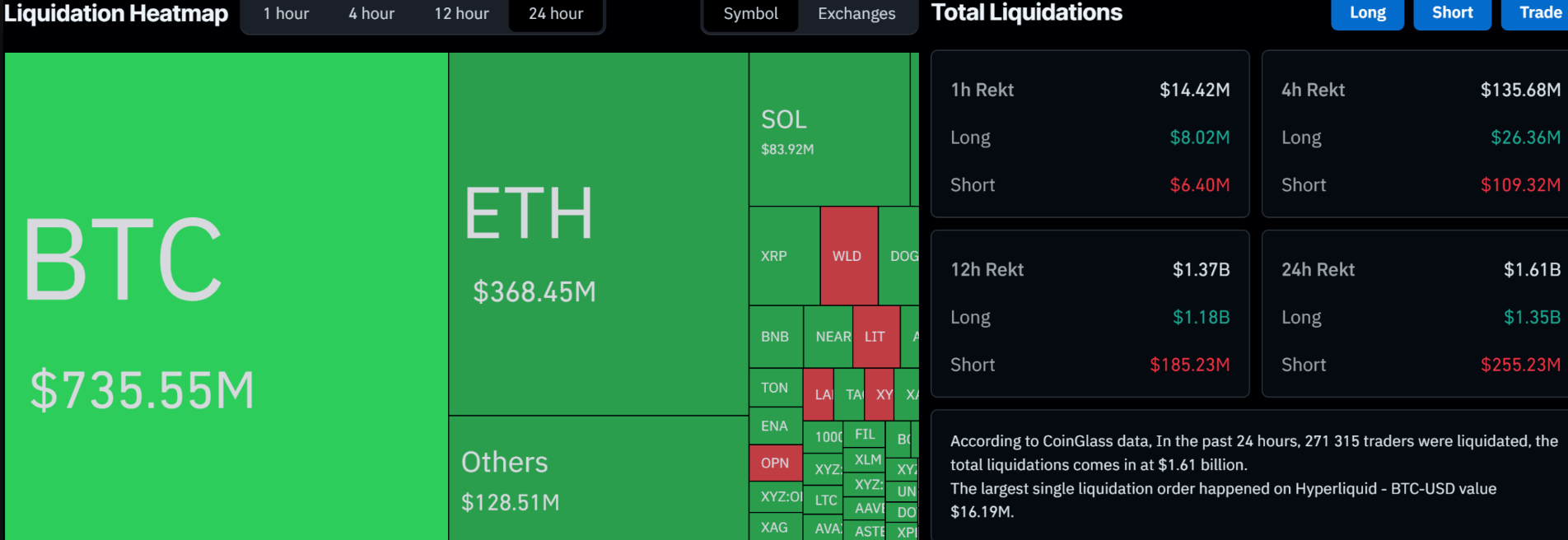
According to CoinGlass data, more than 270,000 traders were liquidated over the past 24 hours as Bitcoin fell from above $67,000 to nearly $61,000. Total liquidations reached approximately $1.6 billion, with long positions accounting for around $1.35 billion of the losses.
Over 270,000 traders were liquidated over the past 24 hours. | Credit: CoinGlass
Bitcoin traders suffered the largest damage, with roughly $735 million in BTC-related long positions wiped out. Ethereum followed with hundreds of millions in liquidations as the second-largest cryptocurrency sank to a 14-month low near $1,700.
The event ranks among the largest liquidation cascades seen in recent years.
This was one of the largest single-day flushes of leveraged positions in months, representing Bitcoin’s most severe long liquidation event since the October 2025 “black swan” crash.
The liquidation cascade amplified downside pressure, creating a feedback loop in which forced selling from liquidated positions accelerated Bitcoin’s decline and triggered even more liquidations across derivatives exchanges.
Institutional Selling and ETF Outflows Deepen the Downturn
While leverage magnified the crash, several fundamental factors appear to be driving the broader bearish sentiment.
One of the most significant headwinds remains the continued exodus from US spot Bitcoin ETFs.
Data from SoSoValue shows investors withdrew nearly $400 million from spot Bitcoin ETFs on Wednesday alone, following roughly $1 billion in outflows earlier in the week. Over the past three weeks, cumulative ETF redemptions have approached $4 billion.
The outflows suggest institutional investors are reducing exposure to Bitcoin as macroeconomic uncertainty increases. Rising Treasury yields, expectations of tighter monetary policy, and escalating geopolitical tensions have prompted many investors to rotate toward safer assets.
Although the sale was relatively small, it raised concerns about whether even long-term institutional holders are becoming more cautious.
On-chain data also reveals growing exchange balances. CryptoQuant reported that Bitcoin reserves on Binance have climbed to approximately 659,000 BTC, the highest level in three months.
Rising exchange inflows are often interpreted as a signal that investors are preparing to sell, potentially increasing market supply during an already fragile period.
Can Bitcoin Hold the Critical $60,000 Support Level?
Several analysts believe the zone between $60,000 and $61,000 represents Bitcoin’s final major support before a more severe downtrend could emerge.
MN Capital founder Michael van de Poppe pointed to the 200-week moving average near $61,000 as a key area where buyers may attempt to regain control.
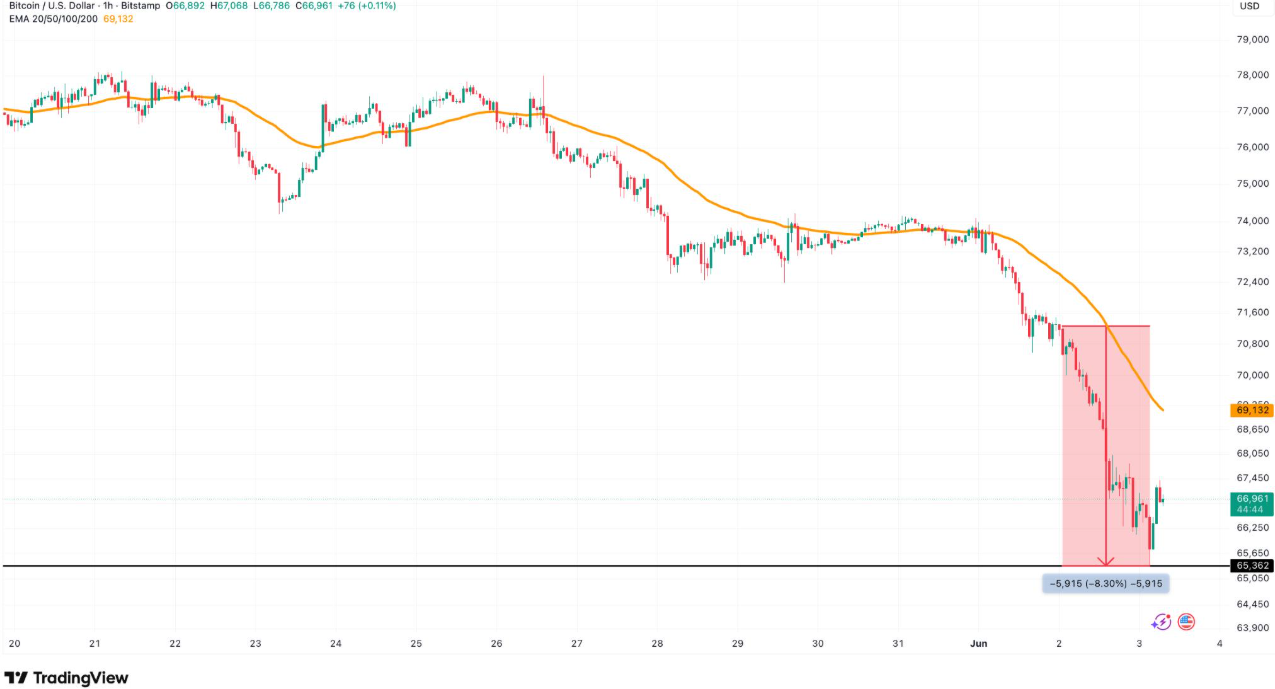
Bitcoin wipes out longs in tumble to $65,000. | Credit: TradingView
Others are less optimistic. While Bitcoin may experience a short-term relief rally from current levels, a retest of $60,000 remains highly likely, and a break below that threshold can still happen later this year.
The technical picture remains challenging. Bitcoin has broken below a short-term falling trend channel, momentum indicators continue to deteriorate, and market sentiment has shifted decisively toward fear.
Meanwhile, Ethereum and major altcoins continue to underperform, suggesting risk appetite remains weak across the broader digital asset market.
Giuseppe Ciccomascolo began his career as an investigative journalist in Italy, where he contributed to both local and national newspapers, focusing on various financial sectors.
Upon relocating to London, he worked as an analyst for Fitch's CapitalStructure and later as a Senior Reporter for Alliance News. In 2017, Giuseppe transitioned to covering cryptocurrency-related news, producing documentaries and articles on Bitcoin and other emerging digital currencies. He also played a pivotal role in establishing the academy for a cryptocurrency exchange website. Crypto remained his primary area of interest throughout his tenure as a writer for ThirdFloor.