Arthur Hayes is bullish on stablecoin-driven projects ETHFI and ENA | Credit Veronica Cestari
Share
Key Takeaways
The BitMEX co-founder believes ETHFI and ENA could skyrocket, fueled by stablecoin adoption.
ether.fi Cash signups are expanding its liquidity while Ethena’s USDe is improving holder retention
While fundamentals look strong, Hayes’ 3000%+ price predictions may be overly ambitious.
Co-founder and former CEO of crypto exchange Arthur Hayes has never hidden his vocal opinions on market assets.
This time, he’s pointing to two projects with stablecoin fundamentals that he believes could explode in value in the coming years.
The projects are an Ethereum-based liquid staking protocol for ether.fi (ETHFI) and synthetic-dollar provider Ethena (ENA).
In this analysis, CCN explains why Hayes is betting heavily on these tokens. We also evaluate whether his prediction holds weight.
The Arthur Hayes Thesis
Hayes made this prediction seven days ago. According to him, these predictions might hold water by 2028, when current U.S. President Donald Trump will leave office.
In Hayes’s view, spending on goods and services is the most important behavior for new stablecoin users.
He argued that people are already used to tapping their phone or swiping a debit or credit card at checkout.
Get These Top Crypto Casino Offers Now!
Sponsored
Disclosure
We sometimes use affiliate links in our content, when clicking on those we might receive a commission at no extra cost to you. By using this website you agree to our terms and conditions and privacy policy.
For stablecoins to achieve mass adoption, the experience must feel just as seamless.
Hayes added that such a solution already exists. Ether.fi Cash lets users deposit their stablecoins into a dApp and spend them as effortlessly as using a Visa card.
Due to this, he noted that ETHFI’s price can increase by over 3000% by 2028.
“Currently, after only four months in existence, the percentage is 0.07%. Given that this product just launched, I believe there is room to grow that percentage to 1.00% by 2028. I believe that ETHFI can 34x from the current levels,” Hayes mentioned in his blog post.
For Ethena, Hayes highlighted the growth of its synthetic dollar, USDe, as the key driver of its potential.
He argued that USDe’s market share and adoption rate give it a strong edge, positioning it as a serious contender in the stablecoin space.
According to Hayes, if this growth continues, USDe could eventually flip USDC, which currently commands around 25% of the stablecoin market. Due to that, ENA’s price could rise as high as 51x by 2028.
“It makes sense that if there are millions more DeFi users who have trillions of dollars in stablecoin deposits at their disposal, they can pump OI into the trillions of dollars. I believe that ENA can 51x from the current levels,” He stated.
ETHFI
From an on-chain perspective, DeFiLlama data shows that ETHFI’s Total Value Locked (TVL) recently surpassed $12 billion. As of this writing, it has experienced a slight pullback to $11.14 billion.
This TVL indicates that ETHFI is attracting deep liquidity and solidifying its place among the top DeFi protocols.
The higher the TVL, the more secure and capital-efficient the platform becomes, which can, in turn, attract even more users, institutions, and partnerships.
In the long term, this creates a reinforcing cycle: as TVL grows, utility and demand for the token rise, potentially driving the ETHFI price higher.
If ETHFI continues this way, it could establish itself as one of the dominant players in the liquid staking and stablecoin space.
For Ethena, on-chain data shows that its TVL has surged to a new all-time high of $12.76 billion.
This milestone signifies the protocol’s surging growth and adoption, as more users lock value into its ecosystem.
A rising TVL not only boosts liquidity and stability for Ethena’s synthetic dollar, USDe, but also strengthens long-term confidence in ENA’s utility.
If this continues, Ethena could cement its role as one of the dominant forces in the stablecoin and synthetic asset market, with clear upside potential for ENA’s price.
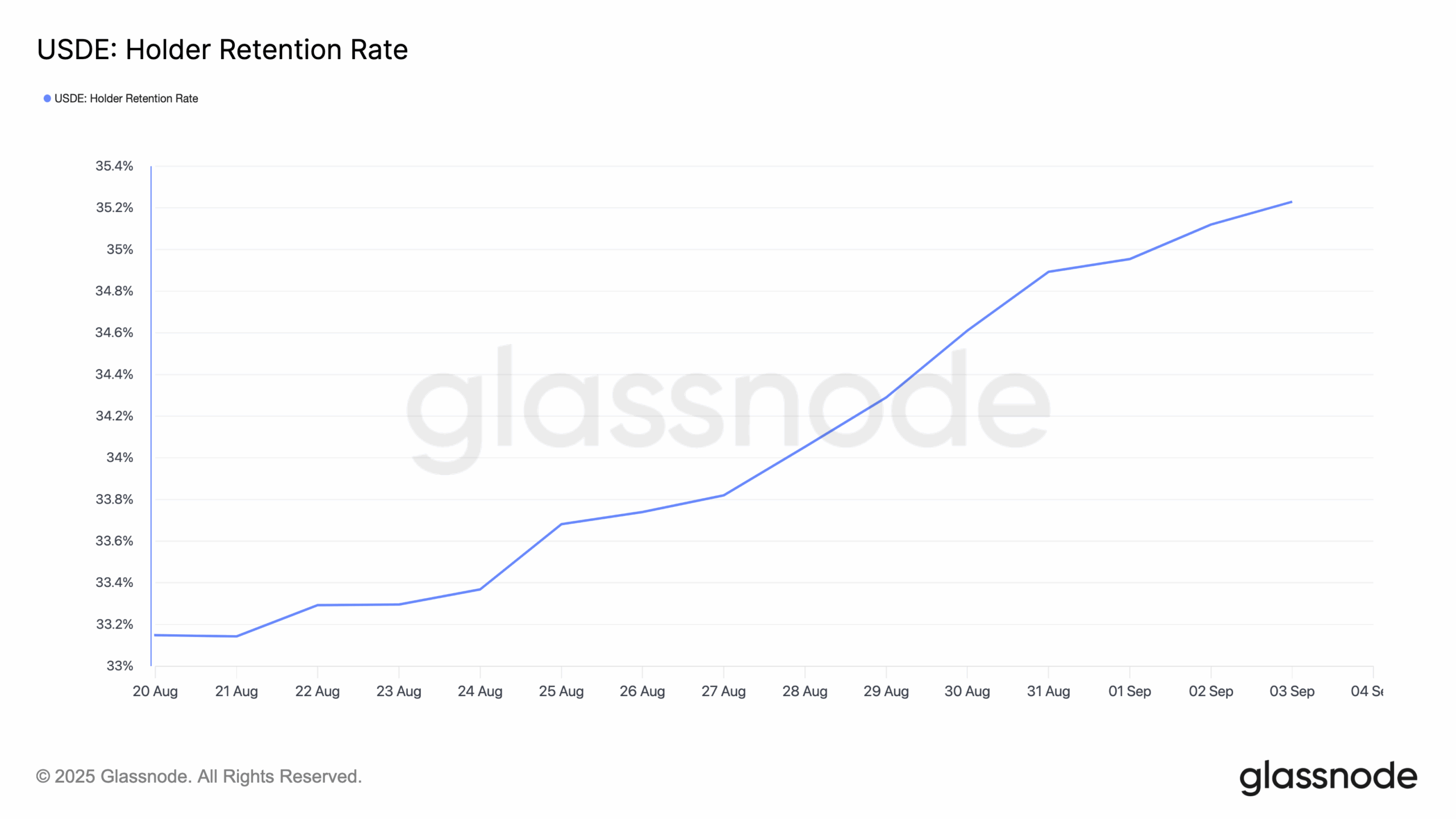
This metric measures the percentage of addresses that continue to hold the asset across consecutive 30-day periods.
A higher retention rate signals stronger confidence and long-term commitment among holders. For instance, an 80% rate means 8 out of 10 wallets continue to hold USDe, while lower readings point to selling pressure or waning trust.
As of this writing, the retention rate has jumped to 35%. While it still seems low, it is an improvement from one month ago.
Hence, the improved retention rate highlights that users aren’t speculating — they’re sticking with the asset. This sustained commitment could provide a solid foundation for USDe’s stability and ENA’s long-term price growth.
Final Thoughts on ETHFI and ENA
In conclusion, it’s worth examining where ETHFI and ENA currently stand. As of this writing, ENA trades at $0.17, up 141% over the past 90 days.
Meanwhile, ETHFI sits at $1.13, roughly the same level it held during that period.
Looking at market caps, ETHFI is valued slightly above $500 million. When compared against its TVL, this suggests the token remains undervalued, lending some weight to Arthur Hayes’ prediction of further upside.
Still, a 34x multiple may be overly ambitious. ENA’s market cap is above $4 billion.
Like ETHFI, it also appears undervalued relative to its TVL. However, Hayes’ bold call for a 51x gain by 2028 may be a stretch. Even so, the fundamentals indicate ETHFI and ENA has more room to run in the years ahead.
Disclaimer:
The information provided in this article is for informational purposes only. It is not intended to be, nor should it be construed as, financial advice. We do not make any warranties regarding the completeness, reliability, or accuracy of this information. All investments involve risk, and past performance does not guarantee future results. We recommend consulting a financial advisor before making any investment decisions.
Victor Olanrewaju is a crypto analyst and reporter at CCN with deep roots in on-chain research and technical analysis. His crypto journey began in 2017, but it was the 2020 Uniswap airdrop that sparked a full-time pivot into the space.
With a foundation in copywriting, Victor honed his craft creating high-converting content for leading crypto brokers — most notably an XRP price prediction that ranked #1 on Google during the 2021 bull run.
He later joined AMBCrypto in 2022, where he combined storytelling with technical and on-chain analysis to cover key market narratives.
In 2024, he expanded his expertise at BeInCrypto, collaborating with analysts and using tools like Glassnode, Santiment, and IntoTheBlock to break down Bitcoin and altcoin trends.
At CCN, Victor covers the top cryptocurrencies, memecoins, macro shifts, blending real-time insights with deep-dive metrics.
He holds a Bachelor’s degree in Physics from the University of Ibadan, equipping him to simplify complex data for a wide audience. Follow his work or connect on LinkedIn or X.