XRP open interest has declined sharply across major exchanges, signaling a retreat from the aggressive positioning seen at the mid-2025 price peak.
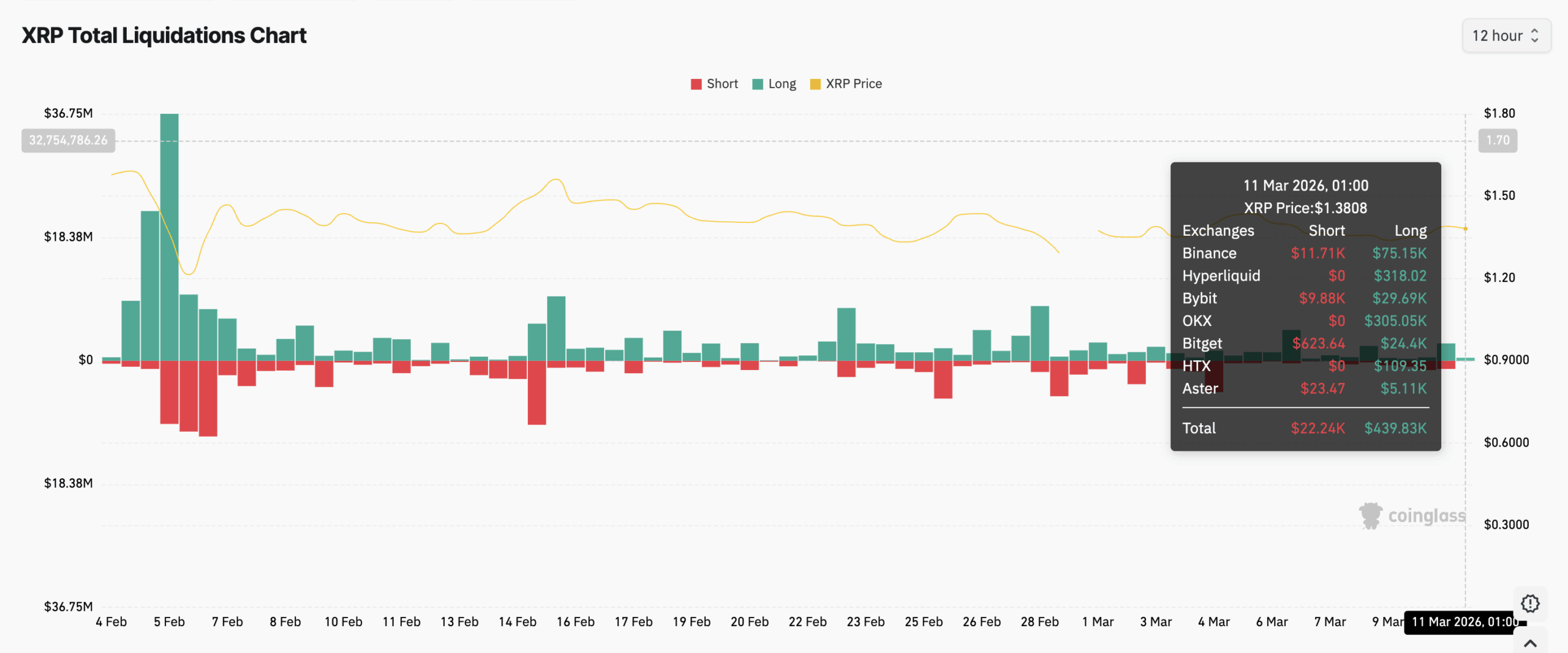
Long liquidations totaled $439,000 in Wednesday’s session alone — more than 20 times the $21,000 recorded in short liquidations — reflecting sustained bearish pressure in the derivatives market.
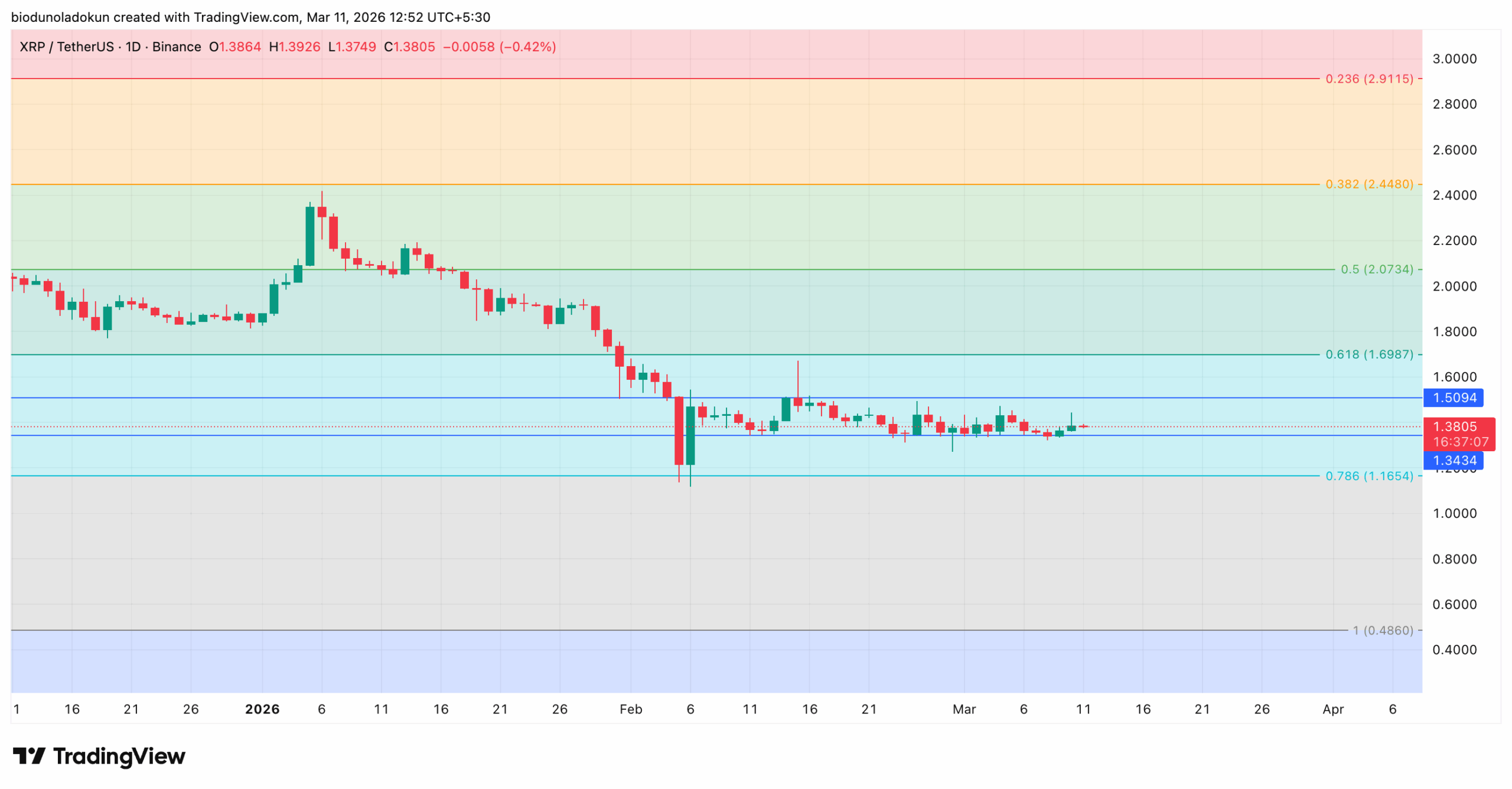
XRP trades above a critical support level; a breakdown risks a retest of lows not seen since 2024.
Ripple’s XRP remains trapped within the horizontal channel that has constrained its price performance since early February, and may be about to break to the downside.
Escalating tensions between the United States, Israel, and Iran have continued to rattle confidence across both traditional and digital asset markets, prompting a broad risk-off shift among investors.
In the XRP derivatives market, that sentiment is playing out in real time, as traders cut losses and exit active contracts rather than hold leveraged exposure amid the uncertainty.
This puts the altcoin at risk of a downside break.
XRP Derivatives Market Cools as Open Interest Falls
According to a recently published CryptoQuant report by Amr Taha, XRP’s derivatives market is showing clear signs of cooling. This is reflected by its open interest, which has fallen sharply across multiple major exchanges in recent weeks.
Taha found that Binance currently leads the market with $222 million in open interest, followed closely by Bybit at $195 million.
While both figures remain above the floor levels recorded in 2024, they sit well below the highs registered when XRP approached its July 2025 price peak.
An asset’s open interest measures its total number of outstanding derivative contracts, such as futures or options, that have not been settled.
When an asset’s open interest declines during a period of poor price performance, it signals waning market participation and weakening trader confidence.
It presents a bearish near-term outlook for the asset, as its price may continue to decline unless new buying pressure re-emerges.
Commenting on the implications of this trend, Taha wrote:
“Historically, steep drops in OI indicate that derivatives traders are closing positions and avoiding extreme leverage, often a sign of market caution.”
This means XRP enters the near term with retreating leverage and deteriorating macro sentiment, heightening the risk of a breakdown of its sideways price structure.
XRP Bulls Take the Hardest Hit
Taha assessed XRP’s liquidation trends across exchanges and found that holders of long positions have borne the brunt of its recent lackluster performance.
Liquidations occur in an asset’s derivatives market when the asset’s price moves against the trader’s position. Long liquidations occur when traders with long positions (bets that prices will continue to rise) are forced to sell the asset at a lower price to cover their losses as prices fall.
This typically happens when the asset’s price decreases beyond a certain level, forcing traders with open positions betting on a price increase to exit the market.
According to Taha:
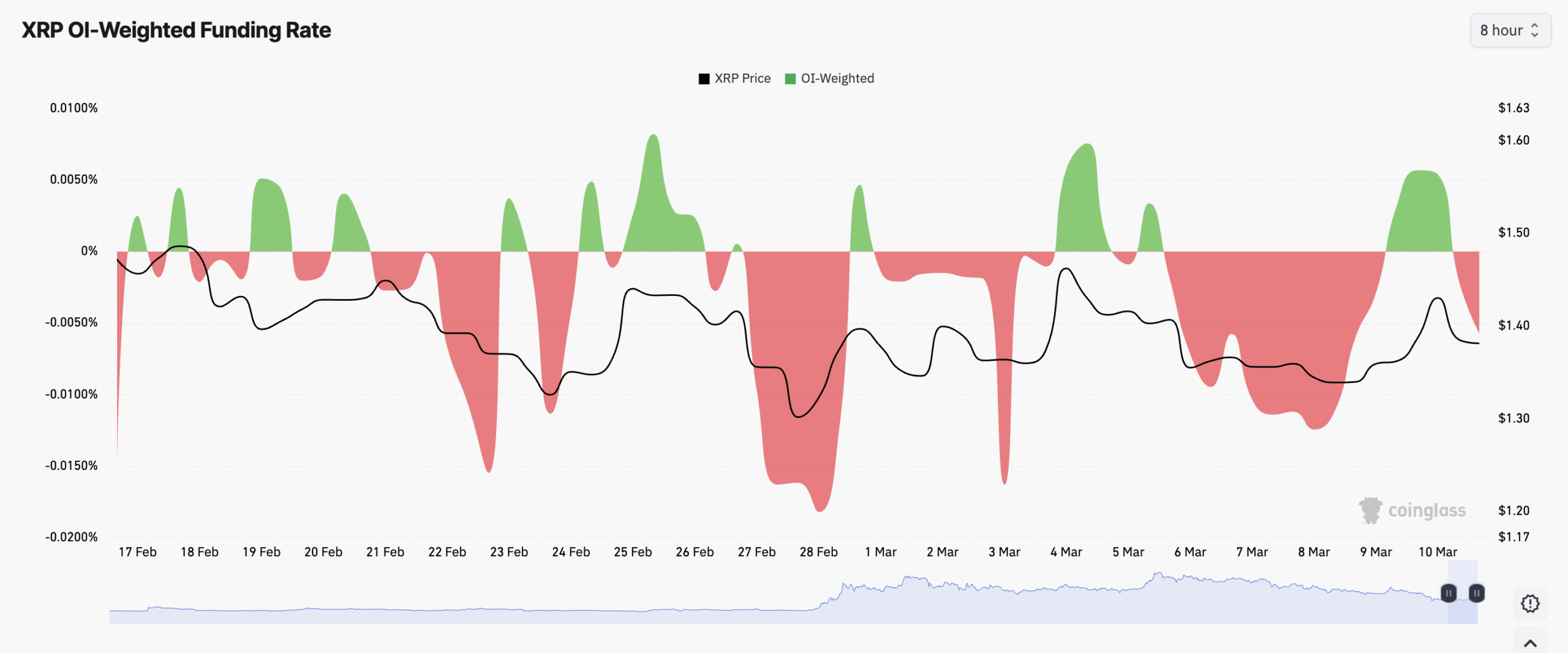
“The data highlights a clear dominance of long liquidations, both in number and size, compared to shorts. Heavy long liquidations typically push funding rates lower, often into neutral or negative zones, reflecting bearish sentiment.”
So far in today’s session, XRP long liquidations have totaled $440,000 across exchanges, dwarfing short liquidations of just $22,000, per Coinglass.
However, if demand returns to the market, XRP’s price could climb above the $1.50 resistance level.
A break above that level could fuel a recovery toward the 0.618 Fibonacci retracement at $1.69, a level it has struggled to reclaim since breaking below it in early 2026.
[You-may-like]
Disclaimer:
The information provided in this article is for informational purposes only. It is not intended to be, nor should it be construed as, financial advice. We do not make any warranties regarding the completeness, reliability, or accuracy of this information. All investments involve risk, and past performance does not guarantee future results. We recommend consulting a financial advisor before making any investment decisions.
Abiodun Oladokun is a Research Analyst at CCN, where he covers cryptocurrency markets with a focus on on-chain analysis, technical assessments, and emerging trends across decentralized finance (DeFi), real-world assets (RWA), artificial intelligence (AI), decentralized physical infrastructure networks (DePIN), Layer 2s, and meme coins.
Prior to CCN, he served as a Senior On-Chain Analyst at BeInCrypto, producing market reports spanning diverse crypto sectors.
Before that, he conducted technical analysis and market assessments of various altcoins at AMBCrypto, where he also contributed long-form quarterly research papers on DeFi, NFTs, DAOs, and scaling architectures, leveraging on-chain platforms including Messari, Santiment, DefiLlama, and Dune Analytics.
He began his crypto career as a research analyst at SixthSense DAO, developing blockchain forensic tools to trace the history of stolen assets.
Abiodun is a lawyer called to the Nigerian Bar and the founder of Ilé Ijó, a Lagos-based electronic dance music collective.