Vitalik Buterin’s radical vision could transform Ethereum by 2030—the same year Standard Chartered predicts ETH could reach $40,000.
Share
Key Takeaways
Vitalik Buterin says Ethereum’s 2027 Hegotá upgrade could be its final “normal” fork before the network undergoes a more radical transformation.
His vision combines blockchain settlement with cryptographic proofs and decentralized off-chain infrastructure.
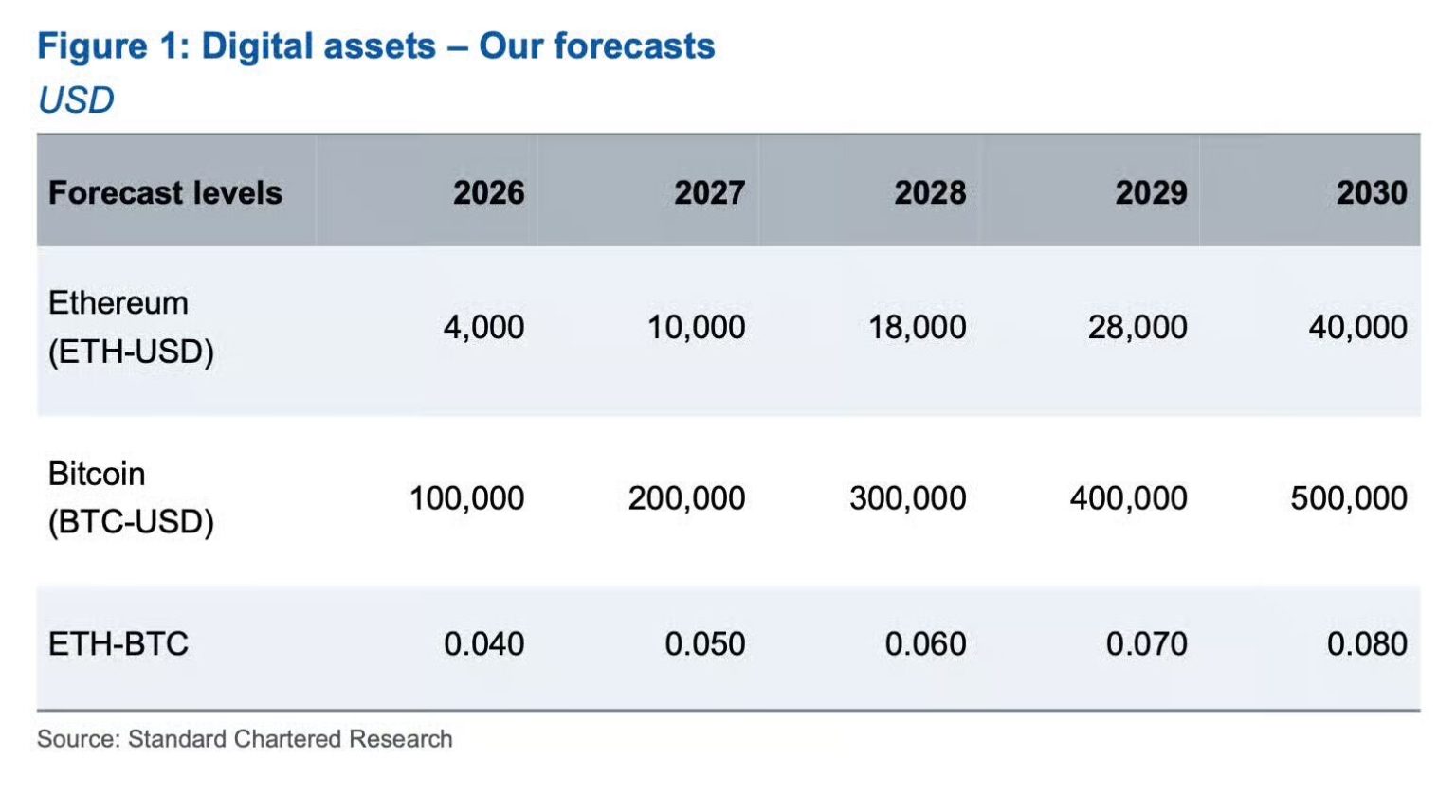
Standard Chartered has forecasted that ETH could reach $40,000 by 2030, requiring a 1,411% rise from its current price.
Ethereum may look so different by 2030 that calling it a blockchain would be technically inaccurate, according to co-founder Vitalik Buterin.
In a new essay outlining Ethereum’s long-term direction, Buterin argued that the network is evolving into a hybrid system combining traditional blockchain structure with cryptographic proofs, privacy technology and computation outside the chain.
The timeline of the comments offers an intriguing contrast to Standard Chartered’s expectation that Ethereum will reach $40,000 by the end of the decade.
Try Our Recommended Crypto Exchanges
Sponsored
Disclosure
We sometimes use affiliate links in our content, when clicking on those we might receive a commission at no extra cost to you. By using this website you agree to our terms and conditions and privacy policy.
In his “cryptographic world computer” essay, Buterin described Ethereum’s future as markedly different from the blockchain originally proposed by Bitcoin’s creator, Satoshi Nakamoto.
He expects that transformation to accelerate after Hegotá, the Ethereum upgrade planned for 2027.
Traditional blockchains require participating computers to download transactions and repeat the calculations needed to verify them.
Buterin’s proposed architecture would increasingly enable a single system to complete a calculation and produce a cryptographic proof that the work was performed correctly.
Other participants could then verify that proof without repeating the entire computation.
That could let separate computers handle different tasks simultaneously, increasing Ethereum’s capacity without requiring every machine to process the same activity.
Buterin said Hegotá is likely to be Ethereum’s last “normal” fork, using features and technology that would still be recognizable to someone working on the network in 2015.
Everything afterward could increasingly rely on recursive STARKs and security designed to withstand future quantum computers.
Could Ethereum Reach $40,000?
Standard Chartered’s digital assets team expects Ethereum to reach $40,000 by the end of 2030, based in part on its role in stablecoin settlement and tokenized financial markets.
At the time of reporting, Ethereum currently trades near $2,647, meaning the bank’s target would require the price to increase approximately 15.1 times, equivalent to a gain of around 1,411%.
Assuming its circulating supply remained near its current level, a $40,000 price would yield a market capitalization of approximately $4.8 trillion.
The bank maintained its Ethereum prediction. | Source: Standard Chartered
That would make Ethereum several times larger than Bitcoin’s present valuation and place the network alongside some of the world’s largest publicly traded companies.
Standard Chartered’s nearer-term expectations are less extreme.
The bank currently targets approximately $7,500 by the end of 2026, after cutting its earlier $12,000 forecast.
A More Powerful Network May Not Mean a More Valuable Token
Buterin’s roadmap could strengthen the technical case for Ethereum by making applications cheaper and more scalable.
However, it also raises the question of how much of the resulting economic activity benefits ETH itself if more work occurs off-chain.
Layer 2 networks already process transactions off-chain before submitting compressed data to the mainnet.
That arrangement has increased capacity and lowered costs for users, but it has also enabled external networks to collect fees that might otherwise have gone directly to Ethereum.
Standard Chartered has previously estimated that Coinbase’s Base network alone removed around $50 billion from ETH’s potential market capitalization by diverting economic activity away from the main chain.
Buterin’s proposed architecture goes considerably further than today’s Layer 2 system.
In his vision, applications would structure and aggregate more computation before it reached the final block.
That may create a faster and more useful ETH, but investors would still need ETH to remain essential as collateral and staking capital.
Otherwise, applications could flourish while the token captures only a limited portion of their value.
What Would $40,000 ETH Require?
For Standard Chartered’s forecast to materialize, Ethereum would likely need more than successful technical upgrades.
Stablecoin settlement and tokenized financial assets would have to expand substantially,
Meanwhile, demand for Ethereum would also need to rise in tandem with network usage.
That could happen if global firms increasingly hold Ethereum and use it as collateral.
However, ETH would face significant risks along the way.
Producing cryptographic proofs cheaply and securing the system against new attack vectors will require years of engineering.
Buterin believes modern cryptography can finally deliver Ethereum’s original ambition of using decentralization to improve performance rather than merely accepting it as the cost of security.
Whether that transformation can support a $4.8 trillion valuation is a separate question.
Disclaimer:
The information provided in this article is for informational purposes only. It is not intended to be, nor should it be construed as, financial advice. We do not make any warranties regarding the completeness, reliability, or accuracy of this information. All investments involve risk, and past performance does not guarantee future results. We recommend consulting a financial advisor before making any investment decisions.
Kurt Robson is a London-based reporter at CCN, specialising in the fast-moving worlds of crypto and emerging technology. He began his career covering local news in Cornwall after graduating from Falmouth University with First Class Honours in Journalism. There, he cut his teeth on everything from council meetings to missing swans.
He quickly rose through the ranks to become a frontline journalist at several of the UK’s leading national newspapers. Over the years, he has interviewed musicians and celebrities, reported from courtrooms and crime scenes, and secured multiple front-page exclusives.
Following the upheaval of the COVID-19 pandemic, Kurt shifted his focus to technology journalism—just ahead of the AI boom. With a natural curiosity and a trained eye for emerging trends, he has found a new rhythm in reporting on innovation.
At CCN, Kurt's work focuses on the cutting edge of crypto, blockchain, AI, and the evolving digital world. Drawing on his background in people-first reporting and his deep interest in disruptive tech, Kurt delivers stories that are insightful, entertaining, and human-centric.