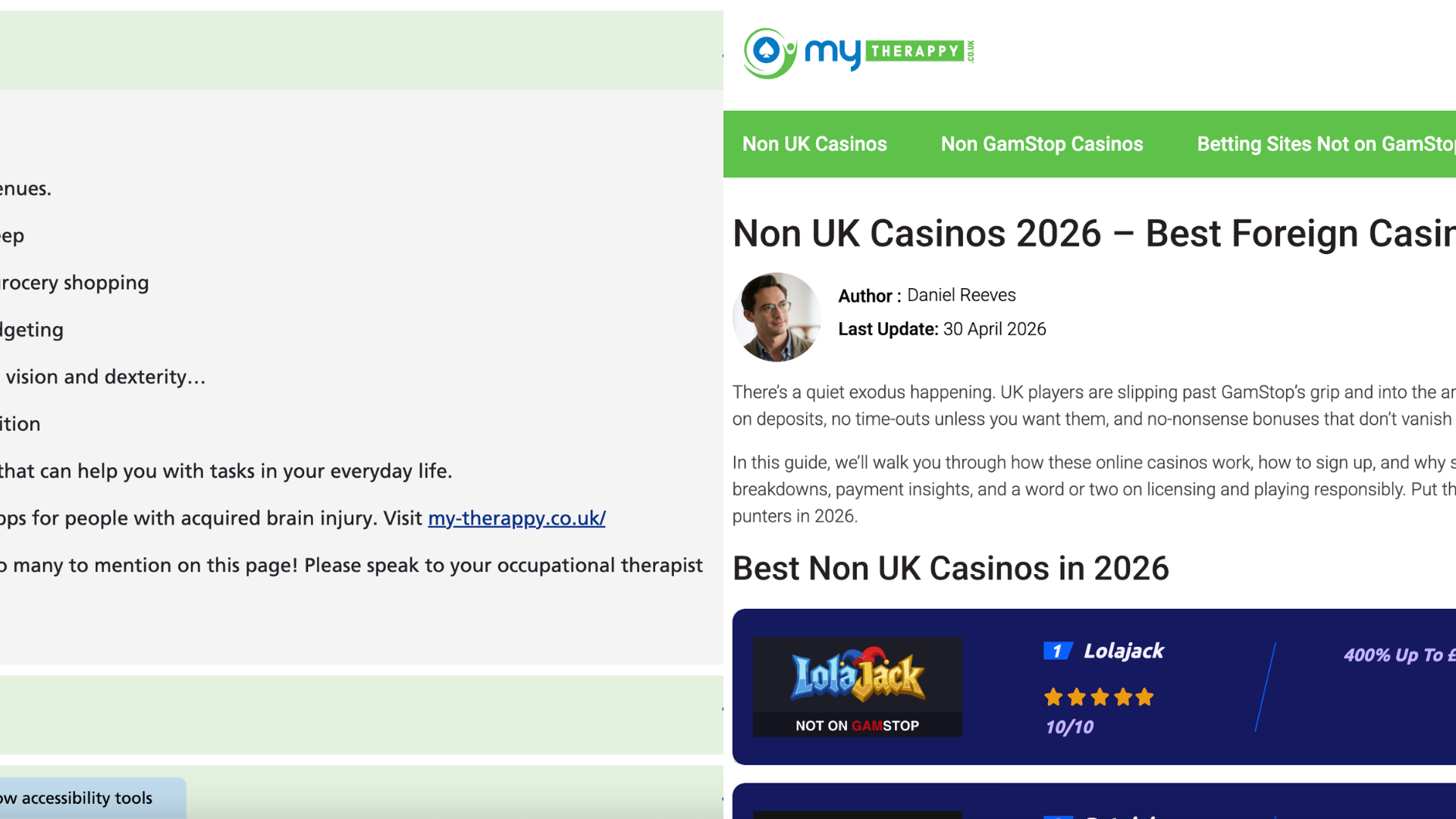
CCN found NHS patients are still being directed to MyTherappy, now repurposed for casino content.
Share
Key Takeaways
An NHS webpage dated Aug. 25 still directs acquired brain-injury patients to offshore casino content.
Royal Devon University Healthcare NHS Foundation Trust said it was investigating after reports that the former health site was promoting “Non-GamStop” casinos.
Historical records show the domain was due to expire in 2024 and later redirected through a UK domain-backordering service, raising questions over how control was lost.
At least three NHS trust websites are still directing stroke and brain-injury patients to MyTherappy, a former health resource that now redirects visitors to offshore casino content, CCN has found.
Among them is Royal Devon University Healthcare NHS Foundation Trust itself, despite the Trust confirming its cybersecurity teams are investigating what happened to the domain.
The discovery follows The Independent’s report that MyTherappy had become the latest UK public-sector-facing site targeted “by hackers” promoting non-UK and “Non-GamStop” casinos.
However, CCN has now uncovered historical domain records that suggest MyTherappy may have been allowed to expire before being repurposed for gambling content.
That would point not necessarily to a cyberattack, but to the loss of control over a trusted NHS-linked domain.
Multiple NHS Trusts Still Send Users to Casino Content
CCN found the problem extends beyond a single NHS rehabilitation resource.
A live page for Staples Ward, the stroke unit at North Devon District Hospital, says the service uses technology to support rehabilitation, including “specific apps recommended on” MyTherappy.
Clicking the MyTherappy link currently sends visitors to its “Non UK Casinos 2026 – Best Foreign Casino Sites” page.
CCN also found Cumbria, Northumberland, Tyne and Wear NHS Foundation Trust directing acquired brain-injury patients to the same domain.
Cumbria, Northumberland, Tyne and Wear NHS Foundation Trust still has a casino link embedded on its website. | Source: CNTW NHS
Its rehabilitation resource, published on Aug. 25, 2026, tells patients that MyTherappy provides “NHS-recommended, user-tested apps” before linking to the website.
A separate Northumberland Head Injuries Service resource hosted by the same Trust also continues to recommend MyTherappy.
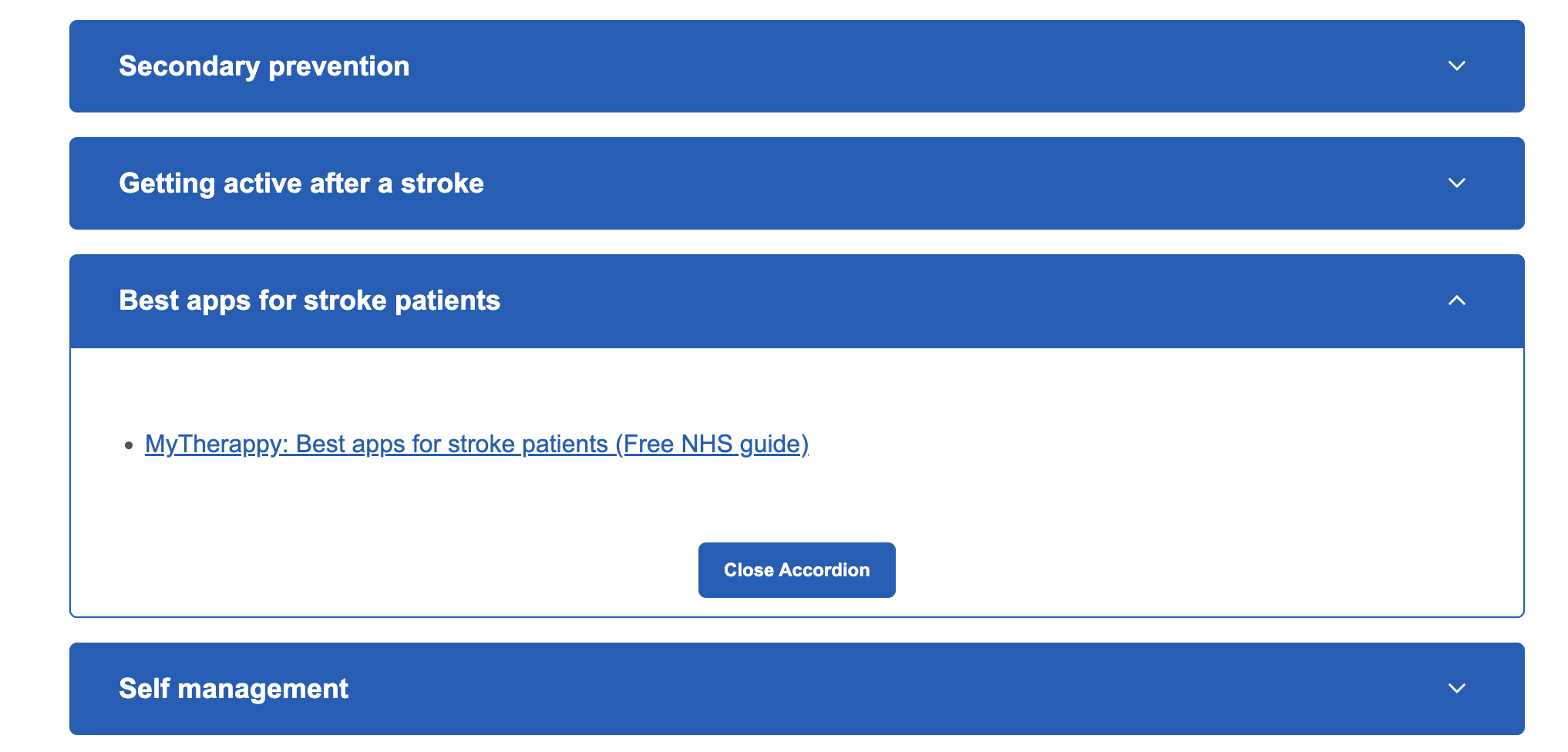
Leeds Community Healthcare NHS Trust currently lists MyTherappy under a “Best apps for stroke patients” section on its stroke rehabilitation website.
CCN also identified an older patient resource still hosted by Berkshire Healthcare NHS Foundation Trust that directs users to a MyTherappy page for the Virtual Hope Box mental-health app.
The findings show MyTherappy’s links remain embedded across NHS websites and patient materials years after the service was originally developed.
Was MyTherappy Actually Hacked?
Initial reports have described MyTherappy as having been hacked or hijacked.
The Independent said the site appeared to be the latest public-sector-facing website targeted by hackers promoting illegal casinos.
SBC News similarly described the site as apparently being compromised by gambling promotions.
But Royal Devon’s statement did not confirm exactly what happened.
The Trust said it was still trying to establish the domain’s status, and historical records reviewed by CCN raised another possibility.
A historical WHOIS record reproduced by RankChart shows my-therappy.co.uk was registered in September 2015 and had an expiry date of Sept. 18, 2024.
BuiltWith later recorded my-therappy.co.uk redirecting to UKBackorder.uk in January 2025.
This timeline suggests the website may have been repurposed after a change in domain control, rather than hackers simply inserting gambling pages into an NHS-controlled website.
CCN contacted the Trust for comment.
Public Websites Targeted With Gambling Content
MyTherappy is not the first public-sector-linked site to become associated with gambling promotions.
SBC News reported that parts of the Scottish Borders Council web infrastructure were recently affected by illegal gambling advertising.
The BBC, meanwhile, reported that an Old Catton Parish Council page was found displaying an advert for an Indonesian online slots casino earlier this year.
MyTherappy presents a particularly sensitive example because the site’s new content focuses heavily on casinos outside GamStop.
GamStop is the national self-exclusion system used by UK-licensed online gambling operators.
For now, Royal Devon has not publicly confirmed whether the former health website was hacked, its domain expired, or control was changed through another process.
But while that question is investigated, the redirected MyTherappy service remains online elsewhere in the NHS.
Disclaimer:
The information provided in this article is for informational purposes only. It is not intended to be, nor should it be construed as, financial advice. We do not make any warranties regarding the completeness, reliability, or accuracy of this information. All investments involve risk, and past performance does not guarantee future results. We recommend consulting a financial advisor before making any investment decisions.
Kurt Robson is a London-based reporter at CCN, specialising in the fast-moving worlds of crypto and emerging technology. He began his career covering local news in Cornwall after graduating from Falmouth University with First Class Honours in Journalism. There, he cut his teeth on everything from council meetings to missing swans.
He quickly rose through the ranks to become a frontline journalist at several of the UK’s leading national newspapers. Over the years, he has interviewed musicians and celebrities, reported from courtrooms and crime scenes, and secured multiple front-page exclusives.
Following the upheaval of the COVID-19 pandemic, Kurt shifted his focus to technology journalism—just ahead of the AI boom. With a natural curiosity and a trained eye for emerging trends, he has found a new rhythm in reporting on innovation.
At CCN, Kurt's work focuses on the cutting edge of crypto, blockchain, AI, and the evolving digital world. Drawing on his background in people-first reporting and his deep interest in disruptive tech, Kurt delivers stories that are insightful, entertaining, and human-centric.