Key Takeaways
Sixteen years ago, a Florida programmer made what is now considered the most expensive food purchase in modern financial history.
On May 22, 2010, Laszlo Hanyecz famously spent 10,000 Bitcoin on two Papa John’s pizzas in what became the first widely recognized real-world Bitcoin transaction. At the time, the coins were worth roughly $41, and Bitcoin itself was little more than an obscure experiment discussed in online cryptography forums.
Today, Bitcoin Pizza Day has become a global crypto holiday celebrated across exchanges, conferences, and online communities. But every year, the same question resurfaces: what if Laszlo had simply held onto the Bitcoin instead of spending it?
With Bitcoin trading at $77,209.86 on Bitcoin Pizza Day 2026, the answer is almost incomprehensible.
Those 10,000 BTC would now be worth approximately $772.1 million.
The figure highlights not only Bitcoin’s meteoric rise over the last decade and a half, but also the extraordinary transformation of digital assets from internet curiosity to globally recognized financial instruments.
+70
Shiba Inu
Bitcoin
PAX Gold
Ampleforth
Ethereum
Cardano
EOS
Solana
Avalanche
Dogecoin
Ripple
TRON
Bitcoin Cash
Ocean Protocol
Litecoin
Reserve Rights
Ontology
Bitcoin SV
Ethereum Classic
Kusama
Dash
Neo
Chainlink
Qtum
Polkadot
VeChain
Stellar
Tezos
Zcash
Zilliqa
Status
JUST
Cosmos
Ravencoin
Trust Wallet Token
ARPA Chain
Nervos Network
Storj
Beam
NKN
Algorand
Celer Network
THORChain
Fantom
Optimism
Aptos
APEcoin
Wrapped Bitcoin
Compound
Monero
Basic Attention Token
Arweave
Aergo
Decentraland
SushiSwap
Conflux Network
NEAR Protocol
Polkastarter
Ankr
Maker
Artificial Superintelligence Alliance
Mask Network
Cronos
Internet Computer
Badger DAO
USD Coin
BakeryToken
Alpaca Finance
Aave
Treasure
BitTorrent
FLUX
Bancor
IoTex
Build'N'Build
+76
Bitcoin
Ethereum
Tether
USD Coin
Solana
Ripple
Dogecoin
Cardano
Toncoin
Shiba Inu
Avalanche
TRON
Chainlink
Polygon Matic
Polkadot
Wrapped Bitcoin
Litecoin
Dai
NEAR Protocol
Bitcoin Cash
Stellar
Cosmos
Filecoin
Ethereum Classic
Aptos
Hedera Hashgraph
Immutable
Optimism
Arbitrum
VeChain
The Sandbox
Decentraland
Axie Infinity
Injective Protocol
Render
The Graph
Aave
Chiliz
Helium
PAX Gold
Compound
Lido DAO Token
Sui
Conflux Network
Lido Staked ETH
OKB
Uniswap
Pepe
Ondo
Mantle
First Digital USD
XDC Network
Artificial Superintelligence Alliance
Jupiter
Quant
Worldcoin
Bonk
Tether Gold
JITO
JasmyCoin
Core
Floki Inu
Ethereum Name Service
SushiSwap
1inch Network
Tezos
Algorand
Flow
Trust Wallet Token
Curve DAO Token
MultiversX
Basic Attention Token
Enjin Coin
Ethena
Ethena Staked USDe
Build'N'Build
Kava.io
Celestia
Sei
IOTA
Frax
+217
Bitcoin
Ethereum
Tether
Build'N'Build
USD Coin
Solana
Ripple
Dogecoin
Cardano
Toncoin
Shiba Inu
Avalanche
TRON
Chainlink
Polkadot
Polygon Matic
Wrapped Bitcoin
Litecoin
Dai
NEAR Protocol
Bitcoin Cash
Monero
Stellar
Cosmos
Filecoin
Ethereum Classic
Aptos
Hedera Hashgraph
Immutable
Optimism
Arbitrum
VeChain
The Sandbox
Decentraland
Axie Infinity
Injective Protocol
Render Token
The Graph
Maker
Aave
Chiliz
Helium
PAX Gold
Compound
Lido DAO Token
THORChain
Stacks
Arweave
Sui
Conflux Network
Lido Staked ETH
Bitget Token
Wrapped Ethereum
OKB
Uniswap
Pepe
Ondo
Mantle
First Digital USD
Bittensor
Kaspa
Celestia
XDC Network
Artificial Superintelligence Alliance
Jupiter
Quant
Worldcoin
PayPal USD
Bonk
Flare
Tether Gold
Sei
JITO
JasmyCoin
PancakeSwap
Core
Floki Inu
Ethereum Name Service
SushiSwap
Kava.io
1inch Network
Tezos
Algorand
Flow
Trust Wallet Token
Curve DAO Token
KuCoin Token
MultiversX
Gitcoin
Zcash
IOTA
Basic Attention Token
Frax
Ethena
Ethena USDe
Fasttoken
Pi Network
SATS
Adventure Gold
Audius
Alchemy Pay
Arkham
API3
Bounce Token
Altlayer
Aergo
Amp
Aevo
ARPA Chain
Astar
Ark
Ankr
AirSwap
Alpaca Finance
Blur
Badger DAO
Bancor
BakeryToken
Biconomy
Chromia
Celer Network
Celo
Shentu
Civic
Convex Finance
Cartesi
Cyber
COTI
DigiByte
DIA
ether.fi
FUNToken
FLUX
Firo
Ampleforth
Golem
GMX
Gnosis
Moonbeam
Holo
IoTex
ICON
Illuvium
JUST
Kadena
Liquity
Livepeer
Lisk
Memecoin
Manta Network
Treasure
Mask Network
MetisDAO
Origin Protocol
ORDI
Ontology
Osmosis
Powerledger
Phala Network
Pendle
Portal
Pyth Network
ConstitutionDAO
Polkastarter
Qtum
iExec RLC
Rocket Pool
Reserve Rights
Ronin
Ravencoin
Starknet
Storj
Status
Spell Token
Sun (New)
SuperVerse
Toko Token
Theta Fuel
Tellor
Tensor
LayerZero
Usual
Eigenlayer
Hamster Kombat
Catizen
Berachain
KAITO
Pudgy Penguins
Solayer
Bio Protocol
ChainGPT
Cookie DAO
Solv Protocol
Alchemix
Bitcoin SV
Movement
DeXe
Binance Staked SOL
Nexo
Wrapped eETH
Hyperliquid
Casper
Zilliqa
Secret
Nervos Network
TrueUSD
BitTorrent
Mina
Dash
STEPN
Gemini Dollar
UNUS SED LEO
Synthetix
APEcoin
Gala
Theta Network
Fantom
Cronos
Internet Computer
Binance USD
At today’s market price, Laszlo Hanyecz’s famous Bitcoin transaction has become one of the most iconic examples of unrealized gains in financial history.
The calculation means the two pizzas purchased in 2010 now carry an implied value of more than three-quarters of a billion dollars.
16 years ago today, Laszlo Hanyecz paid 10,000 Bitcoin for two Papa John's pizzas.
Today, 10k $BTC is worth over $775,000,000. pic.twitter.com/HBkqsmpmD7
— Watcher.Guru (@WatcherGuru) May 22, 2026
To put that into perspective, $772 million would be enough to:
Yet despite the enormous figure, the transaction remains celebrated rather than ridiculed within the Bitcoin community.
The reason is simple: without early real-world transactions like Laszlo’s pizza purchase, Bitcoin may never have evolved into the global asset it is today.
Back in 2010, Bitcoin had almost no commercial utility. Exchanges were primitive, institutional investors had no interest in digital assets, and very few merchants accepted cryptocurrency as payment.
By spending Bitcoin on an actual product, Hanyecz helped demonstrate that the technology could function as money.
In many ways, the pizza purchase became Bitcoin’s first major proof-of-concept.
The appreciation of those 10,000 BTC mirrors Bitcoin’s broader evolution over the past 16 years.
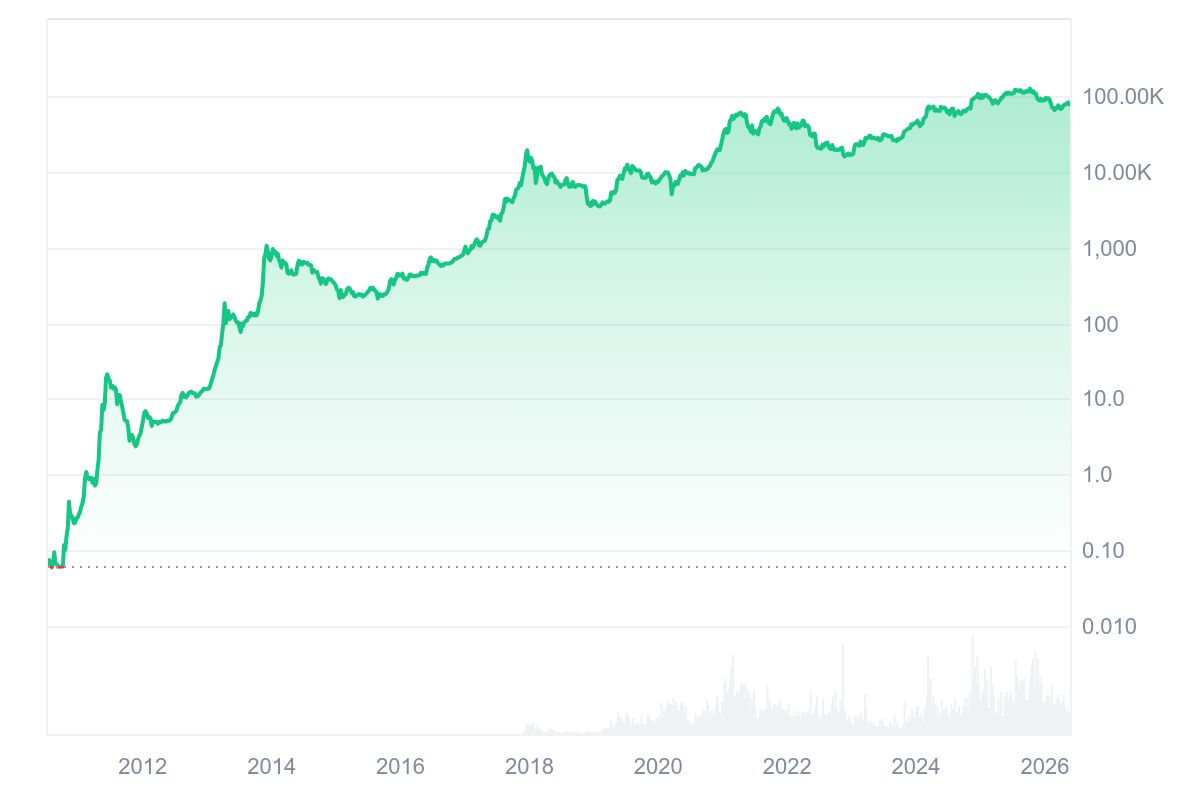
When Laszlo bought the pizzas, Bitcoin traded for less than one cent per coin. Mining could be done on ordinary home computers, and the asset was viewed largely as an experimental project among developers and libertarian technologists.

Since then, Bitcoin has undergone one of the most dramatic price expansions ever recorded.
By 2013, Bitcoin briefly crossed the $1,000 mark, making Laszlo’s holdings worth $10 million in theory. During the 2017 crypto bull market, Bitcoin surged close to $20,000, pushing the value of the pizza coins to roughly $200 million.
The next major wave came in 2021, when institutional adoption accelerated rapidly. Public companies added Bitcoin to balance sheets, exchange-traded products emerged globally, and large asset managers began treating Bitcoin as a legitimate macro asset class. Bitcoin eventually climbed above $69,000 during that cycle.
Now, in 2026, Bitcoin trading above $77,000 has pushed the value of those original 10,000 BTC beyond $772 million.
The rise has been fueled by multiple structural developments, including:
Bitcoin’s market perception has shifted dramatically over the years. What was once dismissed as “internet money” is now discussed alongside gold, sovereign debt, and traditional reserve assets in institutional portfolios.
Despite the staggering valuation, many longtime Bitcoin advocates argue that focusing only on the “lost millions” misses the true significance of Bitcoin Pizza Day.
Laszlo Hanyecz himself has repeatedly said he does not regret the purchase.
For early adopters, Bitcoin’s success depended on proving that it could actually be used in commerce. At the time, spending Bitcoin was essential for demonstrating its utility. Without transactions, Bitcoin would have remained merely a theoretical digital token.
The pizza purchase helped establish a real economic use case for decentralized currency.
That symbolic importance has only grown over time. Bitcoin Pizza Day is now celebrated globally with crypto meetups, exchange promotions, NFT launches, Bitcoin-funded pizza giveaways, and educational campaigns about crypto adoption.
The event has evolved into a reminder of how quickly disruptive technologies can reshape financial systems.
It also underscores one of the most difficult realities of investing: transformative innovations are rarely obvious in their earliest stages.
Very few people in 2010 could have realistically predicted that Bitcoin would eventually become a trillion-dollar asset class held by hedge funds, corporations, sovereign entities, and global financial institutions. Even among early believers, almost nobody held their entire Bitcoin position uninterrupted through years of extreme volatility, regulatory uncertainty, exchange collapses, and repeated bear markets.
In hindsight, holding 10,000 BTC appears obvious. In reality, surviving Bitcoin’s 16-year journey required extraordinary conviction.
That is ultimately why Bitcoin Pizza Day continues to resonate across the crypto industry. The story is not simply about a missed fortune. It is about the birth of an entirely new financial system — and the first real transaction that helped bring it to life.
Giuseppe Ciccomascolo began his career as an investigative journalist in Italy, where he contributed to both local and national newspapers, focusing on various financial sectors.
Upon relocating to London, he worked as an analyst for Fitch's CapitalStructure and later as a Senior Reporter for Alliance News. In 2017, Giuseppe transitioned to covering cryptocurrency-related news, producing documentaries and articles on Bitcoin and other emerging digital currencies. He also played a pivotal role in establishing the academy for a cryptocurrency exchange website. Crypto remained his primary area of interest throughout his tenure as a writer for ThirdFloor.
You’re All Set!
Thanks for signing up. We’ll be in touch soon with the latest insights.