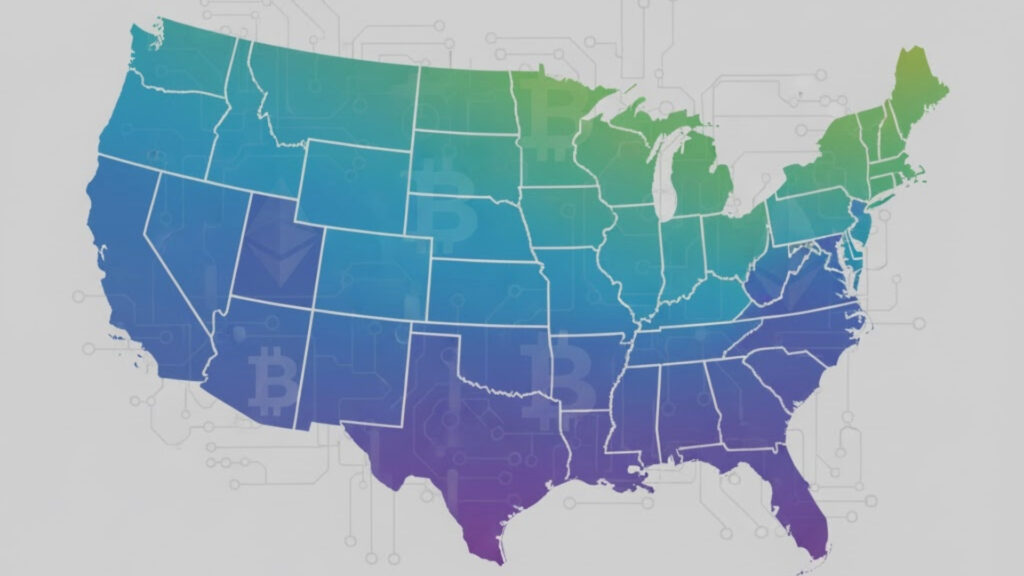
Crypto friendly states are fighting for top spot. | Source: Image created with Gemini
Share
Key Takeaways
Coinbase is leaving Delaware for Texas, citing a more favorable corporate legal environment.
Texas is emerging as a top destination for tech and crypto firms.
Several U.S. states are now competing to attract crypto businesses, where is the best?
Coinbase is preparing to abandon Delaware as its legal home and re-establish itself in Texas, according to reporting from The Wall Street Journal.
The decision was announced publicly by Coinbase and has been extensively explained by the company’s Chief Legal Officer, Paul Grewal, who claimed the decision was “best for our customers.”
With so many tech giants leaving the area, join CCN as we explore what the best U.S. state is for crypto firms and traders.
Coinbase Leaves Delaware
In a statement shared on X, Chief Legal Officer Paul Grewal wrote that “this decision was not made lightly.”
However, he emphasized that the company will “always do what’s best for our customers, our employees, and our shareholders.”
The move comes as Texas steps up its pitch to become a national corporate hub for technology firms.
Grewal, in a series of posts, said the shift signals a much broader trend.
While he stressed that he has “had great experiences in Delaware as a lawyer and judicial colleague,” he added that the state “no longer has a monopoly on corporate law.”
Today @Coinbase is announcing our decision to leave Delaware and reincorporate in Texas. This decision was not made lightly, but we’ll always do what’s best for our customers, our employees, and our shareholders. 1/6
According to Grewal, multiple states “are innovating to offer the right environment for business and innovators to thrive,” and Texas has emerged as a clear contender.
The change aligns with Coinbase’s argument that the U.S. is entering a more open contest over regulation and corporate governance.
“Coinbase is not the first company to make this decision. We surely won’t be the last,” Grewal said, describing the trend as “a return to a free market economy in all things, including regulation and judicial review.”
Grewal has been explicit about why Texas stood out.
He said Texas’ corporate legal landscape provides “the right mix of efficiency, predictability, and fairness” for a high-growth public company seeking long-term stability.
“We remain laser-focused on our mission to increase economic freedom by building the on-chain economy,” Grewal said. “And today’s decision keeps us on that road.”
Not the First Company, Not the Last
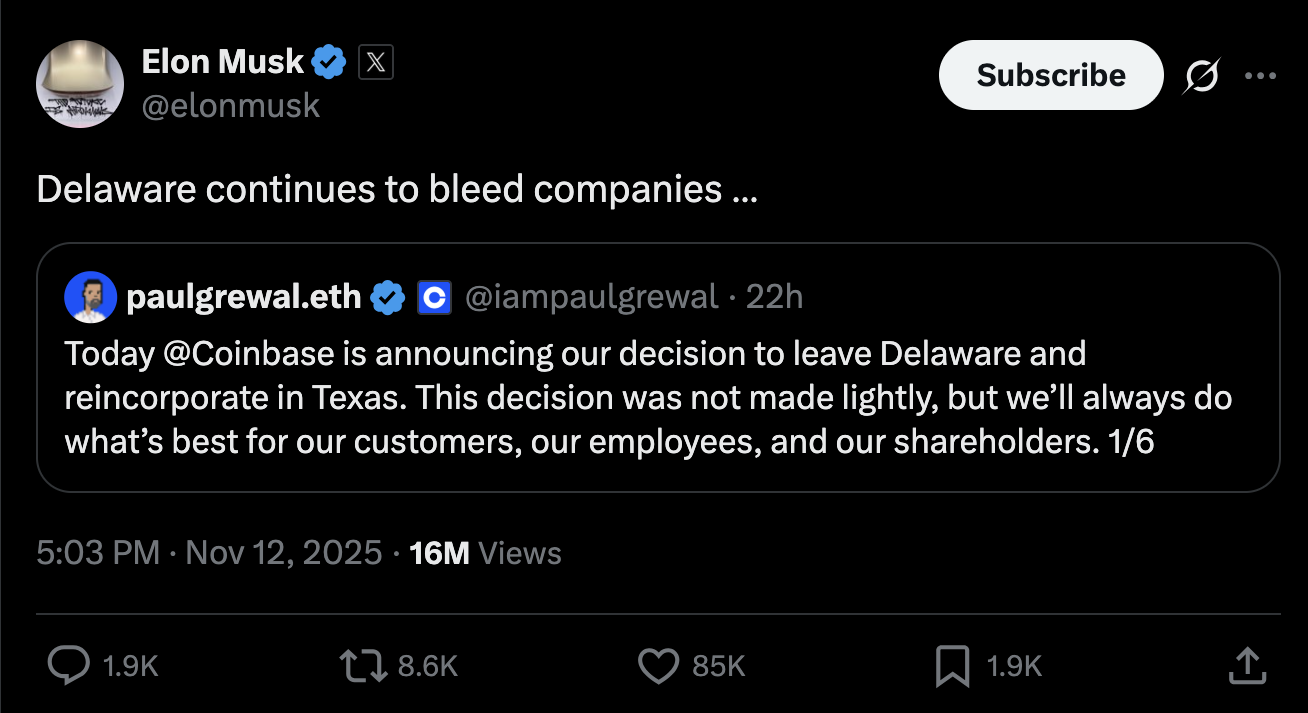
Elon Musk has even jumped in to throw shade at Delaware, reposting Grewal’s departure announcement:
“Delaware continues to bleed companies …”
The Tesla and X billionaire followed up in a separate post, stating that the state needed to make “major changes immediately” or risk losing its title as “the incorporation state for most companies in America.”
Elon Musk moved SpaceX and Tesla from Delaware in 2024. | Source: X
Musk was one of the first high-profile departures from Delaware to Texas in 2024, as he relocated both Tesla and SpaceX to the state after a court rejected his $56 billion compensation package.
Since then, several other major companies have followed, including Dropbox, Andreessen Horowitz, and Roblox.
Meta is reportedly weighing a similar change.
The Best State For Crypto
A recent blog from the tax platform CoinLedger highlights how several U.S. states have positioned themselves as national leaders for cryptocurrency businesses and investors.
The ranking reflects a mix of regulatory flexibility, tax advantages and state-level experimentation that is shaping where crypto companies choose to set up shop.
Wyoming
CoinLedger identifies Wyoming as the most assertive early mover in building a framework for digital-asset businesses.
The state has eliminated money transmission licensing for crypto companies, introduced a Financial Technology Sandbox for testing new products, and established special-purpose crypto banks.
With no state income tax, Wyoming remains especially appealing to both companies and high-volume traders seeking a low-tax environment.
Florida
Florida, according to the blog, mirrors many of Wyoming’s advantages.
Crypto firms are exempt from money-transmission licensing, and the state operates its own fintech sandbox.
Florida has also experimented with allowing government fees to be paid in crypto.
Combined with the lack of a state income tax, Florida continues to draw traders and entrepreneurs in the digital-asset space.
Texas
CoinLedger reported that Texas has become a major hub for crypto mining, thanks to comparatively inexpensive energy and regulatory support for blockchain development.
The state’s authorization in 2021, which allows state-chartered banks to offer crypto custody services, provides companies with a clearer legal footing.
Like Wyoming and Florida, Texas has no state income tax, adding to its attractiveness for large-scale crypto operations.
Brian Armstrong stated that Texas has always been supportive of crypto. | Source: X
Coinbase co-founder and CEO Brian Armstrong said that the move to Texas was an “easy choice.”
“Coinbase has always been about increasing economic freedom, and these factors into the state where we choose to incorporate,” he wrote.
“Texas has a strong culture of celebrating builders who are growing our economy, creating prosperity for all. They’ve also embraced crypto,” Armstrong added.
The state now allows taxpayers to pay state taxes in cryptocurrency and has actively promoted itself as a testing ground for blockchain technologies.
CoinLedger points out that Colorado’s 4.40% flat income tax applies to crypto earnings, making it less competitive for traders who prioritize tax efficiency.
Kurt Robson is a London-based reporter at CCN, specialising in the fast-moving worlds of crypto and emerging technology. He began his career covering local news in Cornwall after graduating from Falmouth University with First Class Honours in Journalism. There, he cut his teeth on everything from council meetings to missing swans.
He quickly rose through the ranks to become a frontline journalist at several of the UK’s leading national newspapers. Over the years, he has interviewed musicians and celebrities, reported from courtrooms and crime scenes, and secured multiple front-page exclusives.
Following the upheaval of the COVID-19 pandemic, Kurt shifted his focus to technology journalism—just ahead of the AI boom. With a natural curiosity and a trained eye for emerging trends, he has found a new rhythm in reporting on innovation.
At CCN, Kurt's work focuses on the cutting edge of crypto, blockchain, AI, and the evolving digital world. Drawing on his background in people-first reporting and his deep interest in disruptive tech, Kurt delivers stories that are insightful, entertaining, and human-centric.