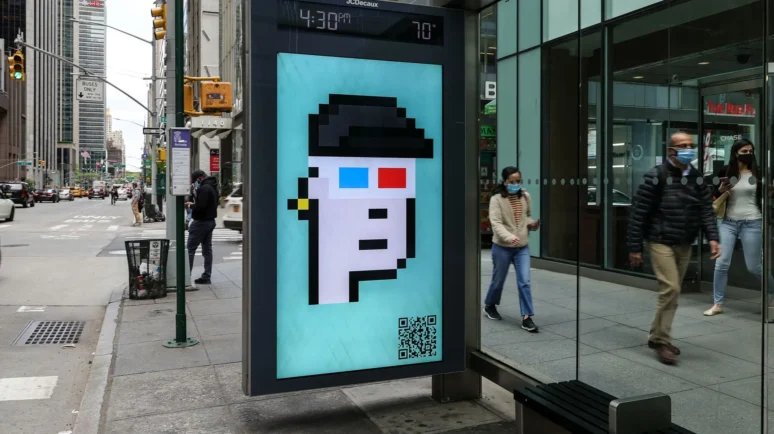
Blur closes its frontend on November 12, 2026. Blend borrowers face a repay-or-default deadline, with a withdrawal tool promised afterward. | Credit: CCN.com
Share
Key Takeaways
Blur will shut down its website frontend and stop matching new Blend loans on Nov. 12, 2026.
Borrowers have until the deadline to repay or allow a default, potentially losing their pledged NFTs.
A withdrawal tool will follow, but its release date and post-cutoff refinancing options remain unspecified.
Blur will retire its website frontend on Nov. 12, 2026, and stop matching new loans through Blend on the same date, giving borrowers a month to address outstanding positions.
The NFT marketplace announced the changes on Oct. 12, emphasizing that its marketplace protocol will remain operational on-chain. BLUR will also retain control over the protocol’s fee switch.
For borrowers, however, the deadline carries a more immediate consequence: repay their Blend loans or allow them to default.
A separate withdrawal interface will follow, although Blur has not specified when it will be available.
Try Our Recommended Crypto Exchanges
Sponsored
Disclosure
We sometimes use affiliate links in our content, when clicking on those we might receive a commission at no extra cost to you. By using this website you agree to our terms and conditions and privacy policy.
Blend Borrowers Face a Repayment-or-Default Deadline
Blur’s instructions to existing borrowers are direct: they have until Nov. 12 to repay their loans or go into default.
That means the promised withdrawal tool should not be confused with an extension of borrowing arrangements. Blur described it as an interface for withdrawing assets after the cutoff, rather than a replacement service for maintaining or refinancing loans.
Borrowers seeking to retain their pledged NFTs therefore need to understand their outstanding debt and the current status of each position before the deadline.
Blend’s published design explains why default matters. The protocol allows borrowers to pledge NFTs as collateral, with interest accruing continuously. Borrowers can repay at any time, while lenders can seek an exit through a refinancing auction.
If another lender takes over, the loan continues under the new terms. If refinancing fails, the existing lender can claim the collateral, meaning the borrower loses the pledged NFT.
However, Blur’s announcement does not explain the precise operational process for every outstanding loan at the cutoff. It also does not establish that all collateral will transfer automatically on November 12.
Those implementation details remain important for borrowers whose positions are already undergoing refinancing.
“Perpetual” Loans Still Depend on Available Financing
Blend launched in May 2023 with a structure that differed from conventional fixed-term NFT lending.
Its loans generally have no scheduled expiry, and the core protocol does not depend on an external price oracle to value collateral. Instead, lenders determine the terms they are willing to accept.
The perpetual structure reduces the need for routine loan renewals, but it does not guarantee unlimited financing. A lender can initiate a refinancing auction, where the interest rate rises until another lender agrees to assume the debt.
If nobody accepts within the auction’s parameters, liquidation becomes possible.
Last month, the contracts powering Magic Eden were exploited to the tune of millions of dollars. I was lucky enough to be in a position to rescue a good portion of that, but it highlighted the danger of leaving approvals open as adversaries get access to better and better tools… https://t.co/aB1jG8x7pe
Stopping new loan matching, therefore, raises a practical question: which supported refinancing routes, if any, will remain after Nov. 12?
Blur has not answered that question in its announcement. Users should not assume that the marketplace protocol remaining operational means Blend’s current borrowing experience will continue unchanged.
Lenders also face uncertainty. The withdrawal tool is intended to help users retrieve assets, but the announcement does not guarantee that every lender will receive immediate cash repayment.
Under Blend’s design, an unsuccessful refinancing process can result in receiving NFT collateral instead. Recovering the original loan’s economic value would then depend on that asset’s value and liquidity.
BLUR Falls as the Website Retreats
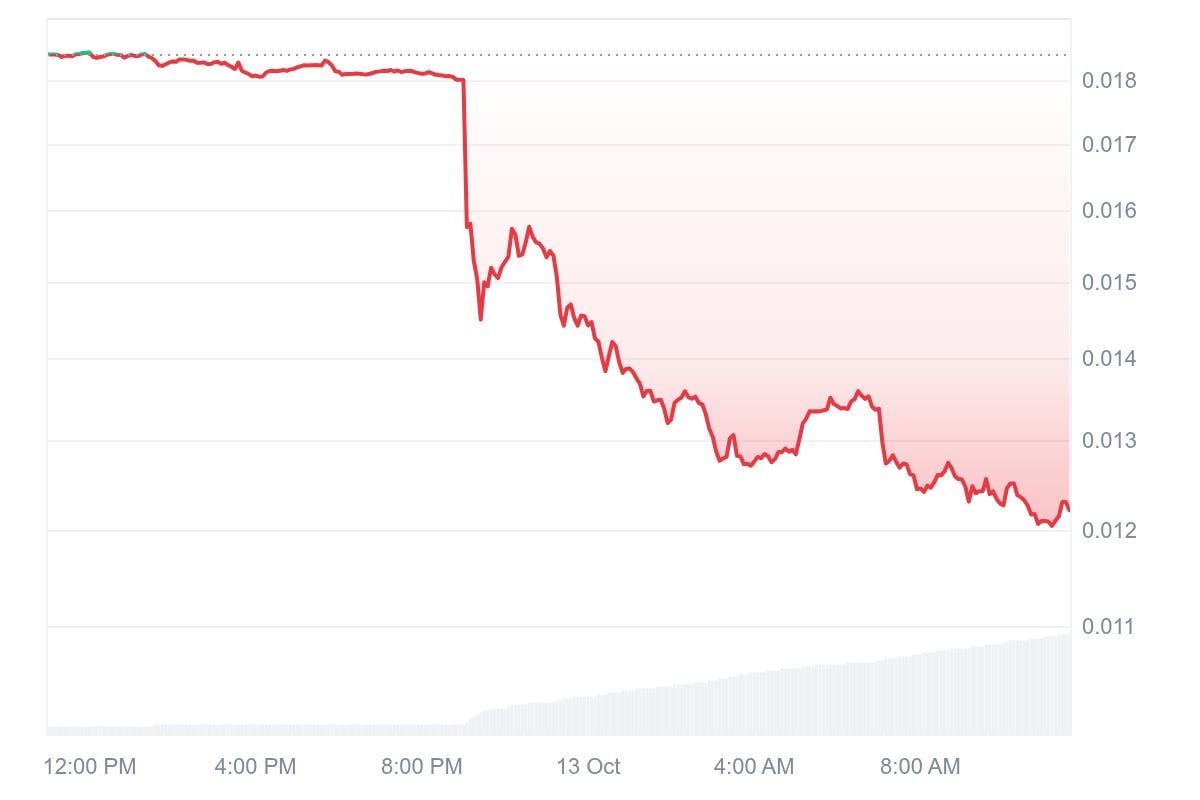
BLUR declined sharply following the announcement. In the supplied Binance market snapshot, the token touched 0.01410 USDT before recovering to 0.01523 USDT, leaving it down 16.55% over 24 hours.
The retreat comes years after Blur raised $11 million in a March 2022 seed round backed by Paradigm, eGirl Capital, and 0xMaki.
BLUR price collapsed after the shutdown announcement. | Credit: CoinMarketCap
Keeping the marketplace contracts operational preserves infrastructure, but it does not preserve the convenience of Blur’s official website. Likewise, retaining governance over the fee switch does not guarantee future trading activity or revenue.
Blur also warned about impersonators and fraudulent announcements, identifying @blur_io as its only official account. For borrowers and lenders, verified withdrawal instructions remain the next critical update.
Disclaimer:
The information provided in this article is for informational purposes only. It is not intended to be, nor should it be construed as, financial advice. We do not make any warranties regarding the completeness, reliability, or accuracy of this information. All investments involve risk, and past performance does not guarantee future results. We recommend consulting a financial advisor before making any investment decisions.
Giuseppe Ciccomascolo began his career as an investigative journalist in Italy, where he contributed to both local and national newspapers, focusing on various financial sectors.
Upon relocating to London, he worked as an analyst for Fitch's CapitalStructure and later as a Senior Reporter for Alliance News. In 2017, Giuseppe transitioned to covering cryptocurrency-related news, producing documentaries and articles on Bitcoin and other emerging digital currencies. He also played a pivotal role in establishing the academy for a cryptocurrency exchange website. Crypto remained his primary area of interest throughout his tenure as a writer for ThirdFloor.













 Balancer Faces Shutdown as Revenue Crashes 95% After $128M Hack