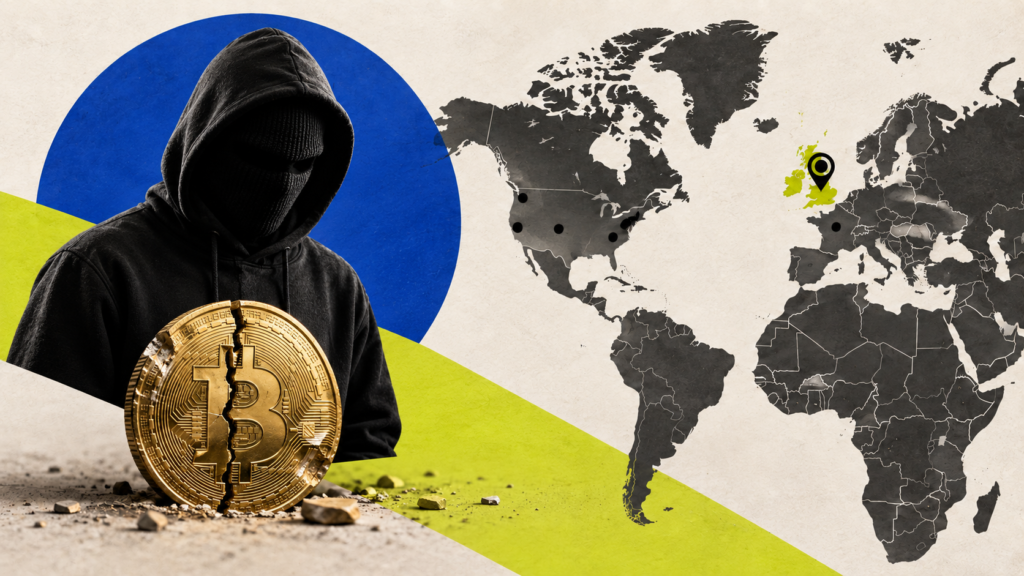
A newly launched interactive map from Bitcoin security researcher Jameson Lopp shows the UK has recorded 24 publicly known physical attacks involving crypto holders.
The crimes have put it third globally, as the researcher warns that the true number could be far higher.
Try Our Recommended Crypto Exchanges
Sponsored
Disclosure
We sometimes use affiliate links in our content, when clicking on those we might receive a commission at no extra cost to you. By using this website you agree to our terms and conditions and privacy policy.
Lopp, co-founder and chief security officer of Bitcoin self-custody company Casa, launched the interactive map on Sept. 21.
It transforms his long-running database of so-called “wrench attacks” into a geographical view of kidnappings, home invasions, and other physical attacks involving Bitcoin.
The database has tracked publicly disclosed incidents since 2014.
The UK ranked third globally for violent crypto crimes. | Source: Bitcoin Wrench Attacks
France currently leads with 68 recorded cases, followed by the US at 59 and the UK at 24.
The UK total includes an April 2026 attack in Maidenhead where crypto executive Oliver von Landsberg-Sadie’s home was raided by four men.
Sadie and his family were reportedly tied up and threatened at knifepoint to hand over crypto.
France’s Crypto Attack Surge Is Even More Extreme
While the UK ranks highly on the map, France has emerged as the most striking hotspot in 2026.
Lopp’s data recorded 41 attacks during the first nine months of 2026, almost three times the number recorded over the equivalent period in 2025.
Outside France, the database recorded only 21 during the same 2026 period, representing a decline of more than half.
Other datasets suggest even Lopp’s figures may substantially underestimate the problem.
French Interior Minister Laurent Nuñez said authorities had documented 77 crypto-linked kidnapping, extortion or attempted-extortion incidents during the first half of 2026 alone, compared with 45 during all of 2025.
The blockchain intelligence firm said a French tax official was accused of stealing and selling information on wealthy crypto owners, including names, addresses, telephone numbers, holdings, and tax records.
A separate breach disclosed by crypto tax company Waltio in January reportedly exposed information belonging to around 50,000 users.
Chainalysis found that France averaged fewer than one known physical crypto attack per month before 2025.
That has increased to approximately 4.6 per month during the first half of 2026.
The attacks have also increasingly involved relatives.
More than 40% of French incidents analyzed by Chainalysis targeted a family member or associate rather than the crypto holder directly.
Is Bitcoin’s Bull Run Causing More Attacks?
Bitcoin gained roughly 45% during the third quarter of 2026 as of late September.
Personal-security firm Gart’s historical data show periods when physical attacks moved broadly in line with Bitcoin prices, sometimes with a delay.
Higher prices can make known holdings more valuable, but attack numbers can also be affected by data breaches and media coverage.
Chainalysis found that just 26% of documented violent theft attempts resulted in a payment through late June 2026, down from 49% in 2025.
Even so, the company estimated criminals had successfully stolen more than $30 million through violent crypto attacks during the first half of 2026.
Bitcoin’s bull market may therefore be making some targets more valuable on paper.
Disclaimer:
The information provided in this article is for informational purposes only. It is not intended to be, nor should it be construed as, financial advice. We do not make any warranties regarding the completeness, reliability, or accuracy of this information. All investments involve risk, and past performance does not guarantee future results. We recommend consulting a financial advisor before making any investment decisions.
Kurt Robson is a London-based reporter at CCN, specialising in the fast-moving worlds of crypto and emerging technology. He began his career covering local news in Cornwall after graduating from Falmouth University with First Class Honours in Journalism. There, he cut his teeth on everything from council meetings to missing swans.
He quickly rose through the ranks to become a frontline journalist at several of the UK’s leading national newspapers. Over the years, he has interviewed musicians and celebrities, reported from courtrooms and crime scenes, and secured multiple front-page exclusives.
Following the upheaval of the COVID-19 pandemic, Kurt shifted his focus to technology journalism—just ahead of the AI boom. With a natural curiosity and a trained eye for emerging trends, he has found a new rhythm in reporting on innovation.
At CCN, Kurt's work focuses on the cutting edge of crypto, blockchain, AI, and the evolving digital world. Drawing on his background in people-first reporting and his deep interest in disruptive tech, Kurt delivers stories that are insightful, entertaining, and human-centric.