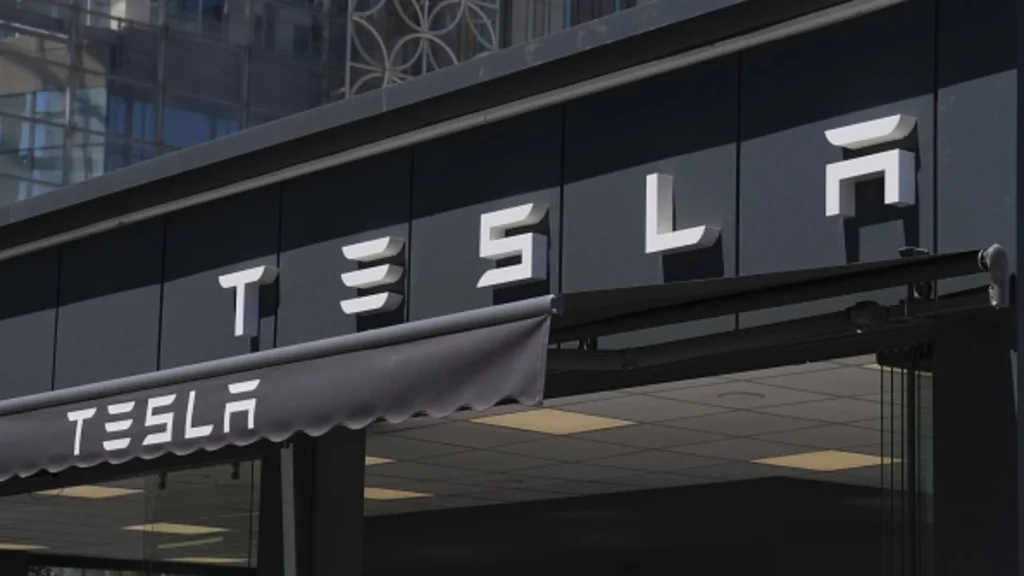
Shareholders argue that the company's optimistic public statements around the safety and scalability of its robotaxi platform artificially inflated Tesla’s stock price | Credit: Anadolu / Getty Images.
Share
Key Takeaways
Investors have filed a class action lawsuit claiming Tesla and Elon Musk concealed significant safety risks associated with its self-driving technology.
A public test of Tesla’s robotaxi in late June drew heavy criticism.
The lawsuit adds to Tesla’s growing legal troubles, including a recent $329 million judgment over a crash involving Autopilot.
Tesla and CEO Elon Musk are facing a class action lawsuit from shareholders who accuse them of concealing major risks associated with the company’s self-driving vehicle technology.
The complaint, filed on Monday, claims Tesla misled investors about the safety of its robotaxis, specifically highlighting incidents surrounding a public test conducted in late June.
The lawsuit alleges that Tesla and its leadership, including current Chief Financial Officer Vaibhav Taneja and former CFO Zachary Kirkhorn, failed to disclose significant safety concerns linked to Tesla’s autonomous driving features.
Shareholders argue that the company’s optimistic public statements around the safety and scalability of its robotaxi platform artificially inflated Tesla’s stock price, Reuters reported.
Central to the case are statements made in April, in which Tesla promoted its robotaxi development as offering “scalable and safe deployment across diverse geographies and use cases.”
Investors claim such assertions were misleading, especially given the troubling outcomes of recent public demonstrations.
Robotaxi and Autonomous Safety
For years, Tesla has promoted its Autopilot and Full Self-Driving (FSD) technologies as steps toward full autonomy.
Elon Musk has repeatedly stated that full autonomy was just around the corner, suggesting in January 2024 that over a million robotaxis would be on the road by the end of the year.
Most recently, in April 2025, he claimed “millions of Teslas” would be operating fully autonomously by 2026.
Despite these assurances, Tesla’s systems have consistently fallen short of full autonomy, with persistent concerns raised by regulators, safety advocates, and industry experts.
According to eyewitnesses and leaked videos, the vehicle exhibited unsafe driving behavior, such as erratic lane changes and failure to navigate traffic signals correctly.
One clip shows a Tesla robotaxi driving at twice the legal speed limit and making sudden, dangerous maneuvers.
Footage seen by Futurism also reportedly instances of abrupt braking and the car’s steering wheel jerking erratically.
A viral video by YouTuber Mark Rober, viewed over 25 million times, demonstrated the vehicle’s inability to detect a physical wall displayed on a screen mimicking a road, resulting in a collision.
Regulatory Pressure Builds
In addition to the shareholder lawsuit, Tesla has recently been ordered to pay approximately $240 million in damages related to a fatal crash involving its Autopilot system.
The incident adds to a growing list of legal and regulatory challenges faced by the company.
Tesla’s robotaxi service remains limited to a small area in Austin, Texas.
In California, the rollout has been even more cautious, with vehicles operating under human supervision and without full regulatory approval for commercial autonomous service.
The lawsuit and regulatory hurdles come amid a broader downturn for Tesla.
The company is grappling with declining revenue and sales, as competition increases and public confidence in its self-driving technology wanes.
Kurt Robson is a London-based reporter at CCN, specialising in the fast-moving worlds of crypto and emerging technology. He began his career covering local news in Cornwall after graduating from Falmouth University with First Class Honours in Journalism. There, he cut his teeth on everything from council meetings to missing swans.
He quickly rose through the ranks to become a frontline journalist at several of the UK’s leading national newspapers. Over the years, he has interviewed musicians and celebrities, reported from courtrooms and crime scenes, and secured multiple front-page exclusives.
Following the upheaval of the COVID-19 pandemic, Kurt shifted his focus to technology journalism—just ahead of the AI boom. With a natural curiosity and a trained eye for emerging trends, he has found a new rhythm in reporting on innovation.
At CCN, Kurt's work focuses on the cutting edge of crypto, blockchain, AI, and the evolving digital world. Drawing on his background in people-first reporting and his deep interest in disruptive tech, Kurt delivers stories that are insightful, entertaining, and human-centric.