Galaxy posts strong second-quarter figures but its CEO warns on crypto treasury rush. | Credit: Noam Galai/Getty Images
Share
Key Takeaways
Galaxy Digital reported strong second-quarter results driven by crypto and treasury gains.
Bitcoin exposure reached $715 million, boosting the Treasury and Corporate segment’s $228 million contribution.
CEO Mike Novogratz believes the rush of public firms adding crypto to balance sheets has peaked.
Galaxy Digital released its Q2 2025 earnings report, showing strong gains from crypto markets and treasury positions — but investor reaction was mixed.
The company reported nearly $300 million in adjusted gross profit, with major contributions from its Bitcoin holdings and expanding data center business.
Galaxy Digital Posts Strong Q2 on Crypto and Treasury Gains
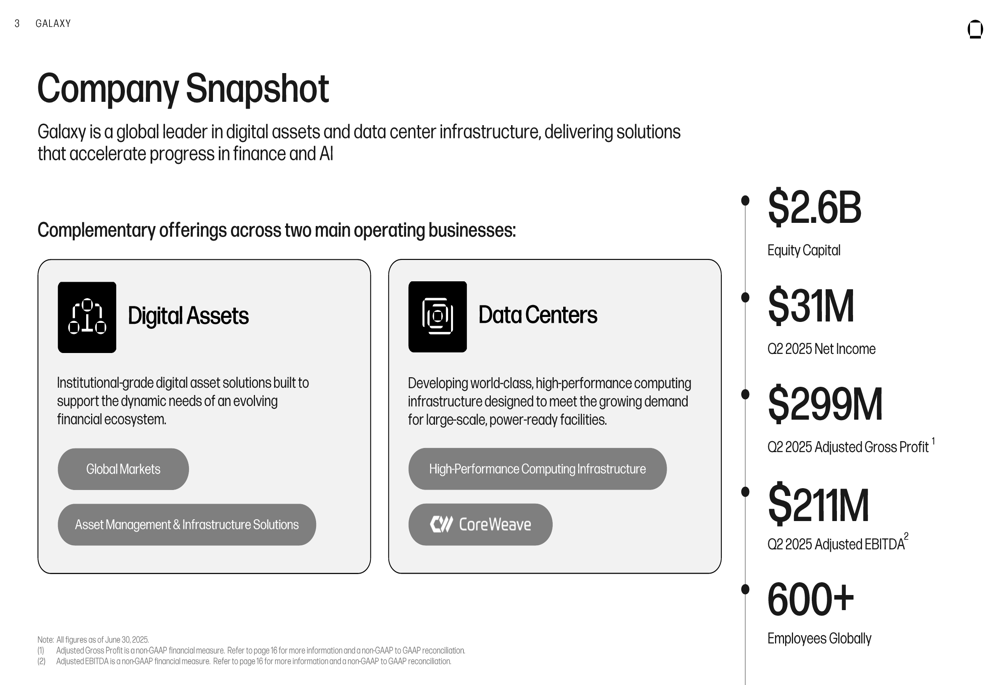
Galaxy’s adjusted gross profit for Q2 came in at $299 million, with its Digital Assets segment contributing $71 million, a 10% increase from the previous quarter.
The Treasury and Corporate segment added $228 million, primarily due to gains on its $715 million in Bitcoin holdings and other proprietary investments.
The company also reported $31 million in net income, $211 million in adjusted EBITDA, and an increase in equity capital to $2.6 billion.
Galaxy Digital second-quarter figures. | Credit: Galaxy Digital
Still, Galaxy shares fell 7.6% in premarket trading, landing at $28.10.
Analysts suggest the dip reflects broader market caution around crypto volatility and regulatory uncertainty — even as Galaxy’s fundamentals improve.
Projections for the full year remain cautious, with a forecasted net loss of $0.93 per share, highlighting a gap between quarterly performance and long-term expectations.
Galaxy’s Next Phase: Stablecoins and AI-Powered Infrastructure
Alongside its crypto operations, Galaxy is actively building out new verticals, including a euro-backed stablecoin (EURAU) and a massive expansion into data centers.
The highlight is Galaxy’s Helios facility in Texas, which currently has 800 MW of approved capacity, with potential to scale to 2,700 MW.
A 15-year deal with CoreWeave, an AI infrastructure firm, will see 526 MW leased out in phases — expected to generate over $1 billion in annual revenue once fully operational.
Galaxy says this move positions it at the intersection of AI, blockchain, and decentralized finance, areas it believes will converge in the coming years.
Corporate Crypto Adoption May Have Peaked, Says Novogratz
On the earnings call, Galaxy CEO Mike Novogratz offered a reality check on the recent surge of companies adding crypto to their balance sheets.
“We’ve probably gone through peak treasury company issuance,” he said. “The question now is which existing companies will become monsters.”
Galaxy currently works with over 20 crypto treasury clients, helping them manage $2 billion in digital assets — a source of consistent revenue through management fees.
Novogratz also highlighted the potential of tokenization and ETFs to reshape traditional finance, but cautioned that the infrastructure to support tokenized equities still lags.
“If you tokenize Apple stock, where does that liquidity exist? There isn’t a good answer yet,” he noted, referencing the SEC’s Project Crypto initiative aimed at exploring these frameworks.
Giuseppe Ciccomascolo began his career as an investigative journalist in Italy, where he contributed to both local and national newspapers, focusing on various financial sectors.
Upon relocating to London, he worked as an analyst for Fitch's CapitalStructure and later as a Senior Reporter for Alliance News. In 2017, Giuseppe transitioned to covering cryptocurrency-related news, producing documentaries and articles on Bitcoin and other emerging digital currencies. He also played a pivotal role in establishing the academy for a cryptocurrency exchange website. Crypto remained his primary area of interest throughout his tenure as a writer for ThirdFloor.