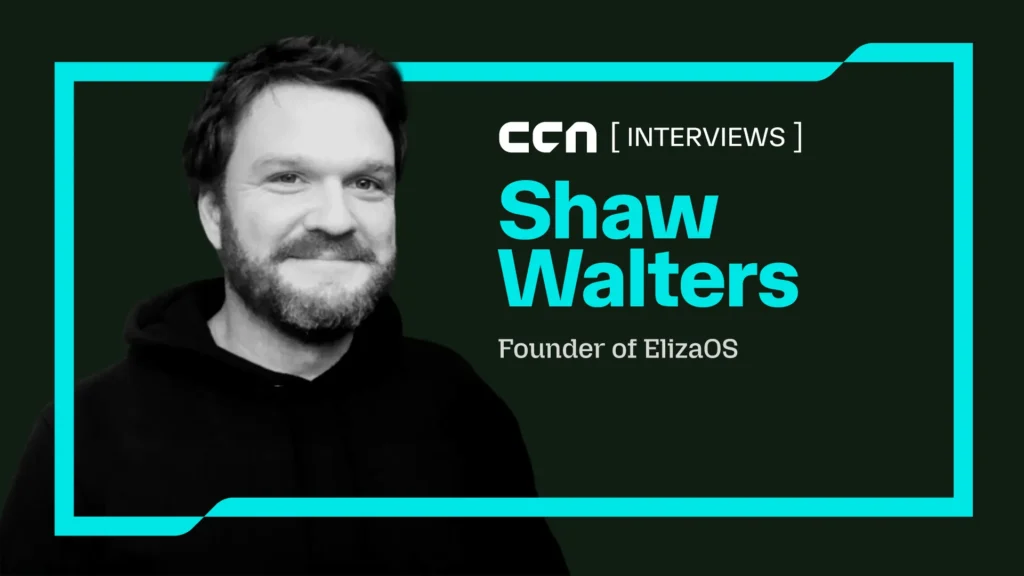
“I don’t think any of the social media we have will be usable in three years because they’ll be flooded by AI.”| Credit: Veronica Cestari /CCN
Share
As artificial intelligence agents evolve from chat interfaces into autonomous digital actors, the architecture of the internet itself may change.
Shaw Walters, founder of Eliza Labs, believes the shift could happen far faster than many expect.
In an interview with Dr. Lorena Nessi from CCN, Walters explained how AI agents could reshape social media, why the “attention economy” may collapse, and why decentralized infrastructure could become essential in a world dominated by machine-driven activity.
He also shared blunt criticism of today’s crypto industry and warned that many blockchain projects may struggle to remain relevant in the age of autonomous AI systems.
Watch the full interview here:
From Sci-Fi Hobby to Agent Frameworks
Walters described a long-standing interest in agentic systems that predates the current AI cycle.
He said, “When I was a kid, I was like a science fiction writer. Like this is my private hobby. And I just really loved AI agents.”
He linked that interest to a turning point when early large language models (LLMs) began to feel less like a toy and more like a usable interface.
Walters said the release of the GPT-3 beta marked a turning point. Earlier AI systems could produce small outputs such as poems or partial responses, but GPT-3 showed that models could interact in a way that felt much closer to human conversation, which he described as a transformative moment.
From there, he started building frameworks for agents, including an early version he named after a Greek philosopher.
Walters said, “I started working on my first framework, called Thales.”
He also described early skepticism from startup circles about why an agent framework mattered.
Walters said, “People just didn’t really get what I was doing.” Walters explained that people did not understand the use of an agent framework.
The Digital Twin Experiment and the Rise of AI Agents
Walters said Eliza Labs gained attention after he and collaborators recreated an online persona as an agent, which helped people see what AI agents could do on social platforms.
Walters said the team recreated the figure as an AI agent designed to replicate the person’s tone and personality online, creating what he described as a digital version that audiences quickly connected with.
He described the scale of the response as a signal that the internet may soon shift toward agent-driven activity.
Walters said, “Suddenly we had 50,000 people loading our open source repo and launching agents on X.”
He linked that moment to a broader realization about where online platforms could be heading.
Walters said the experiment revealed what he believes is an inevitable shift, arguing that the internet will increasingly be populated by AI agents because the incentives to deploy them are simply too strong.
Why AI Agents Could Break Social Media Platforms
Walters argued that platforms built on ad-driven feeds sit on a fragile foundation once users can deploy agents that filter content, remove ads, and control what gets shown.
“Basically, your algorithm is gate-catched by somebody who has a financial incentive to take money from you and to make money from you.”
He described an alternative model in which individuals control how information is filtered and delivered. In this setup, personal AI agents select and organize content based on the user’s preferences, rather than relying on algorithms designed by social media platforms.
He suggested that personal AI agents could retrieve only the content users actually want, filtering out advertising and unwanted posts, thereby reducing the need to rely on social media platforms altogether.
Walters believes this shift could happen much faster than many expect.
AI Agents Could Replace Digital Intermediaries
“I don’t think we’ll be using X in three years,” he said. “I don’t think any of the social media we have will be usable in three years because they’ll be flooded by AI.”
In that environment, decentralized systems could become the default infrastructure for digital interaction.
“Decentralization is the only option,” Walters said.
He added that personal AI agents could increasingly replace platform-driven algorithms.
“I’m going to have an agent on my phone. You’re going to have an agent on your phone,” Walters said.
Those agents could manage tasks and coordinate directly with one another.
“If I want to schedule a meeting with you, I’m going to be like, ‘Hey, schedule a meeting with Lorena,’ and it will happen,” he said.
In that scenario, traditional intermediaries such as centralized platforms or services become less necessary.
In that scenario, he said, “I don’t have to go through Google Calendar,” Walters said. “I don’t have to go through X. I don’t have to pay anybody.”
Anti-Attention Economy and the Fight for User Time
Walters describes this shift as the beginning of what he calls the “anti-attention economy.”
Instead of competing for user engagement, AI agents could act as filters, returning time and focus to individuals.
“I’m overwhelmed,” he said. “Too many messages, too many notifications, too many things pinging me.”
For Walters, the core advantage of AI agents lies in their ability to eliminate routine digital friction.
“The killer use case of agents is getting you your time back,” he said.
He argued that many everyday digital tasks could disappear once agents begin handling them automatically.
“That right there is 15 minutes back to your day,” Walters said, referring to tasks such as scheduling or sorting messages.
Filtering information could create even larger time savings.
In Walters’ view, this transformation would directly undermine the engagement-driven business model of modern platforms.
He is optimistic.
“What our products would do, and what agents would do generally, is give you your attention back,” he said.
Blockchain, Decentralization and AI Infrastructure
Walters believes decentralized systems will play an important role as AI agents begin interacting across networks.
“Crypto is the obvious way to solve the Byzantine generals problem,” he said.
The Byzantine generals problem refers to the challenge of coordinating trust across decentralized systems.
Distributed networks allow agents to communicate and exchange information without relying on a central authority.
“We need distributed systems that are fault-tolerant and allow us to communicate openly in public,” Walters said.
However, Walters also criticized much of the crypto industry for focusing primarily on financial speculation rather than infrastructure.
“Crypto is totally captured by finance,” he said.
In his view, the technology itself remains valuable, but the surrounding culture needs to evolve.
“The technology will survive,” Walters said.
AI Automation and the Future of Digital Work
The rise of autonomous AI agents also raises questions about employment and automation.
Walters believes many forms of digital labor will change dramatically.
“My job is already gone,” he said.
He described how coding assistants and AI tools have dramatically accelerated software development, allowing developers to produce and deploy code far more quickly than before.
Walters said he now releases code “two hundred times faster.”
Tasks that once took days or weeks can now be completed in hours.
“Things I could never do in my lifetime, I’m doing in a weekend,” he said.
Walters argues that automation could ultimately allow humans to focus on more meaningful activities.
“The AI should do everything we don’t want to do,” he said.
Instead of eliminating human creativity, he believes automation could free people to pursue it.
“We’ll look back at this time and say it was crazy that we had to do things we didn’t want to do for money,” Walters said.
AI Creativity and the Future of Digital Culture
Walters also challenged the idea that AI will undermine creativity.
He argued that AI tools may expand creative expression rather than replace it.
“In a world where culture is dead, a new culture is going to emerge,” Walters said.
AI systems, he said, allow individuals to create without the institutional barriers that often shape traditional media industries.
“They don’t have to go through a chain of executives to get approval,” he said.
For Walters, this could lead to a more decentralized cultural landscape.
“Random people on the internet can create the stories they want to tell,” he said.
Looking Ahead: AI Agents and the Future of the Internet
Despite the disruptions that AI may bring, Walters remains optimistic about the long-term trajectory of technology.
He sees the current moment as part of a larger transformation in how humans interact with information and with each other.
“We’re creating something much bigger than ourselves,” he said.
For Walters, AI systems represent not a replacement for human agency but an extension of it.
“The AI is not separate from us,” he said. “It’s the collection of everything that humans have said and done.”
As autonomous agents, decentralized networks, and AI tools continue to evolve, Walters believes the internet may enter a fundamentally new phase.
“The internet is going to change very fast,” he said.
Disclaimer:
The information provided in this article is for informational purposes only. It is not intended to be, nor should it be construed as, financial advice. We do not make any warranties regarding the completeness, reliability, or accuracy of this information. All investments involve risk, and past performance does not guarantee future results. We recommend consulting a financial advisor before making any investment decisions.
Dr. Lorena Nessi is an award-winning journalist and media technology expert with 15 years of experience in digital culture and communication. Based in Oxfordshire, UK, she combines academic insight with hands-on media practice.
She holds a PhD in Communication, Sociology, and Digital Cultures, and an MA in Globalization, Identity, and Technology.
Lorena has taught at Fairleigh Dickinson University, Nottingham Trent University, and the University of Oxford. She is a former producer for the BBC in London, with additional experience creating television content in Mexico and Japan.
Her research focuses on digital cultures, social media, technology, capitalism, and the societal impact of blockchain innovation.
She has written extensively on digital media and emerging technologies, with her work featured in both academic and media platforms. Her Web3 expertise explores how blockchain technologies shape culture, economics, and decentralized systems.
Outside of work, Lorena enjoys reading science fiction, playing strategic board games, traveling, and chasing adventures that get her heart racing. A perfect day ends with a relaxing spa and a good family meal.


 Easy
Easy