Blockchain hacks have become larger and more sophisticated, with damages reaching into the billions.
The Bybit $1.5 billion theft in 2025 surpassed all previous records, signaling a new age of state-backed cybercrime.
Cross-chain bridges, oracles, and hot wallets remain crypto’s most exploited entry points.
Each hack led to better security standards, from multisig reforms to quantum-resistant encryption and cold storage mandates.
The crypto world is one of stark contrasts: volatile shifts, endless opportunities, and lurking vulnerabilities. Tales of wins and joy can hardly erase the spooky fear of missing out or, even worse, the chilling horror of losing it all. Hackers, like digital zombies, are always prowling for the weakest victim.
This Halloween-inspired list brings to life 10 of the darkest chapters in blockchain history, where cunning actors made millions vanish, leaving their victims haunted and empty-handed.
These ten confirmed cases, spanning 2014 to 2025, wiped out more than $5.4 billion in crypto assets, revealing how vulnerability scales with innovation.
Each breach, from early exchange collapses to billion-dollar state-backed exploits, shows that even as blockchain technology advances, the real danger still lies in human oversight and targeted manipulation, the true horror story haunting crypto’s evolution.
Mt. Gox’s legacy reads like an infamous ghost crypto story. This notorious heist was the first of its kind, as it was the first major exchange to suffer. Over several attacks, 850,000 BTC disappeared into the digital void.
The malicious actors were exploiting poor security measures and internal mismanagement. The event crippled the exchange, which controlled the majority of Bitcoin transactions at the time. It led to its liquidation and years of legal battles.
Recent plans aim to compensate affected users using the recovered assets. The Mt. Gox case remains a cautionary tale, highlighting the need for secure and regulated asset storage within crypto exchanges.
2. Hot Wallet Haunt (Coincheck, $532M, 2018)
Hackers targeted Japan-based Coincheck, exploiting its hot wallet to steal $532 million in NEM tokens. Low staffing contributed to the exchange’s vulnerability, prompting Japan’s regulators to crack down on crypto exchanges.
Coincheck quickly moved assets to cold storage, but the incident highlighted the lasting risks hot wallets pose. This hack intensified scrutiny of wallet practices, a lesson still relevant in today’s exchange security standards.
3. Key Back Attack Breach (KuCoin, $281M, 2020)
Hackers breached KuCoin’s hot wallet and stole $281 million in digital assets. This attack exposed the risks associated with managing private keys in hot wallets. KuCoin immediately coordinated with other exchanges, which helped recover most of the stolen funds and limited the overall damage.
This hack underscored the importance of collaborative security within the crypto industry, highlighting how collective action can help mitigate losses during breaches. KuCoin recovered close to $240 million of the stolen funds.
4. Twisted Lesson of Horror (Poly Network, $611M, 2021)
In crypto, hackers can often teach lessons. In this unusual case, a lone hacker exploited Poly Network’s vulnerabilities to steal $611 million. But instead of vanishing with the fortune, the hacker eventually returned most of the funds, framing the heist as a “lesson” on Poly Network’s security flaws.
The unexpected twist sent shockwaves across the DeFi community, pushing platforms to prioritize frequent code audits and strengthen defenses. Eventually, Poly Network ceased its operations, arguably due to several incidents.
5. The Ghost Bridge (Ronin Network, $625M, 2022)
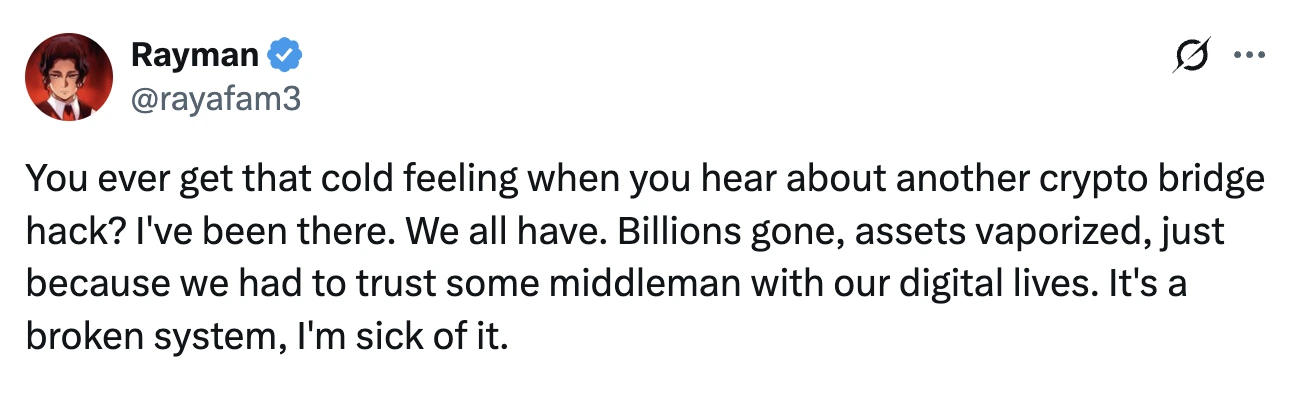
Hackers exploited Ronin’s validator nodes in a staggering breach to siphon $625 million in ETH and USDC. The attack prompted Ronin to improve its validator security, highlighting the fragile nature of cross-chain bridges, which enable data and asset transfers across different chains.
This attack is a warning about bridge technology risks in crypto ecosystems.
Have you heard this? | Source: @rayafam3 on X
6. Portal to the Lost Dimension (Wormhole, $325M, 2022)
A vulnerability in the Wormhole bridge allowed hackers to steal $325 million, creating an open portal through which assets vanished. This incident drove the need for stricter open-source code management and exposed the dangers of delayed security updates.
Hackers exploited a bug in the BNB Chain’s cross-chain bridge, minting millions in fake BNB tokens and draining $569 million. Binance responded swiftly, freezing stolen tokens and halting operations to prevent further loss.
This breach highlighted critical flaws in bridge infrastructure and set new security standards for cross-chain protocols.
8. Final Blow (FTX, $600M, 2022)
In a cruel twist, FTX faced a $600 million hack just one day after filing for bankruptcy. The breach exposed the risks of poor asset management during insolvency and forced other exchanges to rethink asset protection protocols in bankruptcy scenarios. For FTX, this case underscored the urgent need for post-bankruptcy security measures.
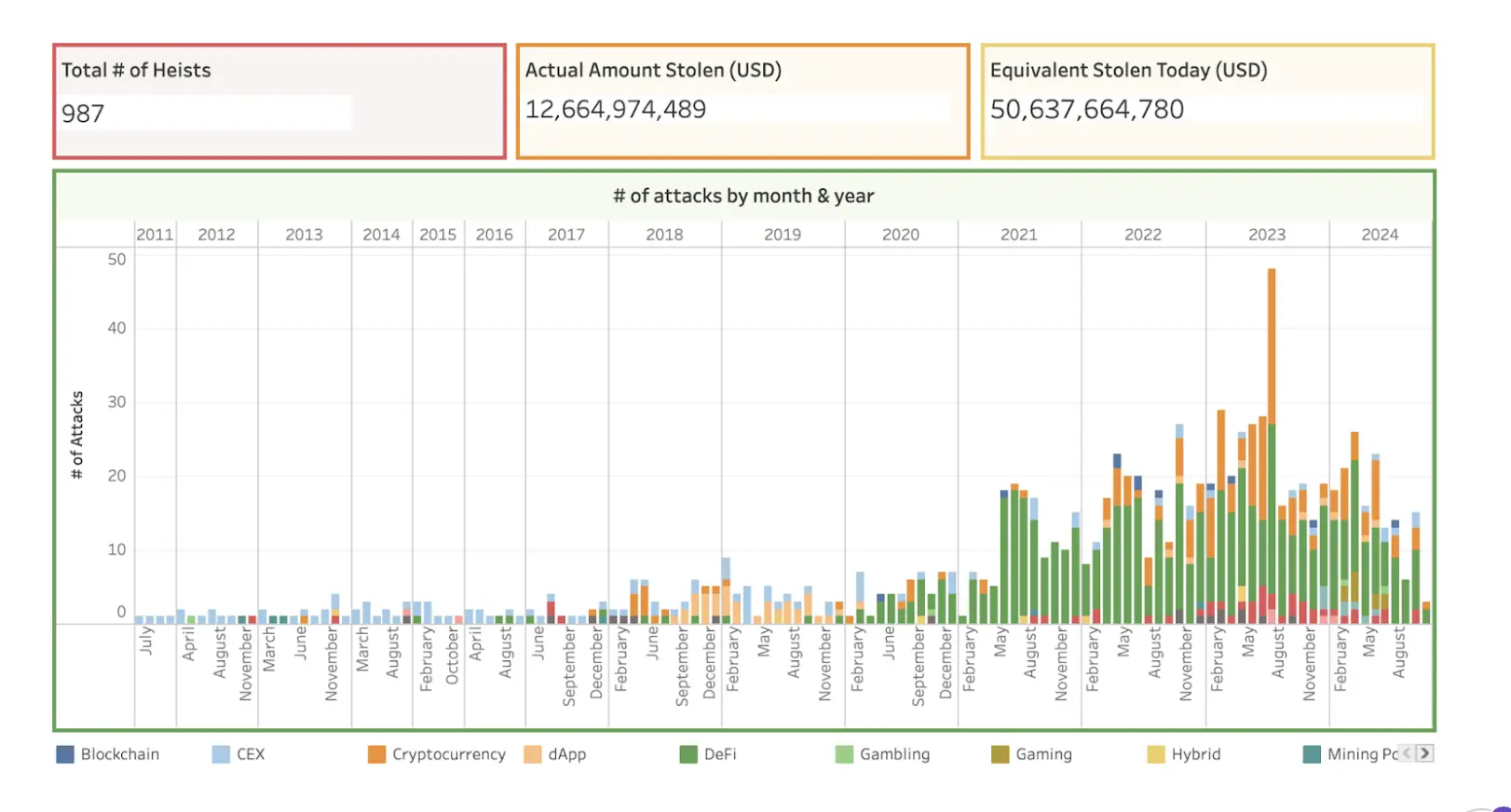
Attacks by month and year| Source: Comparitech.
9. The Hot Wallet Horror (DMM Bitcoin, $305M, 2024)
May 2024 brought chaos to DMM Bitcoin when hackers stole 4,502 BTC, worth $305 million, from the exchange’s hot wallets. The breach, attributed to compromised keys, shocked Japan’s crypto community.
DMM pledged full reimbursement through company loans and partner aid, yet its operations crumbled by March 2025 as assets migrated to safer exchanges.
The attack reignited calls for cold wallet adoption and stronger authentication systems to shield funds from state-backed threat actors.
10. The Record-Shattering Rift (Bybit, $1.5B, 2025)
February 2025 shattered every record in crypto history. Bybit, one of the world’s leading exchanges, suffered a $1.5 billion theft from its Ethereum (ETH) cold wallets, a breach traced to a sophisticated multisig exploit attributed to North Korea’s Lazarus Group.
The Dubai-based firm detected the attack within hours, froze transfers, and coordinated with international agencies to recover partial funds.
Despite swift containment, the scale of loss redefined the industry’s sense of security. The incident triggered global calls for quantum-resistant encryption, air-gapped cold storage, and constant monitoring against state-backed exploits.
Hunting Crypto Lessons Behind the Attacks
The ten cases spanning 2014 to 2025 trace crypto’s ongoing battle between innovation and intrusion. Each breach exposed a distinct weakness, shaping the security principles that now define the industry’s defense playbook.
Cold storage as a safeguard: Keeping large reserves offline remains the strongest defense against theft. Incidents at Mt. Gox, Coincheck, and DMM Bitcoin proved that hot wallets are easy targets and that isolation from online systems can prevent catastrophic drains.
Smart contract and code audits: The Poly Network and Wormhole breaches revealed how minor coding oversights can open multimillion-dollar vulnerabilities. Frequent audits and real-time bug monitoring have since become standard in DeFi architecture.
Transparency during crises: Honest communication builds trust when chaos hits. KuCoin’s immediate disclosure and collaboration across exchanges contrasted sharply with FTX’s opaque collapse, showing that openness helps stabilize user confidence after an attack.
Bridge and validator resilience: Cross-chain exploits at Ronin and Binance BNB Bridge highlighted how validator nodes and bridge contracts remain the weakest link. Strengthening consensus mechanisms and enforcing decentralized validation are now essential for interoperability security.
Industry coordination: Coordinated recovery, as demonstrated by KuCoin’s network of supporting exchanges, showed how collaboration can reclaim stolen assets and reduce broader contagion across markets.
Regulatory bodies: Agencies like the Securities Exchange Commission (SEC), Japan’s Financial Services Agency (FSA), and the Financial Action Task Force (FATF) have implemented tighter security standards, licensing protocols, and reporting requirements to address weaknesses exposed by these breaches. By setting clear regulatory frameworks, these organizations help protect investors, enhance transparency, and reduce risks in digital transactions, creating a more secure foundation for crypto platforms.
Conclusion
The obscure corners of the world of crypto remain thrilling and terrifying, showing that it is a world of innovation shadowed by relentless threats. Each of these ten hacks, from Mt. Gox’s collapse to Bybit’s $1.5 billion breach, exposed deep flaws in how digital assets are protected and managed. Together, they erased more than $5.4 billion in value but also reshaped the industry’s security standards.
The past decade shows that every major attack, no matter how devastating, pushed crypto closer to maturity. KuCoin’s coordinated recovery efforts proved the strength of collaboration, while the Poly Network case showed how transparency and communication can turn chaos into reform. Regulators worldwide have since tightened oversight, reinforcing investor protection and technical accountability.
Crypto’s evolution is a cautionary tale written in code and consequence. The technology may grow smarter, but its greatest risk still lies in human error and complacency. Vigilance, collaboration, and continuous improvement remain the only defenses against the next digital storm.
The most expensive crypto attack to date was the Bybit breach in February 2025, where hackers linked to North Korea’s Lazarus Group stole $1.5 billion from the exchange’s Ethereum cold wallets.
What major vulnerabilities do hackers most commonly exploit?
Cross-chain bridges frequently serve as prime targets due to weaknesses in private key management and flaws within smart contracts. High-profile attacks like Ronin and Wormhole illustrate the significant losses stemming from these bridge vulnerabilities.
What unique attack strategies have hackers used?
Hackers targeting crypto platforms have used various sophisticated strategies, including exploiting smart contract vulnerabilities, social engineering, flash loan attacks, and cross-chain bridge exploits.
Why did Poly Network eventually shut down after its 2021 hack?
Even though most of the $611 million stolen from Poly Network was returned, the damage to its credibility was irreversible. Repeated exploits in the following years eroded user trust and investor confidence, leading to its gradual shutdown as developers shifted toward more secure cross-chain solutions.
Dr. Lorena Nessi is an award-winning journalist and media technology expert with 15 years of experience in digital culture and communication. Based in Oxfordshire, UK, she combines academic insight with hands-on media practice.
She holds a PhD in Communication, Sociology, and Digital Cultures, and an MA in Globalization, Identity, and Technology.
Lorena has taught at Fairleigh Dickinson University, Nottingham Trent University, and the University of Oxford. She is a former producer for the BBC in London, with additional experience creating television content in Mexico and Japan.
Her research focuses on digital cultures, social media, technology, capitalism, and the societal impact of blockchain innovation.
She has written extensively on digital media and emerging technologies, with her work featured in both academic and media platforms. Her Web3 expertise explores how blockchain technologies shape culture, economics, and decentralized systems.
Outside of work, Lorena enjoys reading science fiction, playing strategic board games, traveling, and chasing adventures that get her heart racing. A perfect day ends with a relaxing spa and a good family meal.


 Easy
Easy