Modular vs Monolithic Blockchains: Who’s Winning Crypto’s Scalability War in 2026?| Credit: Veronica Cestari /CCN
Share
Key Takeaways
Modular and monolithic blockchains represent two distinct scaling approaches shaping crypto infrastructure in 2026.
Data from early 2026 shows modular ecosystems leading in TVL growth and developer activity, while monolithic chains remain competitive on throughput and user experience.
Monolithic blockchains such as Solana continue to perform well in speed-sensitive and consumer-facing applications but face scaling pressure under sustained load.
Modular architectures gain traction by separating execution, data availability, and settlement, supporting long-term scalability and institutional use cases.
As 2026 begins, developers, users, institutions, and enterprises face a clear choice between modular blockchains and monolithic blockchains, two models that shape how decentralized networks scale, secure data, process transactions, and support real-world use cases.
In early 2026, crypto markets pushed past $3 trillion in total market capitalization, bringing renewed attention to infrastructure, adoption, and network reliability.
Will monolithic chains like Solana hold the crown, or will the flexibility of modular ecosystems like Ethereum’s rollups and Celestia dominate?
The question no longer focuses on which chain moves faster or costs less in isolation. The debate now centers on other elements such as developer growth, long-term adoption, and real usage across decentralized finance (DeFi) and Web3 applications.
This article examines data and industry reports to assess how modular and monolithic blockchains compare today. At a quick glance, modular ecosystems lead in total value locked (TVL) growth and developer activity, while monolithic chains remain competitive on throughput, costs and user experience.
Monolithic Blockchains Explained: How the Single-Layer Model Works
Monolithic blockchains represent the original blockchain architecture. They rely on a single-layer structure where all core functions operate together.
In this model, execution handles transaction processing, consensus validates network agreement, settlement finalizes blocks, and data availability (DA) ensures transaction data remains accessible and verifiable.
Bitcoin introduced this structure, while newer networks such as Solana and Sui adapted it to support higher throughput and faster confirmation times.
Monolithic Blockchains in Practice: Speed, Security, and Scaling Limits
Simplicity is the main strength of these models. Developers interact with one environment rather than coordinating across multiple interconnected layers. As a result, users experience fewer abstractions, which can reduce friction when interacting with applications.
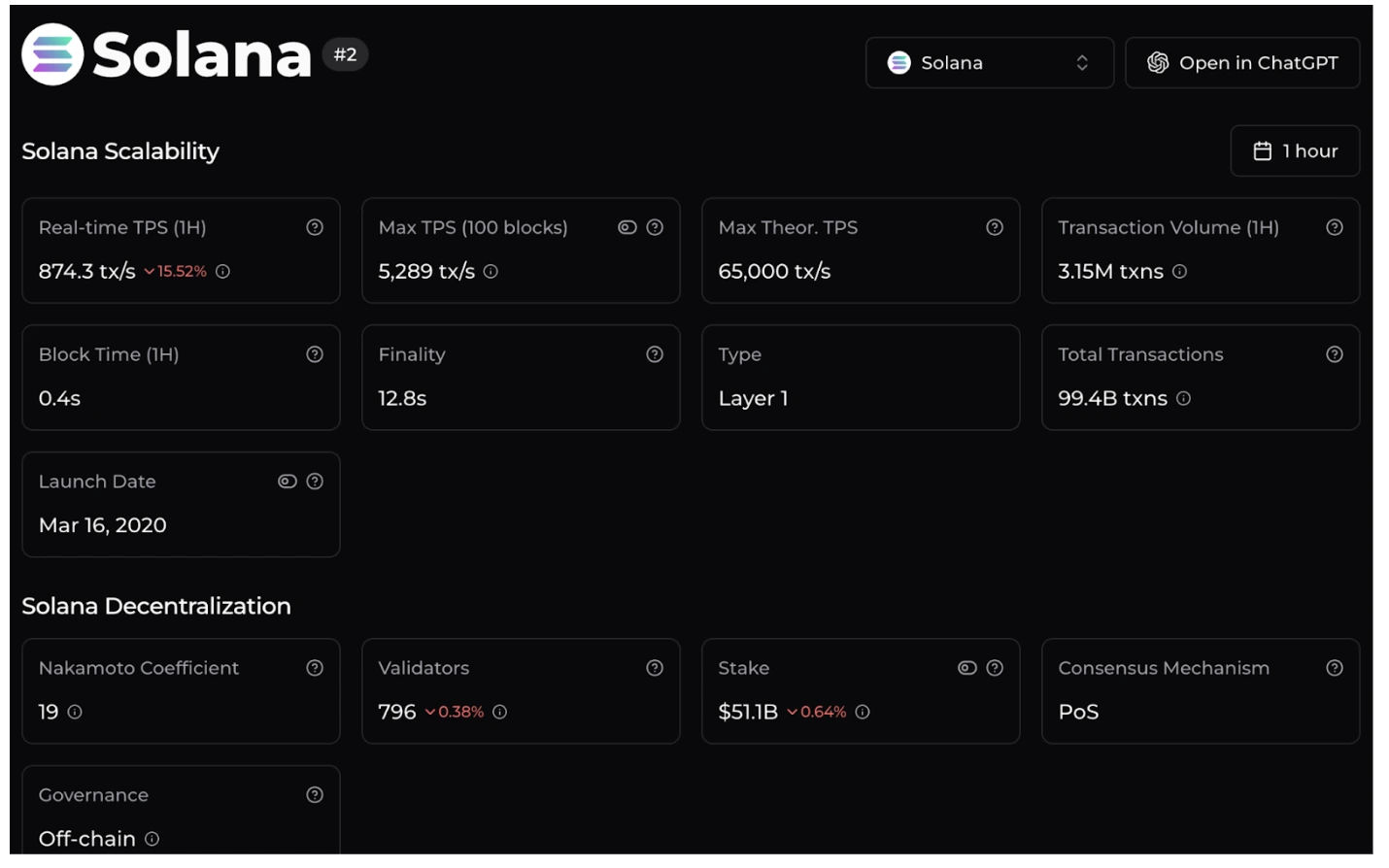
For example, Solana uses this approach with a theoretical throughput of up to 65,000 transactions per second (TPS), a design choice that supports high-frequency trading activity, decentralized exchanges, and memecoin trading during peak demand.
Security also plays a very important role. Every node processes the complete workload, which preserves a shared view of the network state and strengthens consistent validation. This structure reduces reliance on external components and limits cross-system dependencies.
However, scaling remains the core challenge. As demand increases, congestion can strain a single-layer system. Ethereum experienced this pressure during its early monolithic phase, when gas fees rose sharply during periods of heavy usage.
In 2026, with global crypto users approaching 1 billion, similar concerns apply to Solana, especially during traffic spikes.
Network outages have drawn scrutiny, even as upgrades such as Firedancer aim to improve stability and reliability.
Live performance data highlights these trade-offs. Chainspect shows Solana sustaining real-time throughput around 800 to 900 TPS during the observed period, with short-term peaks reaching approximately 5,200 TPS over 100-block windows.
These figures remain well below Solana’s theoretical maximum of 65,000 TPS, particularly during periods of network stress.
Understanding this gap between theoretical capacity and real-world performance helps explain the strengths and limitations of the monolithic blockchain model.
Strengths and Limitations of Monolithic Blockchains
Monolithic blockchains simplify execution, but they can also concentrate risk during periods of high demand.
Key Strengths of Monolithic Blockchains
High throughput potential: Single-layer execution enables fast transaction processing under stable network conditions.
Simpler development environment: Developers build directly on one base layer without coordinating across multiple systems.
Strong base-layer security: Full node participation maintains a consistent view of network state and validation.
Lower architectural overhead: Fewer moving parts reduce cross-layer dependencies and operational complexity.
Core Limitations of Monolithic Blockchains
Scalability constraints under load: Congestion emerges as activity increases across the same execution layer.
Single-layer failure exposure: Outages or bugs affect the entire network simultaneously.
Performance volatility during spikes: Throughput drops sharply when demand surges.
Upgrade challenges at scale: Protocol changes require careful coordination across the whole network.
This trade-off between efficiency and constraint explains why alternative designs gained traction. As network usage expands, especially with expectations around automation and artificial intelligence-driven activity, horizontal scaling becomes harder to ignore.
Industry commentary increasingly reflects that view. Several analysts argue that long-term scalability depends on distributing workload across specialized layers rather than pushing all execution onto a single base layer.
Modular vs. monolithic isn't dead.
The terminology and narrative marketing has ran its course, but there's very clear, objective truth to the way blockchain systems design works. If you want to try to defy gravity on one baselayer, feel free.
The debate has shifted away from branding and toward engineering realities, particularly around how systems behave as user counts and transaction volume grow at scale.
The next section examines how modular blockchains approach scalability by separating execution, DA, and settlement across specialized layers.
Modular Blockchains Explained: How Layered Architectures Work in 2026
Modular design discussions increasingly focus on how layered systems address the scaling limits seen in single-layer blockchains. Recent commentary around newer networks reflects that shift.
Been diving into @MorphLayer design today and the modular picture is finally clicking 🌿
Most chains are still built monolithic easy to start with, but they choke under load. Morph’s flipping that by splitting things into layers that actually work better together.
Modular blockchains take a different architectural approach by separating core network functions across multiple layers.
Instead of running execution, consensus, settlement, and DA on a single chain, modular systems assign each role to specialized components.
How Modular Architectures Separate Core Blockchain Functions
Execution typically occurs on rollups such as Arbitrum and Optimism,DA runs on dedicated layers such as Celestia, shared security can extend through systems like EigenLayer, and settlement takes place on base layers such as Ethereum.
This separation allows each layer to optimize for a specific function. Rather than forcing one network to balance every trade-off, modular designs distribute responsibility across the stack. Celestia, for example, focuses on DA, which lowers costs and removes execution bottlenecks for rollups built on top of it.
Ethereum’s ecosystem shows how modularity works in practice. The Ethereum mainnet provides settlement and security, while Layer 2 networks such as Optimism and Base process transactions off-chain before submitting compressed data back to the base layer. This structure reduces congestion while preserving Ethereum’s security guarantees.
Ethereum’s transition toward modularity accelerated with the introduction of EIP-4844, also known as Proto-Danksharding. The upgrade added dedicated data blobs for rollups, reducing data costs and improving throughput without increasing execution load on the base layer.
This change reinforced Ethereum’s role as a settlement and DA layer rather than a high-throughput execution chain.
Modular Adoption and Performance Trends
By 2026, modular adoption has accelerated. Industry reports point to a broader shift away from monolithic designs as Web3 infrastructure matures and application demands increase.
Modular architectures support decentralization, experimentation, and parallel development across ecosystems.
Reports highlight modular blockchains for their flexibility, noting that developers can customize execution environments without redesigning the entire network.
Scalability remains a defining advantage. Ethereum Layer 2 networks now handle significantly higher aggregate throughput than the base layer alone, measured in tens of thousands of transactions per second when accounting for compressed data and gas efficiency.
Roadmap upgrades target substantially higher capacity over time, rather than current literal million-TPS levels.
Understanding how modular systems distribute responsibility across layers helps clarify their strengths and limitations.
Strengths and Limitations of Modular Blockchains
Modular architectures reduce base-layer congestion and improve scalability, but they also introduce coordination challenges across systems.
Key Strengths of Modular Blockchains
Scalability across layers: Execution and DA scale independently, supporting sustained growth.
Lower transaction costs: Rollups reduce base-layer congestion and fee pressure.
Faster innovation cycles: Teams upgrade individual components without altering the full stack.
Flexible deployment options: Developers tailor environments for consumer, enterprise, and data-heavy use cases.
Core Limitations of Modular Blockchains
Higher architectural complexity: Multiple layers increase operational and maintenance demands.
Interoperability risks: Cross-layer communication introduces dependency and latency challenges.
Fragmented user experience: Bridges and rollups add friction for less technical users.
Security dependency chains: Weaknesses in one layer can affect connected components.
By 2026, much of the response to this fragmentation centers on chain abstraction. Rather than forcing users to interact with multiple networks, wallets and applications increasingly hide underlying chains, bridges, and rollups.
Transactions route automatically across layers, allowing modular systems to scale without exposing complexity at the user level.
This layered model contrasts directly with single-layer designs, making architectural differences easier to compare side by side.
Modular vs Monolithic Blockchains Compared
This table summarizes how monolithic and modular blockchains differ at the architectural level, based on performance, scalability, and ecosystem design in 2026.
Category
Monolithic blockchains
Modular blockchains
Architecture
Single-layer system handling all core functions
Layered system separating execution, data availability, settlement, and consensus
Scalability
Limited under sustained high demand
Scales horizontally across multiple layers
Transaction fees
Low in stable conditions, volatile during spikes
Generally lower due to off-chain execution
Developer flexibility
Simpler environment, fewer configuration options
High flexibility with customizable execution layers
Failure impact
Network-wide outages possible
Issues often isolated to specific layers
Upgrade process
Requires coordination across the entire network
Individual layers can upgrade independently
Taken together, the comparison highlights a clear structural divide rather than a clear winner. Monolithic and modular blockchains optimize for different trade-offs, balancing simplicity, performance, and scalability in distinct ways.
Those differences shape how each model responds as networks grow, workloads increase, and new use cases emerge.
That context sets the stage for the broader question heading into 2026: how these architectural choices influence long-term adoption, developer behavior, and real-world deployment across a multi-chain ecosystem.
Future Outlook: Modular Blockchains in a Multi-Chain Market
By 2026, modular blockchains appear positioned to play a central role in scaling blockchain infrastructure.
Data across TVL, transaction throughput, and developer activity increasingly points to modular designs outperforming monolithic architectures in large, complex networks.
That trend does not signal the decline of monolithic blockchains. Networks such as Solana, Sui, and Aptos continue to perform well in use cases where speed, tight execution, and unified design matter. Payments, trading, and consumer-facing applications still benefit from vertically integrated systems.
Research firms and financial institutions largely expect both models to coexist. Some outlooks argue that the institutional phase of crypto adoption favors modular blockchains, particularly for real-world assets (RWAs) and artificial intelligence-related use cases, where scalability and composability play a larger role.
Separately, Silicon Valley Bank has highlighted stablecoin growth as increasingly dependent on modular infrastructure, especially for settlement efficiency and interoperability across chains.
Taken together, the research points to a layered market rather than a single winner. Modular blockchains support broad expansion, experimentation, and institutional scale, while monolithic chains continue to hold an advantage in performance-driven niches.
As several analysts note, both models are likely to coexist. However, modular architectures appear better positioned to support mass adoption as blockchain use expands across payments, assets, and enterprise systems.
Are modular blockchains more secure than monolithic ones?
Security differs by design. Modular systems rely on shared security models and layer coordination, while monolithic chains rely on full-node validation at a single layer.
What is “Chain Abstraction” in modular blockchains?
Chain abstraction is a 2026 design trend that solves the fragmented user experience of modular blockchains. It uses a middleware layer to hide the complexities of different execution and settlement layers from the end user. With chain abstraction, a user can interact with a decentralized app (dApp) without knowing which rollup they are on or needing to manually bridge assets, effectively making the “modular” nature of the backend invisible to the front-end user.
How does “Data Availability” (DA) help blockchains scale?
Data Availability (DA) is the most critical bottleneck for scaling in 2026. In a modular setup, a dedicated DA layer (like Celestia or Ethereum’s EIP-4844) ensures that transaction data is accessible for verification without requiring every node to download the entire history. This Data Availability Sampling allows the network to handle significantly more TPS while keeping hardware requirements low for individual validators, preserving decentralization.
Will users notice the difference between modular and monolithic systems?
End users often experience differences in fees, reliability, and bridges. Modular systems may add complexity, while monolithic systems prioritize simplicity and speed.
Disclaimer:
The information provided in this article is for informational purposes only. It is not intended to be, nor should it be construed as, financial advice. We do not make any warranties regarding the completeness, reliability, or accuracy of this information. All investments involve risk, and past performance does not guarantee future results. We recommend consulting a financial advisor before making any investment decisions.
Dr. Lorena Nessi is an award-winning journalist and media technology expert with 15 years of experience in digital culture and communication. Based in Oxfordshire, UK, she combines academic insight with hands-on media practice.
She holds a PhD in Communication, Sociology, and Digital Cultures, and an MA in Globalization, Identity, and Technology.
Lorena has taught at Fairleigh Dickinson University, Nottingham Trent University, and the University of Oxford. She is a former producer for the BBC in London, with additional experience creating television content in Mexico and Japan.
Her research focuses on digital cultures, social media, technology, capitalism, and the societal impact of blockchain innovation.
She has written extensively on digital media and emerging technologies, with her work featured in both academic and media platforms. Her Web3 expertise explores how blockchain technologies shape culture, economics, and decentralized systems.
Outside of work, Lorena enjoys reading science fiction, playing strategic board games, traveling, and chasing adventures that get her heart racing. A perfect day ends with a relaxing spa and a good family meal.


 Intermediate