Phishing dominates crypto crime in 2025, with over $400 million in stolen assets in the first half of the year.
A new global phishing defense network, including MetaMask and the Security Alliance (SEAL), aims to stop these attacks through shared, real-time intelligence.
The initiative introduces the concept of a “decentralized immune system.”
By partnering with SEAL, wallet teams can move from reactive defense to proactive coordination, deploying countermeasures across the ecosystem within minutes.
Phishing has long been one of crypto’s most persistent and devastating security problems, and in 2025, it has reached new levels of sophistication.
According to blockchain security firm CertiK, crypto phishing attacks have already stolen over $400 million in digital assets in the first half of the year alone. However, a new alliance between major wallet providers and security researchers is taking shape to fight back, not with isolated defenses, but with what they call a “decentralized immune system” for crypto.
In an unprecedented collaboration, MetaMask, Phantom, WalletConnect, and Backpack have joined forces with the Security Alliance (SEAL) to launch a global phishing defense network.
The project aims to build shared, verifiable intelligence that protects users across wallets, chains, and platforms in real time, much like how an immune system identifies and neutralizes threats in a living organism.
MetaMask and SEAL Partner to Build a Global Phishing Defense Network
Announced on Oct. 21, 2025, the partnership marks one of the most ambitious cross-ecosystem efforts yet to combat phishing and crypto “drainers”, malicious smart contracts, and fake websites that trick users into signing transactions that empty their wallets.
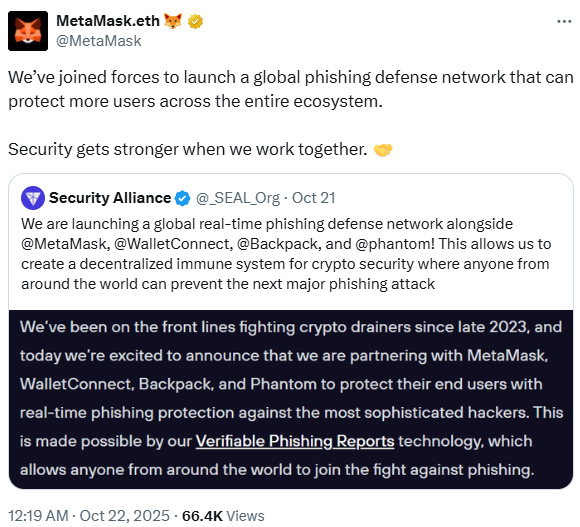
“We’ve joined forces to launch a global phishing defense network that can protect more users across the entire ecosystem,” said the MetaMask team.
MetaMask announcement on cooperation with SEAL. | Credit: MetaMask X profile
The network will be powered by SEAL’s new verifiable phishing reports system, a protocol that lets researchers cryptographically prove that a malicious website contains phishing content.
This is a significant leap forward: in the past, false positives and unverifiable claims made it difficult for wallets and security firms to act swiftly against new threats.
SEAL aims to “allow us to create a decentralized immune system for crypto security where anyone from around the world can prevent the next major phishing attack.”
How SEAL’s Decentralized Phishing Defense Works
The biological immune system inspires the concept: when one cell identifies a pathogen, the information spreads quickly to other cells, triggering a coordinated defense.
Similarly, SEAL’s system allows wallets and users to share verified threat intelligence across the entire network.
Detection: When a user or researcher discovers a phishing site, they can submit a report through SEAL’s verification system.
Verification: SEAL’s cryptographic tools confirm that the report corresponds to real malicious content, preventing abuse or misinformation.
Distribution: Once verified, the phishing warning instantly propagates across all participating wallets and applications.
Defense: Users of MetaMask, Phantom, and other integrated wallets receive immediate alerts or automatic blocks when they encounter the same domain or malicious contract.
The process is decentralized; no entity decides what constitutes a phishing threat. Instead, the network leverages community reporting, verification, and shared data, reducing the delay between discovery and protection from hours or days to minutes.
“Anyone with a valid report can trigger a phishing warning across network participants in real time and without special permissions,” SEAL explained. “This means quicker response times to new phishing threats and more funds saved.”
Why Phishing Remains Crypto’s Top Threat
Despite massive improvements in on-chain monitoring and smart contract audits, phishing remains the number one cause of stolen funds in crypto. Unlike traditional hacks, phishing doesn’t exploit software vulnerabilities; it exploits people.
Attackers impersonate trusted websites, NFT projects, or wallet interfaces, tricking users into connecting their wallets and approving malicious transactions. Once a drainer contract is authorized, it can empty the victim’s wallet in seconds.
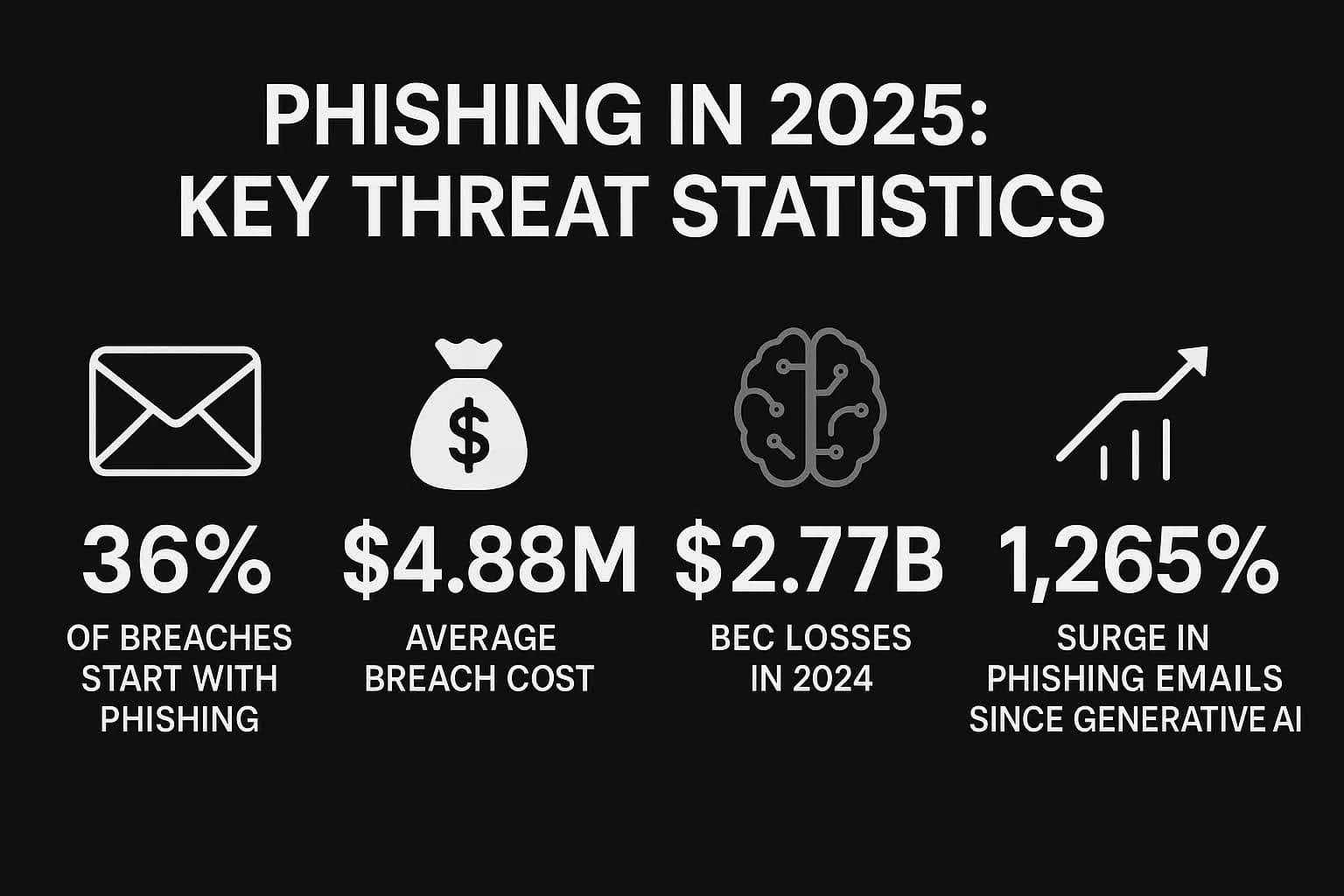
Phishing statistics for 2025. | Credit: Certik
According to CertiK’s mid-year report, phishing incidents accounted for the highest number of crypto security breaches in 2025, far surpassing protocol exploits or bridge hacks.
The evolving tactics of these attackers have made traditional defenses, like URL blocklists or blacklists, increasingly ineffective.
The Evolving Threat: From Phishing Scams to Crypto “Drainers”
As the crypto ecosystem matures, phishing attacks have evolved from crude email scams into sophisticated, organized operations.
The new crypto “drainers” generation operates like coordinated malware syndicates: fast-moving, automated, and globally distributed. Their tactics are designed to exploit Web3’s openness while staying one step ahead of detection systems.
Modern “drainers” function like professionalized malware networks, not small-scale phishing operations.
They deploy rotating landing pages that change frequently to bypass URL blocklists.
Attackers use offshore hosting and automated infrastructure to reappear within hours after takedowns.
Cloaking techniques hide malicious content from automated scanners, showing safe pages to bots and phishing pages to victims.
“Drainers are a constant cat-and-mouse game,” notes Ohm Shah of MetaMask. Attackers evolve faster than traditional defenses can react.
The SEAL partnership allows wallets to coordinate quickly, transforming security from reactive (per-wallet detection) to proactive (shared defense).
When one participant identifies a phishing site or drainer, protection is instantly deployed across all wallets in the network.
Collaboration with SEAL lets wallet teams translate security research directly into practice, disrupting attacker infrastructure faster than before.
Collaboration Over Competition: Building a Web3 Security Commons
Crypto wallets have competed fiercely for users and market share for years. However, phishing has become a unifying threat that transcends brand boundaries.
As attackers target the ecosystem rather than individual products, leading wallet teams realize that collaboration, not competition, is the only sustainable path to security. By working together, they’re laying the groundwork for a shared “security commons” that protects everyone interacting with Web3.
Crypto wallets like MetaMask and Phantom set aside competition to collaborate on shared security.
Phishing is a universal threat that undermines trust across the entire crypto ecosystem, not just individual platforms.
The new “security commons” model pools resources, data, and intelligence across wallets, creating a collective defense layer.
This reflects a broader cybersecurity trend: recognizing that no single actor can defeat distributed, adaptive threats alone.
In Web2, organizations share threat intelligence through centralized alliances such as the Cyber Threat Alliance.
The same concept is emerging in Web3, but through decentralized, verifiable networks that preserve transparency and user trust.
Verifiable Reporting: Using Cryptographic Proof to Detect Phishing in Web3
One of the core innovations behind SEAL’s approach is verifiable reporting. In traditional Web2 phishing detection, reports often rely on screenshots or subjective user claims, both prone to error or manipulation. SEAL replaces this with cryptographic proof.
Researchers or users can generate a proof-of-phish, a signed attestation that a domain serves malicious code or drainers. This proof is distributed through SEAL’s network, where participating wallets can automatically ingest the data and deploy warnings.
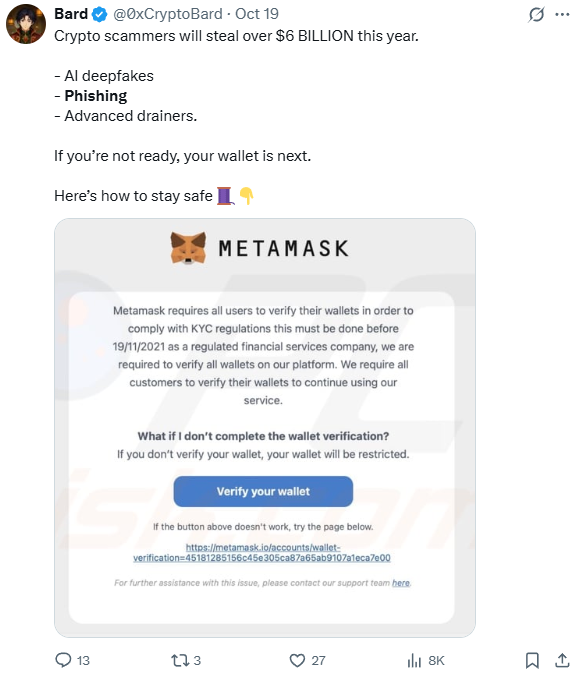
MetaMask requirements request to users. | Credit: @0xCryptoBard X profile
The result is a fully automated pipeline:
User submission – Verification – Network propagation – User protection.
Once the report is confirmed, the warning appears instantly in all integrated wallets. For end users, this means seeing a “Phishing site detected” message when they land on a known malicious domain. This is regardless of which wallet they use.
Decentralized Verification: Building Trust Through Transparency and Community Defense
The decentralized nature of SEAL’s system is crucial. Instead of relying on a central authority to decide which sites are dangerous, multiple verifiers contribute evidence and cross-sign the reports. This makes the system transparent, censorship-resistant, and trust-minimized.
In practice, that means:
Users can see why a site was flagged and by whom.
Researchers can audit the verification trail.
Attackers can’t easily poison the database with fake reports.
For crypto, where decentralization and trustlessness are foundational principles, this model fits far better than centralized threat feeds. It allows the community to self-immunize — creating a living, evolving defense layer that grows stronger with every new report.
Why Crypto Immune System Matters for the Future of Web3 Security
The idea of a “crypto immune system” isn’t just a catchy metaphor; it’s a potential paradigm shift for Web3 security. For years, the industry has relied on patchwork defenses: isolated blacklists, proprietary detection systems, and post-mortem investigations.
SEAL and MetaMask’s collaboration could mark the beginning of a unified, self-healing security infrastructure for decentralized systems.
By leveraging community verification, cryptographic proofs, and instantaneous data sharing, the model transforms every wallet user into a potential immune cell, capable of detecting, reporting, and neutralizing threats for the entire ecosystem.
Collaborative defense may be the only sustainable way to keep pace with evolving threats in a space built on permissionless innovation.
A New Era of Web3 Security: From Isolated Defenses to a Collective Immune Network
The launch of SEAL’s decentralized phishing defense network marks more than just a new security protocol. It signals a philosophical shift in the crypto industry’s approach to safety.
Web3 security has been fragmented for years, with each wallet, exchange, or dApp defending its perimeter. Attackers exploited those silos, moving faster than individual teams could respond.
Now, through cryptographic verification and real-time data sharing, the ecosystem can turn every user and wallet into part of a collective immune system. Instead of isolated defenses, Web3 gains a shared network that learns, adapts, and protects itself. It mirrors the biological systems that keep living organisms safe.
If successful, this model could redefine what “security” means in the decentralized era. It transforms defense from a reactive posture into a continuous, community-driven process. Here, every phishing report strengthens the network, and every wallet update makes the entire ecosystem smarter.
As SEAL and MetaMask lead the way, the broader Web3 community may be witnessing the beginning of a new phase: decentralization powers innovation and protects it.
The “crypto immune system” is a term the Security Alliance (SEAL) uses to describe a decentralized, collaborative defense network against phishing and wallet-draining attacks. It connects major crypto wallets like MetaMask, Phantom, WalletConnect, and Backpack, allowing them to share verified phishing data in real time, similar to how the human immune system shares signals to fight off infections.
Who is behind this initiative?
The system is a joint effort between MetaMask and several leading wallets, collaborating with SEAL (Security Alliance), a research and security coordination group. Together, they aim to build a global infrastructure for phishing detection and prevention that operates across wallets and ecosystems.
Why is phishing such a big problem in crypto?
Phishing remains the leading cause of crypto losses, accounting for over $400 million stolen in just the first half of 2025, according to CertiK. Unlike protocol hacks, phishing attacks exploit human behavior, tricking users into approving malicious transactions through fake websites, social media links, or wallet prompts. Once approved, these transactions are irreversible, making prevention critical.
What are “crypto drainers,” and how do they work?
“Drainers” are malicious smart contracts or scripts designed to automatically steal funds once a victim connects their wallet or approves a transaction. They are run by organized networks that rotate domains, use offshore servers, and cloak malicious content to evade detection. Essentially, they’re phishing operations supercharged with automation and scale.
Disclaimer:
The information provided in this article is for informational purposes only. It is not intended to be, nor should it be construed as, financial advice. We do not make any warranties regarding the completeness, reliability, or accuracy of this information. All investments involve risk, and past performance does not guarantee future results. We recommend consulting a financial advisor before making any investment decisions.
Giuseppe Ciccomascolo began his career as an investigative journalist in Italy, where he contributed to both local and national newspapers, focusing on various financial sectors.
Upon relocating to London, he worked as an analyst for Fitch's CapitalStructure and later as a Senior Reporter for Alliance News. In 2017, Giuseppe transitioned to covering cryptocurrency-related news, producing documentaries and articles on Bitcoin and other emerging digital currencies. He also played a pivotal role in establishing the academy for a cryptocurrency exchange website. Crypto remained his primary area of interest throughout his tenure as a writer for ThirdFloor.


 Easy
Easy