ASIC Stablecoin Rules Explained: What Australia’s New Exemption Means. | Credit: Pexels.
Share
Key Takeaways
ASIC’s exemption eases licensing for intermediaries distributing stablecoins, provided the issuer holds an AFS licence.
The relief is temporary, expiring on 1 June 2028, acting as a bridge to Australia’s upcoming permanent stablecoin framework.
Consumers benefit from access to more regulated stablecoins, with mandatory disclosure documents improving transparency.
Australia’s approach is lighter than Hong Kong and Singapore, but more proactive than New Zealand, positioning it as a regional middle ground.
Australia has taken a major step in shaping its digital asset regulations. On 18 September 2025, the Australian Securities & Investments Commission (ASIC) announced a new class exemption for intermediaries dealing in stablecoins.
The move is designed to reduce red tape, support innovation, and provide a smoother transition towards Australia’s upcoming stablecoin regulatory framework.
This article breaks down what the exemption means, who benefits, and what risks remain.
What’s the New Exemption for Stablecoin Distribution in Australia
ASIC’s latest reform is formalised in the ASIC Corporations (Stablecoin Distribution Exemption) Instrument 2025/631. The exemption provides what’s known as class relief, allowing intermediaries who engage in secondary distribution of stablecoins to avoid certain licensing requirements.
Try Our Recommended Crypto Exchanges
Sponsored
Disclosure
We sometimes use affiliate links in our content, when clicking on those we might receive a commission at no extra cost to you. By using this website you agree to our terms and conditions and privacy policy.
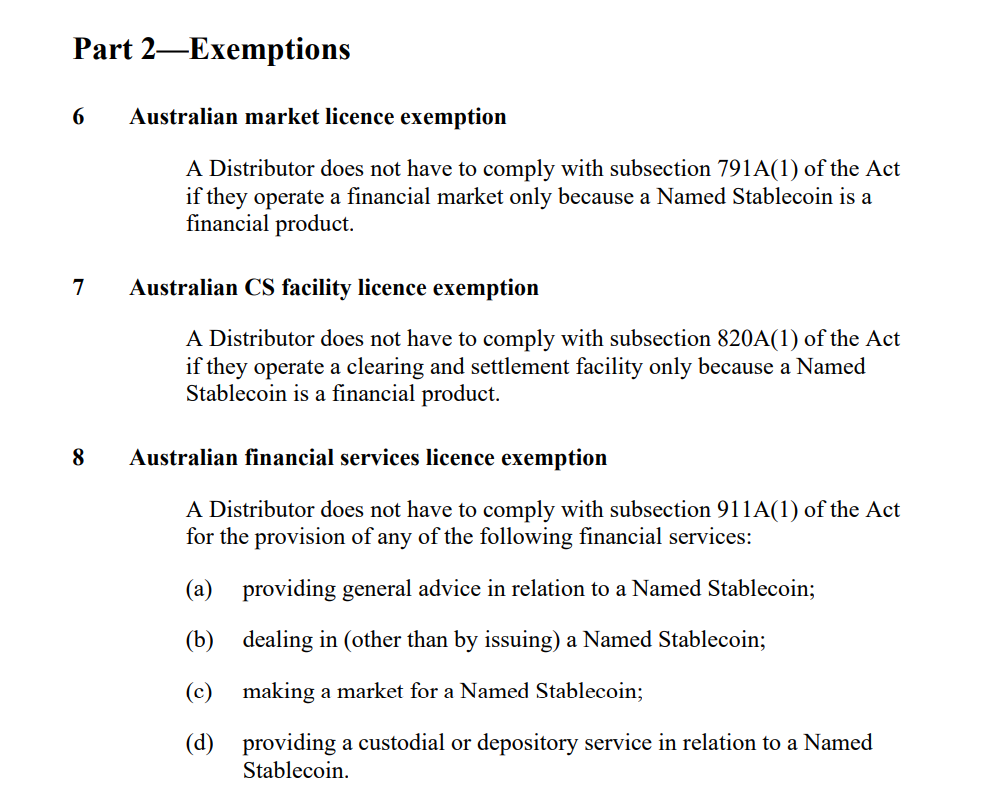
In simple terms, this means that intermediaries such as exchanges, brokers, and custodians will not need to hold their own Australian Financial Services (AFS) licence or an Australian market or clearing licence, provided the stablecoin they distribute is issued by an AFS-licensed entity.
This exemption is significant because it clears a path for intermediaries to operate more efficiently while still keeping issuers under ASIC’s oversight.
ASIC Corporations (Stablecoin Distribution Exemption) Instrument 2025/631. | Source: asic.gov.au
Key Conditions and Limits of ASIC’s Stablecoin Relief
While the relief is important, it does not give intermediaries a free pass. ASIC has set clear boundaries around when the exemption applies.
The relief only applies to secondary distribution of stablecoins, not to issuers themselves.
Intermediaries relying on the exemption must ensure the Product Disclosure Statement (PDS) prepared by the issuer is accessible to their clients.
The exemption is temporary, scheduled to expire on 1 June 2028, unless extended or replaced by new laws.
These conditions ensure that while the market gains breathing space, consumer protections remain in place.
Who Is Affected by the ASIC Stablecoin Rules Update
The exemption has ripple effects across multiple players in the Australian financial ecosystem.
Intermediaries such as exchanges, brokers, and payment service providers benefit most directly, as they can distribute eligible stablecoins without securing separate licences.
Stablecoin issuers that hold an AFS licence, like Catena Digital Pty Ltd, issuer of AUDM, the first approved stablecoin, will find it easier to partner with intermediaries.
Consumers stand to gain access to more regulated stablecoin options, with mandatory disclosure documents ensuring they are better informed about risks.
Overall, the relief reduces barriers to entry while keeping issuers accountable.
Why ASIC Introduced the Exemption for Stablecoins
ASIC’s decision is part of a bigger strategy to balance innovation with regulation. By easing licensing requirements for intermediaries, the regulator hopes to create a more dynamic digital asset market while ensuring oversight is not diluted.
The exemption serves three main purposes:
Reduce regulatory burden by removing duplicative licensing requirements.
Support innovation in payments, tokenisation, and digital finance by giving businesses room to grow.
Act as a bridge to Australia’s future stablecoin framework, which is still under development through consultations and draft laws.
This reflects ASIC’s intention to encourage growth without compromising investor protection.
Risks, Challenges and Criticisms of the New Stablecoin Exemption
Despite its benefits, the exemption does not solve every challenge facing Australia’s stablecoin market. There are still limitations and concerns to consider.
Narrow initial scope: Only stablecoins issued by AFS-licensed entities qualify, meaning many popular tokens remain outside the exemption.
Temporary measure: With a June 2028 expiry, uncertainty remains about what the permanent regime will look like.
Consumer and systemic risks: Stablecoins still face risks around collateral quality, redemption guarantees, fraud, and financial stability.
These challenges highlight why ongoing regulatory reform will be crucial.
What ASIC’s Stablecoin Rules Mean in Practice for Businesses and Consumers
For businesses, the exemption reduces compliance costs and speeds up the ability to offer stablecoin products. Exchanges and payment providers can onboard eligible stablecoins more easily, provided the issuer holds the proper licence. This could drive faster adoption and innovation in Australia’s digital asset space.
For consumers, the move may result in wider availability of trusted stablecoins at lower costs. Importantly, mandatory disclosure ensures they receive better information on risks before using these products.
Ultimately, the exemption signals a shift towards a more innovation-friendly environment, while still laying the groundwork for a more robust, long-term regulatory framework for stablecoins in Australia.
ASIC’s new exemption for stablecoin intermediaries is a significant step in making Australia’s digital asset regulation more flexible and innovation-friendly.
By easing licensing burdens, there’s more room for growth and competition in stablecoin offerings, but this comes with responsibilities for transparency, consumer protection, and staying compliant.
With broader regulatory reforms underway, the exemption acts as a transitional tool to align market practices and law.
How does Australia’s exemption differ from Singapore’s rules?
Australia offers a temporary exemption for intermediaries until 2028, while Singapore’s MAS enforces a permanent licensing regime with strict reserve and redemption requirements.
How is Australia’s approach different from Hong Kong’s stablecoin rules?
Hong Kong requires all issuers to be licensed with no exemptions for intermediaries, whereas Australia reduces licensing burdens for distributors of AFS-licensed stablecoins.
Does New Zealand have a similar exemption for stablecoin distribution?
No, New Zealand has no dedicated stablecoin framework, focusing mainly on AML compliance. Australia is moving faster with transitional rules.
What makes Australia’s exemption unique compared with neighbours?
It is temporary, intermediary-focused, and transitional, sitting between New Zealand’s light-touch model and Singapore/Hong Kong’s stricter permanent regimes.
Disclaimer:
The information provided in this article is for informational purposes only. It is not intended to be, nor should it be construed as, financial advice. We do not make any warranties regarding the completeness, reliability, or accuracy of this information. All investments involve risk, and past performance does not guarantee future results. We recommend consulting a financial advisor before making any investment decisions.
Onkar Singh has three years of experience as a digital finance content creator. Throughout his career, he has collaborated with various DeFi projects and crypto media outlets. In his leisure time, he enjoys fitness activities at the gym and watching movies across different genres. Balancing his professional and personal interests, Onkar continues to contribute to the digital finance landscape while pursuing his hobbies.


 Easy
Easy