Depending on the actors, the implications can vary. For retail users, abstraction simplifies onboarding. | Image source: CCN
Share
Key Takeaways
EIP-8141 embeds account abstraction into Ethereum’s base layer. Frame Transactions move validation, gas logic, and execution directly into the protocol instead of relying on external bundlers.
Existing Ethereum addresses remain valid. Externally Owned Accounts can migrate into the new framework without changing their 0x address, preserving balances and transaction history.
Hardware wallets gain clearer and stronger signing models. Users sign structured Frames rather than opaque data, improving transparency and enabling support for advanced signature schemes.
Gas payments become flexible at the protocol level. Fees can be paid in supported ERC-20 tokens through Payment Frames, reducing reliance on holding ETH for basic transactions.
Ethereum is preparing one of its most user-focused upgrades in years.
It could fundamentally change how every ETH holder interacts with the network.
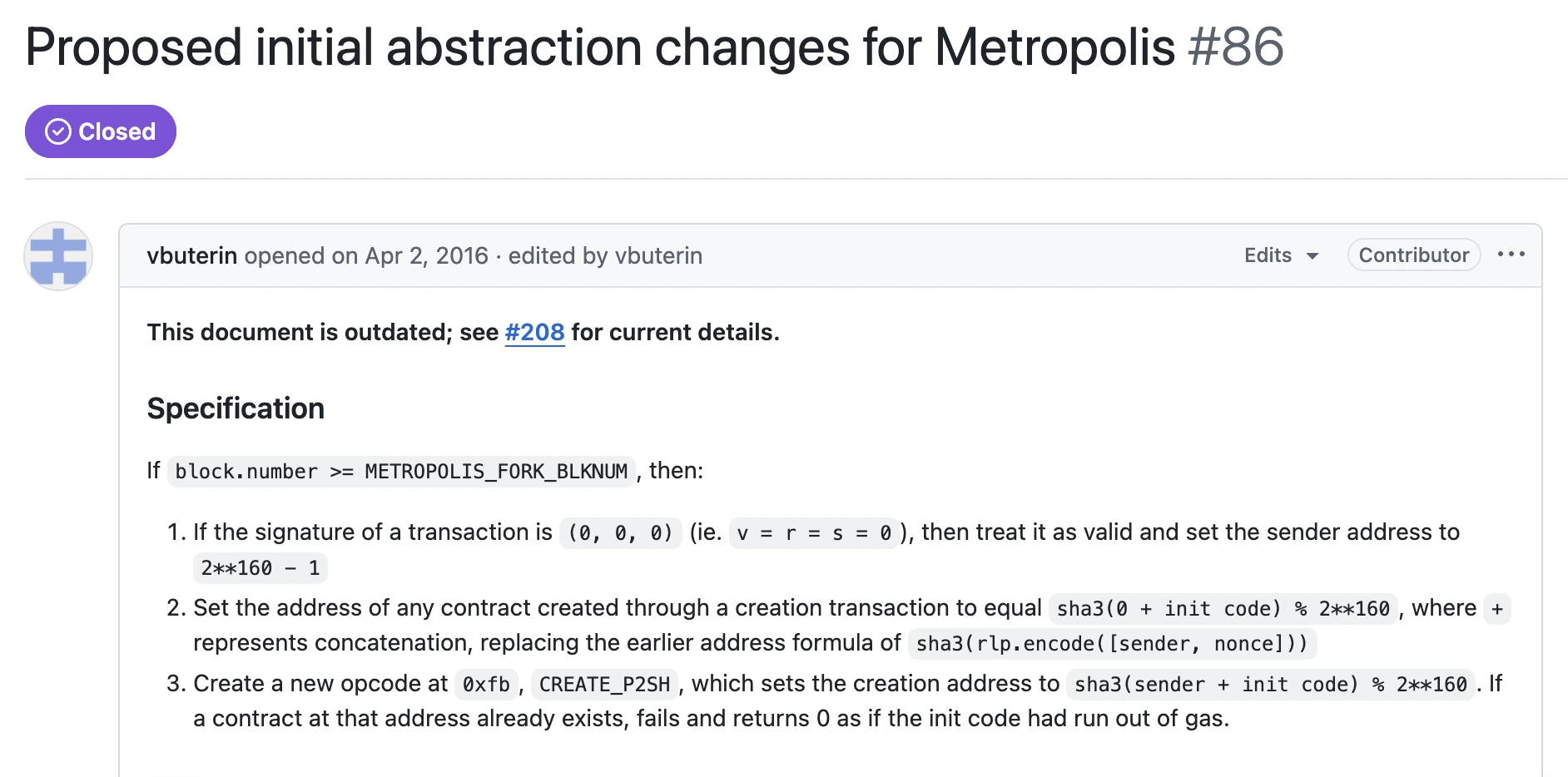
On Feb. 28, 2026, Ethereum co-founder Vitalik Buterin announced that native account abstraction is finally within reach through Ethereum Improvement Proposal (EIP) 8141, with rollout expected within a year as part of the upcoming Hegota fork.
In practical terms, this means Ethereum wallets could soon function as programmable smart accounts by default.
Users may no longer need ETH to pay gas, manage rigid signature rules, or rely on external infrastructure for advanced security features.
This milestone follows nearly a decade of research. Early public discussions about account abstraction date back to 2016 on Ethereum research forums and GitHub threads led by Buterin and core developers.
Since then, multiple proposals have attempted partial solutions. None embedded abstraction directly into the base protocol.
Buterin described EIP-8141 as an “omnibus” proposal that consolidates earlier ideas, resolves remaining blockers, and extends functionality beyond original goals.
As of March 3, 2026, the proposal remains in draft status but has gained visible support from major client teams, including Geth, Erigon, and Nimbus, according to recent All Core Devs Execution discussions.
This article explains what account abstraction is, how EIP-8141 works, what Frame Transactions introduce, how the Hegota fork fits into Ethereum’s roadmap, and what this upgrade could mean for ETH users, wallets, and the broader decentralized finance (DeFi) ecosystem.
What Is Account Abstraction and Why Ethereum Needs It
Ethereum’s design has remained stable since launch, but its account model still reflects early blockchain priorities: simplicity, cryptographic security, and minimal protocol complexity. As adoption grows, that structure shows its limits.
Ethereum runs on two types of accounts:
Externally Owned Accounts (EOAs): Controlled by private keys and secured with the Elliptic Curve Digital Signature Algorithm (ECDSA).
Contract accounts:Smart contracts deployed on-chain that execute code when triggered.
EOAs keep the system simple. They sign transactions, send ETH, and interact with smart contracts. But they also create friction.
No native batching: Users cannot combine multiple actions into one transaction.
Limited multisignature support: Multisig requires separate smart contract wallets.
Gas locked to ETH: Users must hold ETH to pay fees.
Full seed phrase reliance: One lost seed phrase can mean permanent loss of funds.
These constraints affect usability and security. They also make crypto harder for everyday users.
Account abstraction changes this structure. Instead of separating EOAs from contract accounts, it treats every account as programmable. That means accounts can define their own rules.
With account abstraction, accounts can support:
Custom signature logic: Multisig, passkeys, or alternative authentication methods.
Flexible gas payments: Fees paid in tokens other than ETH.
Built-in recovery models: Social recovery instead of single-seed dependence.
Transaction automation: Batching, scheduling, or conditional execution.
The goal has remained consistent: improve security, reduce friction, and make Ethereum easier to use without weakening decentralization.
Ethereum does not yet support native account abstraction at the protocol level. Developers currently target the Hegota upgrade in the second half of 2026 through proposals such as
Ethereum Improvement Proposal (EIP)-8141, also called Frame Transactions.
In the meantime, the network moves forward in steps:
Ethereum Improvement Proposal (EIP)-4337 (2023): Enabled practical account abstraction without changing Ethereum’s core. It introduced smart accounts through a separate mempool and bundler system and now powers millions of wallets.
Native account abstraction will complete the shift at the protocol level.
Until then, Ethereum continues building toward that future through measured upgrades that balance innovation with stability.
How Ethereum Implemented Account Abstraction So Far
Ethereum’s most significant step toward abstraction came in March 2023 with Ethereum Improvement Proposal (EIP) 4337.
Unlike EIP-8141, EIP-4337 did not change consensus rules. Instead, it introduced a parallel transaction pathway that operates through smart contracts.
The system includes:
UserOperations, which describe intended actions.
Bundlers, which aggregate multiple UserOperations into a single transaction.
The EntryPoint contract, which validates and executes those operations.
Paymasters, which can sponsor transaction fees.
A dedicated alternative mempool for UserOperations.
Under this structure, bundlers submit transactions to Ethereum’s main chain.
The EntryPoint contract verifies each operation according to the account’s custom logic before execution.
This design enabled smart contract wallets to operate at scale without requiring a hard fork.
By early 2026, ERC-4337 supports tens of millions of accounts and hundreds of millions of transactions. Wallet teams such as Safe, Argent, and ZeroDev rely on it to deliver gas sponsorship, social recovery, batched actions, and token-based fee payments.
ERC-4337 proved that account abstraction works in practice.
However, it remains an overlay system. Validation still depends on contract execution rather than native protocol rules.
Why Native Integration Still Matters
ERC-4337 reduced friction but introduced additional architectural layers.
UserOperations move through a separate mempool. Bundlers must stay online. The EntryPoint contract becomes a central coordination hub for validation.
For most users, this complexity remains invisible.
For infrastructure providers, exchanges, custodians, and institutional participants, the separation adds operational overhead.
Native integration removes those layers.
When abstraction becomes part of consensus, transactions no longer require intermediate aggregation logic.
Validation executes directly inside the protocol’s transaction engine.
This simplifies tooling, monitoring, fee estimation, and state transition analysis.
It also eliminates structural divergence between standard accounts and smart accounts.
The Evolution of Ethereum Accounts
Features
ERC-4337 (2023–2025)
EIP-8141 / Hegota (2026+)
Architecture
Overlay Layer. Operates as a “smart contract” wrapper over the protocol.
Native Layer. Embedded directly into Ethereum’s core consensus logic.
Transaction unit
UserOperations. Sent to a separate, private mempool.
Frame Transactions. Processed as first-class protocol objects.
Middlemen
Requires Bundlers to aggregate actions and submit to ETH.
Intermediary-free. Direct submission to the public mempool.
Validation
Verified via the EntryPoint smart contract.
Verified via a Validation Frame in the protocol.
Gas payment
Handled by Paymasters (smart contracts).
Handled by Payment Frames (native protocol rules).
UX impact
Improved, but can be complex for devs to implement.
Smart-by-default. Every wallet is a programmable account.
Instead of routing programmable logic through a singleton contract, Ethereum would process modular Frame Transactions.
Each frame performs a defined role:
Validation
Gas authorization
Execution
Optional deployment
This internal sequencing replaces the EntryPoint contract model.
The key distinction lies in where validation occurs.
Under ERC-4337, validation executes as contract logic. Under EIP-8141, validation becomes part of Ethereum’s core transaction processing rules.
That shift reduces reliance on external actors while preserving programmable flexibility.
It also allows deeper optimization of batching, fee accounting, and execution ordering because the protocol understands frame structure directly.
How Hegota Completes the Transition
Developers target EIP-8141 for the Hegota fork, expected in the second half of 2026.
Recent All Core Devs discussions show growing alignment among client teams, including Geth, Erigon, and Nimbus.
Integration requires coordination between execution-layer transaction handling and consensus-layer validation.
Testing must confirm:
Deterministic behavior across clients.
Backward compatibility for existing Externally Owned Accounts.
Stable gas accounting under frame execution.
Resistance to new attack surfaces introduced by flexible validation logic.
If deployed successfully, Hegota would unify account abstraction at the protocol level.
ERC-4337 would no longer function as a workaround layer but as an early-stage bridge toward native support.
Institutional Implications of Protocol-Level Abstraction
Depending on the actors, the implications can vary. For retail users, abstraction simplifies onboarding.
For institutions, the impact extends further.
Protocol-level smart accounts allow:
Embedded multi-party authorization
Structured role permissions
Automated policy enforcement
Internal transaction controls
These capabilities reduce reliance on layered contract wrappers or external orchestration systems.
From a systems perspective, fewer moving parts improve auditability and reduce operational risk.
Ethereum’s base layer becomes more adaptable without altering monetary policy, validator incentives, or block production mechanics.
A Structural Shift After a Decade of Research
Public discussions about account abstraction began a decade ago. Since then, developers proposed multiple designs that improved wallet flexibility but stopped short of modifying Ethereum’s transaction validation rules.
ERC-4337 marked the first large-scale implementation. It enabled programmable smart accounts without altering consensus and demonstrated sustained demand across millions of wallets and transactions.
However, it relied on additional infrastructure layered on top of the protocol.
EIP-8141 moves validation logic into Ethereum’s execution layer itself. Instead of simulating abstraction through contract wrappers and alternative mempools, the proposal integrates modular transaction frames directly into the transaction lifecycle.
If included in the Hegota upgrade, Ethereum would formalize programmable accounts as a base-layer feature rather than an optional extension.
The proposal redefines how transaction authorization is processed within consensus rules.
As a result, account abstraction would transition from experimental architecture to protocol standard.
Will I need to get a new wallet or address for EIP-8141?
No. A major goal of EIP-8141 is backward compatibility. Existing Externally Owned Accounts (EOAs) can “migrate” to the new framework without changing your public 0x… address. You will keep your current funds and history while gaining access to “smart” features like social recovery and gas sponsorship.
How do “Frame Transactions” impact hardware wallet security?
A hardware wallet (like Ledger or Trezor) remains the “root of trust.“ However, EIP-8141 changes what is signed. Instead of a raw hex string, users will sign structured “Frames.”
If I don't need ETH for gas, how do fees get paid?
Fees are handled by the “Payment Frame.” You can pay in stablecoins (USDC/USDT) or any ERC-20 token the dApp’s “Paymaster” accepts. The protocol handles the conversion behind the scenes, so you never have to visit an exchange just to buy $10 worth of ETH to move your funds.
Does this replace existing smart wallets like Safe or Argent?
It actually supercharges them. Currently, wallets like Safe rely on complex off-chain “bundlers” (ERC-4337). EIP-8141 makes these wallets “first-class citizens.” This means faster confirmation times, lower fees (by removing the bundler wrapper), and the same censorship resistance as a standard ETH transfer.
Disclaimer:
The information provided in this article is for informational purposes only. It is not intended to be, nor should it be construed as, financial advice. We do not make any warranties regarding the completeness, reliability, or accuracy of this information. All investments involve risk, and past performance does not guarantee future results. We recommend consulting a financial advisor before making any investment decisions.
Dr. Lorena Nessi is an award-winning journalist and media technology expert with 15 years of experience in digital culture and communication. Based in Oxfordshire, UK, she combines academic insight with hands-on media practice.
She holds a PhD in Communication, Sociology, and Digital Cultures, and an MA in Globalization, Identity, and Technology.
Lorena has taught at Fairleigh Dickinson University, Nottingham Trent University, and the University of Oxford. She is a former producer for the BBC in London, with additional experience creating television content in Mexico and Japan.
Her research focuses on digital cultures, social media, technology, capitalism, and the societal impact of blockchain innovation.
She has written extensively on digital media and emerging technologies, with her work featured in both academic and media platforms. Her Web3 expertise explores how blockchain technologies shape culture, economics, and decentralized systems.
Outside of work, Lorena enjoys reading science fiction, playing strategic board games, traveling, and chasing adventures that get her heart racing. A perfect day ends with a relaxing spa and a good family meal.


 Intermediate