X to Launch In-App Crypto & Stock Trading — Is This the Robinhood Killer?
Share
Key Takeaways
Coinbase faced temporary trading disruptions on earnings day, with some users unable to buy, sell, or transfer crypto, though the company said customer funds were not affected.
Coinbase stock is under pressure, down more than 30% this year, as analysts brace for weaker Q4 earnings amid a broader crypto market downturn.
Lower Bitcoin prices and reduced trading activity are weighing on revenue, with transaction revenue expected to fall sharply compared with last year.
Investors are focused on earnings guidance and service diversification, including subscription and stablecoin revenue, as Coinbase looks to offset volatility in crypto trading.
Coinbase Global, Inc. is under pressure from multiple angles as it heads into its fourth-quarter 2025 earnings report, scheduled for Thursday, February 12, 2026, after the market close.
What would normally be a routine earnings update has become a focal point for both investors and end users, as the company’s stock (COIN) continues to slide alongside a broader downturn in digital assets, and some customers have reported temporary trading disruptions on the platform.
We are aware that customers may be unable to buy, sell, transfer on https://t.co/ohqDivlp6Y at this time. Our team is investigating this issue and will provide an update. Your funds are safe.
Later, Coinbase reported a 20% year-over-year decline in fourth-quarter revenue to $1.8 billion and a net loss of $667 million, compared with a $1.3 billion profit in the same period last year, underscoring how quickly shifting market conditions can impact even a diversified exchange.
Coinbase’s Q4 and full year 2025 financial results. | Source: @coinbase on X.
Coinbase Trading Issues Reported on Earnings Day
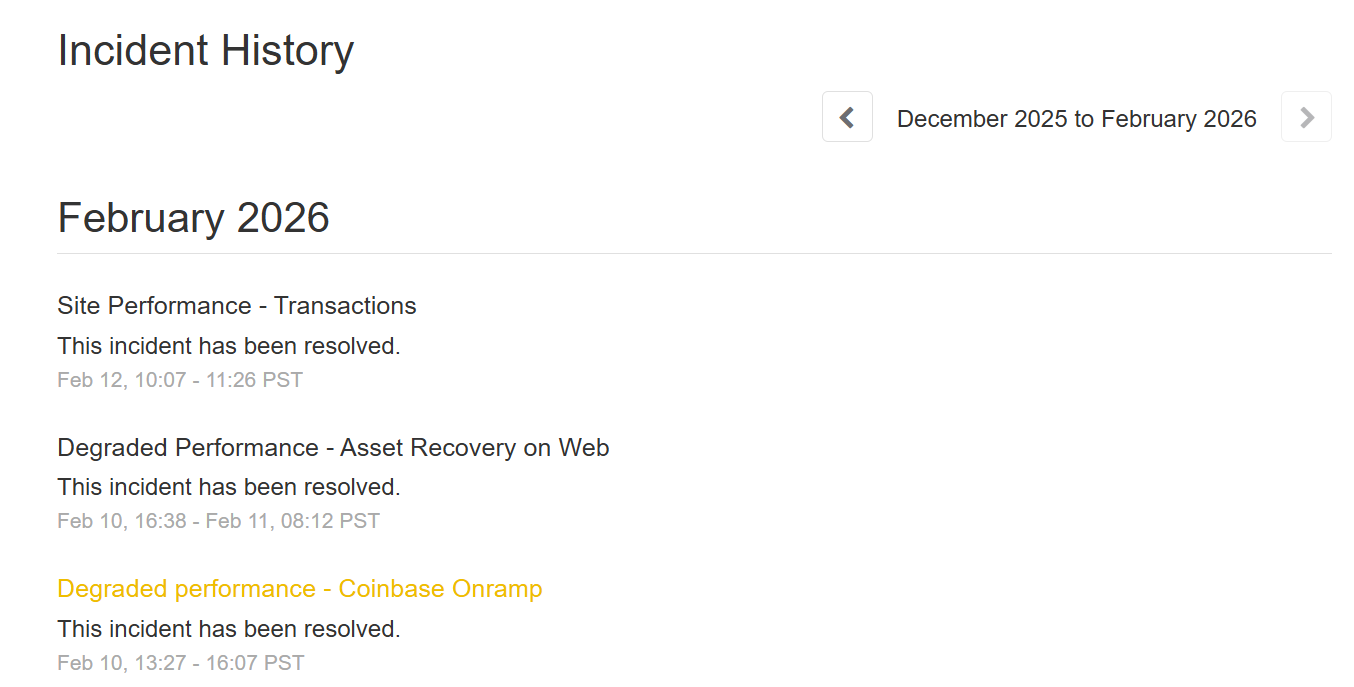
On Thursday, users across parts of Coinbase’s platform reported that they were unable to buy, sell, or transfer cryptocurrencies during trading hours. The exchange’s official status page indicates most core systems remain operational, but noted degraded performance in digital currency services, which affected how some users see prices or execute trades.
These issues are believed to be temporary technical glitches, not a fundamental breakdown of the exchange, and Coinbase has reassured that customer assets remain safe. However, in a market already on edge, even minor disruptions can amplify concerns among traders and shareholders.
Bitcoin Price Decline Weighs on Coinbase Trading Activity
Coinbase’s business is heavily tied to cryptocurrency trading activity, particularly spot trading volume and Bitcoin price direction, the two biggest drivers of its transaction fee revenue. In the past weeks, Bitcoin has fallen under $66,000, contributing to a pullback in trading volumes as investors adopt a more cautious stance toward risk assets.
🚨BITCOIN IS DROPPING
– Ever since the $126,300 high, all bounces have been used as exit liquidity
– Bitcoin selling pressure is pushing the price back down towards $60,000 after an initial 20% bounce pic.twitter.com/GNDqcdW67H
This slump in crypto prices has broader implications: Coinbase’s revenue, historically highly correlated with crypto trading volumes and price action, is expected to weaken as market activity slows. Market participants often watch Bitcoin’s price swings as a barometer for exchange activity levels, and the recent declines have echoed through related equities, like Coinbase’s stock.
Eric Balchunas (Senior ETF Analyst at Bloomberg) noted that while Coinbase shares are under pressure, spot Bitcoin ETFs continue to trade normally, showing no signs of stress. He explained that if there were any concerns about the underlying Bitcoin backing these ETFs, investors would likely see a gap between the ETF price and its intraday net asset value (iNAV), which reflects the real-time price of Bitcoin.
Coinbase is down but the ETFs trading just fine, if there were any concerns about their underlying bitcoin, you'd prob see some disconnect bt the INAV (real time price of btc) and the price of ETF and they are right on top of each other as seen here https://t.co/8zAmPnyUwOpic.twitter.com/wILR0EGZTk
Instead, ETF prices are tracking iNAV closely, indicating that the Bitcoin market itself is functioning smoothly. According to Balchunas, this suggests the sell-off in Coinbase is company-specific and equity-driven, rather than a sign of broader issues with Bitcoin liquidity or ETF structure.
COIN Stock: Falling With Crypto
Shares of Coinbase, listed under the ticker COIN, have been sliding significantly in recent months. According to market data:
COIN is down roughly 20% since the start of the year.
The stock is trading well below its 52-week highs, which were above $419.78.
Year-to-date losses have been reported as high as 30% or more in recent sessions.
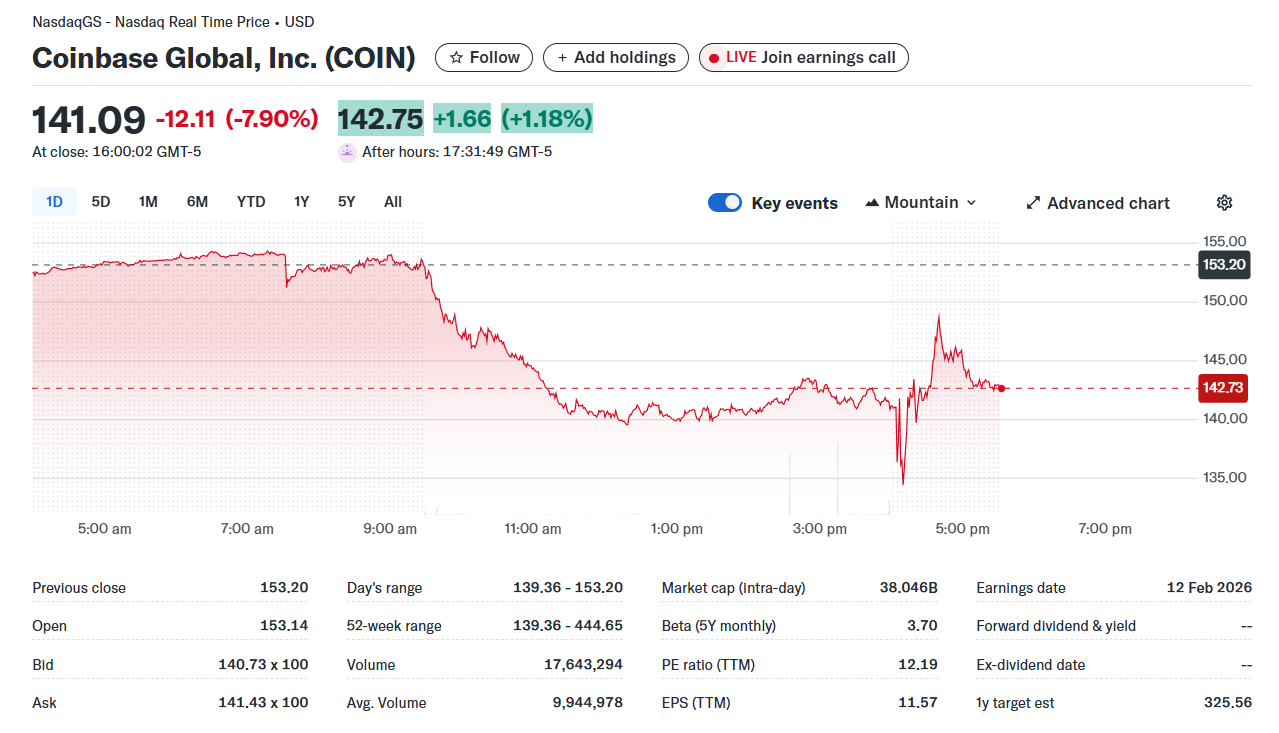
The above chart shows that Coinbase Global, Inc. (COIN) fell sharply during the trading session, closing at $141.09, down $12.11 or 7.90% for the day. The stock opened near the prior close of $153.20 but quickly moved lower as selling pressure intensified.
Throughout the morning and early afternoon, shares trended downward with limited buying support, suggesting investors were reducing exposure ahead of the company’s earnings report. Trading volume reached roughly 17.6 million shares, well above the average daily volume of about 9.9 million, indicating elevated activity and strong conviction behind the move.
The stock touched an intraday low of $139.36 before stabilizing slightly into the close. Despite the steep decline during regular trading hours, shares rebounded modestly in after-hours trading to around $142.75, up about 1.18%. The wide daily range and heavy volume reflect heightened volatility, likely driven by earnings expectations, broader crypto market weakness, and uncertainty surrounding recent trading disruptions reported by some users.
This price action reflects investor sentiment tied to crypto volatility and concerns about the company’s upcoming earnings. Analysts note that when Bitcoin and broader crypto prices retract, it often leads to lower trading volume and reduced fee income for exchanges like Coinbase.
Analysts Cut Coinbase Price Targets Ahead of Earnings Report
Heading into the earnings release, analysts have tempered expectations for Coinbase’s Q4 2025 performance. Multiple models and consensus forecasts point toward weaker revenue and earnings compared with the same quarter last year:
The Zacks Consensus Estimate for Coinbase’s Q4 revenue is approximately $1.84 billion, down from a year earlier.
Earnings per share (EPS) are forecast around $0.99 per share, significantly lower than results in previous cycles.
Some models suggest transaction volumes could shrink by more than 30% year-over-year, given softer trading activity in late 2025.
Analysts from different research firms note that transaction revenue remains Coinbase’s largest and most cyclical segment, highly sensitive to shifts in crypto prices and user trading behavior. Spot trading activity in Q4 is estimated to have contracted compared with Q3, while derivatives and institutional segments provide some offset but not enough to fully counter the decline.
Regulatory Uncertainty and Clarity Act Dispute Add Pressure
Beyond raw numbers, Coinbase’s outlook is being affected by broader market and regulatory forces. Cryptocurrency equities have underperformed more traditional tech and financial stocks as investors grapple with:
Delayed U.S. crypto legislation and mixed regulatory signals
Competition from other platforms and fee compression
Market preference for lower-risk assets in fluctuating macro environments
Some analysts have pointed to the stalled CLARITY Act and other regulatory uncertainty as additional reasons the stock has struggled, making institutional participation and product expansion more difficult in the near term.
🚨NEW: Details from the White House stablecoin yield meeting, per banking and crypto sources in the room:
People on both sides called the meeting ‘productive,’ but, again, no compromise was reached by the end of the meeting. However, deal specifics were discussed in more detail… pic.twitter.com/w5nPlG1DLi
Coinbase Users Temporarily Unable to Buy or Sell Crypto
Some Coinbase customers experienced a temporary trading outage, leaving them briefly unable to buy, sell, or transfer digital assets on the platform earlier in the day. Coinbase acknowledged the disruption on its official support channel and said its team was investigating the issue while reassuring users that customer funds remain safe.
The cause of the interruption has not been publicly disclosed, but the company confirmed the incident was under investigation and that services were being restored. Community trackers and crypto news outlets also reported the outage, which coincided with the company’s Q4 and full-year 2025 earnings release, a period of heightened market focus and volatility.
Temporary service issues on exchanges can affect trading behavior, especially when volumes and market attention are elevated around major financial announcements.
Notably, similar issues have occurred in the past during periods of extreme market stress. In May 2021, at the height of crypto market volatility, Coinbase experienced outages and trading disruptions as prices fell sharply and user activity surged.
Coinbase $COIN down. Not the stock. The system is down. Well the stock is down too.
But “your funds are safe”. They’ve just lost 40% of its value. Brace yourself. pic.twitter.com/yCvTrsHOPl
At the time, users reported difficulty accessing the platform while markets were rapidly declining. The incident became a reference point for critics, who argued that technical failures during high-volatility moments can amplify user frustration, even when exchanges maintain that customer funds remain secure.
Regarding the recent issue, Coinbase later confirmed that the issue had been resolved, with Coinbase Support stating that services were fully restored and thanking users for their patience, while noting that its support team remains available 24/7 to assist customers.
This issue is now resolved. Thank you for your patience. If you have any questions, our support team is available 24/7 to help. https://t.co/ki4z8DwLFz
Options Market Signals Volatility Ahead of Coinbase Results
Coinbase (COIN) is seeing elevated options activity ahead of earnings, with calls slightly leading puts and markets pricing in a 6.1% post-earnings move, in line with history. Despite revenue challenges, strong margins, solid liquidity, and balance-sheet strength keep Coinbase a major player in the crypto exchange sector.
This suggests traders expect significant share price movement after the report, in either direction, based on how results compare to expectations.
Coinbase Q4 2025 Earnings and 2026 Outlook
As Coinbase reports Q4 2025 earnings today, the company finds itself under strain from a weak crypto trading environment, sliding stock performance, and expected earnings decreases, all amid heightened market sensitivity. Temporary user disruptions on the trading platform add another layer of attention, though they appear to be short-lived technical issues rather than systemic failures.
The company reported fourth-quarter and full-year 2025 results that met expectations operationally but underscored how quickly a cooling crypto market can pressure even a diversified exchange.
Fourth-quarter revenue fell 20% to $1.8 billion, reflecting weaker trading activity as Bitcoin dropped nearly 50% from its October high. After marking down crypto holdings and investments, Coinbase posted a net loss of $667 million, compared with a $1.3 billion profit a year earlier. The stock, down nearly 37% year to date, edged higher in after-hours trading.
BREAKING: Coinbase, $COIN, unexpectedly reports a large quarterly loss, posting quarterly EPS of -$2.49 compared to expectations of $0.96.
CEO Brian Armstrong highlighted record 2025 milestones, including $5.2 trillion in trading volume and nearly 1 million Coinbase One subscribers. Meanwhile, CFO Alesia Haas noted that derivatives and stablecoin-related revenue helped offset weaker retail trading. Analysts note that diversification and USDC revenue sharing improve resilience, but warn that prolonged market weakness would still weigh heavily on results.
For investors and market observers, these results serve as a key gauge of how Coinbase intends to navigate slower trading volumes, expand and diversify revenue streams, and manage regulatory challenges heading into 2026.
What Coinbase’s Earnings Mean for Investors and Traders
For everyday Coinbase users, the key takeaway is that temporary trading disruptions do not mean funds are at risk, Coinbase’s systems have not shown any indication of catastrophic failure or loss of assets. Most core services are reported as operational, though individual users might experience degraded performance.
For investors, the stock’s performance ahead of earnings reflects broader bearish sentiment in crypto markets combined with expected weaker financial results. A decline in trading revenue and lower volumes often translates into weaker top-line figures for Coinbase, which in turn weighs on COIN share performance.
After reporting results, questions center on whether Coinbase’s current strategy can stabilize performance if trading volumes remain subdued into 2026.
Why are Coinbase users unable to buy or sell crypto today?
Some Coinbase users reported temporary issues buying, selling, or transferring crypto due to a technical disruption. Coinbase said the issue was system-related, not market-driven, and confirmed that customer funds remain safe while performance is monitored.
Is Coinbase down right now or fully offline?
No. Coinbase is not fully down. While some users experienced degraded trading services, the exchange’s core systems remained operational, and the issue appeared to be temporary rather than a full outage.
Why is Coinbase stock falling ahead of earnings?
Coinbase stock has fallen due to expectations of weaker earnings tied to lower crypto prices, reduced trading volumes, analyst downgrades, and broader market uncertainty. Analysts expect revenue and earnings to decline compared with the prior year.
How does Bitcoin’s price affect Coinbase’s earnings?
Bitcoin’s price strongly influences Coinbase’s revenue because lower prices usually lead to reduced trading activity. When fewer users trade crypto, Coinbase earns less in transaction fees, which can negatively impact earnings.
Disclaimer:
The information provided in this article is for informational purposes only. It is not intended to be, nor should it be construed as, financial advice. We do not make any warranties regarding the completeness, reliability, or accuracy of this information. All investments involve risk, and past performance does not guarantee future results. We recommend consulting a financial advisor before making any investment decisions.
Onkar Singh has three years of experience as a digital finance content creator. Throughout his career, he has collaborated with various DeFi projects and crypto media outlets. In his leisure time, he enjoys fitness activities at the gym and watching movies across different genres. Balancing his professional and personal interests, Onkar continues to contribute to the digital finance landscape while pursuing his hobbies.


 Easy
Easy