RENDER price target $2 run | Credit: Hameem Sarwar
Share
Key Takeaways
NVIDIA’s event today could directly benefit the RENDER crypto price.
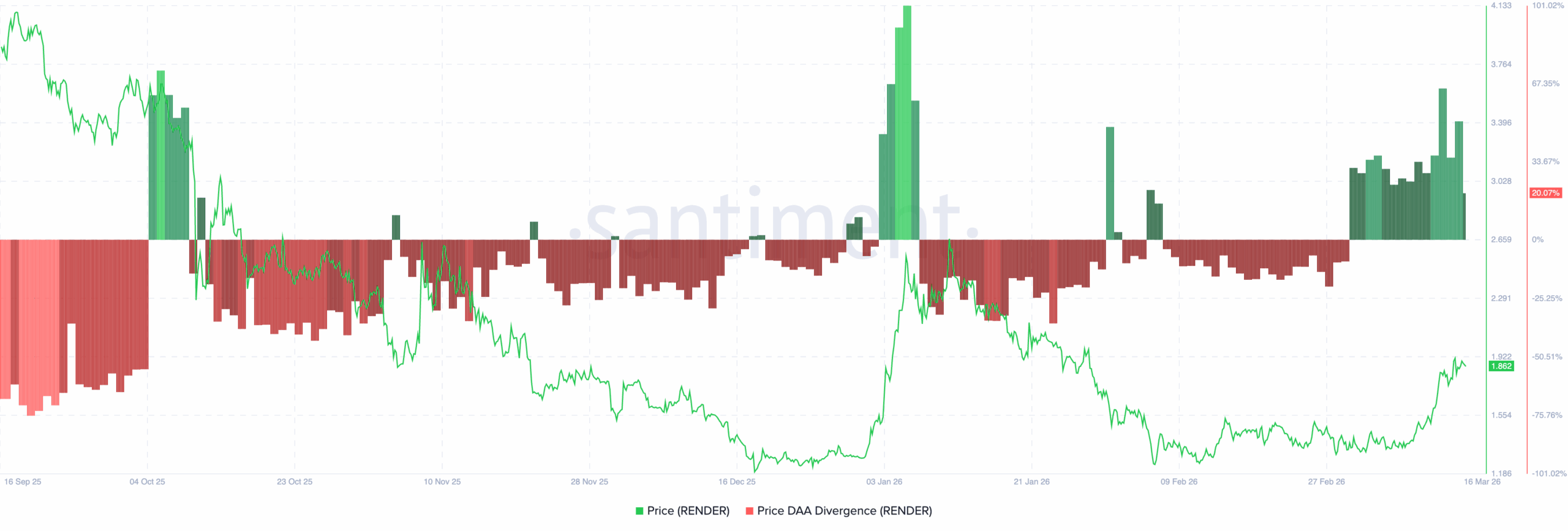
The Price-DAA Divergence has hit 20.07%, indicating genuine network usage.
RENDER has broken out of a six-week descending triangle, while targeting $2.25.
Every year, NVIDIA’s GPU Technology Conference sets the agenda for the global AI and computing industry. This year is different.
GTC 2026 is arriving at a moment when decentralised GPU computing has moved from a niche crypto narrative into a genuine infrastructure conversation.
As it stands, no token sits closer to that intersection than RENDER.
Ahead of the event, RENDER’s price has surged by more than 30% over the past few weeks.
But by the look of things, the rally doesn’t seem to be over, considering today is just day one of the NVIDIA event.
How high can RENDER’s price go?
Why NVIDIA GTC Is Important for RENDER
According to CCN’s findings, NVIDIA GTC will officially begin at 1 PM ET today.
It is expected that CEO Jensen Huang will take the stage at San Jose’s SAP Center to provide the press with updates on what the company has in store for the year ahead.
So, it is possible that every announcement NVIDIA makes about GPU performance improvements could directly impact RENDER’s price.
Amid the development, the RENDER price-DAA divergence chart has flashed a bullish signal.
The Price DAA Divergence bars have been green throughout the current breakout, currently at 20.07%.
This indicates that network usage is expanding alongside price, not lagging behind it.
Furthermore, the historical context strengthens the case considerably. The only prior sustained green DAA periods on this chart (early October 2025 and the first week of January 2026) both preceded meaningful price advances before fading.
Notably, when those green periods ended, and red bars returned, the price fell shortly after. The current green streak, building across the past two weeks, therefore signals that genuine network demand is underpinning the breakout.
So, if this metric sustains the positive reading, RENDER’s price could break past $2 soon.
Metrics Align for Uptrend
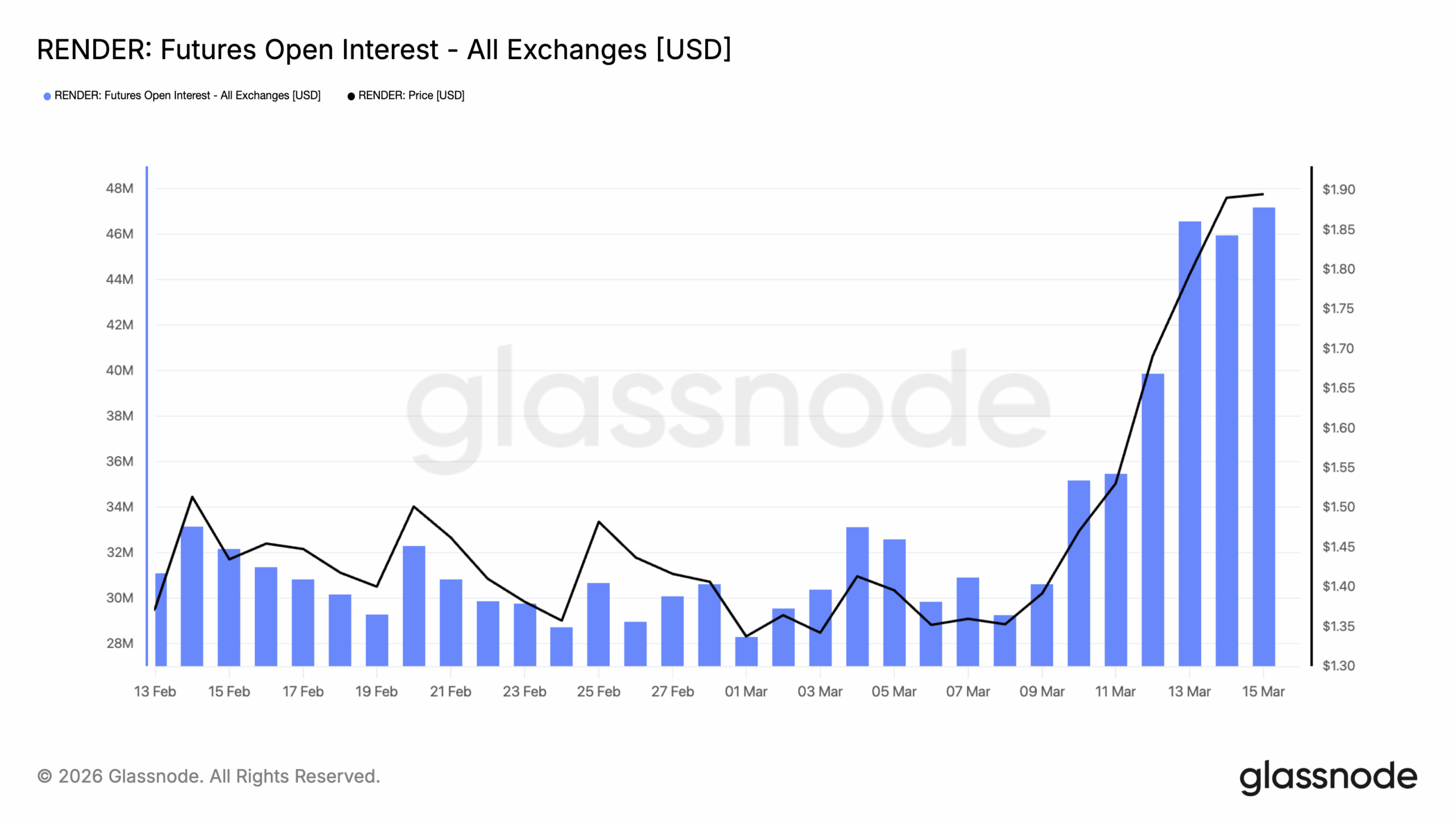
Besides that, the Open Interest (OI) tells a structurally healthier story.
Futures Open Interest has climbed steadily from $28 million on Feb. 27 to $47 million today.
This represents aa 68% increase in leveraged positioning over 17 days. Critically, that increase has been gradual and progressive, rising in step with price rather than spiking ahead of it.
OI and price have moved together in a consistent, correlated fashion since March 9, with each price increase accompanied by a proportional increase in open interest.
This signifies that new money is entering positions as the trend develops, rather than front-running it with speculative leverage.
Consequently, there is no evidence of the crowded positioning. At $47 million, RENDER’s OI is meaningful but not excessive for an asset at this market cap and price level.
Therefore, if this trend continues over the next few days, RENDER’s price will likely extend its rally.
RENDER Price Analysis: Higher
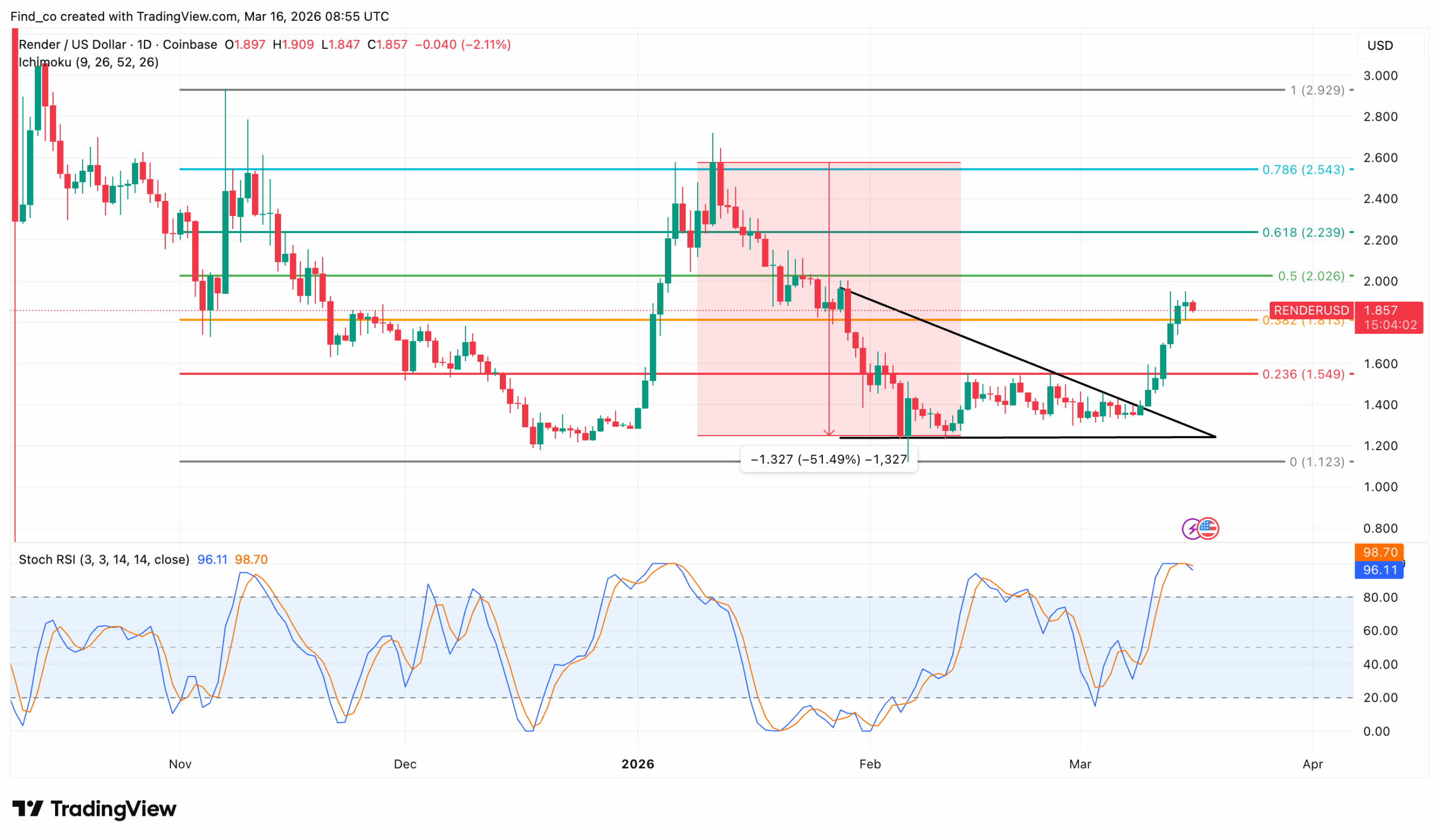
On the daily chart, RENDER has broken out of a descending triangle that formed after a 51.49% decline from the January high.
Following the February collapse from $2.68 to the $1.12 floor, RENDER’s price spent six weeks compressing inside a descending triangle.
That structure has now resolved to the upside. At press time, RENDER trades at $1.857, having cleared both the triangle’s upper trendline and the 0.382 Fib at $1.875 in a recovery move from the $1.38 support.
Notably, the Ichimoku cloud sits overhead as the next structural resistance. However, the cloud boundary near $2.026 (0.5 Fib) will be the first true test of whether the breakout has macro momentum behind it.
Historically, Ichimoku cloud breaks on the daily require sustained closes above the cloud to confirm a full trend reversal.
However, the Stochastic RSI warrants immediate caution. Both the K-line (96.11) and D-line (98.70) are in extreme overbought territory.
On several occasions, when the Stoch RSI reached these levels, a pullback followed.
Consequently, a retest of the $1.55 (0.236 Fib) or the broken triangle upper trendline near $1.65 would be a healthy and expected development.
Disclaimer:
The information provided in this article is for informational purposes only. It is not intended to be, nor should it be construed as, financial advice. We do not make any warranties regarding the completeness, reliability, or accuracy of this information. All investments involve risk, and past performance does not guarantee future results. We recommend consulting a financial advisor before making any investment decisions.
Victor Olanrewaju is a crypto analyst and reporter at CCN with deep roots in on-chain research and technical analysis. His crypto journey began in 2017, but it was the 2020 Uniswap airdrop that sparked a full-time pivot into the space.
With a foundation in copywriting, Victor honed his craft creating high-converting content for leading crypto brokers — most notably an XRP price prediction that ranked #1 on Google during the 2021 bull run.
He later joined AMBCrypto in 2022, where he combined storytelling with technical and on-chain analysis to cover key market narratives.
In 2024, he expanded his expertise at BeInCrypto, collaborating with analysts and using tools like Glassnode, Santiment, and IntoTheBlock to break down Bitcoin and altcoin trends.
At CCN, Victor covers the top cryptocurrencies, memecoins, macro shifts, blending real-time insights with deep-dive metrics.
He holds a Bachelor’s degree in Physics from the University of Ibadan, equipping him to simplify complex data for a wide audience. Follow his work or connect on LinkedIn or X.