Home / Analysis / Crypto / Technical Analysis / Gold, Silver Rally To Record Highs Before Christmas, Leaving Bitcoin Searching for Direction Below $90K
While gold and silver have surged to fresh all-time highs, Bitcoin (BTC) has yet to reclaim the $100,000 mark, highlighting a clear divergence in risk appetite.
The imbalance suggests capital is rotating toward traditional safe-haven assets at the expense of more volatile instruments.
Gold climbed above $4,400 for the first time on record, while Silver pushed past $69.
In this analysis, CCN examines the forces driving the surge in precious metals. We also evaluate what could be next for BTC’s price.
Macro Forces Favor Gold and Silver
Spot gold prices climbed to $4,402 per ounce, marking a roughly 65% gain year-to-date.
Silver has posted an even stronger performance, surging to $69 and rising approximately 132% over the same period.
CCN’s analysis suggests that a confluence of structural factors, rather than short-term speculation, drove the rally, particularly in gold.
Chief among them is sustained institutional and sovereign accumulation.
As reliance on the U.S. dollar has diminished, gold has increasingly been positioned as a reserve asset within these economies.
Currently, combined production from BRICS members and aligned countries — including China, Russia, Brazil, South Africa, Kazakhstan, Iran, and Uzbekistan — accounts for approximately 50% of global gold output.
Beyond accumulation, additional macro forces have helped push gold and silver to record highs.
Geopolitical risk has also resurfaced. Over the weekend, reports suggested that Israel may brief U.S. officials on the possibility of renewed strikes against Iran, amid concerns that Tehran continues to advance its nuclear program.
The backdrop is further complicated by a scheduled meeting between Israeli Prime Minister Benjamin Netanyahu and U.S. President Donald Trump later this month.
In theory, expectations of lower interest rates should be supportive for Bitcoin’s price.
However, escalating geopolitical tensions tend to favor assets perceived as traditional safe havens. In that context, a renewed flare-up in the Middle East could reinforce demand for gold and silver, even if it introduces volatility or hesitation across crypto markets.
Silver’s Possible Pullback Won’t Break Trend
On the monthly chart, CCN observed that silver has posted consecutive positive returns over the past seven months.
This stretch of sustained momentum propelled prices to a fresh record high. The breakout followed a move above the resistance line of a long-forming rounding bottom pattern.
Sentiment indicators have responded accordingly. For instance, the Holders Sentiment around silver has surged to its highest level since March 2013.
At the same time, On-Balance Volume (OBV) has continued to trend sharply higher, signaling strong participation and reinforcing the validity of the breakout.
If momentum persists, the metal could continue pushing higher, with psychological levels near $100 coming into focus over the coming months.
That said, not all observers are convinced the path higher will be linear.
Trader NorthstarCharts has cautioned that silver could be vulnerable to a sharp correction, potentially ranging between 40% and 60%.
However, even under that scenario, the analyst maintains that the broader bull market structure would remain intact—framing any deep pullback as a reset rather than a trend-ending event.
“Be mentally prepared for a large correction, but know this…We have barely even begun this bull era.” The analyst noted.
Gold Volatility Remains Controlled
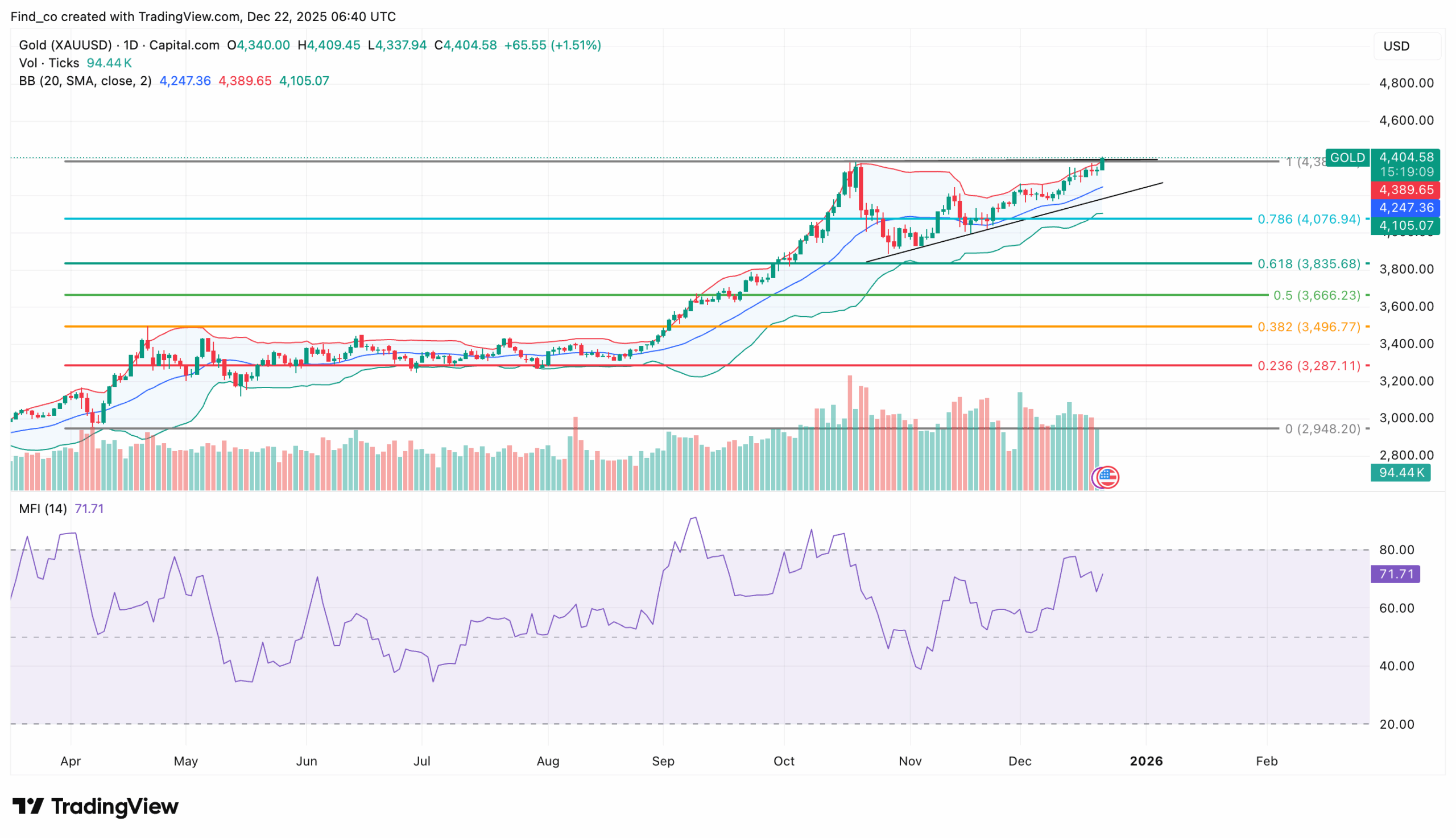
For gold, the daily chart continues to reflect a well-defined ascending channel, suggesting the broader uptrend remains intact.
Supporting that structure, the Money Flow Index (MFI) has stayed elevated, indicating sustained inflows rather than distribution.
Meanwhile, Bollinger Bands remain relatively stable — neither expanding aggressively nor contracting —pointing to controlled volatility rather than exhaustion.
If these conditions persist, gold could extend its rally toward another record high, with the $4,800 region emerging as a potential upside objective.
However, the setup is not without risk.
A cooling in demand or broader risk rotation could trigger a pullback, with spot prices potentially retracing toward the $4,076 area in the period following Christmas or into the New Year.
According to Schiff, participation in the move remains relatively limited, a dynamic he has partly attributed to investor focus shifting toward Bitcoin rather than precious metals.
“Bitcoin is what’s preventing so many people from buying gold or silver. It’s so unfortunate that they will lose most of their money in Bitcoin instead of making even more money in precious metals,” Schiff highlighted.
BTC Price Analysis: Structure Remains Weak
Unlike precious metals, Bitcoin’s technical structure remains less constructive. On the daily chart, the flagship cryptocurrency remains within a descending triangle.
While BTC has recently tested the upper boundary of the pattern, momentum indicators suggest buyers have yet to take decisive control.
For instance, the Bull Bear Power (BBP) remains muted, reinforcing the view that buyers are still on the sidelines.
Disclaimer:
The information provided in this article is for informational purposes only. It is not intended to be, nor should it be construed as, financial advice. We do not make any warranties regarding the completeness, reliability, or accuracy of this information. All investments involve risk, and past performance does not guarantee future results. We recommend consulting a financial advisor before making any investment decisions.
Victor Olanrewaju is a crypto analyst and reporter at CCN with deep roots in on-chain research and technical analysis. His crypto journey began in 2017, but it was the 2020 Uniswap airdrop that sparked a full-time pivot into the space.
With a foundation in copywriting, Victor honed his craft creating high-converting content for leading crypto brokers — most notably an XRP price prediction that ranked #1 on Google during the 2021 bull run.
He later joined AMBCrypto in 2022, where he combined storytelling with technical and on-chain analysis to cover key market narratives.
In 2024, he expanded his expertise at BeInCrypto, collaborating with analysts and using tools like Glassnode, Santiment, and IntoTheBlock to break down Bitcoin and altcoin trends.
At CCN, Victor covers the top cryptocurrencies, memecoins, macro shifts, blending real-time insights with deep-dive metrics.
He holds a Bachelor’s degree in Physics from the University of Ibadan, equipping him to simplify complex data for a wide audience. Follow his work or connect on LinkedIn or X.